Table of Contents (click to expand)
Public, or common, resources such as fisheries, grazing land, and groundwater are owned by no one and open to all, so each user is tempted to take as much as possible before others do. This overuse is the “tragedy of the commons.” It is not inevitable, though: economist Elinor Ostrom showed that communities can manage shared resources sustainably through agreed rules and communication.
The principles of economics say that the law of supply and demand is the most efficient way to allocate resources among competing users in society. Decisions on the price and quantity of goods sold in the market are best arrived at by letting the market operate freely. A free market allows the forces of demand and supply to arrive at optimal prices and quantities. For most goods, letting demand and supply dictate prices works out.
Think about goods like education, streetlights, common grazing ground, law and order, access to drinking water and many more. The commonality among these is that, if left to the markets, these goods would not be optimally distributed.

Economists believe that the markets fail to allocate these types of goods. This is where the government steps in to provide for such goods. The government must provide access to certain goods, irrespective of the user’s financial status, as a society collectively gains from these benefits.
Public Goods Vs Common Property Resources
Law and order, defense, police, and national parks are some prime examples of public goods. The government provides these goods to the citizens via taxes. They are not treated as a market good by charging any user individually for using it.
These goods are non-excludable, meaning that, in principle, no individual can be denied using them if the government provides them. For instance, no child can be denied admission to a public school. It is freely available for all!
At the same time, using a public good doesn’t necessarily mean that less will remain for others. For instance, my visit to a public park doesn’t mean, in principle, that you cannot visit it simultaneously. The essence is that people’s consumption does not affect the supply of the good.
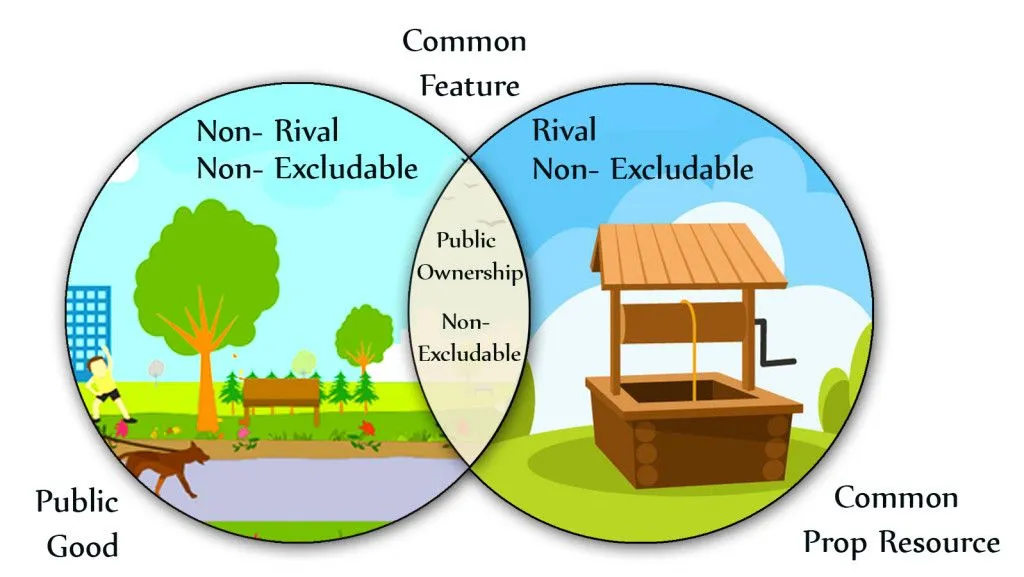
In economics, public goods are known by two standard features, i.e.; they are non-excludable and non-rivalrous.
On the other hand, think of a common grazing plot, stock of fish in an ocean, or even a tree growing in a public place that bears fruit. No individual owns these goods. Since ownership is not clearly defined, they tend to be overused. For instance, nobody stops you from fishing in the ocean or using the entire grazing area for your domestic animals. This makes the above goods non-excludable.
However, unlike public goods, one person’s decision to go overboard will affect the quantity available for others. For instance, overfishing by one fisherman would deplete the fish available for another fisherman.
To sum it up, the goods described above have two standard features, i.e., they are non-excludable, but rival. Goods exhibiting these characteristics are known as common property resources.
The tendency of public property to be constantly subjected to exploitation is known as the tragedy of the commons. Just as the phrase suggests, the sad part is that one person's gain depletes what is left for everyone else. In some instances, it even leads to the outright depletion of a natural resource. The gains are pocketed by one, but the costs are collectively borne, hence the term.
Bear in mind that the classification of resources must be done keeping the context in mind. They are not written in stone. A public good can also become a common property resource and vice-versa. For instance, if national parks get overcrowded, they no longer meet the strict definition of being non-rival and non-excludable. Now that the park is congested, the gatekeepers need to exclude people from entering the park, thus making it excludable.
Is The Tragedy Of Commons A Standard Feature Of Common Property Resources?
Elinor Ostrom, who in 2009 became the first woman to win the Nobel Prize in Economics, begs to differ. During her field studies on farmer-managed irrigation systems in Nepal, she observed that local users often did better than the government at handling such resources.

Just because a resource is commonly owned does not mean it is always subject to over-usage and depletion. She developed the Institutional Analysis and Development (IAD) framework, an approach that drew on game theory.
However, the IAD framework considers many factors before arriving at a decision. Under game theory, it is assumed that an individual is aware of each choice’s outcomes and can rationally pick what is right for the situation. It is also assumed that the individual participating in the game is able to rank his preference for each outcome.
The IAD framework looks at multiple variables, such as the interplay between the attributes of a community, the commonly agreed-upon rules in use over a common property resource, and the biophysical conditions. Here, individuals are not independently arriving at these rules, but instead through what Ostrom called ‘cheap talk’, a term economists use for costless, non-binding communication.
Cheap talk is how resources can be collectively optimized by communicating various strategies among users, rather than the government or intervention by any private player.

The opportunity to be able to talk to one another face to face and arrive at solutions and penalties has been shown to give positive joint returns to the entire community, while keeping governments at bay. This pattern held across more than 500 case studies examined by Ostrom and her team. Such systems are not led by one individual or any institution, but are instead polycentric, where communities collectively reflect on the status of the resource and decide on its usage patterns, and tend to be rational in their own right.
Ostrom has depicted how simplified solutions that follow the bottom-up approach helped facilitate better resource usage. She even highlights that tragedy for her, as seen in her field studies, occurred due to external intervention exerting their powers to gain a personal advantage. She was therefore a staunch proponent of community-led initiatives.