Nonprofits monitor their impact by first mapping a theory of change in a logical framework (logframe) that links inputs, activities, outputs, outcomes and impact. They then attach measurable indicators to each step and track them through monitoring and evaluation (M&E), tools like Social Return on Investment (SROI) and, for rigorous proof, controlled trials.
For any company that is primarily concerned with increasing profits and sales, making a societal impact can be challenging. That is not to say that companies focused on increasing profits and sales do not have any effect. In fact, they have effects in two ways: by acting as donors for not-for-profits, and through their products. However, these products may be affordable only by certain income classes in society.
On the other hand, a non-governmental organization (NGO) works on mainly improving access to public goods. Public goods refer to goods such as education, healthcare, or any other good that is deemed a minimal requirement for each citizen in the society. Public goods must be provided by the government because access to these goods ensures a better standard of living. If its provision is left to the market, these goods would never be optimally distributed. Thus, it is the right of each citizen to have access to these goods, but market forces may price them at high levels, thereby hampering access.
NGOs play a crucial role in bridging these gaps in various ways. They play a critical role in helping countries ensure that development reaches grassroots levels. There are regional, national and international NGOs. There is no standard definition for an NGO. They run on donations made by governments, corporations, philanthropists and individual donors alike.
A not-for-profit places its primary emphasis on addressing societal needs, rather than profit maximization. Moreover, unlike governments, they are also able to focus on smaller pockets and ensure quality access to the public good on which they are focused.
How Does A Not-for-profit Organization Map Its Intervention?
Every not-for-profit works towards eradicating a societal evil. Be it eliminating or alleviating poverty, improving access to education, improving menstrual hygiene, and so many more. This is known as the outcome that the organization is expecting to achieve through its intervention.
For a long time, many not-for-profit companies got away with shoddy interventions. Whenever there was a failure in their promised delivery to bring change, it was most often attributed to changing contexts that they had failed to anticipate. This shortsightedness disappointed donors and organizations alike. Their failure to chalk out their journey from identifying a problem to solving it (to some extent) was deeply affected by the lack of a flexible yet long-term framework.
To achieve any social goal, a not-for-profit needs to put in collective efforts to bring this desired change to the targeted population. Collective efforts mean coordination from multiple stakeholders, from donors to the targeted population. How they collate interests and work to bring about that change is known as the "theory of change" (ToC).

To achieve any developmental change or outcome, the biggest thing an organization must understand is the context in which it operates. For instance, if the outcome is to improve girls' education, the same intervention can play out very differently across two communities, because their social barriers differ. A literacy program designed for an inner-city neighborhood in the United States would need a different theory of change than one aimed at a remote rural region, even when the goal is identical.
Every community has its own notions of what a girl can and cannot do, and its own practical obstacles, whether that is the cost of transport, unsafe routes to school, or cultural pushback. Suppose that education for young women has to be improved. In that case, the not-for-profit needs to account for all the local assumptions and risks while designing an intervention to ensure that no factor is taken for granted. This is precisely why every not-for-profit has a different theory of change. Each theory, although seeking to achieve common goals, might tackle different assumptions and risks based on their location.
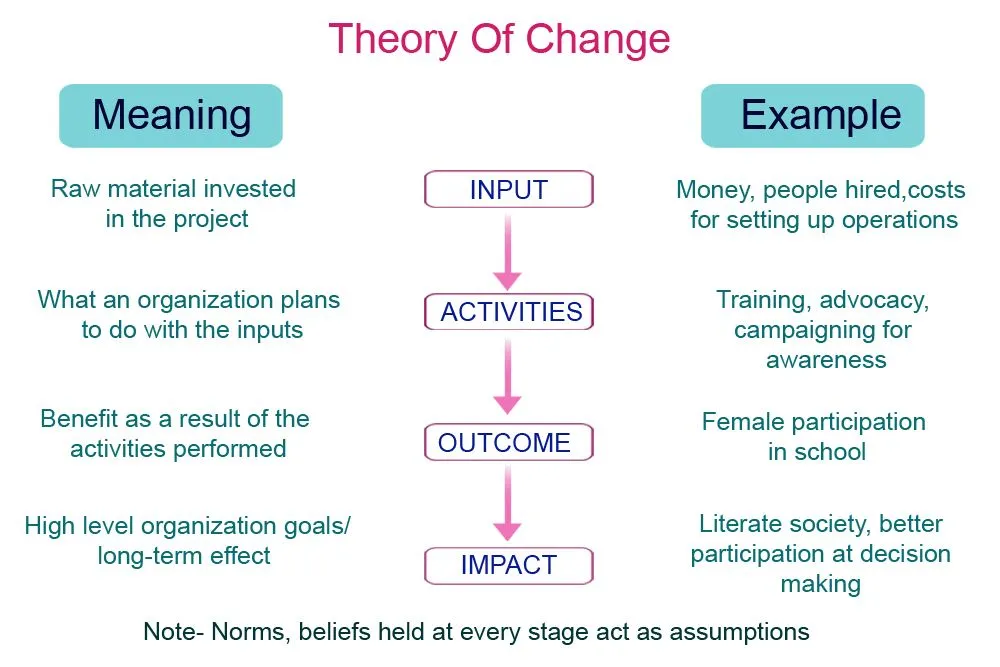
The theory of change (ToC) is usually mapped in a logical framework (logframe) that helps break down the expected transition into methodological steps with suitable indicators to visualize and quantify the desired change.
Where Did The ToC Originate?
No single founding date exists, but a group of scholars working in the evaluation field, namely Huey Chen, Peter Rossi, Michael Quinn Patton, and Carol Weiss, are credited with shaping the idea. Chen and Rossi coined the term "theory-driven evaluation" in the 1980s, and Weiss popularized "theory of change" in a 1995 essay for the Aspen Institute Roundtable on Community Change. It was the culmination of decades of research and application in evaluation studies.
ToC was widely adopted because it slots neatly into the logframe method, which helps organizations monitor and evaluate developmental projects. The logframe is simply a formal representation of that causal pathway. Properly called the Logical Framework Approach, it was developed in 1969 by Leon Rosenberg of the consulting firm Practical Concepts Incorporated, working under contract for the U.S. Agency for International Development (USAID). Today it is used just as widely by for-profit and government project teams.
How Does The ToC Work?
ToC helps a not-for-profit organization map its causal interventions backwards. Once an organization identifies its outcome, it looks back at the conditions required to achieve those goals. This causal pathway helps connect and explain the necessary conditions to bring about this change by defining the inputs the organization would invest in to bring about this change.
For example, if an NGO aims to work on empowering women, that should be the outcome of their activities. To attain this outcome, there will be several activities they will have to conduct, such as training, improving livelihoods, improving access to education, awareness and advocacy among multiple stakeholders in the system. An NGO cannot also do all these activities, so it needs to identify its strengths, which is where they will direct their resources. This exercise helps them narrow down their activities.
Along with defining these activities, an NGO also needs to define the indicators of these activities, along with their frequency. It is imperative to list these out so that an NGO can channelize their efforts to the inputs they believe will help them achieve their outputs.
The process of ideating a ToC must be highly participatory and deliberative, and heavy brainstorming is usually required. Airing assumptions is crucial, as it can appear at every stage. Outcomes are added, deleted and modified until the logic of the logframe is collectively agreed upon.
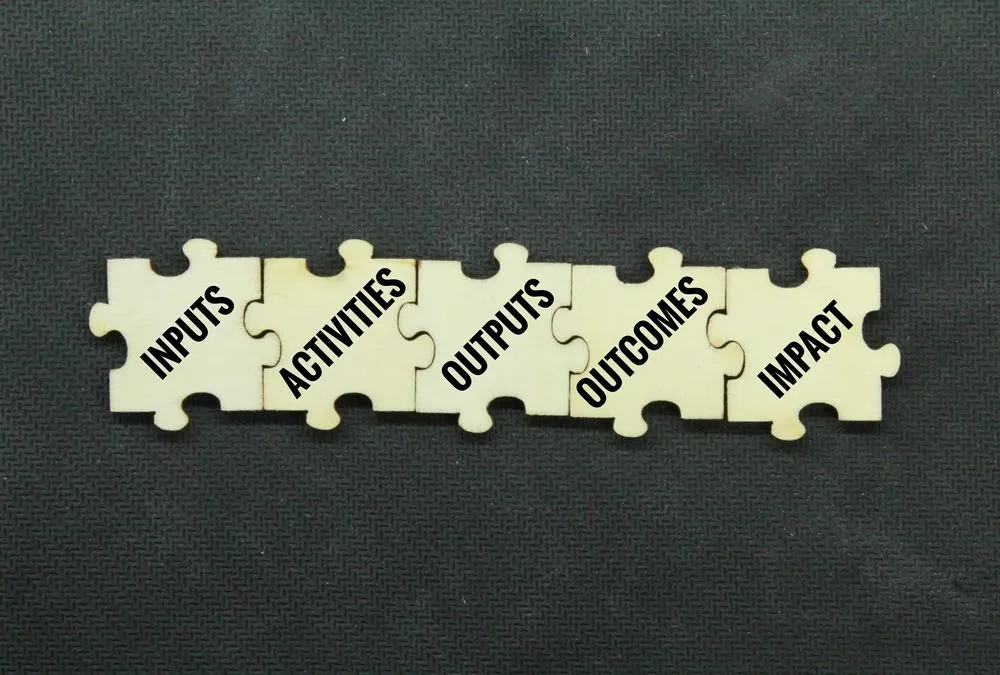
The underlying activities of the ToC can also change as the context changes or uncovers itself. This change warrants a not-for-profit to reformulate its strategy to tackle the development change.
The level of detail in the ToC helps funders assess the practicality and feasibility of the proposed change. It helps them hold the not-for-profit accountable for vaguely defined goals, inputs, activities or outcomes. Each activity must have indicators that signal when a step has been accomplished. This helps an organization present a systematic front to donors and have confidence in their execution of developmental programs, which are never mechanical in execution!
How Is The Impact Actually Measured?
Mapping a theory of change tells you what success should look like. Actually monitoring impact means turning each step of that logframe into numbers you can collect over time. This is the job of what the sector calls monitoring and evaluation, or M&E. Monitoring is the routine, ongoing tracking of whether activities are happening as planned (how many workshops ran, how many people attended), while evaluation steps back periodically to ask the harder question of whether those activities actually changed anything.
The trick is choosing the right indicators. A common rookie mistake is to count outputs and call it impact. Handing out 10,000 textbooks is an output; children reading better a year later is an outcome; a measurable lift in their lifetime earnings is the impact. Good monitoring attaches a specific indicator to each rung of that ladder, along with a target, a baseline reading taken before the program starts, and a schedule for re-measuring. Without a baseline, you can never honestly say what changed because of you.
To translate all of this into a single figure that donors understand, many organizations use Social Return on Investment (SROI). SROI assigns a monetary value to the social outcomes a program creates and compares it to what the program cost, expressed as a ratio. A result of, say, $4 of social value for every $1 invested means the program returned four times its cost in measurable benefit. The method was formalized in a widely used 2009 guide originally published by the UK Cabinet Office, and it is popular precisely because it speaks the language of funders.
The most rigorous answer to "did it really work?" comes from impact evaluation, and the gold standard there is the randomized controlled trial (RCT), the same design used to test new medicines. Participants are randomly sorted into a group that receives the program and a comparison group that does not, so any later difference between them can be credibly attributed to the intervention rather than to luck or pre-existing differences. Charities like GiveDirectly have used RCTs to show, for example, that direct cash transfers measurably raised household income, results that a simple before-and-after count could never have proven.
Finally, donors who lack the time to run their own evaluations lean on independent assessors. Charity evaluators such as GiveWell dig into the underlying studies to estimate how much good a dollar actually does, while raters like Charity Navigator now score organizations on whether they measure, learn from and report their results, not just on how lean their overhead is. Between internal M&E, SROI and external scrutiny, a nonprofit's claim of impact can be checked rather than simply trusted.
References (click to expand)
- Blamey, A., & Mackenzie, M. (2007). Theories of change and realistic evaluation: peas in a pod or apples and oranges?. Evaluation, 13(4), 439-455.
- Theory of Change Supplement: A short literature review and .... stapgef.org
- Theory of Change. UNDAF Companion Guidance. United Nations Sustainable Development Group
- Backwards Mapping and Connecting Outcomes. theoryofchange.org
- Developing a Logic Model or Theory of Change. Community Tool Box, University of Kansas.
- A guide to Social Return on Investment. New Economics Foundation.
- Introduction to randomized evaluations. The Abdul Latif Jameel Poverty Action Lab (J-PAL), MIT.
- Impact & Measurement methodology. Charity Navigator.