Table of Contents (click to expand)
A wheelie is the rear axle of a bike winning a torque tug-of-war. The engine sends torque to the rear wheel, which tries to rotate the whole motorcycle backwards about that contact point; gravity, pulling down on the centre of mass ahead of the rear axle, tries to rotate the bike forwards and keep the front wheel planted. Open the throttle hard enough and the drive torque exceeds the gravitational torque, the normal force on the front tyre drops to zero, and the front wheel lifts.
No matter how much faster, more advanced and more sophisticated you make something, the human tendency to tinker and tweak will never be quenched. Consider bikes, for example. It doesn’t matter how comfortable and swift you make them, there will always be people for whom riding a bike the conventional way will be too ‘mainstream’. Sometimes, motorcyclists bend at dangerously low angles to bank a turn or raise their front wheel just for the fun of it. However, both of these ‘stunts’ involve an important understanding and manipulation of physics.
While we have already covered how motorcycle riders bend over so much without falling off their bikes in this article, it’s time to find out how they can raise the front wheel of their bikes while riding, or in other words, “pop a wheelie”.
What’s A Wheelie?
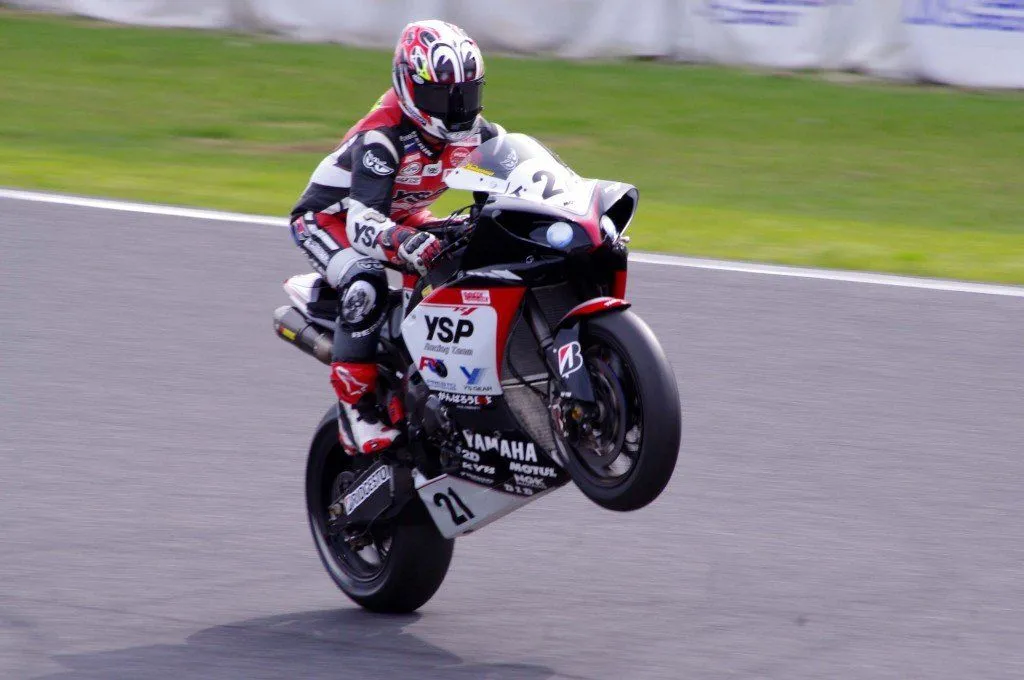
A wheelie, also known as a wheelstand, is a vehicular maneuver that involves raising the front wheel (or wheels) above the level of the rider relative to the vehicle in question, while keeping the rear wheel/s on the ground. You’re most likely to see riders perform wheelies with motorcycles or bikes, although they can also be performed with other automobiles, like cars, tractors and so on.
A wheelie is considered to be a daredevil stunt for obvious reasons. However, like a lot of other audacious stunts, wheelies are also based on two very common physical concepts: angular momentum and torque.
Angular Momentum And Torque
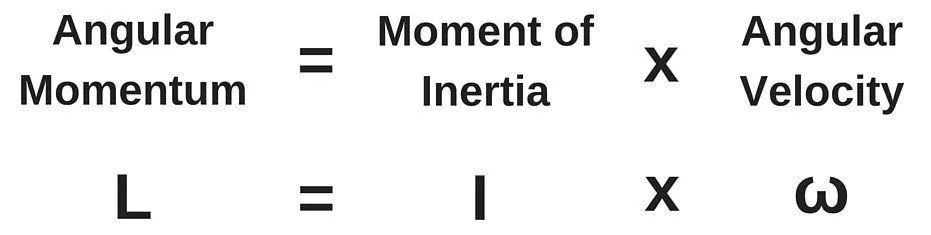
In the most basic terms, angular momentum can be considered as the measure of the momentum of a body that is moving in circles (i.e., undergoing a rotational motion). For physics geeks, the angular momentum of an object is the product of its moment of inertia and angular velocity.
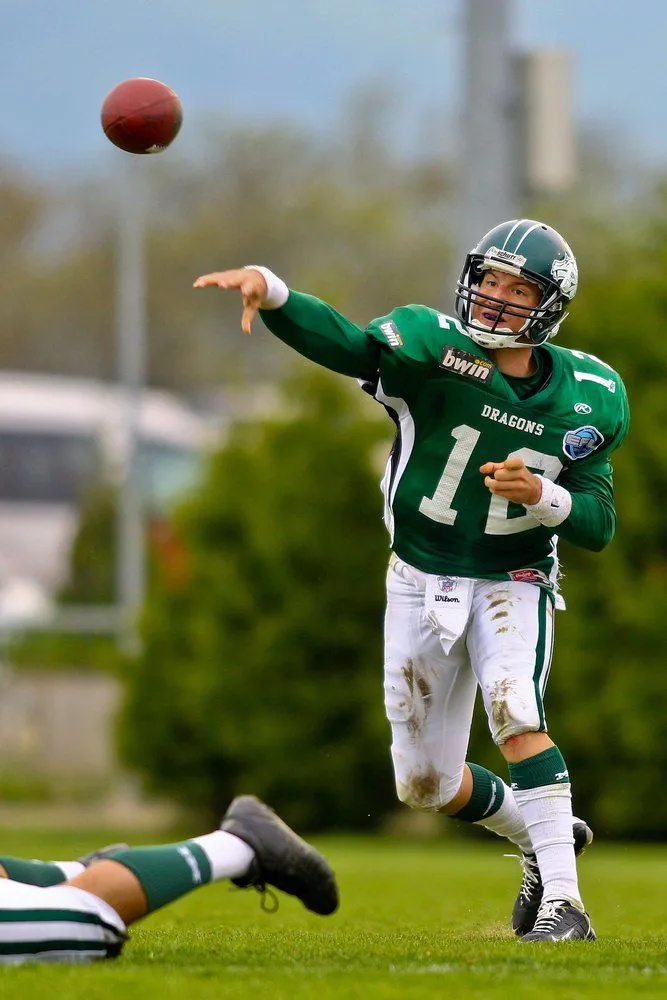
There are many examples of angular momentum around you, such as a quarterback imparting a spin while throwing the ball, or a bullet spinning as it leaves the muzzle of a gun.
On the other hand, torque is a measure of the twisting force that causes an object to rotate. This is something even more common in everyday life. You apply torque more often than you realize, such as when you turn a doorknob, unlock a lock, or turn the key in the ignition of a car, you’re applying torque on something. In more technical terms, it’s the cross product of the force vector ‘F’, distance vector ‘r’ and the sine of the angle between the two.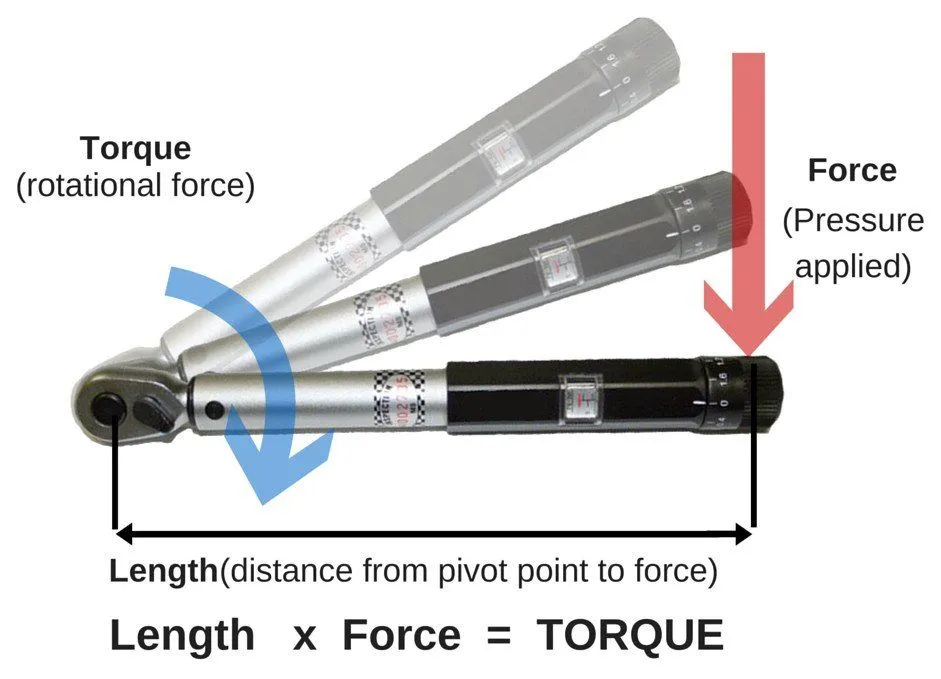
Now that you have a fair idea about angular momentum and torque, let’s see how these physical forces help raise the front wheels of a motorcycle into a wheelie.
When a motorcycle moves on a level surface, the force of gravity is exerted on the center of mass of the motorcycle, and the normal forces (acting in the opposite direction of gravity) are exerted by the ground on the front and rear wheels. Hence, an equilibrium is established between these forces and the motorcycle moves normally.
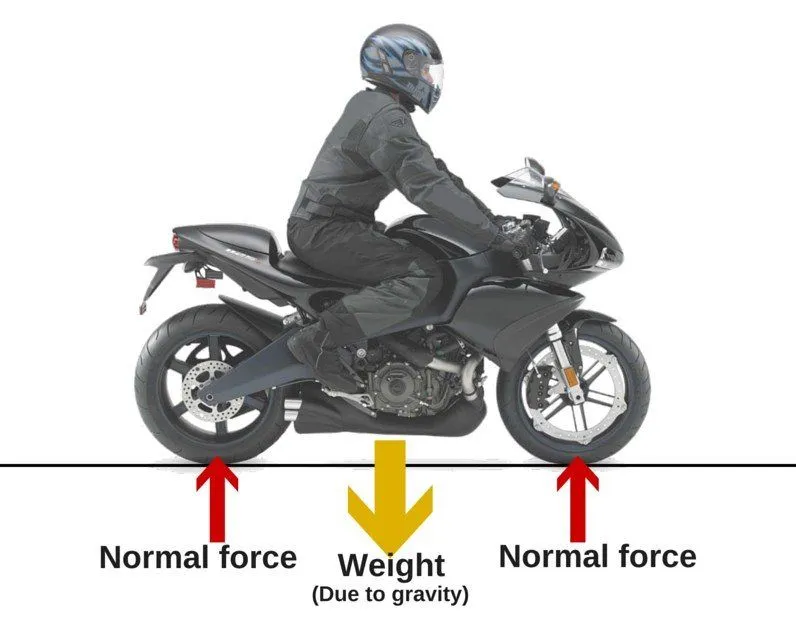
In order to lift the front wheels off the ground, you need to disturb this equilibrium between these two opposing forces. More specifically, you need to unbalance the torques acting on the rear wheel.
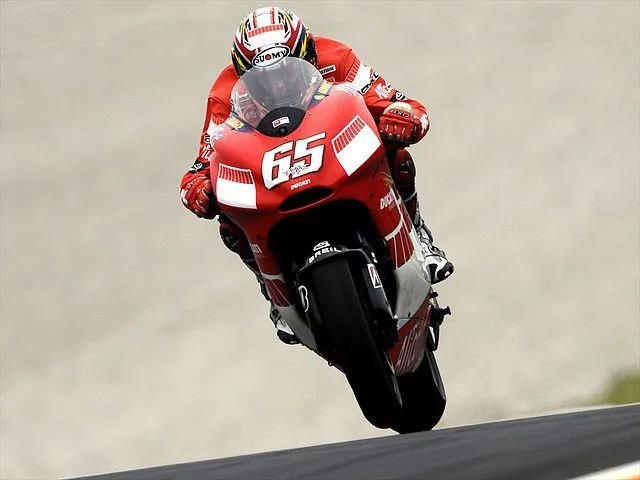
This is achieved by accelerating the motorcycle until the load borne by the front axle is decreased to zero, thereby increasing the torque that’s applied around the rear axle – and therefore the rear wheels. Note that the normal force on the rear wheel does not apply any torque on the rear wheel; only gravity and the engine of the motorcycle do. Therefore, all the engine has to do is supply more torque (through the drive train) to the rear wheel than the gravitational torque, and lo and behold! A Wheelie!
How Much Power Is Required To Perform A Wheelie?
That all depends. You see, the power required for performing a wheelie can be obtained from the formula:
P = mva
where P is power, ‘m’ is the mass of the bike, ‘v’ is the velocity of the bike and ‘a’ represents the acceleration of the bike.
It’s clear from this equation that the power needed to perform a wheelie is proportional to the velocity and mass of the motorcycle. In a practical scenario, this means that for lifting the front wheels with minimum power, you need to have a light motorcycle that’s moving slowly (without considering the power that would be required to overcome the air resistance as the motorcycle moves).
And yes, it also means that the best time to perform a wheelie with a bike is when it’s just starting to move. In fact, it’s so incredibly easy at the start that many times, people accidentally raise their front wheels up without consciously trying to do so at the beginning of a race or a ride.
How Do You Actually Pop A Wheelie? The Balance Point
Getting the front wheel up is the easy half. The real skill is keeping it there. As the nose rises, the combined centre of mass of the rider and bike swings upward and backward, and there is one magic angle where that centre of mass sits directly above the rear tyre’s contact patch. At that point gravity pulls straight down through the pivot, so it produces no pitching torque in either direction, and the bike hangs in momentary equilibrium. Riders call this the balance point, and holding it feels a lot like balancing a broom upright on your palm: it is an inverted pendulum that constantly wants to topple one way or the other.

On a motorcycle there are two common ways to reach it. A power wheelie is performed by simply opening the throttle: if the engine has enough power, the drive torque alone lifts the front wheel. A clutch wheelie is performed by revving the engine with the clutch disengaged and then abruptly engaging (or “dumping”) it, so a sudden burst of torque snaps the nose up even at low speed.
The thing every rider fears is looping out, going past the balance point and flipping over backwards. The cure is the rear brake. A light tap slows the rear wheel, and that braking force at the contact patch creates a forward-pitching moment that drops the nose back down. In practice the throttle lifts the front and the rear brake lowers it, and a skilled rider feathers the two against each other to sit on the balance point. That is also why a runaway wheelie is so dangerous: go past the point of no return without a quick dab of rear brake, and physics finishes the move for you.
Bicycle Wheelies vs Motorcycle Wheelies: What’s The Difference?
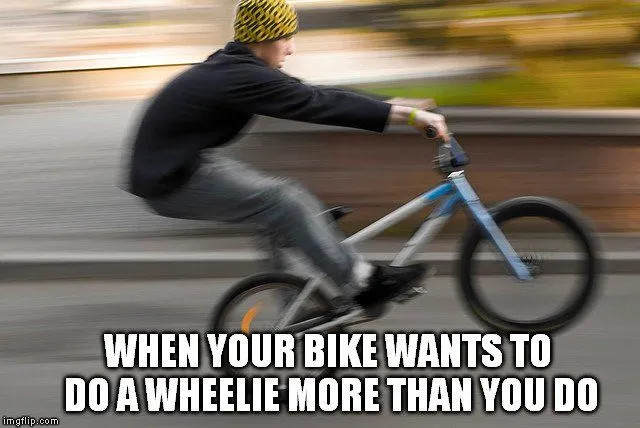
The physics is identical, but the engine is not. A motorcycle borrows torque from its motor; on a bicycle, you are the motor. To lift the front wheel of a pushbike you combine a hard pedal stroke with a shift of your body weight backwards, usually while pulling up on the handlebars and riding a low gear for maximum torque at the rear wheel.

Shifting your weight is doing real work. The minimum acceleration needed to raise the front wheel is proportional to how far forward your centre of mass sits and inversely proportional to how high it sits, so leaning back (which moves your centre of mass rearward and upward) lets the wheel come up with far less effort. That is exactly why riders slide to the back of the saddle before they pop one.
Holding it is the same trick as on a motorcycle, just human-powered. Once the wheel is up, a bicycle is balanced by the rider’s weight together with the rear brake, and a wheelie can be sustained almost indefinitely by trading pedalling force against gentle feathering of that rear brake. Pedal a touch harder and the nose rises; squeeze the rear brake a touch and it drops. The rear brake is the safety valve on two wheels of any size.
Other Factors Affecting A Wheelie
Apart from unbalancing torques on the rear wheel, there are a few other factors that facilitate a clean and smooth wheelie. A motorcycle with a small front sprocket, a large rear one, and a shorter wheelbase is preferable. Also, you need to sit as far as back as possible, so that more of your weight is borne by the rear wheels.
Remember, however cool it may seem, performing a wheelie is actually very difficult – and quite dangerous too! Therefore, it’s best not to try it yourself without proper training and practice.
Where Did The Word “Wheelie” Come From?
Here is a fun twist: the stunt is much older than the word for it. The first wheelie is generally credited to the American trick cyclist Daniel J. Canary, who reportedly rode along on his rear wheel alone around 1890, only a few years after the modern “safety” bicycle (the two-equal-wheels design we still ride today) became popular. Canary was celebrated as the foremost trick rider of his era.

The slang term took decades to catch up. The word “wheelie” did not appear in print until 1966, formed simply from “wheel” plus the “-ie” ending, with the Oxford English Dictionary’s earliest record coming from a New York Times piece that year. So riders were popping wheelies for roughly three-quarters of a century before anyone had a snappy name for the move. The BMX craze of the 1970s did the rest, turning “pop a wheelie” into a phrase almost every kid on a bike grew up using.
References (click to expand)
- Wheelie - Wikipedia. Wikipedia
- Wheelies or wheelstands: From Physclips. The University of New South Wales
- Bicycle and motorcycle dynamics - Wikipedia. Wikipedia
- Lecture Notes | Chemistry of Sports | Experimental Study Group. MIT OpenCourseWare
- How does a wheelie work? - Physics Stack Exchange. Stack Exchange
- The Wheelie Was Invented in 1890. Smithsonian Magazine
- Wheelie - Etymology, Origin & Meaning. Online Etymology Dictionary