Table of Contents (click to expand)
A sailboat moves because the curved sail acts like an airplane wing, generating aerodynamic lift as wind flows around it. The keel underwater cancels the sideways component of that lift, leaving a net forward force, which is why a sailboat can even sail upwind. A lever called the tiller steers the rudder, and skilled sailors can outrun the wind itself.
“This is the day you will always remember as the day you almost caught Captain Jack Sparrow.”
People sometimes associate sailing with the quirky and eccentric Jack Sparrow from Pirates of the Caribbean. He’s arguably one of the most popular fantasy fiction characters of the 21st century.

The movie series boasted a number of unusual and dirty creatures, but one thing that caught everyone’s eye were the gargantuan sailboats moving around in the water so smoothly and dexterously. Obviously, one might wonder how these bizarre yet majestic-looking boats actually work, in spite of not having a functioning engine.
Before jumping into the physics behind sailing, let’s establish a brief background of sailboats.
What Exactly Are Sailboats?
Sailboats are one of the oldest forms of transportation, and the invention of these fuel-less boats is an extremely significant part of human history. Sailboats marked the beginning of humans being able to tame and harness the wind to suit their needs. Egyptian vase paintings show sailing vessels by around 3500 BC, the earliest pictures we have of a boat with a mast and a square sail. Back then, the boats merely consisted of a simple cloth sail rigged on a reed or wooden hull. Since then, however, they have evolved and played an integral part in shaping the world’s history. Sailboats were aggressively used to conquer lands, discover new places, fight wars and carry out acts of piracy. Sailing has been an Olympic sport since the 1900 Paris Games (where it was called yachting until the Sydney 2000 Games).
Simply put, sailboats are boats that are propelled by wind when it blows on a set of fin-shaped sails.
Parts Of A Sailboat
A sailboat consists of eight primary parts. The hull, keel, rudder, tiller, jib, boom, mainsail and mast.
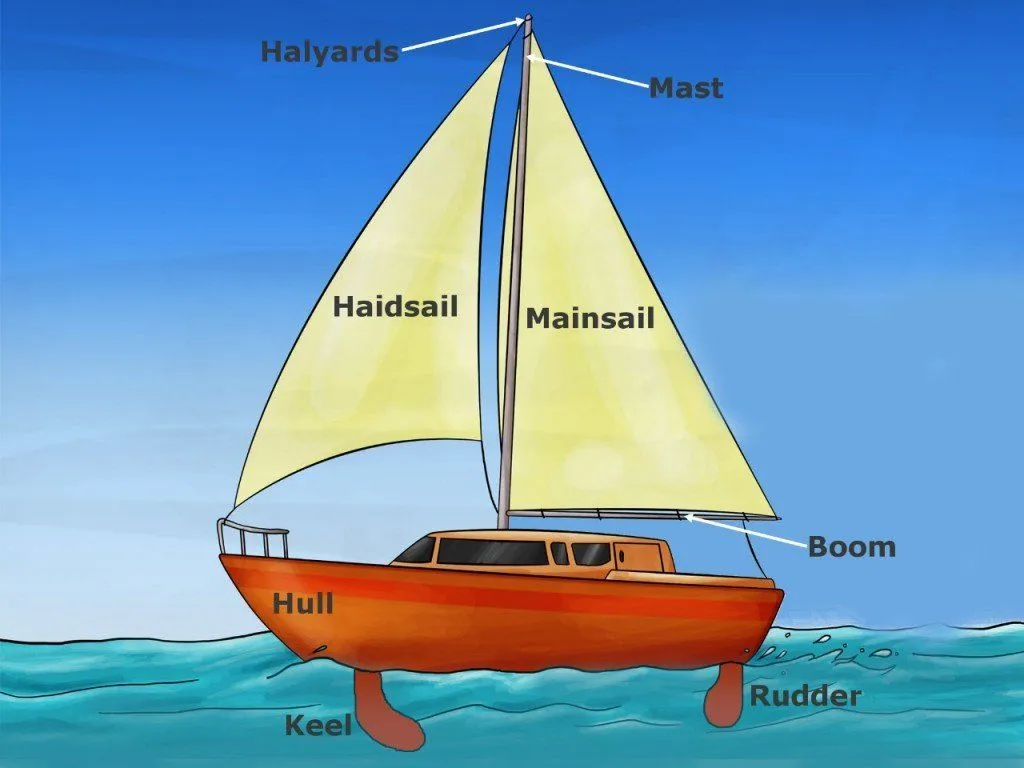
The hull is the main body of a sailboat and houses the main components of the boat. Modern sailboats have motors attached to the stern in order to propel the boat when there is no wind. A tiller is attached to the rudder. The tiller is a lever used to steer the boat. The rudder is always submerged in the water. When a sailboat is in operation, the steering mechanism is controlled by the tiller-rudder duo. The direction of motion of the rudder depends on the tiller, which in turn facilitates the boat’s change of direction.
The motion of a sailboat can be attributed to the mainsail and the keel. These are the engines of the sailboat. Mainsails are triangular in shape and capture most of the wind power necessary to propel the boat. The keel, on the other hand, is responsible for maintaining balance and ensuring that the boat doesn’t tip over.
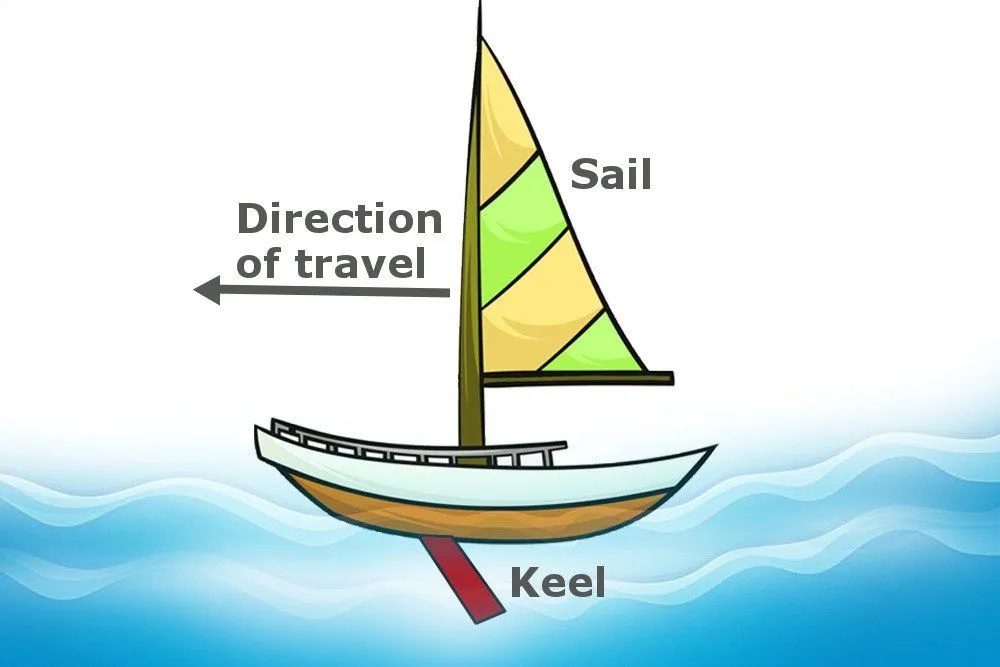
The mast is a vertical rod supporting the mainsail. Similarly, the boom supports the mainsail horizontally. A sailboat also has a secondary sail called a jib, which is a miniature version of the mainsail. The jib offers extra wind power so that the boat can reach higher velocities.
Now that we can picture a sailboat and understand its fundamental parts, let’s take a look at the main aspect of this article i.e. the physics involved in sailing one!
Physics Involved In The Working Of Sailboats.
The physics behind sailing is very interesting, as sailboats do not require wind to be blowing from behind in order to move. It is actually possible for the boat to move forward even if the wind is blowing in from the sides. How does that work?
This is attributed to a very popular physics concept called aerodynamic lift.
When wind hits a sail at an angle, the force it generates can be split into two components: one pushes the boat forward, and the other shoves it sideways. The direction the boat actually moves depends on the resultant of those two forces. In the case of a sailboat, sideways motion is undesirable. The aim is to maximize the forward component as much as possible. That is exactly where the keel earns its keep. By presenting a long, thin blade to the water, it cancels almost all of the sideways force while barely resisting forward motion. As mentioned above, the sail and the keel are the components responsible for the motion of the sailboat.
Now, imagine that you’re trying to sail upwind with the wind coming from the left over the front part of the hull. The wind fills the sail into the shape of a wing.
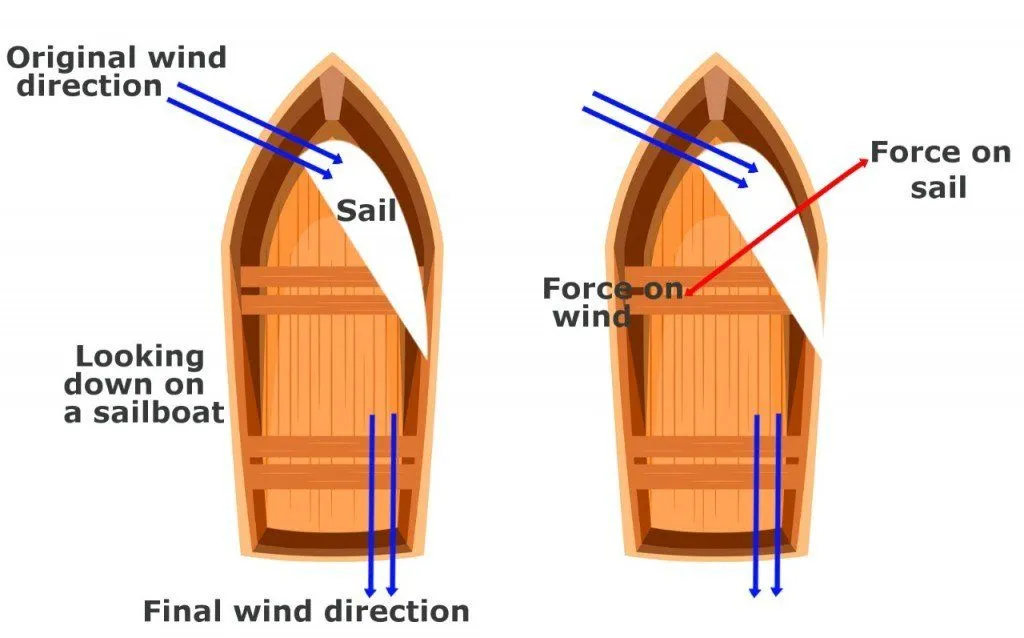
The sails borrow a concept straight from the design of airplane wings. Once filled, the sail takes on the shape of an aerofoil, which lets it generate aerodynamic lift. Air flowing around the curved, leeward side of the sail has to travel a longer, faster path than the air on the windward side, and by Bernoulli’s principle, faster-moving air has lower pressure. That pressure difference pulls the sail (and the boat) toward the low-pressure side. The force is mostly sideways relative to the boat, but the keel cancels that sideways push, leaving a net force in the forward direction. As a result, the boat moves forward, even when the wind is coming from somewhere ahead of the beam. By trimming the sails to different angles, a sailor can steer the boat in almost any direction relative to the wind, except for a narrow no-go zone pointing directly into it.
Some sailboats can even sail faster than the wind itself, and not just in theory. Because a sail produces force through lift rather than simple push, what matters is the apparent wind that the moving boat feels, not the true wind blowing across the sea. As the boat picks up speed, the apparent wind angles forward and the sail keeps generating lift, so a well-designed boat can outrun the breeze that is driving it. Modern America’s Cup foiling catamarans routinely sail downwind at roughly 1.6 to 2 times the speed of the true wind, and the wind-powered land yacht Greenbird set a record of 126.1 mph (202.9 km/h) in 2009, about three times the wind speed at the time. There is still a ceiling, of course: drag from the water and the air goes up steeply with speed, which is why most cruising sailboats never come close to these numbers.
So in conclusion, sailing entails much more than a boat propelled by a couple of unusually shaped flags. It can be regarded as an acquired skill requiring considerable understanding of wind and its behavior.