Table of Contents (click to expand)
A rocket moves and turns in space without any air to push against, thanks to Newton's third law. Firing small thrusters expels exhaust gas in one direction, and the equal, opposite reaction pushes the craft the other way. Fire a thruster on one side to rotate, or a reaction wheel to spin without using fuel.
There are many things that we can do on Earth that we take for granted, but in space, those same things would be much more difficult. For example, gravity makes it possible for us to walk and direct our bodies in a particular direction. When we move in the wrong direction, we might bump into something, so we react and change our motion. Airplanes change direction by pushing on the air around them, but what does a spacecraft push on to maneuver itself when it is surrounded by the endless void?
Remember those Newtonian laws you learned in school? We will need to refresh ourselves on those basic laws of physics, because they have everything to do with understanding how a rocket moves, turns or chooses a direction in outer space.
Law 1: A body will remain at rest or in motion in a straight line unless acted upon by a force.
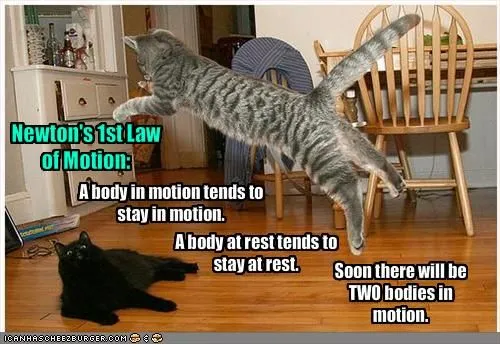
Law 2: A change in motion is proportional to the applied force and parallel to it.
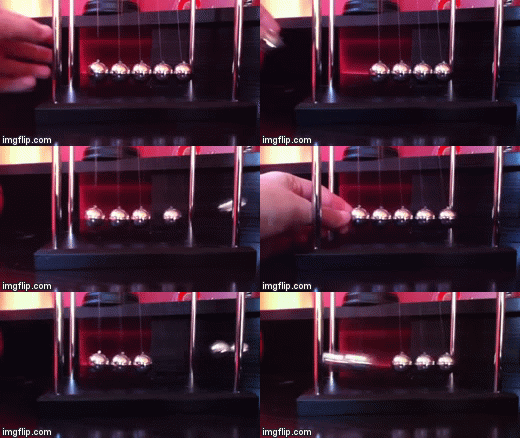
Law 3: For every action, there is an equal and opposite reaction. The best example of this is Newton’s cradle balls.
Rockets And The First Law Of Motion
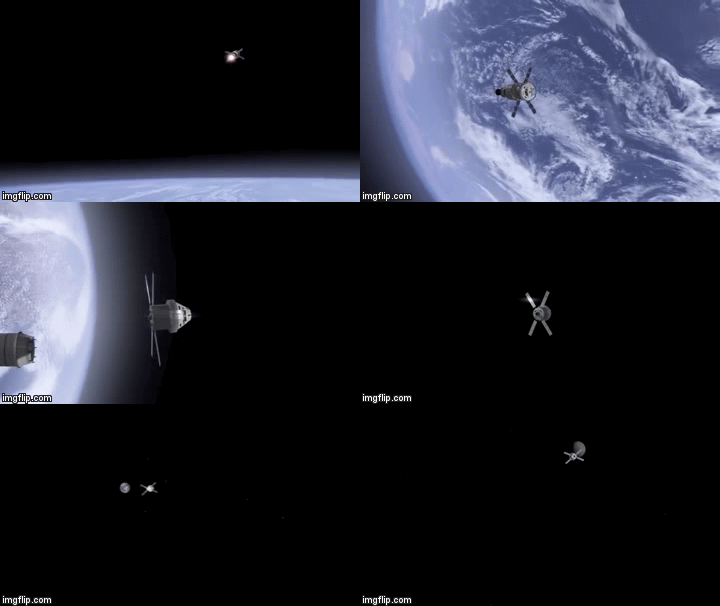
Once a rocket is in space, it will not experience any drag, which airplanes have to handle. Therefore, if the engines are shut down, the spacecraft will coast along the same path it was on when the engines were running, due to the first law of motion. Unless it is hit by an external object, which would exert the “force” that the law of motion talks about, or it comes close to a planetary object that can exert a gravitational force on the object, it will continue on the same path.
Rockets And The Third Law Of Motion
We encountered the application of this law when we considered examples of pushing on a surface to direct motion. Rockets propel themselves using fuel that generates high-pressure gas. The movement of the exhaust gases away from the rocket body pushes the rocket in the forward direction, since the force exerted by the exhaust gas has an equal reaction in the opposite direction.
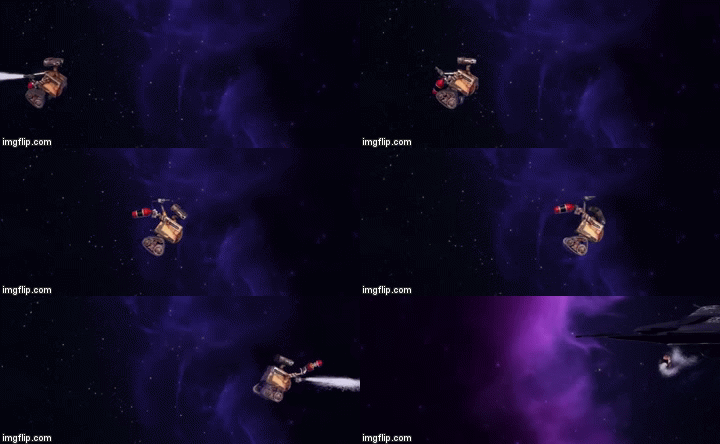
So, if the spacecraft has to turn, small steering thrusters (part of what engineers call the reaction control system) are fired in pairs to spin it about its center of mass. To swing the nose one way, you fire a thruster pointing the other way, and a second thruster stops the rotation once the craft is aimed correctly. In fact, it is easier to maneuver a spacecraft in space than in normal air. As the exhaust gas leaves the rocket engine, it must push away the surrounding air, which uses up some of the energy of the rocket. In space, the exhaust gases can escape freely.
Thrusters are not the only trick. Many satellites and telescopes turn using reaction wheels, which are heavy spinning flywheels mounted inside the craft. Speed one up and, by conservation of angular momentum, the craft slowly rotates the opposite way. The neat part is that this burns no fuel at all, which is why the same third law that launches a rocket can also point a telescope at a distant galaxy.
However, the fuel that produces the exhaust gases that propel the rocket will also require oxygen in order to burn. As we’ve already mentioned, the vacuum of space has no oxygen, so how do you ignite the fuel?
Oxidizers And Other Fancy Stuff
Rockets need to carry oxygen on their journeys into space. Inside the rocket’s engine, fuel and oxidizers are ignited in the combustion chamber, creating hot expanding gases that are released from the bottom of the spacecraft, giving it the thrust it needs to move forward. However, imagine carrying several heavy tanks of oxygen along on a long space mission. That is a major load. Fortunately, some rocket fuels that have been developed do not need oxygen to burn, such as hydrazine. Hydrazine decomposes into ammonia, nitrogen and hydrogen when exposed to the right catalyst.
How Does A Rocket Steer While Its Engines Are Firing?
The small steering thrusters we met earlier are wonderful once a craft is coasting in space, but they are far too gentle to aim a giant rocket fighting its way up through the first few minutes of launch. So how does a rocket point itself when its main engine is roaring at full power? The trick is to steer using that very engine, and the method has a lovely name: gimbaled thrust, also called thrust vectoring.

The whole engine, or just its exhaust nozzle, sits on a pivot called a gimbal, so it can swivel from side to side across two axes (pitch and yaw). When the nozzle points straight back, the thrust runs right through the rocket's center of gravity and the craft flies straight. Tilt the nozzle a few degrees, though, and the thrust no longer lines up with the center of gravity. That off-center push creates a torque, a twisting force, and the nose swings around, much the way pushing a door near its hinge swings the door. NASA's Glenn Research Center notes that most modern launchers steer this way, including the Space Shuttle and the mighty Saturn V Moon rocket. This is also a big part of why a rocket arcs over instead of climbing straight up.
Engineers did not always have this luxury. The wartime German V-2, the first rocket to reach the edge of space, had a fixed engine that could not swivel at all. Instead, it steered with four graphite jet vanes planted right in the white-hot exhaust stream, deflecting the plume like rudders dipped into a jet of gas. The vanes worked, but they were slowly eaten away by the heat and sapped some of the engine's thrust, which is exactly why today's rockets prefer to swivel the whole engine instead.
How Does A Spacecraft Change Its Orbit Or Catch Up With Another?
Pointing the nose in a new direction is only half the story. The harder question is how a spacecraft moves from one orbit to another, or sidles up to a space station, with no road, no brakes and nothing to push against. The currency for every such move is delta-v (literally "change in velocity"), the total nudge in speed a mission has to spend, and every gram of fuel is rationed against it.

Here orbital mechanics serves up a delightful surprise. To climb to a higher orbit, you fire your engine forward, in the direction you are already travelling (a prograde burn). That extra energy lifts the far side of your orbit higher. To drop to a lower orbit, you fire backward against your motion (a retrograde burn), and the opposite side sinks. The classic, fuel-thrifty route between two circular orbits uses exactly two of these burns: one to swing onto a stretched, egg-shaped transfer orbit, and a second at the far end to round the path out at the new altitude. It is the same maneuver that lifts communications satellites from a low parking orbit out to their final perch high above the equator, and it leans on the same energy bookkeeping behind escape velocity.
Catching another spacecraft is trickier still, because in orbit, slowing down can paradoxically lower you onto a faster inner lane. To "stop" relative to a target, then, is never about hitting a brake; it is about matching orbits with a carefully timed sequence of these prograde and retrograde burns until the two craft drift together at walking pace.
How Do Deep-Space Probes Steer With Almost No Fuel?
Chemical rockets are powerful but greedy, and a probe headed for the outer Solar System simply cannot haul enough fuel to keep firing for years. The answer is to swap a brief, violent shove for a feather-light push that never stops. That is the job of the ion thruster.

An ion engine takes a gas, usually xenon, strips electrons off its atoms to give them an electric charge, and then uses an electric field to fling those charged atoms (ions) out the back at 7 to 10 times the exhaust speed of a chemical engine. By the same third law that launches a rocket, hurling the ions one way pushes the spacecraft the other. The catch is that the push is tiny. Each of NASA's Dawn probe engines produced about 91 millinewtons of thrust at full throttle, roughly the force you feel holding a single sheet of notebook paper in your hand. From a standstill, it would take that engine about four days to coax a car from 0 to 60 mph (0 to 97 km/h).
So why bother? Because the engine can run not for minutes but for years, sipping only a few milligrams of xenon per second, and a feeble force applied for that long adds up to an enormous change in speed. Dawn carried 425 kg (937 lb) of xenon and fired its thrusters for more than 2,000 days, eventually building up as much velocity change as the entire chemical rocket that had launched it. For simply nudging a spacecraft's orientation, even gentler systems exist: cold-gas thrusters, the simplest rocket of all, just a tank of inert gas such as nitrogen, a valve and a nozzle, puff out a little gas to tweak which way a small satellite faces, the same conservation of momentum at work as in every other example here.
I think it’s clear that dear old Newton didn’t just make up those laws to torture you in science class! Calculating space travel and determining how to maneuver through the cosmos would be impossible without those basic principles of physics. Thanks Isaac!
References (click to expand)
- Rocket Principles. NASA Glenn Research Center
- How does a rocket work in space where there is no air to push .... Union University
- Propulsion Through a Vacuum! - macaulay.cuny.edu:80
- Thrusters and Spinning Wheels. Smithsonian National Air and Space Museum
- Gimbaled Thrust. NASA Glenn Research Center
- Basics of Space Flight, Chapter 4: Trajectories. NASA Science
- Ion Propulsion. NASA Science (Dawn mission)