You feel a ship move when it speeds up, slows down, or rocks with the waves, but not when it cruises at a steady speed. Your inner ear senses acceleration, not constant velocity, so calm sailing feels almost still. In rough seas the rolling and pitching are obvious, most of all on high decks and toward the bow or stern.
The Earth is a pretty huge place. From crawling on all fours to bipedalism to the invention of the wheel, species have learned to deal with that undeniable fact. Nowadays, the general public has the means to traverse thousands of kilometers in a matter of hours, so we tend to take for granted the vast distances that separate us from the rest of the world. Before the advent of ships, cross-continental travel was mostly impossible.
In fact, there was no way for human beings from one continent to even know about the existence of the other continents.
Maritime Travel – An Overview

The earliest historical evidence of the existence of ships dates back to the 4th millennium BC, from the Egyptian civilization. The sewn-plank royal boats unearthed at Abydos, the burial site of Egypt’s first kings, are roughly 5,000 years old and rank among the oldest built boats ever found. The rest, as they say, is history. From a basic means of travel, ships have now become a status symbol. Cruise liners, yachts, onboard hotels, and massive transit ships are the culmination of the human need for travel and the human desire for comfort.
Just like any other mode of travel, ships have their own set of trade-offs. The primary one is the unpredictability of weather conditions and how that weather impacts the water bodies in question. Turbulent weather has been a hazard to overseas travel for as long as overseas travel has existed. Ships are built to withstand a certain degree of turbulent weather and weathering, just due to being in the water all the time, but there is no way of predicting the real-life conditions a ship will face with 100% accuracy.
However, to answer the original question, let’s disregard extreme conditions where a ship is facing a fate like the Titanic.

Ships have two uses, transporting cargo and transporting people across bodies of water. In either case, it is necessary to ensure that the ship protects its contents from external turbulence. Cargo, whether material or human, is precious and usually insured, so it must be protected from damage.
Ships aren’t exactly compact vehicles, so ensuring that the cargo doesn’t tumble around and break a bone or handle every time a wave passes beneath the ship is a top priority for the manufacturer. Now, this is where the laws of physics come into play. More specifically, the concept of inertia and relative velocity.
Inertia And Relative Velocity
The law of inertia[1] states that if a body is at rest or moving at a constant speed in a straight line, it will remain at rest or keep moving in a straight line at a constant speed unless an external force is applied. This is Newton’s first law of motion. Now, here’s the key point: humans cannot feel constant velocity itself. The reason isn’t gravity, it’s the principle of relativity. Steady motion in a straight line is physically indistinguishable from sitting still, so there’s simply no force for your body to register. We cannot inherently feel the motion of any vehicle while it is traveling at a constant speed.
The best proof is right under your feet. The Earth spins at about 1,670 km/h (1,040 mph) at the equator and races around the Sun at roughly 107,000 km/h (66,000 mph), yet you feel none of it, because that motion is smooth and steady, with no sudden changes in speed for your senses to catch.
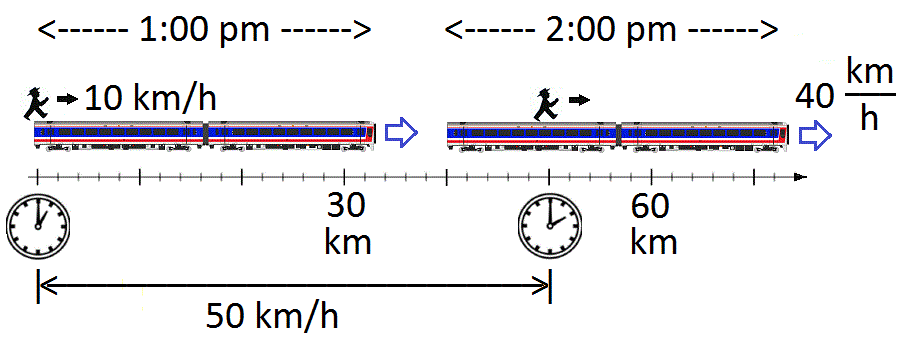
We can, however, feel its motion if the speed changes, i.e., when it accelerates or decelerates. This is the job of your vestibular system, the balance organ tucked inside each inner ear.[5] Two otolith organs (the utricle and saccule) sense linear acceleration, while three fluid-filled semicircular canals pick up rotation. Crucially, these sensors respond to changes in motion, not to steady speed, which is exactly why a smooth, constant cruise feels like nothing at all. When we’re inside the vehicle, our relative velocity with the vehicle is 0, i.e., there is no relative motion between us and the vehicle. We are moving with the vehicle inside it.
However, when the vehicle accelerates or decelerates, its speed changes. According to the law of inertia, since we are inside the car, our speed will also change, right along with the car.
The thing is, this process is not instantaneous. The force applied when you press the brakes or the accelerator, or pass over a bumpy road, may take some time to bring you to the same speed as the vehicle, so you are able to feel the speed of the vehicle changing, subsequently “feeling” its motion.
Physics In Real-world Motion
To help you understand the concept of inertia better, let’s take the example of a moving car. When you sit in a car, no matter how fast it’s moving, the only reason you’d be able to tell whether it’s actually moving is looking out at the world moving past the window.
If blinds were placed on the windows, all you’d feel would be the vibrations of the engine while in use. There’d be no way to tell with absolute certainty whether the car was moving or if the engine was simply being revved up as the car stayed in one place.
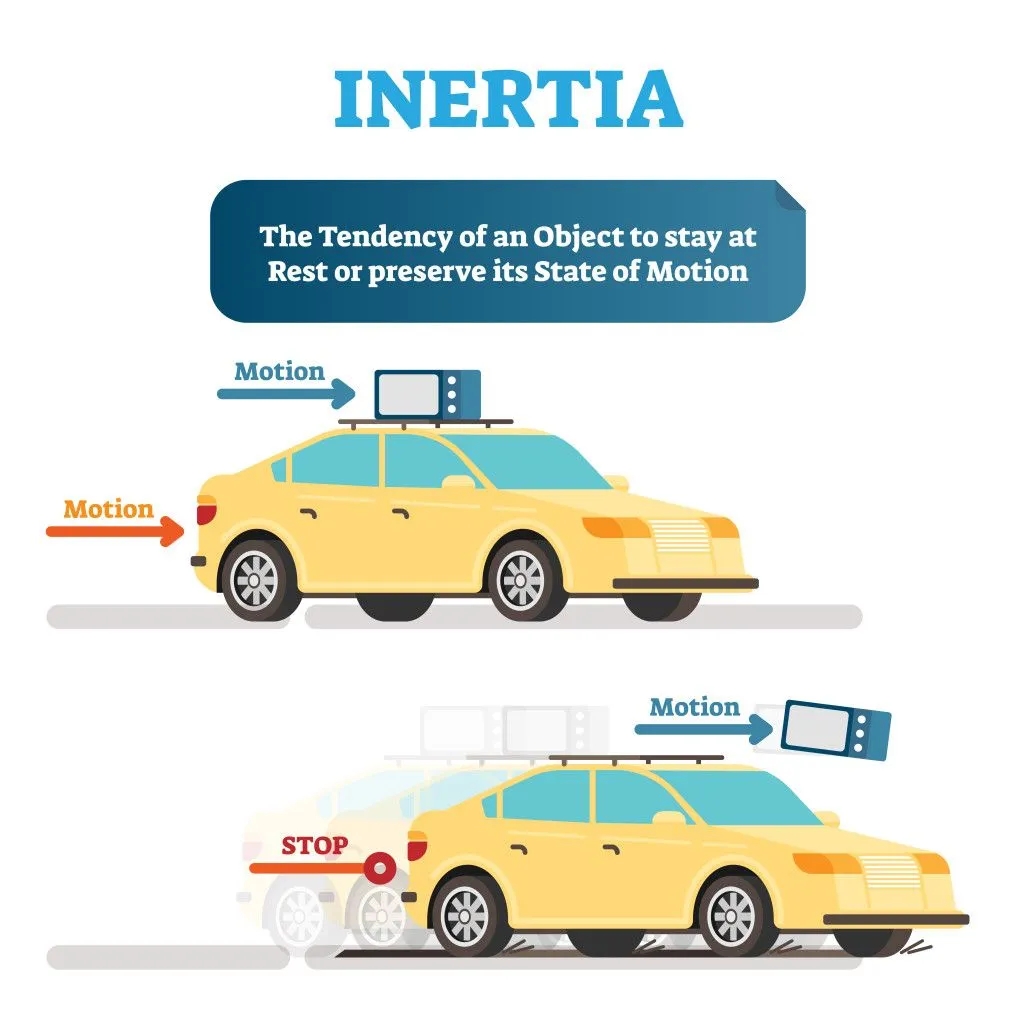
Now, if the car runs over a speed breaker or a bumpy road, you’d start feeling the movement of the car. Additionally, if the car came to a stop or suddenly started moving, you’d be able to feel some change in the state of rest or motion of the car. This is due to inertia. The same principle would apply to a ship.
Since water bodies are constantly marred by waves that affect the velocity of any ship traveling on them, and vehicles traveling by sea are far more susceptible to turbulent weather conditions, due to the lack of an anchor holding them to the sea bed, you would definitely be able to feel the motion of the ship on such waters.
Can You Feel The Movement Of A Ship Onboard?

So, the answer to the question of whether you’d feel the motion of a ship while onboard is not black and white. You won’t inherently feel the motion of the ship you’re traveling aboard. However, due to the turbulent and unpredictable nature of water bodies, in general, the ship won’t be able to travel with a constant velocity.
Waves don’t just nudge a ship forward and back. Naval architects describe six ways a vessel moves at once: it rolls (tilts side to side), pitches (the bow and stern see-saw up and down), and heaves (lifts and drops bodily), along with the gentler surge, sway, and yaw.[6] Rolling and heaving are the big troublemakers, and they are exactly the accelerations your inner ear picks up. That’s why even a steady-speed ship can feel anything but steady once the sea kicks up.
This is also where seasickness comes from. According to the widely accepted sensory-conflict theory, motion sickness arises when your senses disagree.[4] Below deck, your inner ear feels the ship rolling while your eyes, fixed on a still cabin wall, insist you aren’t moving. Your brain can’t reconcile the mismatch, and the result is the queasy, dizzy feeling so many travelers know well.
Most modern ships are built to withstand changes in velocity, in terms of preventing their passengers from feeling most or any of those changes. Large cruise liners even carry retractable fin stabilizers that swing out below the waterline to damp the worst of the rolling.[3] However, in the case of any particularly turbulent traveling conditions, you will certainly feel the motion of the ship, so be careful loading up at the buffet line if you’re headed for rough waters!
Where Do You Feel The Most Motion On A Cruise Ship?
If you’re prone to queasiness, where you sleep matters more than you might think. A ship pivots around its center, so the bow and stern swing through the widest arcs while the middle stays comparatively calm. Height adds to it too: just as the top of a tree sways more than the trunk, the upper decks exaggerate every roll, while the lower decks, closer to the waterline, ride more gently.[6]
The practical takeaway is simple. To feel the least motion, book a cabin midship and as low as you reasonably can; to feel the most (handy if you actually enjoy the rocking), head forward or aft and up high.[7] No cabin choice or stabilizer can erase the motion entirely in a real storm, but it can make the difference between a relaxing crossing and a long night spent staring at the horizon.
References (click to expand)
- Drake, S. (1964, August). Galileo and the Law of Inertia. American Journal of Physics. American Association of Physics Teachers (AAPT).
- Sciama, D. W. (1953, February 1). On the Origin of Inertia. Monthly Notices of the Royal Astronomical Society. Oxford University Press (OUP).
- LAWTHER, A., & GRIFFIN, M. J. (1986, April). The motion of a ship at sea and the consequent motion sickness amongst passengers. Ergonomics. Informa UK Limited.
- Golding, J. F. (2016). Motion sickness. Handbook of Clinical Neurology. Elsevier.
- Physiology, Vestibular System. StatPearls. NCBI Bookshelf.
- Ship motions. Wikipedia.
- Motion Sickness. CDC Yellow Book. Centers for Disease Control and Prevention.