Hot air balloons cannot be steered directly, as there is no rudder. The pilot controls only altitude: firing the propane burner to heat the air and rise, or pulling the parachute valve at the top of the envelope to release hot air and descend. Because winds at different altitudes typically blow in different directions, climbing or descending into a different layer lets the pilot pick the heading.
Think back to when you were eleven or twelve…didn’t one of your fantasies involve flying away holding the strings of loads of balloons like in the movie ‘UP’? An airplane allows one to be airborne, but it doesn’t truly give you the experience of flying like a glider would, or for the slightly less adventurous, like a hot air balloon. Flying in a hot air balloon would be somewhat similar to hanging onto a few hundred balloons, but the latter scenario leaves you a rather limited scope in terms of choosing your altitude and direction… landing is a bleak possibility altogether. So, how do hot air balloons do it? How do you steer a hot air balloon?
The answer… hot air and wind direction.
Deconstructing A Hot Air Balloon
There are 3 basic parts of a hot air balloon; the envelope (the balloon part), the burner, and the basket or carrier. The envelope is made from nylon gores, which are reinforced with sewn-in webbing. Nylon is the material of choice since it is lightweight, sturdy and has a high melting point, all of which are extremely suitable for the purpose of flying through the air! The part of the envelope closest to the burner is called a skirt and is coated with special fire-resistant material to prevent the envelope from flaring up.
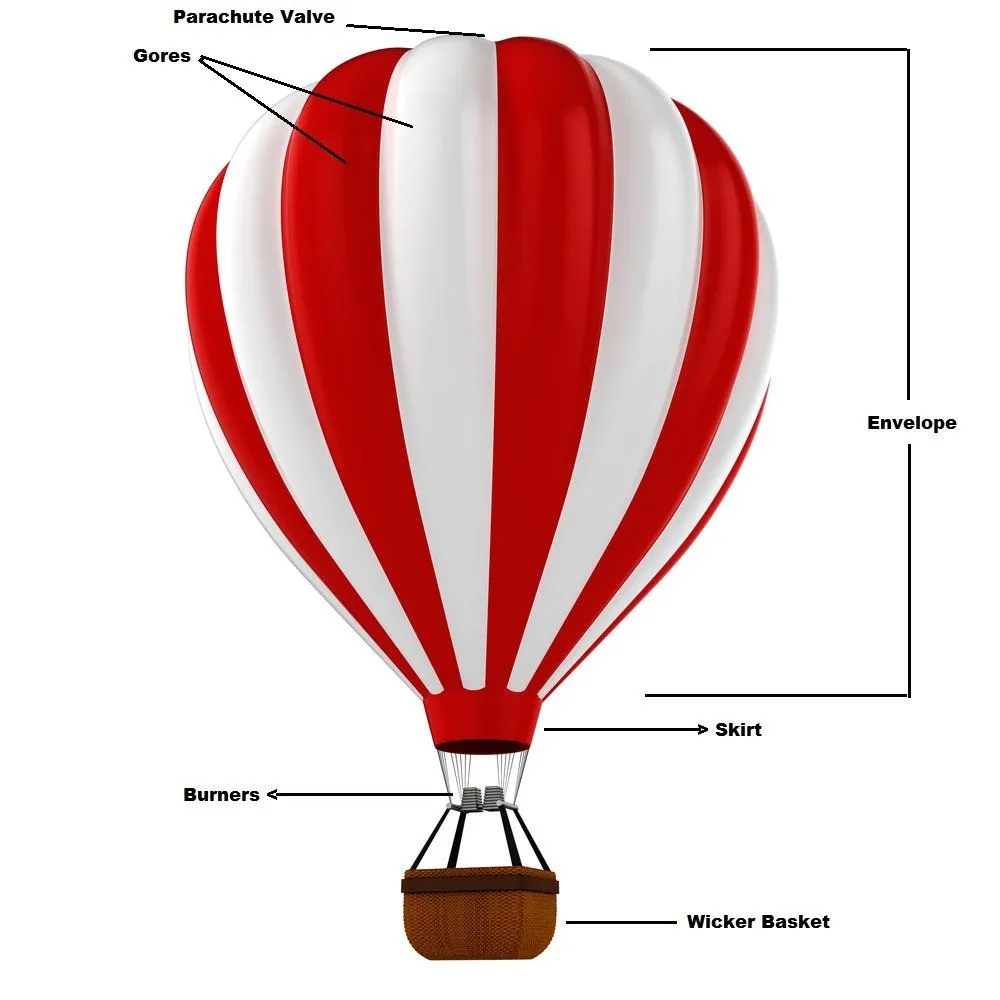
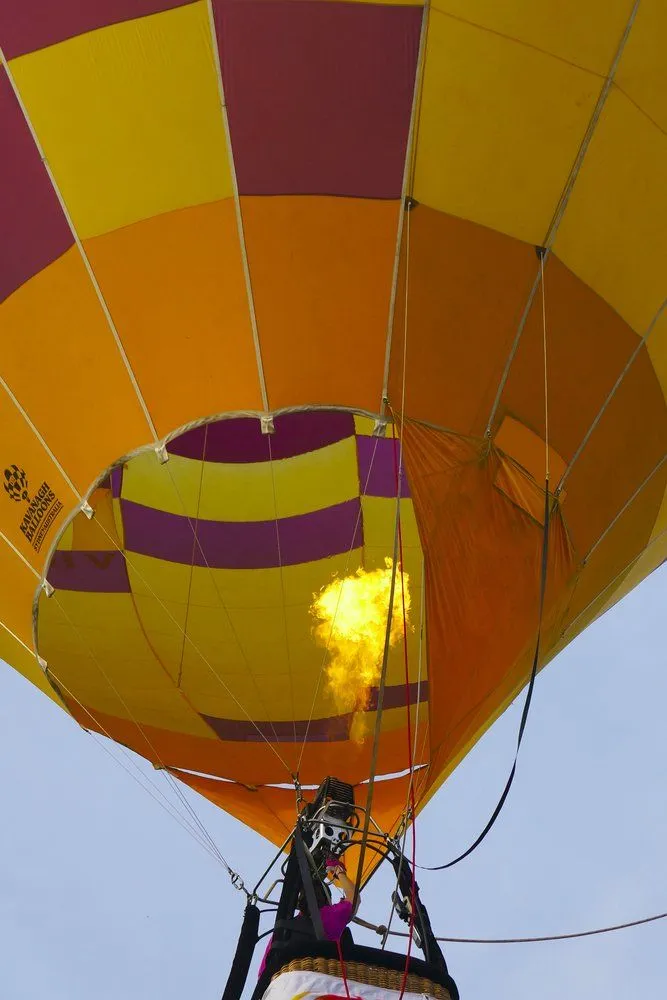
The burner uses propane gas to heat up the air in the envelope, which moves the balloon off the ground and into the air. The pilot must keep firing the burner at regular intervals throughout the flight to ensure that the balloon continues to be stable. The basket that holds the gas tanks and passengers is actually made of wicker, which is sturdy, lightweight and flexible. The flexibility is important, since hot air balloon landings involve impacting the ground, but the flexibility of wicker absorbs some of that energy to prevent the basket from breaking apart. The burner is set just underneath the mouth of the envelope, which heats the air inside it.
The Ascent And Descent
Hot air balloons rely on a basic principle of science: hot air rises upwards since it is lesser in density than cool air. A cubic foot of air weighs roughly 28 grams. If you heat the air by 100 degrees Fahrenheit, it weighs about 7 grams less, which is still a rather small amount. Therefore, to lift about 1,000 pounds, approximately 65,000 cubic feet of air is required. This explains why the balloon part is so large. As the burner heats the air inside the envelope, it creates a lift force, which makes the balloon rise. When the burner is on, it will continue to rise, whereas it will lose altitude when the burner is switched off. However, the balloon definitely won’t come crashing down to the ground, since the air inside will never escape from the mouth of envelope, because buoyancy makes it rise.
In order to return to the ground, the pilot needs to open the parachute valve (a circle of fabric that can be opened) at the top-most region of the envelope by pulling an attached chord and letting off inner hot air. Landing a balloon is quite difficult and pilots usually land it on a large empty piece of land, such as a meadow or any countryside area. The reason for such empty bases for landing is that hot air balloons cannot be steered like airplanes.
Steering A Hot Air Balloon
A hot air balloon has no built-in mechanism for steering. It uses the direction in which the wind travels to steer itself. However, that does not mean that pilots let the balloon amble anywhere. At different altitudes, the wind direction is different, so pilots use this to steer their hovering crafts. They can get information about the direction of winds at different altitudes and then rise up or down to the altitude that has wind blowing in the desired direction. The lateral or horizontal motion of the balloon is then completely controlled by the wind, but somewhat guided by the operator.
Hot air balloons are clearly not designed for long distance air travel or for fighting wars, like jets and planes, but they do provide a serene experience of being suspended in the open air, as well as a magnificent view of the world below!
What Instruments Does The Pilot Use?
If there is no steering wheel, what is the pilot actually watching? Quite a lot, as it turns out. A hot air balloon may have no rudder, but it does carry a small set of flight instruments, and in the United States the aviation rules spell out exactly which ones are mandatory. Every balloon must carry an altimeter and a rate-of-climb indicator, and a hot air balloon must additionally have a fuel quantity gauge and an envelope temperature indicator.

The altimeter tells the pilot the balloon’s height, which matters because the whole game of choosing a direction depends on knowing exactly which layer of air you are sitting in. The rate-of-climb indicator, often called a variometer or vertical speed indicator, shows how quickly the balloon is rising or sinking, so the pilot can feather the burner and settle gently into a new altitude rather than overshooting it. The envelope temperature gauge (also called a pyrometer) reads the air temperature near the crown of the envelope from a sensor mounted up top, warning the pilot long before the fabric gets close to its safe limit. The fuel gauges, sitting on the propane tanks, show how much gas is left to keep the burner going. On most modern balloons the altimeter, variometer and temperature readout are grouped into a single instrument pod clipped to the basket, while older balloons may still use analog, pressure-driven dials.
How Do Pilots Navigate And Get Back To Earth?
Steering by altitude only works if the pilot knows what the wind is doing at each height, so navigation really begins on the ground. Before launch, pilots gather the winds-aloft picture from weather services and forecasts, and many also send up a small helium pilot balloon (a “pibal”) and watch how it drifts, plotting the wind direction at successive altitudes. The result is a fan, or “V”, of possible tracks spreading out from the launch site: low winds carry the balloon one way and higher winds another, and the spread between those extremes is what balloonists call steerage. By flying higher or lower the pilot tracks closer to one leg of the V or the other, in effect picking a path down the middle.
Because surface winds usually shift direction with height, a pilot can sometimes climb into a layer moving one way, drift across, then descend into a lower layer moving back the other way, nudging the balloon toward a chosen landing field rather than wherever the breeze happens to lead. A good balloonist, more than any other kind of pilot, has to picture these winds in three dimensions and keep a running mental map of how the craft is moving through the air.
In flight, the direction check is wonderfully low-tech. Pilots read the wind below by watching smoke, flags, dust and the ripples on ponds and lakes, and they can even drop a light tissue ball and time its fall to gauge where the wind changes. Hand-held GPS units now make position-fixing easy, but the old habit of lining up a fixed point on the basket with a landmark ahead, to read the ground track by eye, still works when the batteries do not. And to come back to earth, the pilot simply stops feeding the burner and opens the parachute valve at the top of the envelope, letting hot air spill out so the balloon cools, sinks and settles into an open field below.
References (click to expand)
- Ballooning Facts - plaza. The University of Florida
- How do you steer a flying hot air balloon? - for How Things Fly. The Smithsonian Institution
- Steering a Balloon | amomentofscience - Indiana Public Media. WFIU
- Balloon Flying Handbook (FAA-H-8083-11) - Federal Aviation Administration
- 14 CFR 31.85, Required basic equipment - Legal Information Institute, Cornell Law School