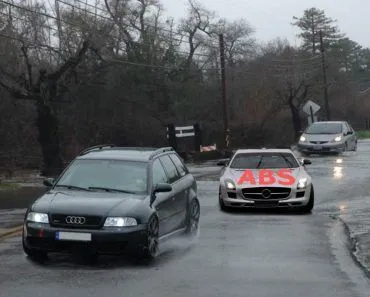
When you brake, the car's kinetic energy (the energy of its motion) is mostly converted into heat. Friction between the brake pads and the spinning disc heats up the metal until almost all of the car's kinetic energy has become thermal energy in the brakes, tires and road. Smaller fractions become sound (the squeal you can hear) and a tiny amount goes into wearing material off the brake pads. In hybrid and electric cars, some of that kinetic energy is recovered as electrical energy through regenerative braking and stored in the battery for later use.
Imagine cruising down the street in your Lamborghini at a speed of 120 km/h when you see the traffic light go red… what do you do? Unless you want a ticket sent to your door, you slam the brakes to the floor and stop the car. Your car had so much energy just a moment ago, so where did it all go? To understand the answer, we need to think about the amount of energy that things have when in motion, as well as the way they usually stop.
Kinetic Energy: The Energy Of Movement
It’s quite intuitive that a moving object has some amount of energy. Think of a rolling football, which certainly has more energy than a stationary football; it won’t stop until this energy is lost. The energy that something has when it’s moving is called kinetic energy. If a player sticks his foot out to control the ball, the energy of the ball will be transferred to the player’s foot as it moves backwards; some will also be converted to sound energy that we can hear.

When a cricket ball or football runs over grass, the kinetic energy is eventually absorbed through friction by the grass. However, these balls have very little energy, whereas a much more massive car will have a huge amount of energy. Therefore, it’s not possible to simply transfer all that energy as friction to the road in a short span of time.
In fact, if you move twice as fast, the kinetic energy is four times as large. All of this energy must be dissipated while braking so that the car can come to a halt. Also note that energy fundamentally cannot be destroyed; the only control we have over it is to change its form.
How Do Brakes Convert Energy?
For instance, the energy to move the car comes from burning petrol or gasoline, which is consumed in the process. This is an example of the conversion of energy, from chemical interactions in petrol to the energy of motion or kinetic energy in a car. When stopping a car, the kinetic energy must be transferred into another form, which is done by dissipating the kinetic energy of the car in the form of heat.
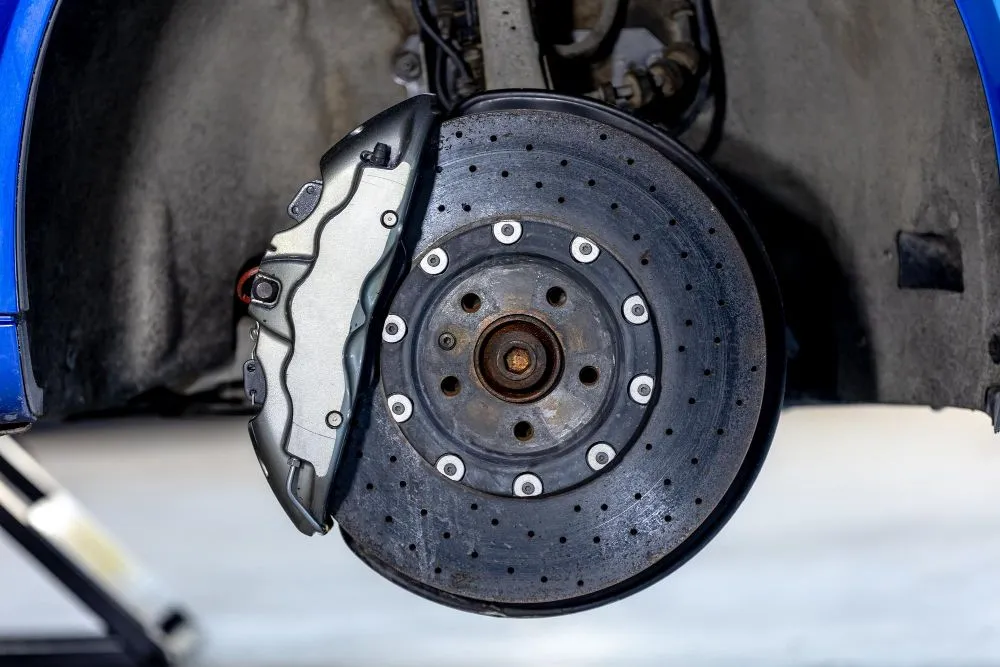
Most cars on the road today use what’s called a disc brake. As you press the brake pedal, a process begins that leads to the clamping of the brake rotor, which is attached to the wheel or axle of the vehicle. This clamping or squeezing causes a lot of friction and resistance to the motion of the wheel. In the process, significant heat is generated by the brake rotor and pad.
Which Energy Store Does The Car Lose?
If you have met this question in a physics class, it is usually phrased in terms of energy stores: once the brakes are applied, which of the car's energy stores loses energy, and which one gains? The answer follows from everything above. A moving car holds its energy in a kinetic energy store. When you brake, that store is steadily emptied, and the energy is transferred into the thermal energy store of the brakes, the tires and the surrounding air.
What links the two stores is the pathway by which the energy travels. Here the pathway is mechanical: the braking force pushes the pads hard against the spinning disc, and the work done against friction is what shifts the energy out of the kinetic store and into the thermal store. Because that heat then spreads out into the surroundings, where we can no longer make use of it, physicists say the energy has been dissipated.
None of this energy is created or destroyed along the way, which is simply the first law of thermodynamics at work. As the University of Calgary's energy encyclopedia puts it, braking has to obey the conservation of energy, so the thermal energy produced is exactly equal to the kinetic energy lost. The car's kinetic store empties into a thermal store that you cannot drive on.
Observing Energy Conversion
Trucks have air brakes, modern cars have disc brakes, and bicycles mostly have rim brakes. Despite these differences, the conversion of kinetic energy to heat is quite similar in all three. The rim brakes clamp the rim of the wheel when the brakes are applied, making the rim the site of heat generation. You might be able to feel it for yourself on a bicycle after braking for an extended period, like on a long descent.
You might also notice that brake pads wear out after a while. This is partly due to heat and partly due to the wheel’s rim pulling off parts of the brake pad due to intense force and friction. Therefore, some energy will go towards tearing off tiny pieces of the brake pads as well.
In cars, the heat generated by braking can reach up to a few hundred degrees Celsius, as cars will have much more kinetic energy at the same speed due to greater mass. This heat must be dissipated so the braking components don’t sustain permanent damage due to prolonged exposure to heat. In fact, in super-fast Formula One cars, special materials are used for brake pads and are specifically designed to allow a lot of air to pass through and quickly dissipate heat.
The kinetic energy is also converted to sound, which can be heard as a screech if you brake suddenly.
How Much Of The Car's Energy Becomes Heat?
So just how much of the car's energy ends up as heat? In ordinary friction braking, the honest answer is almost all of it. A peer-reviewed thermal study of disc brakes states the working assumption plainly: all of the kinetic energy reaching the rotor surface is converted into heat. Only tiny slivers leave as sound and as the material scraped off the pads, so close to 100% of the car's energy of motion lands in the brakes as thermal energy.

It helps to put a number on that energy of motion. Kinetic energy is given by the formula KE = ½mv2, where m is the mass and v is the speed. A 1,500 kg family car travelling at 100 km/h (about 27.8 m/s) carries roughly ½ × 1,500 × 27.82, which works out to about 580 kJ of kinetic energy. Every joule of that has to be turned into heat for the car to come to a halt.
That is why brakes get so hot. In one study of an emergency stop from 70 km/h, the friction surface of the disc was modelled at around 200 °C (about 390 °F), and harder or repeated stops can push everyday brake discs to several hundred degrees Celsius. The faster and heavier the car, the more energy the formula hands to the brakes, and the hotter they have to run.
Can We Reuse The Energy?
Either way, the kinetic energy of a car is lost to the surroundings when braking. That said, thanks to the advent of regenerative braking, this energy story has taken a rejuvenating twist.
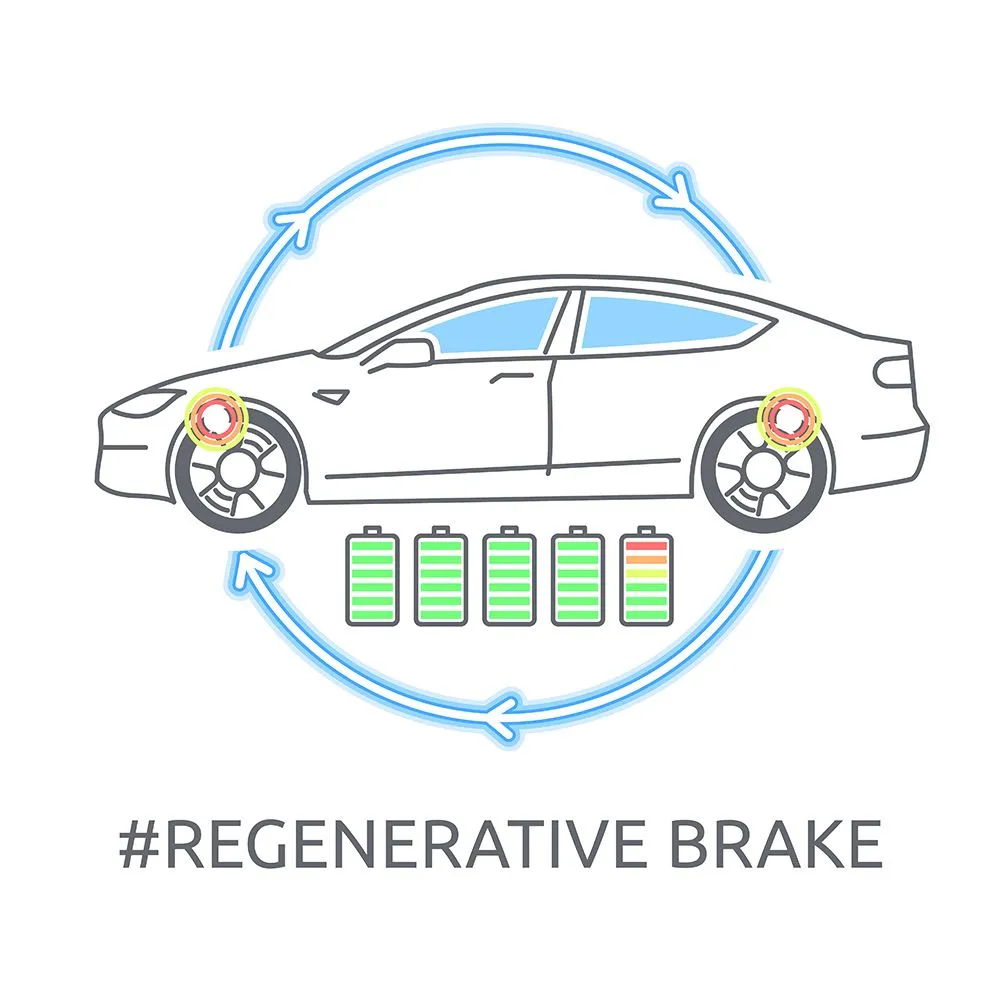
In hybrid or electric cars, the energy of the moving car is recovered by the battery by switching the motor that propels the wheels into a generator. The kinetic energy supplied by the moving wheels is converted to electrical energy by the generator and returned to the battery, which can then store it for future use. Even so, at least 30% of the energy is still given off to the environment, mostly as heat.
The next time you’re behind the wheel or kicking a ball, remember that energy is constantly changing forms. Most of the time, it will change from useful to useless, such as when our cars dissipate kinetic energy as heat. With braking systems like regenerative braking, however, we’re moving towards the more efficient usage of energy in cars. The recovered energy can be used again, rather than being dissipated to the environment.
As we continue to innovate, brakes will change and car engines will advance, but it will always remain true that energy is neither “created” in the engine, nor “lost” in the brakes.
References (click to expand)
- Energy transfer and utilization efficiency of regenerative ....
- Volkov, V., Gritsuk, I., Volkova, T., Dytiatiev, O., Volodarets, M., Chygyryk, N., & Bulgakov, M. (2020, November 11). Energy Approach to the Formation of Braking Properties of Vehicles. SAE Technical Paper Series. SAE International.
- Vol. 11, No. 36, MAY 17, 1856 of Scientific American ....
- Braking. Energy Education, University of Calgary.
- Thermo-Mechanical Behavior of Aluminum Matrix Nano-Composite Automobile Disc Brake Rotor Using Finite Element Method. PMC, NCBI.