Table of Contents (click to expand)
Yes, bananas are mildly radioactive. The fruit is rich in potassium, about 0.0117% of which is the naturally occurring radioactive isotope potassium-40. Each banana delivers a tiny dose of roughly 0.1 microsieverts, known informally as the “banana equivalent dose.” You would need to ingest tens of millions of bananas in one sitting to come close to a lethal dose, and your kidneys keep total body potassium in tight homeostasis anyway, so eating bananas (or any other potassium-rich food) is completely safe.
Technically yes, but only in a wildly impractical scenario: you would need to ingest something on the order of tens of millions of bananas in a single sitting before the dose was anywhere near lethal, and you would die of potassium toxicity (hyperkalemia) long before radiation poisoning got a look in. In real-world conditions, bananas are completely safe.
Luckily, one cannot eat such a massive quantity of bananas, considering that each banana, on average, amounts to 110 calories. Even so, this doesn’t change the fact that bananas do give off radiation. The secret to their radioactivity lies in the composition of the fruit itself. One medium ripe banana, on average, provides 1 gram of protein, 28 grams of carbohydrates, 15 grams of natural sugars, 3 grams of fibre and 450 mg of potassium. This all seems okay, just like a healthy fruit should be… so how can this give you radiation poisoning?
The answer lies in those small amounts of potassium present in this popular yellow fruit.
Is Potassium Radioactive?
Certain elements in nature consist of both stable and unstable (radioactive) atoms. Potassium is one such element. Isotopes are atoms of the same element (so they share the proton count) but with different numbers of neutrons. Natural potassium is a mix of three isotopes: K-39 (about 93.26%, stable), K-41 (about 6.73%, stable) and K-40 (about 0.0117%, radioactive). That tiny K-40 fraction is what makes every banana, and indeed every plant and animal tissue, slightly radioactive.
K-40
As the name suggests, this isotope of potassium has an atomic mass of 40, i.e., 19 protons and 21 neutrons in the nucleus of each atom, but what do these numbers tell us?
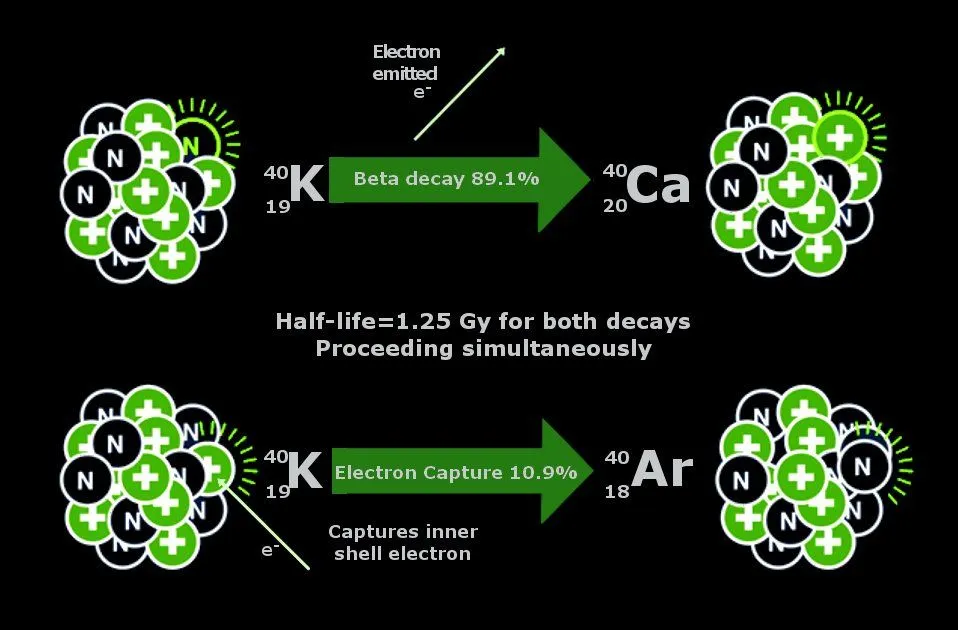
Whether a nucleus is stable or not depends on a delicate balance between protons and neutrons, and the right balance shifts with mass. For K-39 and K-41 the balance works out, but for K-40 it does not quite, so K-40 is slightly unstable and decays with an extremely long half-life of about 1.25 billion years. About 89% of the time it decays into stable calcium-40 by beta-minus emission, and roughly 11% of the time it decays into argon-40 by electron capture or positron emission. The very slow decay of potassium-40 into argon-40 is also highly useful for dating rocks, especially volcanic rocks, with ages between about a hundred thousand and four billion years. When lava cools, any argon present escapes, so a freshly crystallized rock starts with potassium but essentially no argon. Over time, as the potassium-40 disintegrates, argon-40 atoms slowly accumulate, trapped in the solid. Measuring how much argon-40 has built up gives geologists an accurate measurement of the rock’s age.
What Does Radiation Poisoning Do, To The Human Body?
Not to burst your bubble, but radiation exposure to the body does not give you superpowers. Unlike our favourite superheroes, who were either lab rats at military weapon research labs or underwent genetic mutation after getting exposed to space rock radiation, in reality, humans undergo very different transformations. Depending on the duration of exposure and the strength of radiation, the symptoms vary widely. Dizziness, fatigue, hair loss, skin problems, fever and headaches are just the start. Due to the damage, it causes to the body cells, your overall immunity decreases, opening the gateway for a plethora of infections. The untimely intervention of doctors might lead to death in extreme cases.
Now that you know what radiation poisoning can do to your body, it’s worth mentioning that bananas are a radioactive food item. There are dozens of such naturally occurring food items that we ingest, almost on a daily basis, completely unaware of their radioactive nature. Potatoes, sunflower seeds, various nuts and kidney beans are just a few of them. Among these, Brazil nuts are the world’s most radioactive food, but what you probably don’t realise is that every type of food has a small amount of radioactive substances in it. The most common radioactive atoms present in food are potassium 40 (K-40), radium 226 (Ra-226) and uranium 238 (U-238).
Should We Be Concerned?
Luckily, our body maintains proper levels of potassium by flushing out the excess through urination and sweat. Also, the quantity of K-40 in a banana is too small to concern yourself with. The same can be concluded for other radioactive food items. How do these radioactive elements end up in our food? They come from the soil in which the foods are grown! Thus, every food item will have varying amounts of these naturally occurring radioactive elements.
In certain scenarios, the spillage of radioactive materials from industries into the soil leads to the contamination of food with excess amounts of radioactive material. This is a separate case altogether, one in which our not so harmful bananas could actually pose a danger to the consumer. Thus, it is of utmost importance that radioactive waste is handled correctly and disposed off , using proper measures.

Conclusion
We often fail to realise how exposed we are to these forms of radiation, yet we generally remain unaffected by them. We are not entirely protected, but our knowledge of radioactive substances is critical, as they have found their way into a wide range of medical research and treatments.
About one-third of all patients admitted to hospitals are diagnosed or treated using radiation or radioactive materials. The radioactive materials used are called radiopharmaceuticals. A small amount of radioactive material is injected, inhaled or swallowed. The material becomes concentrated in the area under study, where it emits photons. These photons can be seen by a device known as a gamma camera, which can help physicians find and identify tumours or view problems in an organ. Radioactive iodine is also used when imaging the thyroid gland.
As far as our banana is concerned, there is little to no risk of being affected by radiation exposure, but there is a risk of slipping on the peel that you threw on the ground, so pick up after yourself!
References (click to expand)
- Bananas | The Nutrition Source | Harvard T.H. Chan School of .... The Harvard T.H. Chan School of Public Health
- Potassium-40 - phi.nmsu.edu:80
- Radiation sickness - Symptoms and causes. The Mayo Clinic
- Definition of radiation poisoning - NCI Dictionary of Cancer Terms - www.cancer.gov
- Radionuclide Basics: Potassium-40 - U.S. Environmental Protection Agency
- Measuring the Radioactivity of Bananas - Oak Ridge Associated Universities Health Physics Museum
- Naturally Occurring Radioactive Materials NORM. World Nuclear Association
- Backgrounder On Medical Use Of Radioactive Materials. The Nuclear Regulatory Commission