
Table of Contents (click to expand)
- How Did The Chernobyl Catastrophe Happen?
- The Elephant’s Foot
- How Did It Form?
- Chemical Composition Of The Elephant’s Foot
- How Radioactive Is The Elephant’s Foot Today?
- What Would Happen If You Touched The Elephant’s Foot?
- When Will The Elephant’s Foot Be Safe?
- What Is “The Heap”, And What Else Is Down There?
- Conclusion
The Elephant’s Foot is the nickname for a roughly two-tonne mass of corium (solidified molten reactor fuel mixed with concrete, sand and steel) that pooled in a basement room below Chernobyl reactor 4 after the April 1986 disaster. Discovered by a Kurchatov Institute team in December 1986, it initially emitted around 10,000 roentgen per hour - a lethal dose in under five minutes - and by the mid-1990s had fallen to roughly a tenth of that. Four decades of decay have not made it safe: a couple of hours beside it today would very likely still be fatal, and the mass is now crumbling into radioactive dust.
Remember the last time you ate a banana? You were exposed to 0.1μSv (0.0001mSv) of radiation. A single chest X-ray gives about 0.2 mSv of radiation. Fortunately, these levels of radiation are entirely harmless to the human body.

What if I told you that there exists a single item that is more radioactive than radium? Elephant’s foot: the world’s most deadly radioactive substance, which can kill within minutes.
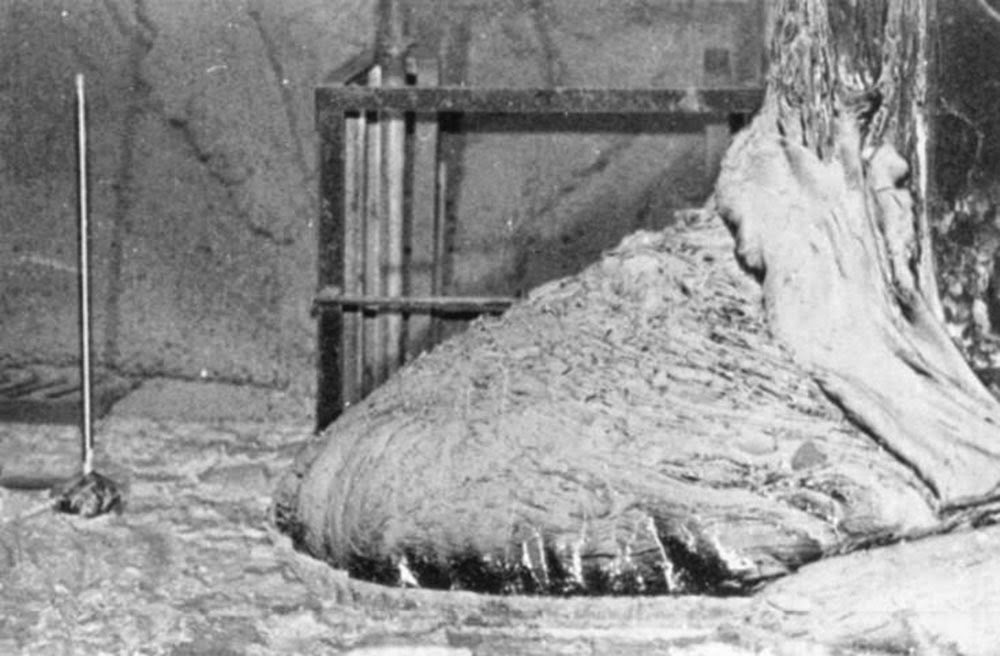
The Elephant’s Foot has little to do with the foot of an actual elephant. It is a nickname given to the solidified pile of radioactive lava or corium that oozed down the nuclear reactor at Chernobyl.
But what created this deadly mass of lava? And how much radiation will hit you if you touch the Elephant’s Foot?
How Did The Chernobyl Catastrophe Happen?
A series of unfortunate events led us to experience one of the worst man-made catastrophes of all time. In the early hours of April 26th, 1986, the world saw a nightmare come to life with an explosion at the Chernobyl nuclear power plant. The citizens of Pripyat woke up to a thunderous boom at around 1:23 AM local time and felt their homes shudder. They gazed out their window to see what had happened and saw an iridescent flame rising from Unit No. 4 of the nuclear plant.
While conducting a routine test, a power surge to the reactor caused a domino effect that ultimately led to the Chernobyl catastrophe.
The power surge increased the reactor core’s temperature. The operators had pulled almost all of the control rods out to keep the sluggish reactor running, and by the time they hit the emergency shutdown button it was too late. Worse, the RBMK’s control rods (made of boron carbide, a neutron absorber, not uranium) each carried a graphite “displacer” on the tip, so the first moment of their insertion pushed water out of the bottom of the core and actually added reactivity there, the infamous “positive scram” effect. Power ran away, fuel channels ruptured, the cooling water flashed to steam, and the pressure blew the reactor apart in two explosions a few seconds apart.
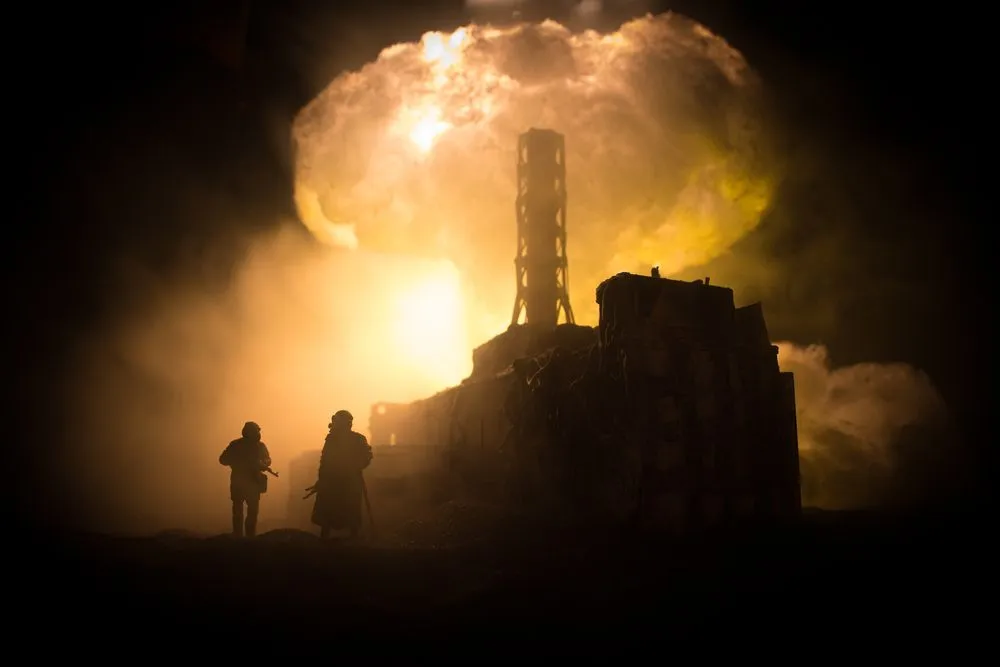
The explosion belched out pieces of broken core material and radionuclides that lingered in the atmosphere for over ten days. While most of the radioactive elements were dispersed into the surroundings, some melted down the core in the form of lava.
If you want to know more about the Chernobyl nuclear disaster, you can watch HBO’s Chernobyl. It might not be scientifically spot on, but it does paint a ghastly picture of what happened, as well as the dramatic aftermath.
The Elephant’s Foot
In December 1986, a team of scientists from the Kurchatov Institute found a massive globular formation made of a mysterious substance in a steam-distribution corridor beneath Reactor 4. The mass must have flowed from somewhere above and solidified into a black glassy lump. Since it was half as tall as a man, weighing about two tonnes and most importantly, looked like an elephant’s foot, the researchers cleverly named it the Elephant’s Foot.
It may be difficult to believe that the harmless-looking pile of solidified lava is one of the most deadly things in the world, but trust me… it has the potential to ensure an agonizing death for anyone who stands near it for 5 minutes.
When it was first measured in late 1986, the Elephant’s Foot was emitting roughly 10,000 roentgen per hour. If you were to stand right next to it for an hour at that intensity, you would absorb roughly 80 to 100 sieverts of radiation - the equivalent of around 400,000 chest X-rays, and many times the dose needed to kill you. By 1996, when the photograph below was taken, a decade of radioactive decay had cut the field to roughly a tenth of the original, and it has kept sliding, slowly, ever since (more on today’s numbers further down). Still wildly unsafe, but no longer a five-minute death sentence. And yet, you can see a researcher taking photographs in the picture below
How Did It Form?
The Elephant’s Foot was just a fraction of the radioactive lava that formed inside the reactor a few minutes after the onset of the accident.
The formation of the Elephant’s Foot began on the day of the explosion, and the lava kept creeping through the building for days afterwards. First, the zirconium (zircaloy) cladding around the fuel rods melted, reaching a temperature of over 1,850 degrees Celsius. It then turned into a hot metal soup as it dissolved the uranium dioxide pellets. It then slowly gulped parts of the reactor vessel: stainless steel, serpentinite, graphite, and melted concrete.
The experts working on the Elephant’s Foot took a few images of the radioactive mass. One such photograph is linked here.
This hot radioactive soup, lean in uranium (only a few percent by weight) but enormous in volume, burned through the steel-and-concrete lower biological shield and the structure supporting the reactor vessel. Roughly 170 tonnes of irradiated uranium, about 95% of the original fuel load, never left the building; it is still in there today as scattered core fragments, dust and lava. The pipes in the reactor provided a convenient path for the radioactive lava to flow through the building. It burnt through three floors of the reactor building, eventually ending up in the basement.
The Photograph
The photograph was taken in 1996 and the person standing next to the lethal elephant’s foot is Artur Korneyev, a radiation specialist whose job was to locate the fuel inside the plant and determine the radiation level. He continued to make repeated visits to the Elephant’s Foot well into his sixties before being barred from the site, and is reported to have died in 2022.
Later on, researchers would take pictures of the radioactive lava from a safe distance with the help of workers (the so-called “liquidators”) who would attach a camera on wheels and push it towards the Elephant’s Foot.
To study this mysterious mass the experts needed to collect samples for further analysis, but the mass seemed indestructible. They used drills and axes to break the substance apart, but to no avail. Finally, they were able to break a fragment of the surface by firing at it with a rifle.
Chemical Composition Of The Elephant’s Foot
The Elephant’s Foot is a glassy, ceramic-like mass dominated by silicate glass with embedded inclusions. Its main constituents are:
- Silicon dioxide (the largest component, formed from melted sand, concrete and serpentinite)
- Uranium dioxide (from the reactor fuel)
- Zirconium oxide (from molten fuel-rod cladding)
- Iron, calcium, aluminum, magnesium and potassium oxides, plus dissolved stainless steel from the reactor vessel
Apart from the Elephant’s Foot, the researchers came across many more similar solidified lava flows inside the ruins of reactor four. Each mass had solidified into uncanny shapes, and were therefore given nicknames like The Drop, the Icicle, the Stalagmite and the Heap.
In these solidified masses of radioactive lava, they also identified a previously unknown crystalline phase that they named Chernobylite, a uranium-doped zirconium silicate that forms tiny black-to-yellow crystals visible only under an electron microscope (it is not, despite a persistent online myth, a glowing blue substance).
How Radioactive Is The Elephant’s Foot Today?
Here is the honest answer: nobody has published a fresh reading in years, so anyone who hands you an exact number for 2026 is guessing. What we do have is a decay curve with a few solid points on it.
In 1986, the dosimetrists logged 8,000 to 10,000 roentgen per hour beside the mass. A decade later, when Artur Korneyev took his famous photograph, the field had dropped to roughly a tenth of that, around 1,000 R/h. That first plunge was steep because the short-lived fission products burned themselves out quickly. What is left is dominated by longer-lived fission products such as cesium-137, which has a half-life of 30.17 years, and the US Nuclear Regulatory Commission (NRC) notes that fission products like cesium-137 account for most of the penetrating radiation in high-level nuclear waste. So since the mid-1990s the decline has slowed to a crawl. Halve 1,000 R/h once every three decades and you land somewhere in the hundreds of roentgen per hour today. Treat that as our back-of-the-envelope estimate, not a measurement, because the mass is also falling apart, and a crumbling shape changes how much of its own radiation it shields.
What does that mean in modern units? For gamma rays, one roentgen of exposure deposits close to one rad in tissue, and for gamma rays a rad and a rem are the same thing (the field rule of thumb is roentgen = rad = rem); 100 rad is 1 gray (Gy) and 100 rem is 1 sievert (Sv). So the 1986 field of 10,000 R/h was about 100 Sv/h, the 1996 field was about 10 Sv/h, and today’s is probably a few sieverts per hour. For scale, the annual dose limit for a US radiation worker is 0.05 Sv. Beside the Elephant’s Foot today you would burn through a whole year’s allowance in about a minute.
Is it the most radioactive object on Earth, as the internet loves to claim? No, and it never was. The NRC points out that an ordinary spent fuel assembly, ten years out of a reactor, exceeds 10,000 rem/h at its surface, which is what the Elephant’s Foot managed on its very worst day. Even within the same building it has rivals: the Kurchatov Institute’s expedition measured up to 2,000 R/h beside a lava “heap” in the pressure-suppression pool, and up to 5,000 R/h in a borehole drilled towards a cluster of fuel assemblies elsewhere in the wreck. The Elephant’s Foot is the celebrity, not the champion.
There is one new twist. The glassy lump that once shrugged off drills is disintegrating. Ukrainian scientists told Science in 2021 that it now “more or less has the consistency of sand.” That changes the nature of the danger: alongside the gamma rays, which reach you from across the room, the mass now sheds radioactive dust laced with uranium and the plutonium bred from it, and that dust is an alpha-particle hazard if you breathe it in.
What Would Happen If You Touched The Elephant’s Foot?
Let’s get the surprising part out of the way first: touching it barely matters. The gamma rays that do the damage stream straight through the air, so standing next to the Elephant’s Foot is nearly as bad as hugging it. Contact would add two extras, radiation burns on the skin and a coating of radioactive dust on your hand that you would then carry around, but the main event is the whole-body dose you soak up simply by being in the room. Looking at it costs you nothing extra either. It does not glow, and your eyes receive the same dose as the rest of you.

So let’s stand next to it and start a stopwatch, using the thresholds the US Centers for Disease Control and Prevention (CDC) publishes for acute radiation syndrome (ARS), the illness you get from a large, penetrating, whole-body dose delivered in minutes. At the 1986 field of roughly 100 Sv/h (for gamma rays, 1 Sv of dose is about 1 Gy absorbed):
- About 30 seconds: 0.7 Gy, the threshold for the bone-marrow form of ARS. Nausea and vomiting within an hour to two days, then a drop in all blood cell counts over the following weeks that leaves the victim open to infection and bleeding, the usual causes of death.
- 1.5 to 3 minutes: 2.5 to 5 Gy, the range the CDC gives as the dose that kills about half of people within 60 days.
- About 6 minutes: 10 Gy. The lining of the gut dies off (the gastrointestinal syndrome); the CDC puts death within two weeks, and survival is not expected at this dose.
- About 30 minutes: 50 Gy. The cardiovascular and central nervous system syndrome: symptoms within minutes of exposure, death within three days, no recovery expected.
That is where the famous line “dead in five minutes” comes from, and it holds up. By the mid-1990s, at around a tenth of that field, every number on the list stretches tenfold: a few minutes for the first symptoms, a quarter to half an hour for a coin-flip on survival, about an hour for a dose nobody survives. Today, with the field lower still, a couple of hours beside it would very likely be fatal. Korneyev could take his 1996 selfie and walk away because a photograph takes seconds, not minutes, and every step back helps, since the dose rate falls off quickly with distance.
When Will The Elephant’s Foot Be Safe?
Short answer: not in your lifetime, and not in your great-great-grandchildren’s either. The longer answer depends on which danger you mean, because the Elephant’s Foot is really two hazards wearing one coat.

The first hazard is the gamma field, and that one does fade. It comes mostly from fission products, and the two that matter now are cesium-137 (half-life 30.17 years) and strontium-90 (29 years). A half-life is the time it takes for half of a radioactive substance to decay, so the arithmetic is simple: forty years on from 1986, about 40% of the original cesium-137 is still there. After 100 years, 10% remains; after 200 years, 1%; after 300 years, one part in a thousand. Even that last figure is not “safe to touch.” One-thousandth of the 1996 field is still around 1 R/h, and an hour of that is roughly 50 chest X-rays. Three centuries from now it would still be something you handle with remote tools, and it would be far longer before anyone would want to pick it up.
The second hazard does not fade on any human timescale. Some of the uranium in the fuel captured neutrons and turned into plutonium-239, which has a half-life of 24,110 years, and plutonium that absorbs neutrons goes on to produce americium-241 (432.2 years). Both are mainly alpha emitters: alpha particles cannot get through your skin, but they are dangerous once the dust that carries them is breathed in. The NRC notes that these heavier-than-uranium elements make up most of the hazard left in high-level waste after 1,000 years. And remember, the Elephant’s Foot is turning to sand. A lump of plutonium-bearing glass is one thing; plutonium-bearing dust is another. That is why Ukraine has no plan to wait it out.
Instead, the plan is to take it apart. In November 2016 the 36,000-tonne New Safe Confinement, a steel arch pushed 327 meters (1,073 ft) into place, was slid over the crumbling 1986 sarcophagus; it was handed over in 2019 with a 100-year design life. Its job is to keep out the rain, contain any collapse of the rickety old shelter, and give robots a dry, sealed workshop in which to dismantle it and eventually dig out the fuel-containing materials for packing and disposal, with a deep geological repository as the intended final home for this nuclear waste. That timetable took a hit on 14 February 2025, when a drone punched a roughly six-meter (20 ft) hole through the arch’s roof; full restoration of the confinement is targeted for 2030. Until the lava is boxed and buried, “safe” is a matter of distance and steel, not time.
What Is “The Heap”, And What Else Is Down There?
The Elephant’s Foot gets all the press, but it is a side puddle. The Kurchatov Institute’s Complex Expedition, which mapped the wreck between 1988 and 1992, found about 173 cubic meters of lava spread through the lower floors of unit 4, and the whole room-217/2 cluster, Elephant’s Foot included, accounts for roughly 2.5 cubic meters of it.

All of it started in one place: room 305/2, directly under the reactor, where the molten core landed after the explosion. From there, the lava left by three routes:
- The big vertical flow poured through the steam-relief valves and pipes, down the steam-distribution corridor and into the two floors of the pressure-suppression pool, a large water-filled cellar built to condense steam in an emergency.
- The small vertical flow only made it as far as the steam-distribution corridor, where it froze in place like a waterfall pouring out of a valve.
- The big horizontal flow burst through a breach in the wall of 305/2, ran along the floor of the next room and two service corridors, then dripped through pipe holes in the floor into the cable room below, room 217/2. Those drips became the Elephant’s Foot, plus the “stalactites,” the “drip” and the “drop” that share the room with it. This is the leanest flow of the three, at 3 to 5 percent uranium dioxide by weight (the first flow carries 8 to 10 percent).
So what is the Heap? That is the nickname for the lava piled up in the pressure-suppression pool at the end of the first route, and the name is literal: the first scouts to reach that cellar in 1986 mistook the mounds for heaps of clay. Water was still in the pool when the lava arrived (it was not drained until 6 May 1986), and lava meeting water frothed into a pumice-like crust, as light as 0.14 to 0.18 g/cm³ and more than 10 cm thick on top of the mounds; floating chunks of it were carried 60 meters (200 ft) across the cellar. The larger Heap, on the pool’s second floor, sits in a gamma field of up to 2,000 R/h, which, together with the awkward layout, is why its size was overestimated at first: the early surveys were rushed. Its little sibling on the floor below, at about 1.8 cubic meters, is the smallest lava cluster in the building and has been proposed as the first test target for practicing how to remove the stuff.
And there is a fourth item, the one that keeps engineers awake: the lava that never left 305/2. Somewhere between 50 and 75 tonnes of uranium fuel are thought to sit there, buried under the concrete that was pumped into the building in 1986 and hidden from direct inspection. In June 1990, after rainwater soaked into it, neutron counts spiked and a scientist dashed in to spray it with gadolinium nitrate, a neutron absorber. Since the New Safe Confinement dried the building out, counts in that room have crept up again, nearly doubling over four years, and the fission there has been described as smoldering “like the embers in a barbecue pit.” Next to that, the Elephant’s Foot is the well-behaved one.
Conclusion
The Elephant’s Foot remains active even today. Radioactive radiation may be invisible, but at high doses it causes unimaginable harm to humans. Radioactive substances produce ionizing radiation, which can damage our genetic material. The radiation from the Elephant’s Foot can make a person sick within a few seconds. On the day of the Chernobyl disaster, 134 first responders suffered from acute radiation sickness, of which 28 died within three months.
References (click to expand)
- Midnight in Chernobyl | Book by Adam Higginbotham. Simon & Schuster
- The Definitive History of the Chernobyl Catastrophe - Routledge. Routledge
- Burakov, B. E., Anderson, E. B., Shabalev, S. I., Strykanova, E. E., Ushakov, S. V., Trotabas, M., … Duco, J. (1996). The Behavior of Nuclear Fuel in First Days of the Chernobyl Accident. MRS Proceedings. Springer Science and Business Media LLC.
- The Elephants Foot of Chernobyl - Stanford University. Stanford University
- Acute Radiation Syndrome: A Fact Sheet for Clinicians. Centers for Disease Control and Prevention (CDC)
- How to Measure Radiation and Radioactivity. Centers for Disease Control and Prevention (CDC)
- Radiation Terms and Units. US Environmental Protection Agency (EPA)
- Radiation: Units of Measure and Health Effects (Gerald Gels, Health Physicist). US Environmental Protection Agency (EPA)
- Radionuclide Basics: Cesium-137. US Environmental Protection Agency (EPA)
- Radionuclide Basics: Strontium-90. US Environmental Protection Agency (EPA)
- Radionuclide Basics: Plutonium. US Environmental Protection Agency (EPA)
- Radionuclide Basics: Americium-241. US Environmental Protection Agency (EPA)
- Backgrounder on Radioactive Waste. US Nuclear Regulatory Commission (NRC)
- Chernobyl Accident 1986. World Nuclear Association
- Sequence of Events: Chernobyl Accident Appendix 1. World Nuclear Association
- RBMK Reactors: Appendix to Nuclear Power Reactors. World Nuclear Association
- Stone, R. (2021). ‘It’s like the embers in a barbecue pit.’ Nuclear reactions are smoldering again at Chernobyl. Science
- Clusters of lava-like fuel-containing masses in Unit 4 of the Chernobyl NPP and an estimate of the fuel in them (Kurchatov Institute Complex Expedition report, in Russian). Geophysical Center of the Russian Academy of Sciences
- Krasnov, V. O. et al. (2008). Estimated experimental researches to characterize hidden nuclearly hazardous clusters of fuel containing materials in destroyed ChNPP Unit 4. Institute for Safety Problems of NPPs, National Academy of Sciences of Ukraine (hosted by Karlsruhe Institute of Technology)
- Gurzhiy, V. V., Burakov, B. E., Zubekhina, B. Y., & Kasatkin, A. V. (2023). Evolution of Chernobyl Corium in Water: Formation of Secondary Uranyl Phases. Materials, 16(13), 4533. PubMed Central
- Hill, K. (2013). Chernobyl’s Hot Mess, “the Elephant’s Foot,” Is Still Lethal. Nautilus

.jpg)