Partly, yes. Desert greening turns sections of desert into productive land by rebuilding the soil with pyrogenic carbon (charcoal/biochar), supplying water through irrigation, treated wastewater, or condensation, and pairing solar and wind farms with salt-tolerant plants. Real-world projects include Africa’s Great Green Wall, China’s Kubuqi project, and the Sahara Forest Project in Jordan and Tunisia.
If you’ve ever seen a desert and thought, “Is it possible to convert these vast expanses of sand into lush green spaces?”, then this is the article for you.
There is a movement called desert greening that intends to do just that. In fact, several massive desert greening projects in Africa, the Middle East, and China are already well underway.
What Is Desert Greening?
Desert greening means exactly what it sounds like: the process of turning deserts into lush forests. This isn’t only for deserts with vast never-ending seas of shifting sand dunes… semi-arid land is also included in desert greening.
The goal of the process is to reclaim parts of desert land, make them fertile, and use them for farming, forestry and other ecological reasons, such as preventing soil erosion and boosting biodiversity. By converting tracts of desert into forests, some experts hope to help battle climate change and protect regions from its symptoms (like drought and famine).
Sahara Forest Project
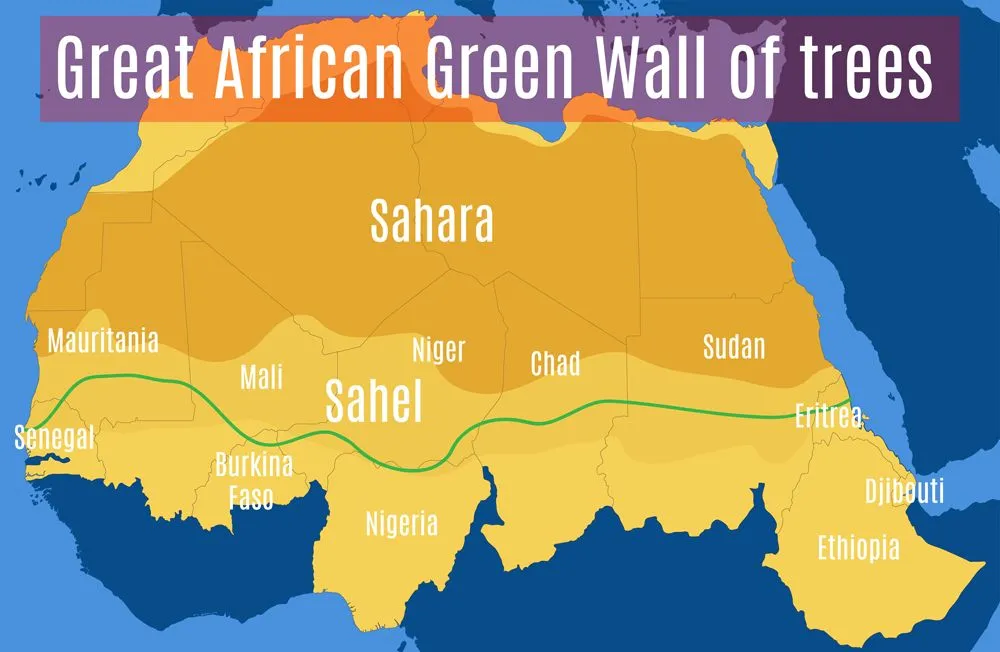
For example, the Sahara Forest Project has run pilot facilities in Qatar (now closed), Tunisia, and most recently Jordan, where its Aqaba site uses seawater, solar energy, and concentrated greenhouses to grow crops in the middle of the desert. Africa is pursuing a different (and even more ambitious) idea: the Great Green Wall, an 8,000-km belt of restored land across the Sahel aiming to revive 100 million hectares by 2030. Both projects exist not just to save lives and boost economies, but also to help blunt the effects of climate change in the region. Progress on the Great Green Wall has been uneven: a 2025 review found that only about a fifth of the planned area has been restored, with funding gaps and political instability stalling many sections.
What Is The Largest Desert-Greening Project?
If you are wondering which of these efforts is the biggest, the title goes to China. Its Three-North Shelter Forest Program, also known as the Three-North Afforestation Program or simply the “Great Green Wall of China”, is the world’s largest afforestation program (source). Launched in 1978 and scheduled to run until around 2050, it stretches across 13 provinces and regions of China’s dry north, aiming to plant and restore roughly 35 million hectares of forest to hold back the advancing sands of the Gobi and other deserts.

Progress has been enormous. By 2024, at least 30 million hectares of trees had been planted. The most striking milestone came in November 2024, when workers set down the final stretch of a roughly 3,000-kilometer green belt that now completely encircles the Taklamakan, China’s largest desert, capping 46 years of work (source).
For comparison, Africa’s Great Green Wall is aiming for an 8,000-kilometer belt and 100 million hectares of restored land by 2030, though it remains far from finished. Between them, these two projects represent the most ambitious attempts humanity has ever made to hold back the desert.
Methods Used For Desert Greening
So, how does one start converting a desert into a forest? Well, of course, with a few seeds and a lot of water.
Water is probably the most crucial aspect to ‘greening’ a desert, but as you can imagine, water isn’t the most readily available resource, especially in a desert region.
Usually, people use a combination of methods, such as irrigation, groundwater, sand-adsorbed water, rainwater and air water. On the other hand, there have also been attempts to significantly reduce the amount of water needed. This has led to technologies like special water-retaining materials (such as certain resins) and condensation techniques (Source).
In the Moroccan city of Ouarzazate, the government is converting wastewater to water that is usable for irrigation, which is helping to “green” the drylands of the region.
Solar And Wind Farms
The Sahara Forest Project is using solar panels and wind turbines to help with their water issues. A 2018 climate-modeling study published in Science has suggested that filling a large portion of the Sahara with wind and solar farms could meaningfully change the climate around them. These farms can increase the heat and humidity in their vicinity, two factors that are crucial for plant growth.
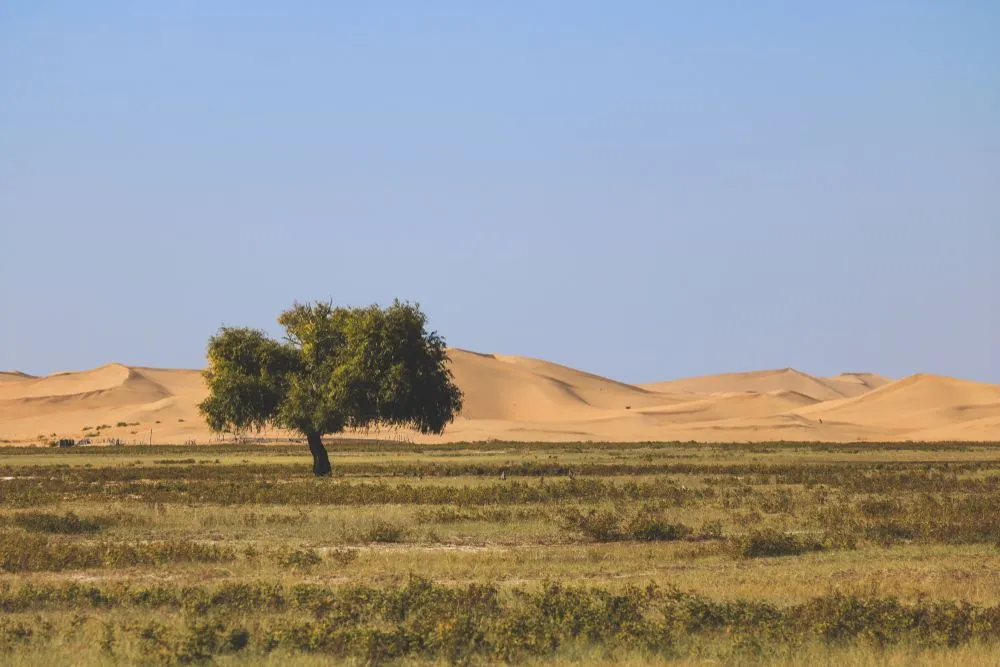
The same study projected that solar and wind farms could also drive an increase in rainfall over the Sahel (a region in Africa that borders the southern edge of the Sahara desert). This sets up a self-perpetuating cycle: the rainfall is used by plants, and the plants transpire, which leads to more rainfall. (It’s worth noting that this is a modeled outcome at a hypothetical Sahara-wide scale, not a measured one yet.)
The other requirement to turn a desert into a forest is fertile soil. Loose sand isn’t great for vegetation, as it has little to no water and doesn’t have enough organic material to facilitate plant growth. Converting arid, desert lands into soil that is capable of supporting life is a challenge.
Adding Pyrogenic Carbon
One way to make the desert soil fertile is by adding pyrogenic carbon. Pyrogenic carbon is nothing but the product of incompletely burnt organic matter. Examples of pyrogenic carbon include charcoal, black carbon, and soot. Recent research has shown that adding sources of pyrogenic carbon is a way to regenerate degraded and infertile soils, bringing them back to fertility (source).
Along with adding pyrogenic carbon, stabilizing the pH, the amount of clay in the soil, and depolluting the soil can all go towards making soil more fertile.
Now, within this fertile soil, plants are ready to grow.
The plants that are used in desert greening projects are often those that love salt. This means that these plants can grow in conditions with high salt concentrations in the water.
If land is being used for agriculture, it is important for sustainable farming practices to be employed. Crop rotation, permaculture, hydroponics, etc., are all key to keeping the soil viable over the long term. In addition to farming practices, intelligent landscaping can drastically reduce or prevent soil erosion, allowing fertile top soil to remain in place.
What Is It Called When Fertile Land Turns Into Desert?
Desert greening is essentially a fightback against a powerful process moving in the opposite direction. When once-productive land in a dry region loses its fertility and slides toward barren, desert-like conditions, that process has a name: desertification.

It is worth clearing up a common misconception. According to the UN Convention to Combat Desertification (UNCCD), desertification is not the natural expansion of existing deserts, but the degradation of land in arid, semi-arid, and dry sub-humid areas. The main drivers are human ones: overcultivation, overgrazing, deforestation, and poor irrigation that leaves salt behind in the soil, all compounded by drought and a warming climate.
The scale is sobering. The UNCCD estimates that more than 12 million hectares of productive land are lost to desertification every year. A vivid historical example is the American Dust Bowl of the 1930s, when years of drought combined with decades of deep plowing that had stripped the native grasses off the Great Plains, sending vast clouds of topsoil billowing across the region (source). Seen in this light, projects like the Great Green Wall are really attempts to run desertification in reverse.
Why Should We Care About Desert Greening?
As mentioned earlier, desert greening is a proposed solution for many of the world’s current environmental concerns.
By adding more green cover, the estimate is that more carbon will be sequestered by plants. This should help mitigate the amount of carbon dioxide in the Earth’s atmosphere, thereby decreasing global warming effects.
Plants also help modulate climatic conditions in the region where they grow. With increased precipitation due to tree cover, as well as solar and wind farms, dangerous conditions like drought can be avoided. Such new growth would also help slow further desertification, which the UN’s convention on the issue defines as land degradation in arid, semi-arid, and dry sub-humid areas caused by climate variability and human activity.
Converting desert land into fertile land also provides benefits for agriculture. Many companies in the agro-tech industry are looking for ways to make farming more sustainable. For countries with desert expanses, desert greening provides an opportunity to increase food yields and potentially cushion future food scarcity.
Desert greening also helps economies. In China, the Kubuqi Desert is currently being greened. There was major desertification in the region, which has caused widespread poverty there. However, since the Kubuqi Ecological Restoration Project, the region is undergoing positive changes.
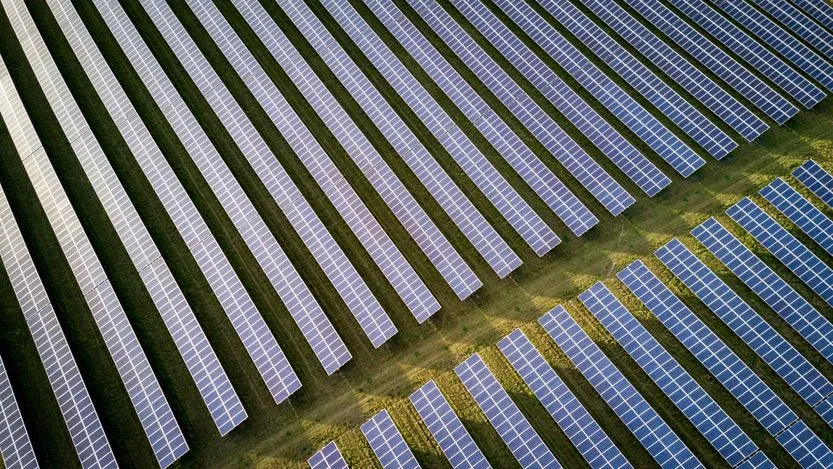
Like the Sahara Forest Project, Kubuqi also has massive solar farms. What began as a roughly 1-gigawatt installation has now ballooned into a multi-gigawatt renewable-energy “megabase”, and China has announced a planned 400-km-long, 5-km-wide “Great Photovoltaic Wall” across the Kubuqi targeting around 100 gigawatts of installed capacity, enough to power tens of millions of homes. The project has also planted special plants that cling to the loose shifting sand, effectively holding it together. This reduces soil erosion and prevents the desertification of other areas.
Unfortunately, where there are pros, there must also be cons.
Some scientists have voiced caution about the loss of desert ecosystems due to desert greening. Desert and semi-arid grassland ecosystems, just like any other ecosystems on Earth, have a critical place in our world. Creating new forests can threaten wildlife that depend on the conditions of a desert.
A case in point is the afforestation efforts of the Yatir Forest in Israel. The project aims to extend the borders of Yatir and prevent desertification of those areas. However, several scientists have pointed out that the extended forest is now encroaching upon dry grasslands that are home to diverse animal life, especially reptiles such as the critically endangered Be’er Sheva fringe-fingered lizard.
Whether the overall benefits outweigh the costs has yet to be seen in many of these projects, but desert greening may be our best idea yet to prevent some of the ills that humans have inflicted on the Earth.
References (click to expand)
- Li, Y., Kalnay, E., Motesharrei, S., Rivas, J., Kucharski, F., Kirk-Davidoff, D., … Zeng, N. (2018, September 7). Climate model shows large-scale wind and solar farms in the Sahara increase rain and vegetation. Science. American Association for the Advancement of Science (AAAS).
- In Israel, Questions Are Raised about a Forest that Rises from .... Yale Environment 360
- Wang, Z. (2020, March 10). Research on desert water management and desert control. European Journal of Remote Sensing. Informa UK Limited.
- From wastewater to oasis: Greening the desert. unenvironment.org
- From wastewater to oasis: Greening the desert. unenvironment.org
- Wang, Y., et al. (2023). Impacts of the world’s largest afforestation program (Three-North Afforestation Program) on desertification control in sandy land of China. GIScience & Remote Sensing.
- China’s largest desert fully encircled with green belt. CGTN, 29 November 2024.
- UNCCD FAQ. United Nations Convention to Combat Desertification.
- Actions to reverse increasing loss of productive lands in the world’s dry regions. UNCCD.
- Dust Bowl: Causes, Timeline and Impact of the 1930s Disaster. HISTORY.