Yes, your weight can vary in different cities in the world due to the different gravitational pulls in those areas. For example, you would weigh less in Colombo, Sri Lanka than in Kathmandu, Nepal because of the different relative gravities in those two cities.
We tend to think of gravity as a standard force that affects every person around the world equally, pulling us down towards the earth at 9.8 m/s2. However, there are actually tiny variations in gravity across the planet, which means that your weight could vary. The same person could weigh more in New York than in Mumbai. Sure, it sounds a bit crazy, but let’s look at some of the main reasons for this gravitational anomaly.
Why Does Weight Change With Location?
1. The Equatorial Bulge
If you’re standing anywhere on the equatorial line, you’re actually about 21 km (13 miles) farther from the center of the Earth than you would be if you were standing at the poles. This difference is due to the equatorial bulge, which is caused by the rotation of the Earth.
At some point in the 17th century, French explorers noticed that the pendulum clocks they used ran faster in the province of French Guiana in South America than they did in France. The reason for this was that the gravitational acceleration was stronger in French Guiana than in France, so the pendulum swung slightly faster, making the clocks speed up. Standing on the equator, you are about 0.5% lighter than at the poles (g drops from roughly 9.832 m/s² at the poles to 9.780 m/s² at the equator), so the closer you are to the equator, the less you weigh, and the faster your pendulum clocks will run.
2. The Surface Of The Earth
If there are ice sheets or breaks in the crust where mantle flows up through on the Earth’s surface, the gravity in that region is usually lower. The Hudson Bay region in Canada is one such region with notoriously low gravity, although the effect is barely noticeable unless measured. There, the Laurentide Ice Sheet once sat kilometers thick and pressed the crust down beneath it. The ice finished melting roughly 8,000 years ago, but the crust it squashed is still slowly springing back, so there is less mass under that region than there otherwise would be, and gravity is correspondingly weaker. That rebound is not the whole story, though. When GRACE satellite data were used to separate the two effects, the leftover ice-age rebound accounted for only about 25% to 45% of the missing gravity. The rest comes from much deeper: cold, dense mantle material sinking beneath the continent, a process running over hundreds of millions of years rather than thousands.
3. Mineral Deposits
Large metallic ore and oil deposits add to the gravitational pull of the Earth and therefore increase the gravitational pull above them. The gravitational analysis is actually an important aspect in the field of mining, as it helps reveal potential mine locations that are rich in heavy metals or oil.
Are You Lighter At The Equator?
If you’re in an elevator accelerating downward, you’ll start to feel lighter as the elevator drops. Similarly, the rotation of the Earth can also reduce the perceived gravity (a measure of acceleration towards the center of the Earth) of a region.
If you’re standing at the equator, your perceived gravity will reduce by approximately 0.35% from the average 9.8 m/s2. This is because the centrifugal force on an object due to the rotation of the Earth is highest at the equator. This is mostly canceled out by the acceleration due to gravity, but the difference between the two is what causes a slight decrease in your weight closer to the equator.
Putting It Together: A Real-World Example
If you’re in Colombo, Sri Lanka, you’ll weigh just a tad bit less than if you’re in Kathmandu, Nepal. The Indian Ocean is one of the lowest relative gravity regions in the world, while the heavy Himalayan mountains increase the gravity in the region, along with other factors, such as distance from the equator. Therefore, if your weight increases slightly after traveling, take a look at this model below and see if it had anything to do with the gravity in the region, or if you just ate a bit too much.
Does Your Mass Change Too, Or Just Your Weight?
Here is the part that trips most people up: your weight wanders around the planet, but your mass stays put. They sound like the same thing, but they are not. Mass is the amount of "stuff" you are made of, the count of atoms in your body, and it does not care where you are standing. NASA puts it simply: mass depends on how many and what kinds of atoms an object contains, while weight is the gravitational force on that object, equal to mass multiplied by the local gravitational acceleration (W = m × g).

So if a bathroom scale in Colombo shows a smaller number than one in Kathmandu, you have not lost any matter. The same atoms are still there. What changed is g, the strength of the local gravitational tug, which means the force pressing you onto the scale is slightly different. That is also why your mass is the honest answer to "how much of you is there?", and why scientists prefer to track mass when they want a figure that travels well. Stand on the Moon and the contrast becomes obvious: your mass is unchanged, yet you weigh only about one-sixth of your Earth weight, because the Moon's gravity is roughly a sixth of ours. For the full breakdown, see our explainer on the difference between mass and weight.
Where Is Gravity Weakest And Strongest On Earth?
If you want to feel as light as physically possible without leaving the planet, head for the summit of Nevado Huascaran in the Peruvian Andes. A 2013 study that mapped Earth's gravity field at ultra-high resolution pinned this peak as the spot with the weakest surface gravity on Earth, at about 9.7639 m/s2. Two things stack up there: the summit sits 6,768 metres (22,205 feet) above sea level, putting you far from Earth's centre, and it lies close to the equator, where the rotational bulge and spin already shave gravity down.

At the other end of the scale, the same study found the strongest pull at the surface of the Arctic Ocean near the North Pole, at about 9.8337 m/s2. There you are near sea level and close to a pole, so you sit nearer the centre of the Earth with almost no rotational lightening. The gap between the lightest and heaviest spots works out to roughly 0.7%, a little larger than the textbook 0.5% you get from a smooth-Earth model, because real mountains and ocean basins exaggerate the effect. In practice that means a 70 kg (154 lb) person would register about half a kilogram (around 1 lb) lighter on Huascaran than over the Arctic. Real and measurable, but never enough to notice without a precise scale.
How Much Would You Weigh On Other Planets?
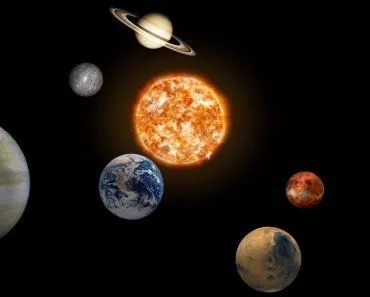
Tiny percentage shifts across Earth are one thing, but leave the planet and the differences become dramatic. Surface gravity depends on a world's mass and radius, so every planet hands you a different weight while your mass stays exactly the same. According to NASA's planetary data, surface gravity runs from about 3.7 m/s2 on Mercury and 3.71 m/s2 on Mars, up to roughly 8.87 m/s2 on Venus, and a crushing 24.79 m/s2 on Jupiter, compared with Earth's 9.8 m/s2. The Moon, smaller still, sits near 1.62 m/s2, about a sixth of Earth's.

Put numbers on it and the spread is wild. If you tip the scales at 45 kg (100 lb) here on Earth, NASA's own comparison says you would weigh only about 17 kg (38 lb) on Mercury, but a hefty 115 kg (253 lb) on Jupiter. Step onto the Moon and the same 45 kg shrinks to roughly 7.5 kg (about 17 lb) on the scale, which is exactly why Apollo astronauts could bunny-hop across the lunar surface in bulky spacesuits. Through all of it, remember the golden rule from earlier: the planet changes your weight, never your mass. The atoms you packed for the trip arrive in full.
References (click to expand)
- Does gravity vary across the surface of the Earth? (Intermediate .... Cornell University
- Chapter 2 - The Earth's Gravitational field. mit.edu
- the shape of the Earth and its gravity field.. The University of California, San Diego
- Weight and Mass. NASA Glenn Research Center
- Hirt, C., et al. (2013). New ultrahigh-resolution picture of Earth's gravity field. Geophysical Research Letters, 40(16).
- Tamisiea, M. E., Mitrovica, J. X., & Davis, J. L. (2007). GRACE Gravity Data Constrain Ancient Ice Geometries and Continental Dynamics over Laurentia. Science, 316(5826).
- Planetary Fact Sheet. NASA NSSDCA.
- Moon Facts. NASA Science.