Table of Contents (click to expand)
A no-fly zone is restricted airspace, usually around war zones, military bases, or sites like the White House, that aircraft are forbidden from entering. Stray in and air traffic control will hail you on guard frequency 121.5 MHz, fighter jets will intercept and rock their wings to signal "follow us," and ignoring those orders can get you escorted to a military airbase, arrested, or in extreme cases, shot down.
Imagine you’re a private pilot. You’re out in your prop plane, enjoying an excursion on a Sunday morning. You get the feeling that it’s a propitious day for a flight (good weather with clear skies). You’re cruising with ease, but all of a sudden, you hear the sound of military jets following you. In no time at all, one jet is right next to your plane. Your heart begins to beat rapidly and you start to wonder what you could have possibly done. Chances are that you’ve trespassed into prohibited airspace, called a no-fly zone.
So, what are no-fly zones and what happens if you trespass one of them in an airplane?
What Is A No-Fly Zone?
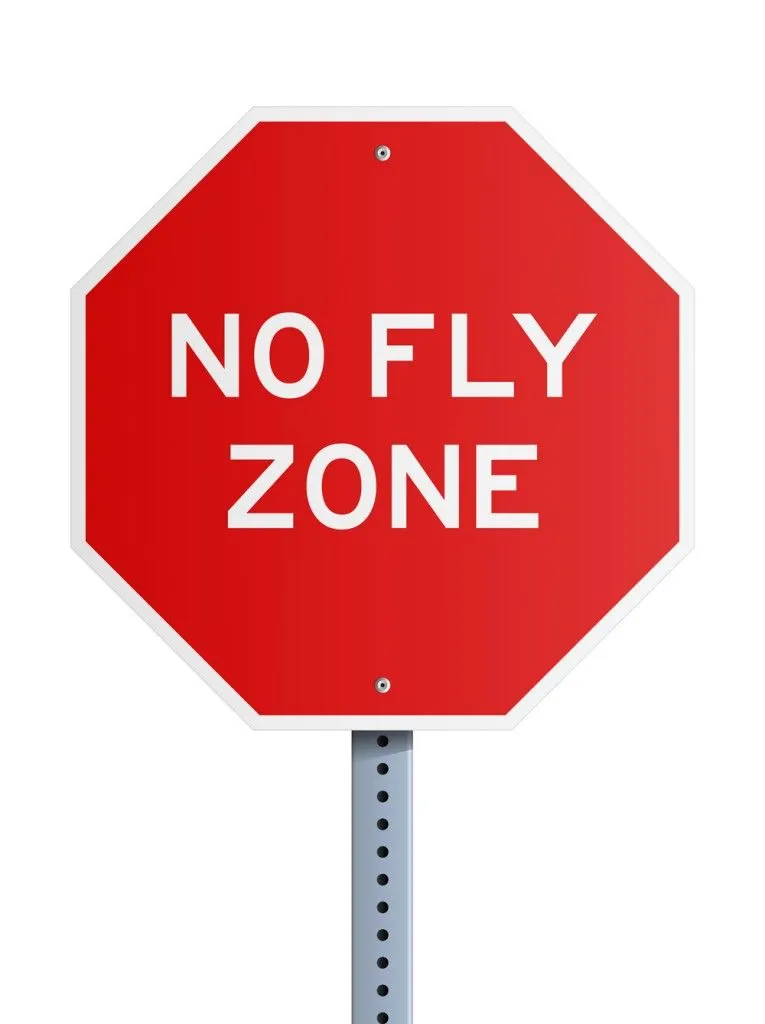
A no-fly zone (NFZ) is a territory over which an aircraft is restricted from flying. NFZs are also called no-flight zones or air exclusion zones.
No-fly zones are typically set up in military contexts and are usually patrolled by fighter jets or other military aircraft. They are generally established with a motive to keep civilian aircraft out of war zones, or to deny an adversary the use of its own airspace. The U.S., U.K., and France enforced no-fly zones over northern and southern Iraq from 1991 to 2003 (operations Provide Comfort, Northern Watch, and Southern Watch); NATO ran a no-fly zone over Bosnia (Operation Deny Flight, 1993–95); and a UN-authorized no-fly zone was enforced over Libya in 2011 (Operation Odyssey Dawn). NATO has so far refused calls to enforce one over Ukraine since Russia’s 2022 invasion, citing the risk of direct great-power conflict.
NFZs are also used to lock down airspace around major events. Britain restricted London’s airspace during the 2012 Olympics under "Atlas Control," with an inner prohibited zone and an outer restricted zone roughly 60 nautical miles (110 km) across, and warnings that intruders could be shot down; China imposed even tighter restrictions for Beijing 2008. Developed nations also keep permanent NFZs around important government buildings. In the United States, prohibited area P-56A covers the White House, the National Mall, and the U.S. Capitol up to 18,000 feet (about 5,500 m), while P-56B sits over the Vice President’s residence at the Naval Observatory.
While the terms regulating a no-fly zone vary by region, in extreme cases an aircraft breaching one can be shot down with just a single warning.
What Happens If You Trespass In A No-Fly Zone?
Unless there’s an emergency, or perhaps you’re simply incompetent, you would not risk flying into a restricted airspace as a pilot.
Warnings
In fact, before entering a no-fly zone, multiple warnings would be sent to you on several radio frequencies cautioning you to retreat. Air traffic control will typically hail you on the VHF emergency “guard” frequency 121.5 MHz (or 243.0 MHz on UHF), which all U.S. pilots are expected to monitor. If you ignore the radio messages, a nearby Air Force base would be alerted of the transgression.
Fighter Jets In Action
At that point, the fighter jets would zoom into action and intercept you. Typically, two fighter jets approach from the rear. One holds station behind you while the other flies around to make visual contact. As a pilot, you are trained in standard flight intercept protocols, and there is really only one option left to dissuade the fighter jets from resorting to anything lethal: do exactly what they tell you.
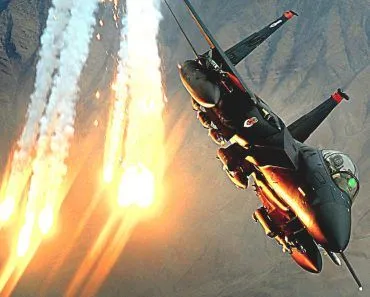
By the FAA’s Aeronautical Information Manual, the interceptor opens with a "Series 1" signal: it pulls up slightly ahead of and to the left of your aircraft, rocks its wings (and, at night, flashes its navigation lights), then begins a slow level turn in the direction it wants you to follow. That means "You have been intercepted, follow me." You acknowledge by rocking your own wings in return and falling in behind the lead jet. Meanwhile, the interceptor crew will try to reach you on guard frequency 121.5 MHz, and you are expected to listen attentively and respond. You are also expected to acknowledge your mistake of intruding into a no-fly zone. If your apology is convincing, the lead jet will guide you out of the restricted airspace toward a nearby air base. If, instead, it suddenly breaks across your flight path and fires off flares, that is the universal "comply immediately, turn now" warning. Ignore it at your peril; the fighter jets will then divert you to the closest military airbase for an urgent landing.
Stern Investigation By Civil Authorities
After landing, military forces are likely to detain you until the civil authorities arrive. Civil authorities will then interrogate you about your trespassing. Depending on the plausibility of your excuse, you might be charged with one or several criminal acts. It can turn out to be a pretty massive mistake on your part as a pilot if you want to continue your piloting career. In the United States, for example, violating a Presidential TFR or the P-56 prohibited area around the White House can draw certificate suspension or revocation, civil penalties, and even criminal prosecution.
Unless authorities are convinced there was a genuine emergency and that you could not avoid entering the no-fly zone despite being warned, they are likely to suspend your pilot’s license either temporarily or permanently.
 So, to summarize, no-fly zones are established in wartime to protect civilians and in peacetime to safeguard the nation’s sovereignty. No matter what the purpose is, as a pilot, it is indispensable to be aware of any local no-fly zones and closely abide by their rules. Otherwise, it might cost you your piloting career or perhaps even your precious life!