The reason that like charges repel and opposite charges attract is because of the way that they interact with each other. Like charges repel because they push each other away, while opposite charges attract because they pull each other towards each other. This is due to the nature of the electric force, which is a force that is exerted between two particles that have either opposite charges or similar charges.
Try rubbing a balloon with a variety of animal furs, such as a woolen sweater or even your own skin. You will likely notice that the balloon will begin reacting differently with the objects surrounding it. If some small bits of paper were placed on a table and the balloon was brought closer and held above the paper bits, then the presence of the charged balloon might create enough attraction for the paper bits to raise off the table. The influence being observed in such an instance is electric force.
The Electric Force And Newton’s Third Law
These electric forces exerted between two oppositely charged particles or similarly charged particles is a force in the same way that gravity, friction, tension and air resistance are forces. Since it is a force, it must follow certain principles and laws. One of the laws that the electric force does follow is the Newtonian Law of Action and Reaction. According to the third law of Newton, a force is simply a mutual interaction between two objects that results in an equal and opposite push or pull upon the respective objects.
Now, by using Newton’s Third Law of Motion, we can describe the movement of both the objects. Object A exerts a rightward push on Object B. Object B exerts a leftward push on Object A. These two pushing forces have equal magnitudes and are exerted in opposite directions of each other. Each object does its pushing upon the other. The push on Object B (by Object A) is directed away from Object A, and the push on Object A (by Object B) is directed away from Object B. Due to the nature of the mutual interaction, the force is said to be repulsive.
Now, let’s apply the same action-reaction principle to two oppositely charged objects, Object C (positive) and Object D (negative). Object C exerts a leftward pull on Object D, and Object D exerts a rightward pull on Object C. Again, each object does its pulling of the other. Just as before, these two forces have equal magnitudes and are exerted in opposite directions of each other. However, in this instance, the direction of the force on Object D is towards Object C, and the direction of the force on Object C is towards Object D. Because both objects move towards each other, a mutual interaction is clear, and the force is described as being attractive.
The Interaction Between Charged Particles And Neutral Objects
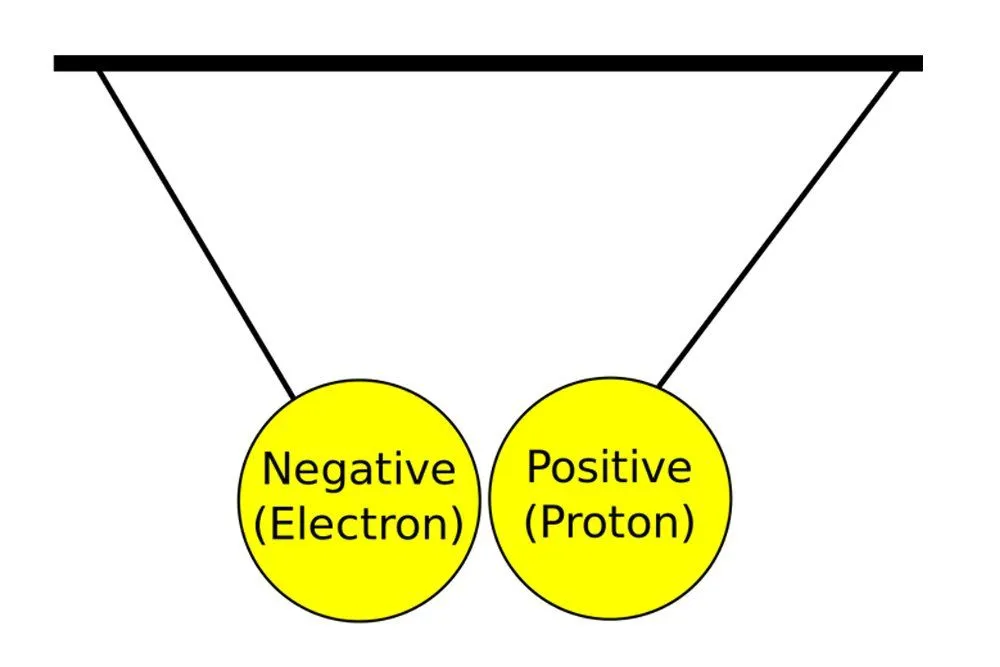
The interaction between two similarly charged objects is repulsive. The interaction between two oppositely charged objects is attractive. However, what type of interaction is observed between a charged object and a neutral object? The answer may actually be quite surprising. Any charged object that is either positively charged or negatively charged will have an attractive interaction with a neutral object. Positively charged objects and neutral objects attract each other, and negatively charged objects and neutral objects attract each other.
This third interaction example between charged and neutral objects is often demonstrated in a simple way. For instance, if a charged balloon is held above neutral bits of paper, the force of attraction for the paper bits will be strong enough to overwhelm the downward force of gravity and lift the bits of paper off the table. If a charged plastic tube is held above some bits of paper, the tube will exert an attractive influence on the paper to lift it off the table. To the bewilderment of many, a charged rubber balloon can be attracted to a wooden cabinet with enough force that it actually sticks to the cabinet! Any charged object (plastic, rubber, or aluminum) will exert an attractive force on a neutral object. Also, as a result of Newton’s law of action-reaction, a neutral object will also attract a charged object.
What Makes The Force Stronger Or Weaker? Coulomb’s Law

So far we have said that like charges push and opposite charges pull, but how hard do they push or pull? That question was settled back in 1785, when the French physicist Charles-Augustin de Coulomb used a delicate torsion balance to measure the force between two charged spheres. The relationship he found is now called Coulomb’s law.
Coulomb’s law says the electric force between two point charges is directly proportional to the product of the two charges and inversely proportional to the square of the distance between them. Written out, it looks like this: F = k|q1q2|/r2, where q1 and q2 are the two charges, r is the distance between them, and k is Coulomb’s constant, about 8.99 × 10⁹ N·m2/C2. The force always acts along the straight line joining the two charges, and (just as in our balloon examples) it is attractive when the charges are unlike and repulsive when they are alike.
Two things fall straight out of that formula. First, pile on more charge and the force grows: double either charge and the force doubles. Second, the distance matters a great deal because of that squared term. Move the charges twice as far apart and the force drops to one-quarter of its old value; bring them ten times closer and the force jumps by a factor of 100. That is why a freshly rubbed balloon snatches at nearby paper but does almost nothing from across the room. So if you ever wonder what would make two oppositely charged objects attract each other more, the answer is simple: give them bigger charges, or bring them closer together. This inverse-square rule has been tested to extraordinary precision, holding to roughly 1 part in 1016 with no known exceptions, even down inside the atom.
How Do Charges Reach Across Empty Space? The Electric Field

There is something slightly uncomfortable about saying two charges simply “pull” on each other across a gap of empty space, with nothing visible passing between them. Physicists were uneasy about this “action at a distance” too, so they introduced a more satisfying picture: the electric field. The idea is that a charge does not reach out and grab a distant partner directly. Instead, it fills the space around itself with a field, and any second charge that wanders into that field feels a force on the spot.
The field has a direction at every point, and that direction is the whole secret. By convention, electric field lines point away from a positive charge and toward a negative charge. A positive test charge always feels a push along the field, while a negative one feels a pull against it. Put a positive and a negative charge near each other, as in the diagram above, and the field lines stream out of the positive charge and curve neatly into the negative one, knitting the pair together. Set down two positive charges instead and their field lines refuse to join, bending away from each other so the two charges are shoved apart. The strength of the field is shown by how crowded the lines are, so the field (and therefore the force) is strongest right next to a charge and fades with distance, exactly as Coulomb’s law demands. If you want to see how a pair of opposite charges sitting side by side behaves as a unit, our explainer on what a dipole is picks up the story.
But Why Do Charges Attract Or Repel At All?

Coulomb’s law and the field picture tell us how charges behave, but you might still be itching for the deeper why. For that we have to leave the world of balloons and pith balls and drop down to the level of individual particles, where the modern theory of the electromagnetic force lives. That theory is called quantum electrodynamics, or QED, and it was worked out in the late 1940s by Richard Feynman, Julian Schwinger and Sin-Itiro Tomonaga.
In QED, the carrier of the electromagnetic force is the photon, the same particle that makes up light. Two charged particles do not really touch or pull on a rope; instead they constantly toss photons back and forth between them, and it is this exchange that is the force. Because these photons are emitted and absorbed in the act of interacting and are never seen directly, they are called virtual photons. The simplest such event is sketched in the diagram above: two electrons approach, swap a single virtual photon, and recoil away from each other, which is exactly what we call repulsion between like charges. When the charges are opposite, the same photon exchange pulls them together instead. It is a strange thing to picture, but this exchange-of-photons model underpins quantum electrodynamics, the most precisely tested theory in all of physics. The same logic explains a puzzle we tackle elsewhere, namely why oppositely charged protons and electrons don’t simply crash into one another.
References (click to expand)
- Electric charges and field | Class 12 Physics (India). Khan Academy
- Electric Charge - Summary - The Physics Hypertextbook. physics.info
- Electric forces - Hyperphysics. Georgia State University
- Coulomb’s Law - College Physics 2e. OpenStax
- June 1785: Coulomb Measures the Electric Force. American Physical Society
- Electric Field - Physics. OpenStax
- Quantum Electrodynamics - The Physics Hypertextbook. physics.info