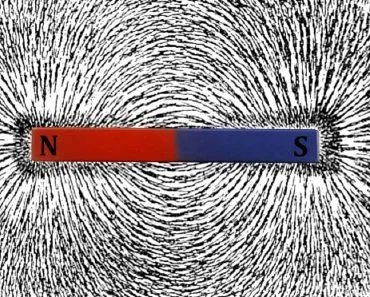
Yes, a magnetic field can deflect a stream of water, but only weakly. Water is a diamagnetic substance: its electrons set up a tiny induced magnetic field that opposes any applied external field, so a magnet repels water. The effect is very small with everyday magnets, but with a strong neodymium magnet held next to a thin stream you can see it bend slightly, and with research-grade superconducting magnets (around 16 tesla) you can levitate water droplets and even live frogs.
Water, along with atmospheric oxygen, is the source of all life on Earth. Water covers about 71% of Earth’s surface and comprises about 60% of the human body. The formula of water is H2O, i.e., each water molecule is composed of two hydrogen atoms and one oxygen atom.
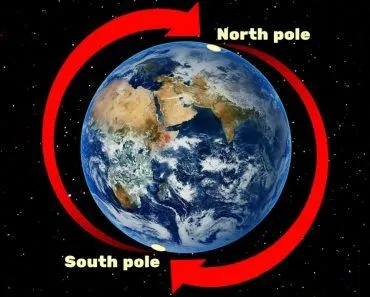
Water is electrically neutral, but it is a polar molecule. A polar molecule contains a positive charge at one end and a negative charge at the other, just like the north and south poles of the Earth.
Magnetism In The Universe
Every object in the Universe possesses a magnetic field, even though it exists at the atomic level for most objects. This is because, in particle physics, a magnetic effect is induced by the spin of all elementary particles, such as atoms and molecules. However, due to the sheer number of such particles, these fields are cancelled out, so the effect of these magnetic fields cannot be felt in everyday life.
Earth, however, is not such a minuscule particle. The Earth’s magnetic field is so strong that it is responsible for the spherical shape of the Moon due to its effects during the Moon’s formation. Furthermore, since water covers 70% of the Earth’s surface, it is critical to study the effects of a magnetic field on water.
Water is diamagnetic in nature. Diamagnetism1 is the phenomenon in which a material repels an external magnetic field due to the formation of an opposing magnetic field within the material. This opposing magnetic field is weak, and lasts only so long as the external magnetic field is applied to the material. Therefore, water, being diamagnetic, is repelled very slightly by a magnetic field. So yes, a stream of water, such as falling raindrops or a river stream, can be deflected by a magnetic field. This is the short answer to the question.
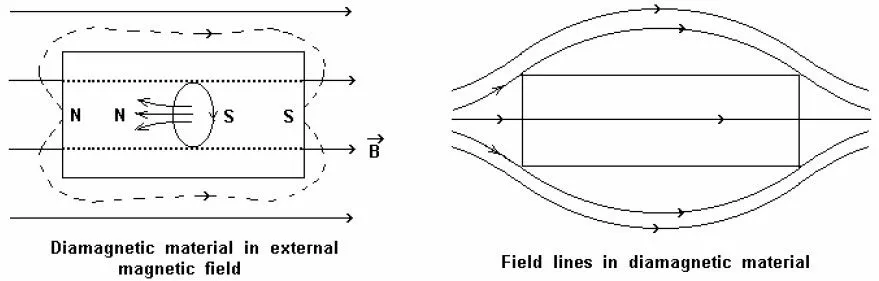
The longer answer to the question takes into account various other factors that decide whether deflecting a stream of water using a magnetic field is practical. As stated above, diamagnetism results in a feeble opposing magnetic field, as compared to the applied external magnetic field, so the deflection induced is very slight. Consequently, if the applied external magnetic field is also of a very low magnitude, the deflection becomes negligible, since it leads to no real change at all. Thus, while some deflection is induced on principle, it does not translate practically.
Now, let’s consider the case of water that contains impurities, such as saltwater. Saltwater contains dissolved salts, such as Sodium and Chlorine, which exist as positively and negatively charged ions. An external magnetic field doesn’t affect stationary charges. Moving charges, however, are deflected by magnetic fields, so a magnetic field will deflect these moving ions in a stream of water. This deflection depends on the charge and nature of the ions, as well as the strength of the magnetic field.
Why Is Water Diamagnetic?
To understand why water pushes back against a magnet, we have to look at its electrons. Magnetism in matter comes mainly from electrons, which behave like tiny spinning magnets. When electrons pair up within an orbital, they spin in opposite directions, so their individual magnetic effects cancel out. A water molecule (H2O) has all of its electrons neatly paired: two bonding pairs shared between the oxygen and hydrogen atoms, and two lone pairs sitting on the oxygen. With no unpaired electrons left over, a water molecule carries no permanent magnetic moment of its own.

So where does the repulsion come from? When water is brought close to a strong magnet, the external field slightly nudges the orbital motion of these paired electrons. In response, the electrons circulate in a way that sets up a weak magnetic field pointing opposite to the applied one, a consequence of the same principle (Lenz’s law) that makes induced currents oppose whatever change creates them. This induced, opposing field is what makes water, and every other diamagnetic1 material, get gently pushed away rather than pulled in.
The effect is genuinely tiny. Water’s magnetic susceptibility is only about −9.05 × 10⁻⁶ in SI units, where the minus sign signals repulsion and the small number shows just how feeble the response is.6 That is why it takes an extremely powerful magnet to make water budge at all, and why a material like iron, whose atoms carry unpaired electrons, responds to magnets millions of times more strongly.
Effect Of A Magnetic Field On A Moving Charge:
The force on a particle of charge q, moving with a velocity v, with an angle of x to the direction of the magnetic field, is calculated using the following formula:
F = q v B (sin x)

So, while it is possible to deflect a stream of water, such as raindrops, using a magnetic field, it is not practical to do so, as the concentration of such ions in the raindrops is far too low to be visibly affected by even the strongest of magnets.
For reference, let’s look at larger streams of water, like a river or an ocean. Due to their volume, these bodies of water contain a high concentration of charged particles in motion. Here, the Earth’s magnetic field causes these ions to get pushed towards separate regions inside the water, creating distinct regions that consist of higher concentrations of positive and negative charges. Similarly, suppose a stream of water is brought under the influence of the magnetic field of a powerful magnet. In that case, it could be deflected, provided that the concentration of ions it contains is sufficient, along with the strength of the magnetic field.
Can Any Magnet Deflect A Stream Of Water?
An important point to note is what kind of magnet you actually need. A strong permanent magnet, such as a Neodymium-Iron-Boron (NIB) magnet, can already bend a very thin stream of water slightly. Neodymium magnets5 are the strongest permanent magnets available, an alloy of neodymium, iron and boron first developed in the 1980s, and their field is locked into the material rather than switched on by an electric current. To generate the far larger fields needed for dramatic effects, however, scientists turn to electromagnets. An electromagnet2 is a magnet whose magnetic field is produced by a flowing electric current. The electromagnet’s strength depends on the magnitude of the current inducing it, a relationship defined by Ampere’s Law3, and this magnetic field disappears as soon as the current stops flowing.

Therefore, electromagnets are generally much stronger than permanent magnets. Since the strength of an electromagnet can theoretically be increased by as much as the magnitude of the current can be increased, there is a point where it will be capable of deflecting a stream of water.
Does Flowing Water Create A Magnetic Field?
Pure water is electrically neutral, so on its own a flowing stream of it does not generate a magnetic field. Natural water, though, is rarely pure. Rivers and, above all, the oceans are loaded with dissolved salts that split into positive and negative ions, and once that salty water begins moving through Earth’s own magnetic field, things get interesting.
As the electrically conducting seawater flows, the Lorentz force pushes its positive and negative ions in opposite directions. This charge separation drives faint electric currents through the ocean, and those currents in turn produce their own weak magnetic field. The signals are small, on the order of a nanotesla at the surface, tens of thousands of times weaker than Earth’s own field, but modern sensors can detect them. Oceanographers actually use these motion-induced fields to measure the speed of ocean currents and to help spot tsunamis.7
So while water itself has no built-in magnetism, moving salt water threading through the geomagnetic field really can create a measurable magnetic signal, a neat mirror image of a magnet deflecting a stream of water.
Does Water Affect Magnets? Do Magnets Still Work Underwater?
People often flip the question around and ask whether water does anything to the magnet itself. The short answer is that water barely affects a magnetic field at all. Because water is only weakly diamagnetic, its magnetic permeability is almost identical to that of empty space, so a magnetic field passes through water essentially unchanged. A magnet held underwater has very nearly the same pull as it does in air, which is why divers and aquarium keepers can count on magnets working perfectly well beneath the surface.

What water can do is attack the magnet as a physical object. The strongest everyday magnets, neodymium (NdFeB) magnets, are roughly two-thirds iron by weight, and iron rusts. Left unprotected in water, and especially in salt water, a bare neodymium magnet corrodes quickly. As it corrodes it can flake and crumble, and any rust that opens up a gap between the magnet and whatever it is holding will weaken its effective grip. This is exactly why almost all neodymium magnets5 are sold with a protective plating of nickel, or sometimes zinc or epoxy, to seal the iron away from moisture.
So a magnet does not lose its magnetism simply by getting wet; the magnetic field itself is unbothered by water. Over a longer period, though, corrosion of the metal can degrade the magnet, so anything used in a wet or marine setting needs a proper waterproof coating.
Fun Fact
If the electromagnet is strong enough, even small creatures made mostly of water, such as frogs and grasshoppers, can be levitated using the same diamagnetic repulsion. In 1997, physicists Andre Geim and Michael Berry did exactly that, floating a live frog inside a magnet producing a field of about 16 tesla at the Nijmegen High Field Magnet Laboratory in the Netherlands.4 The frog was unharmed, and the pair later received an Ig Nobel Prize for the feat in 2000.