A car's passenger-side mirror is convex (it bulges outward), so it shows a wider area but makes objects look smaller. Your brain reads "smaller" as "farther away," so a following vehicle seems more distant than it really is. That is why the mirror warns that objects are closer than they appear.
There is more than one use of a side-view mirror: you can check out how your hair looks (most people do it too, don’t worry) or you can use it to look at some noteworthy feature on the road that your friends pointed at on a long drive.
Oh right, you can also keep track of the vehicles on that side of your car.
It’s a good bet that people sitting in any vehicle spend a decent amount of time looking at the mirror, which always says, ‘Objects in the mirror are closer than they appear.’ Why do all side-view mirrors say that? And what does that warning really mean?
A Safety Warning
The phrase ‘Objects in the mirror are closer than they appear’ is actually a safety warning that is printed or engraved on passenger-side mirrors. It means exactly what it says: the objects (in this case, usually other vehicles) really are closer than they look in the mirror.
In the United States, regulators put that warning only on the passenger side for a reason. Under the federal rear-visibility rule (FMVSS 111), the driver-side mirror has to be flat (or, at most, only very slightly curved), while the passenger-side mirror is allowed to be convex. So if your car has one curved mirror and one flat one, that is by design: the flat driver-side mirror keeps distances honest, while the convex passenger-side mirror trades accurate distance for a wider view, which is exactly why it carries the warning. In much of Europe and elsewhere, both outside mirrors are convex.
You must have observed this many times yourself. When you look at a vehicle in the side mirror and then turn and glance at it directly, you will find that it is much closer than it appeared in the mirror.
How Does This Happen?
The appearance of the objects in the mirror is just another example of how the world of optics works. Perhaps you know this already, but the ‘mirror’ in the side mirror is not just a plain mirror (like the one you have in your bathroom). It is actually a convex mirror, a mirror that bulges outward towards you. Because it has a curved surface (unlike a regular mirror, which has a flat surface), it spreads the reflected light out instead of sending it straight back, which is why physicists also call it a diverging mirror. That curve lets a small mirror cover a much wider slice of the road behind you, but it also changes how images form, which is the key to the whole ‘closer than they appear’ puzzle.
Image Formation In A Convex Mirror
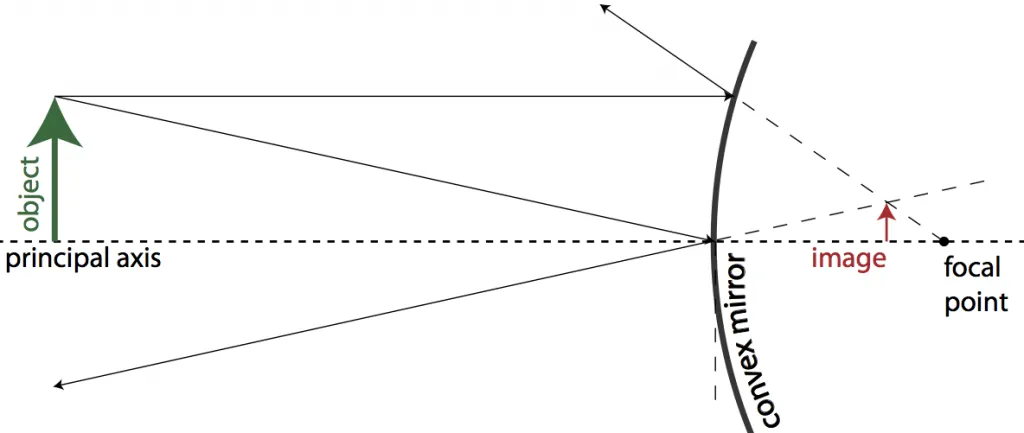
When a light ray from an object hits a convex mirror near its center, its path is barely changed. But because the surface curves away, rays landing toward the edges bounce off at steeper and steeper angles, so the reflected light fans out (diverges) before it reaches your eyes. Your eyes trace those diverging rays back in straight lines, and they only seem to meet at a point behind the mirror. That is where the image appears to sit, so a convex mirror always produces a small, upright, virtual image tucked ‘inside’ the glass.
This is why a car in the side mirror looks like it is sitting ‘further inside’ the mirror, and why its image comes out smaller and more compressed than the real thing. Here is the catch: your brain has no direct way to measure distance from a mirror, so it falls back on a simple rule of thumb. The smaller something looks, the farther away you assume it is. The convex mirror shrinks the image, your brain reads ‘small’ as ‘distant,’ and the following car ends up seeming farther away than it truly is.
To cut a long story short, the shrunken image in the mirror fools your sense of distance, so the object is always closer than that reflection makes it look.
Convex Vs Concave Mirror: Which One Makes Things Bigger Or Smaller?
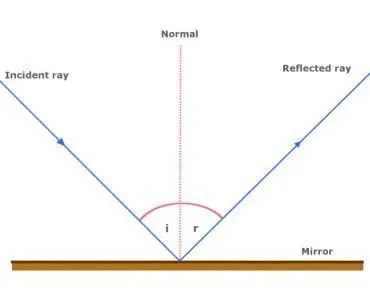
A curved mirror can bulge either way, and the direction of the bulge decides everything. A convex mirror curves outward toward you, like the back of a spoon; a concave mirror curves inward, like the bowl of that same spoon. The two do almost opposite things to light (both still obey the same law of reflection), which is why people so often mix them up.

A convex mirror is the simple one. No matter where you stand, it always makes a smaller, upright, virtual image tucked behind the glass. Move closer or farther away and the image changes size a little, but it stays shrunken and the right way up. That is exactly the behavior the side mirror relies on, and it is why a convex mirror can never make a car look bigger than life.
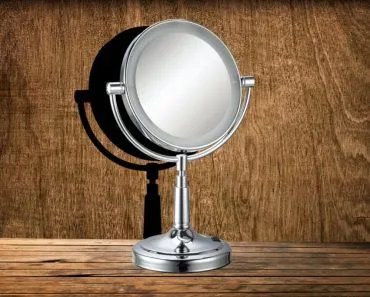
A concave mirror is the moody one, because its image depends on how far the object sits from the mirror. Place an object far away (beyond the mirror's center of curvature) and a concave mirror produces a smaller, upside-down (inverted), real image. Bring the object in closer, to between the center of curvature and the focal point, and the image flips to larger and still inverted. Move it closer still, inside the focal point, and the image jumps to magnified, upright and virtual (the ‘bigger’ reflection you see in a shaving or makeup mirror when your face is right up against it). So the honest answer to ‘does a concave mirror make things bigger or smaller?’ is: it depends on the distance, whereas a convex mirror always shrinks.
That single difference is why your car uses a convex mirror and not a concave one. A convex mirror gives a steady, predictable, shrunken-but-wide view of the road; a concave mirror would magnify, flip and distort the traffic behind you depending on how far back each vehicle happened to be, which is the last thing you want at highway speed.
Why Can’t We Use A Plane Mirror As A Side Mirror?
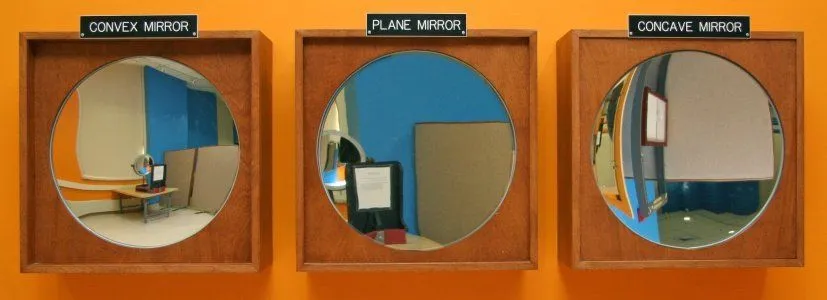
We can, but it wouldn’t be a good idea; a plane mirror shows images of the objects that are right in front of it. In other words, it would definitely show the objects in the mirror at the same distance as they actually are, but it wouldn’t reflect a large area next to the car, leaving a huge (and dangerous) blind spot. A convex mirror, on the other hand, covers a much wider area and has a much smaller blind spot, but comes with the drawback of giving a ‘false distance’.
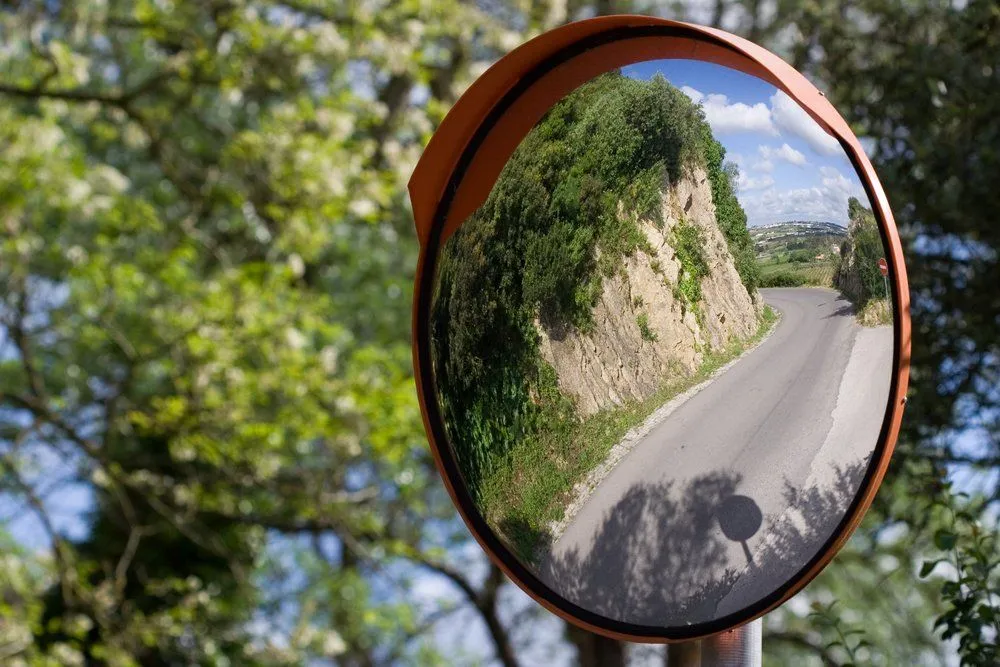
It’s a safety trade-off, but from the overwhelming use of convex mirrors in our automobiles, it seems like the car industry made the right choice. Just be careful out there on the road!
Why Can You See Cars In The Passenger Mirror That The Driver Mirror Misses?
Here is a puzzle a lot of drivers notice: a vehicle pulls up alongside, you catch it clearly in the curved passenger-side mirror, yet it has vanished from the flat driver-side mirror. Nothing is broken. You are watching the difference between a flat mirror and a convex one play out in real time on the same car.
In the United States, that mismatch is written into the rules. Under federal motor vehicle safety standard FMVSS No. 111 (49 CFR 571.111), a passenger car's driver-side outside mirror must be a flat ‘unit magnification’ mirror, while the passenger-side mirror is allowed to be convex. The same standard is the reason for the warning itself: it requires that ‘Each convex mirror shall have permanently and indelibly marked at the lower edge of the mirror’s reflective surface… the words "Objects in Mirror Are Closer Than They Appear."’ The flat driver-side mirror keeps distances honest but shows only a narrow strip of road, so a car drawing level with you can slip into its blind spot. The convex passenger-side mirror sweeps a much wider arc, so it keeps that same car in view (just smaller, and seemingly farther back).
So when something appears in the convex mirror but not the flat one, the convex mirror is simply doing its job: trading honest distance for a wider field of view. The catch is the one the warning is about, that the car you can see is closer than its shrunken reflection suggests. In much of Europe, Australia and elsewhere, both outside mirrors are usually convex, so drivers there get the wide view on both sides, along with the same ‘closer than they appear’ illusion on each.
References (click to expand)
- MJ Flannagan. distance perception in driver-side and passenger-side convex .... deepblue.lib.umich.edu
- (1996) are driver-side convex mirrors helpful or harmful?. deepblue.lib.umich.edu
- Similarities between lenses and mirrors - Physics. Boston University
- Weber, C. O. (1931, April). Visual-Motor Coordination in Concave and Convex Mirror Space. The American Journal of Psychology. University of Illinois Press.
- 2.3: Spherical Mirrors. University Physics III (OpenStax). Physics LibreTexts.
- Image Formation by Convex Mirrors. R. Fitzpatrick, The University of Texas at Austin.
- 49 CFR 571.111. Standard No. 111; Rear visibility (FMVSS 111). Legal Information Institute, Cornell Law School.