The Mystery Spot is a colloquial name given to a peculiar location where the laws and forces of nature, more specifically physics, do not seem to apply. However, it’s important to note that these bizarre occurrences are not the result of magic but rather optical illusions.
In 1929, the Great Depression had a devastating impact on the United States and many other countries. Thousands of industries and businesses were forced to close due to a huge gap between the supply and demand of goods and services.
However, the entertainment industry managed to stay afloat during this time. Many new forms of entertainment emerged, including mystery spots. Although only a few people were familiar with these places, some of them still remain popular today.
In this post, we’ll be taking a closer look at a well-known mystery spot, officially known as “The Mystery Spot,” located near Santa Cruz, California.
The Mystery Spot
This spot artificially creates a fantastic optical illusion, creating a place where the universal laws and forces of nature (physics, specifically) don’t seem to hold up.

While visiting the mystery spot, you will witness various scientifically impossible phenomena, mostly related to defying gravity. These include people standing perfectly upright on a tilted floor, at impossible angles on flat ground, and a ball rolling up a slanted plank.
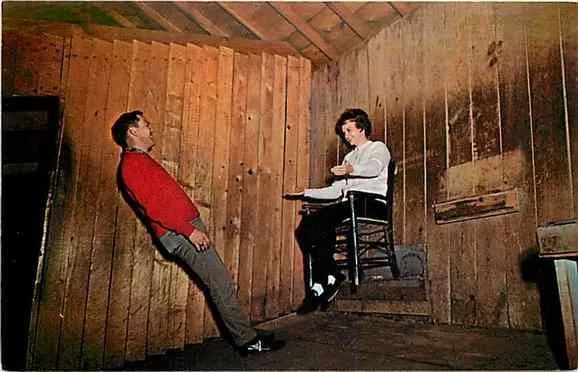
Of course, it is not magic. These bizarre scenes are carefully crafted optical illusions designed to make things appear the way they do.
Science Behind The Mystery Spot
Your own misjudgments of the height and orientation of objects cause the illusions you experience in a gravity-defying house. The house or any place where you see such events is built on an inclination, which may seem absurd at first, but think about it: standing up in a tilted house gives the impression that everything else is wrong.
The inclination of the house is well camouflaged, making it look like a typical, upright house. Constructing such a house on a slope is an ideal step towards creating a mysterious place. Part of the floor can be concealed by burying or covering it with regular household objects. Most things that provide a vertical reference point are removed or placed at an angle.
To make the Mystery House seem even more convincing, they deliberately place physically distorted objects throughout it to reinforce your perception of normality or make you believe you are standing on perfectly flat ground.
Look at the images below: from your vantage point, it is easy to see the person standing at an angle to the horizontal.
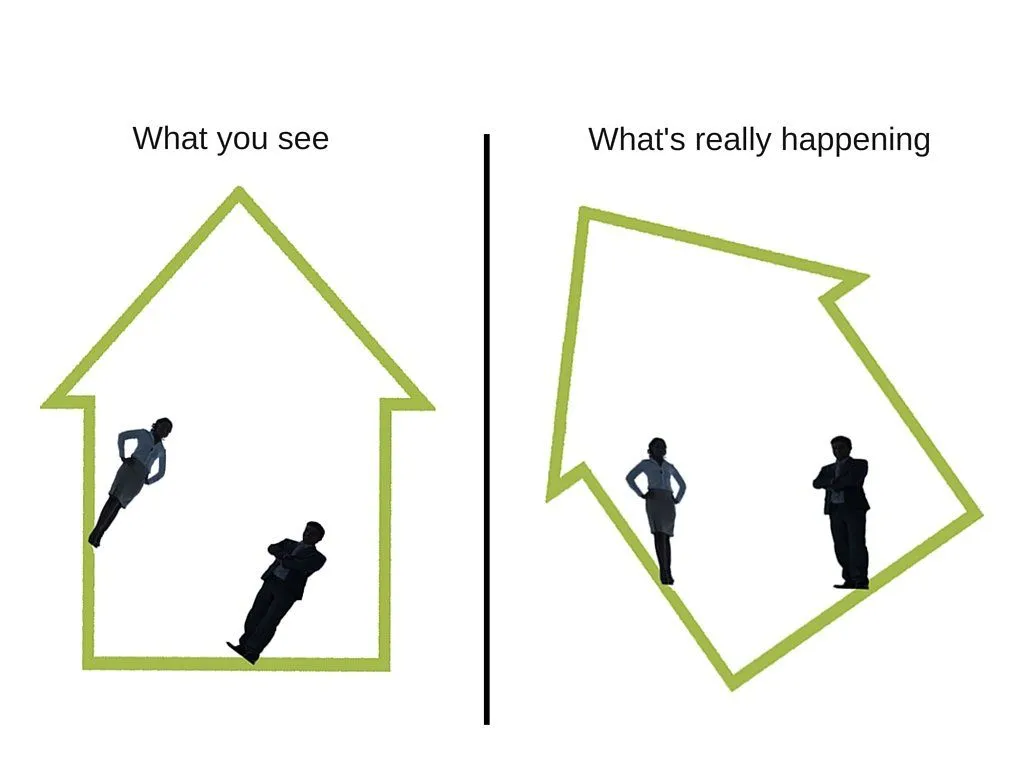
But for the people in the house, the components of the environment that would help them perceive their spatial position correctly are the precise details that prevent them from doing so.
Here’s another example of how water from a regular tap seems to flow against the force of gravity:
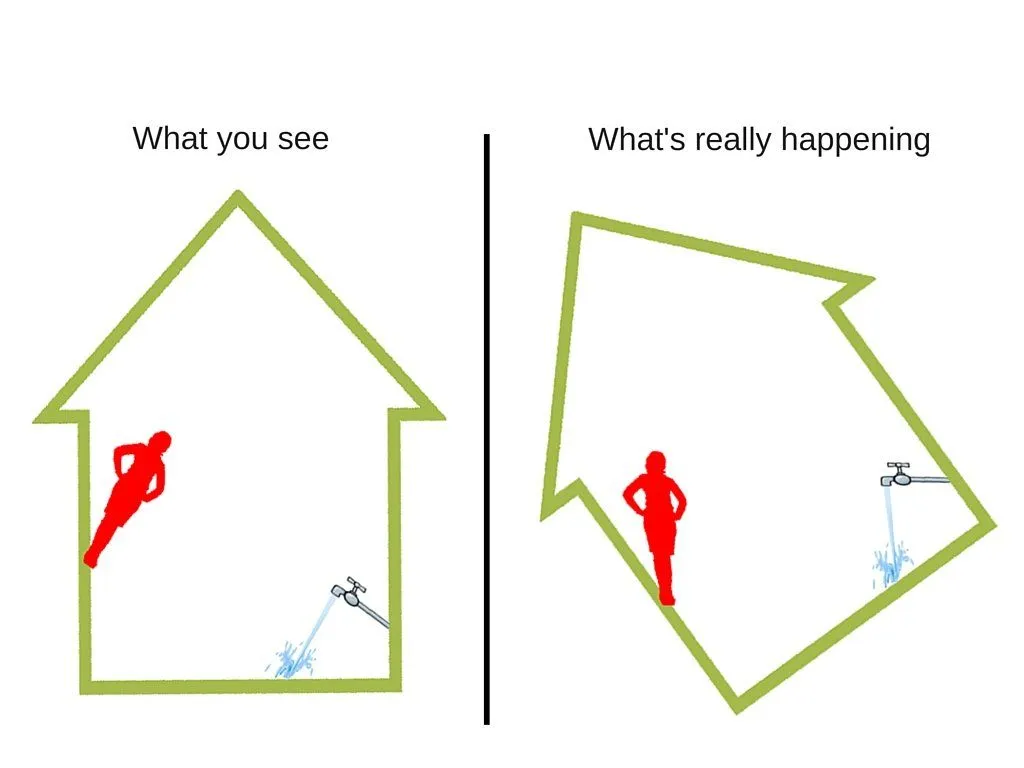
The basic idea is to make landscape alterations with the help of ingenious architectural tweaks to distort viewers’ perception of their own orientation.
Although it’s disappointing to hear that there’s no wizard behind The Mystery Spot at work. On second thought… there kind of is. Aren’t human intelligence and creativity rather magical in themselves?
How Orientation Framing Tricks Your Brain
So why is your brain so easy to fool? The answer is something psychologists call orientation framing. Your visual system doesn’t measure “up” against some absolute cosmic ruler. Instead, it works out which way is vertical and horizontal by reading the lines and edges of the world around you, the walls, the floor, the door frames. Tilt that whole frame, and your sense of true vertical tilts right along with it.

In a 1999 study published in Psychological Science, psychologists Arthur Shimamura and William Prinzmetal showed that a tilted background at the Santa Cruz Mystery Spot makes people misjudge the true horizontal and vertical, and that this single misjudgment is enough to make two people of the same height look dramatically different. They linked the effect to classic lab illusions like the Ponzo and Zöllner illusions, where a misleading frame warps how we read everything inside it. The Mystery Spot, in other words, isn’t a one-off freak of nature; it’s the same trick your eyes fall for on a printed page, just blown up to the size of a room you can walk into.
There’s a second twist, too. UC Santa Cruz psychologist Bruce Bridgeman ran an experiment inside one of these tilted cabins, where an 8 kg (about 18 lb) weight hung from the ceiling on a chain. Seven volunteers pushed it back and forth and rated how hard each push felt on a scale of 1 to 10. Every single one of them reported that pushing the weight toward the visually “vertical” direction felt noticeably harder than pushing it away, even though the actual physical effort was identical. Their expectations, set by the tilted room, literally changed how heavy the weight felt. Your brain doesn’t just see the illusion. It feels it in your muscles.
Why Does the Mystery Spot Make You Feel Dizzy?
Plenty of visitors walk out of a mystery spot feeling queasy, light-headed, or strangely off-balance. That isn’t your imagination, and it certainly isn’t a magnetic field messing with your body. It’s a textbook case of sensory conflict.
Your sense of balance relies on three streams of information working in agreement: your eyes, your inner ear’s vestibular system (which senses gravity and head movement), and the position sensors in your muscles and joints. Normally these all tell the same story. Inside a cleverly tilted room, they don’t. Your inner ear correctly insists that your body is upright and that gravity points straight down. Your eyes, fed a tilted frame with no honest horizon, swear that “down” is somewhere else entirely.

This is the same mismatch that causes motion sickness. According to the StatPearls medical reference, when there is a discrepancy between the expected and actual patterns of vestibular, visual, and muscle inputs, the brain triggers the familiar cascade of nausea, dizziness, sweating, and disorientation. The tilted room hands your brain two contradictory maps of which way is up, and it can’t reconcile them, so it makes you pay for the confusion with a wave of queasiness. The effect fades within minutes of stepping back outside, where the real horizon settles the argument.
Other Famous Mystery Spots Around the US
The Santa Cruz Mystery Spot is the most studied, but it is far from the only one. Gravity-defying attractions like these dotted American roadsides through the mid-20th century, and several are still drawing crowds today.

The granddaddy of them all is the Oregon Vortex in Gold Hill, Oregon, which opened to the public in 1930 around a tilted former mining office. Its popularity is exactly what inspired George Prather to open the Santa Cruz Mystery Spot in 1939. In 1998, the famous skeptic and magician James Randi used photography and simple geometry to show that everything visitors see there, balls rolling “uphill,” people appearing to change height, is the ordinary optical illusion of a tilted reference frame, with gravity left completely intact.
Out in South Dakota’s Black Hills, the Cosmos Mystery Area near Rapid City tells a similar story. Two college students stumbled on its strangely tilted cabin in 1952 and later opened it to the public. Farther east, the Mystery Spot in St. Ignace, Michigan, has been pulling in travelers in the Upper Peninsula since 1953, when surveyors reported their leveling equipment behaving oddly inside a roughly 300-foot circle. The “anomaly,” of course, turned out to be angled ground and tilted buildings, more than enough to send the same illusions into overdrive. Wisconsin’s Wonder Spot and California’s Confusion Hill round out a long list. Every one of them runs on the same physics, or rather, the same predictable misfire in human perception. There is no special “vortex,” no broken gravity, just a tilted room and a brain doing its honest best with dishonest cues.
Last Updated By: Ashish Tiwari
References (click to expand)
- Shimamura, A. P., & Prinzmetal, W. (1999, November). The Mystery spot Illusion and Its Relation to Other Visual Illusions. Psychological Science. SAGE Publications.
- Bridgeman, B. (2005, June). Influence of visually induced expectation on perceived motor effort: A visual-proprioceptive interaction at the Santa Cruz Mystery Spot. Psychonomic Bulletin & Review. Springer Science and Business Media LLC.
- Hill, Sharon A. "Gravity Roads, Magnetic Hills, and Mystery Spots."
- Mystery Spot demonstrates power of perception, UC Santa Cruz psychologist explains. UC Santa Cruz News.
- Motion Sickness. StatPearls. NCBI Bookshelf, National Library of Medicine.
- Mystery Spot. Wikipedia.
- Oregon Vortex. Wikipedia.
- Our Story. Cosmos Mystery Area.
- Mystery Spot, St. Ignace. Pure Michigan (michigan.org).