Table of Contents (click to expand)
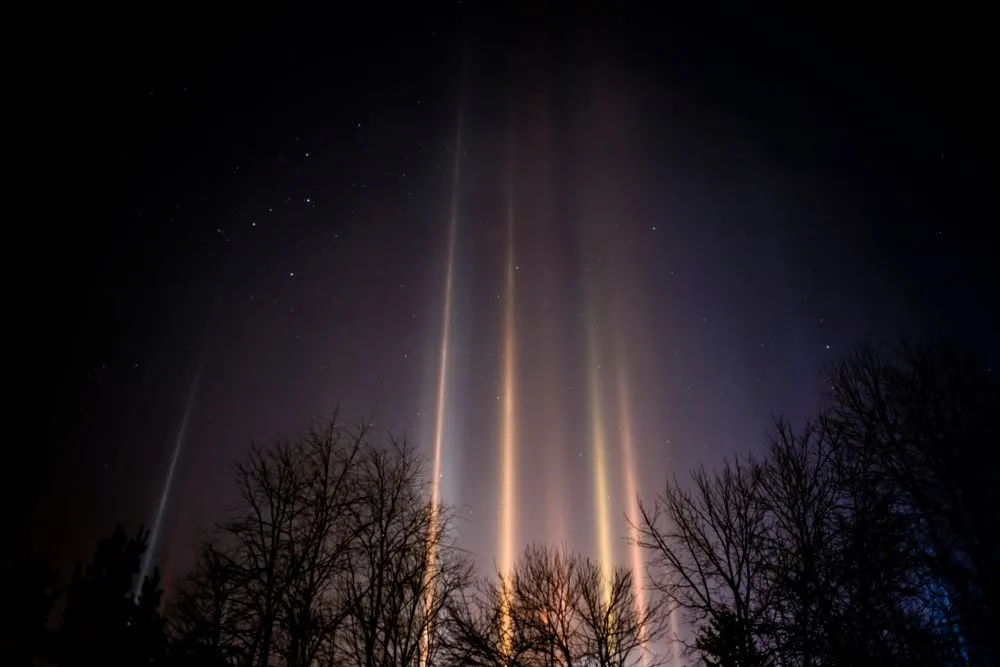
Light pillars are vertical columns of light that appear in the sky on extremely cold, calm nights. They form when flat, plate-like ice crystals drifting in the air settle nearly horizontally and reflect light from street lamps, the Sun or the Moon. Each crystal is a tiny mirror; together, they stack the reflection into what looks like a beam stretching straight up. Despite the look, no actual light is travelling along that column — it's purely an optical illusion.
When the night grows frighteningly dark and the temperature hovers near freezing, you probably can’t even imagine coming out of your house. However, if you’re lucky and take a look outside, you might just see mysterious beams of light stretching up into the sky. These stunningly colorful displays of light may seem supernatural, but they are nothing but simple optical atmospheric phenomena. These types of light pillars have been spotted in many different parts of the world in varying colors, depending on the color of the source light that they reflect.
Nature and its mysterious sources of beauty never fail to surprise us. These light pillars are no exception, but there is even more to learn about these strange visual delights!
How Are Light Pillars Formed?
This truly amazing optical phenomenon is visible only in extremely cold temperatures, when flat hexagonal ice crystals form in the atmosphere. These plate-like crystals orient themselves almost horizontally — flat face down — as they drift slowly through still air. Their collective surfaces act like a giant mirror that reflects the light falling on them, and the resulting reflection extends a certain distance both above and below the light source from the observer's point of view. The denser and larger the ice crystals, the more pronounced this effect becomes.
The light sources involved could be street lights and other ground light sources, or even the sun or moonlight. The angle of the ice crystal surfaces will deviate a few degrees from the horizontal orientation, which causes the light pillar, as it elongates the reflection of light. Thus, these phenomena usually appear as columns of lights to an observer.
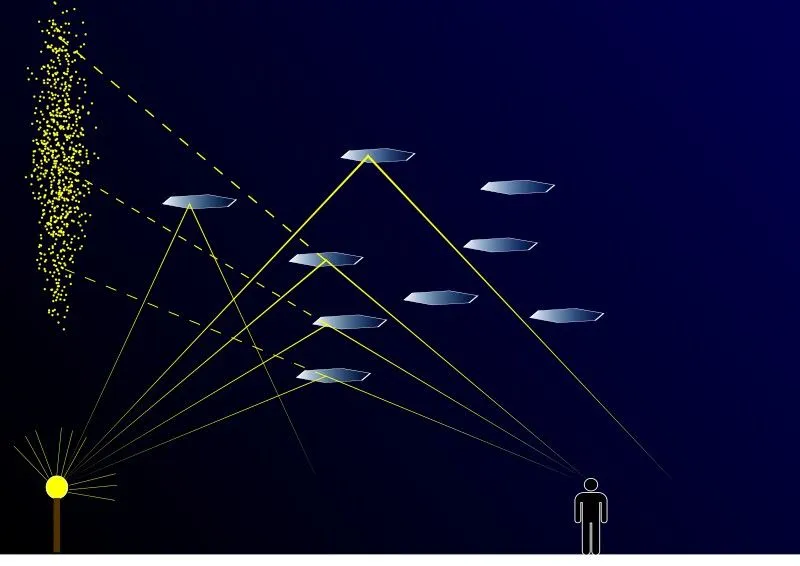
For a light pillar to form, the atmosphere must be calm and cold, with an absence of wind. Although wind is not directly tied to this phenomenon, it will likely disrupt the reflection of light.
Are Light Pillars Just Optical Illusions?
A light pillar is not physically located either above or below a light source. Don't be fooled into thinking they have the properties of an actual light beam just because they look similar. A light beam is a directional projection of light energy from a radiating source such as a lamp or torch — whereas a light pillar is just an illusion created by ice crystals reflecting light back at you. All the ice crystals drifting in the atmosphere reflect the light from the source, but only those tilted at just the right angle within a common vertical plane will direct the reflection toward your eyes. People sometimes assume these are beams of light shooting up into space, but the opposite is true: light travelling up from streetlights, or down from the Sun or Moon, is being reflected back by the ice crystals.
This effect is similar to the reflection of a light source in a body of water. A setting or rising sun often creates a glittering streak of light across the surface of lakes, rivers and oceans — generally called a glitter path. The reflection happens at many points across the rippled water surface, and the reflections that just happen to bounce toward the observer add up to look like a continuous beam of light. Light pillars work the same way, except the "mirrors" are millions of tiny ice crystals suspended in mid-air.
How Rare Are Light Pillars?
Light pillars typically occur in Arctic regions due to the extremely cold temperatures required for such an event and are more common in winter and fall. However, they have also been observed in Iran, where the deserts can get extremely cold at night. On rare occasions, small light pillars may even be seen extending from bright planets like Venus!
They have also been observed in other regions of the world and in different colors, depending on the light source. They can be a basic color when reflected from street lights, but could also be strikingly vivid when they reflect brighter colors. They typically appear soft and gentle when they take up ambient light sources. In any case, light pillars are a visual treat to any observer.
How Are Sun Pillars Different From Sun Dogs?
Sun pillars, sundogs, light pillars… all of these phenomena fall under a family called “halos”. They’re formed by the same factors, namely ice crystals, and light, but they differ in the way they refract or reflect the light. Often, their appearance is fleeting since they require just the right sort of ice crystals falling through the horizon. Also, the clouds must be thin, so that enough amount of light reaches our eyes to witness the wonder. The high-level cirrostratus clouds enhance this phenomenon.
Sun dogs are formed by the refraction of light through ice crystals at exactly 22 degrees. They also form a ring around the sun or moon due to the bending of light (more details here), whereas light pillars are formed when light is reflected off the surface of ice crystals, rather than bending or refraction.
Sun pillars also occur as a result of light reflecting off ice crystals. Since the source in this case is the sun, they are called sun pillars. For sun pillars to be visible, the sun must be low — near or just below the horizon, around sunrise or sunset. The shape, length and width of a sun pillar vary with the sun's position in the sky and the tilt of the crystals. A similar effect is also observed when the moon acts as the light source, producing a moon pillar.
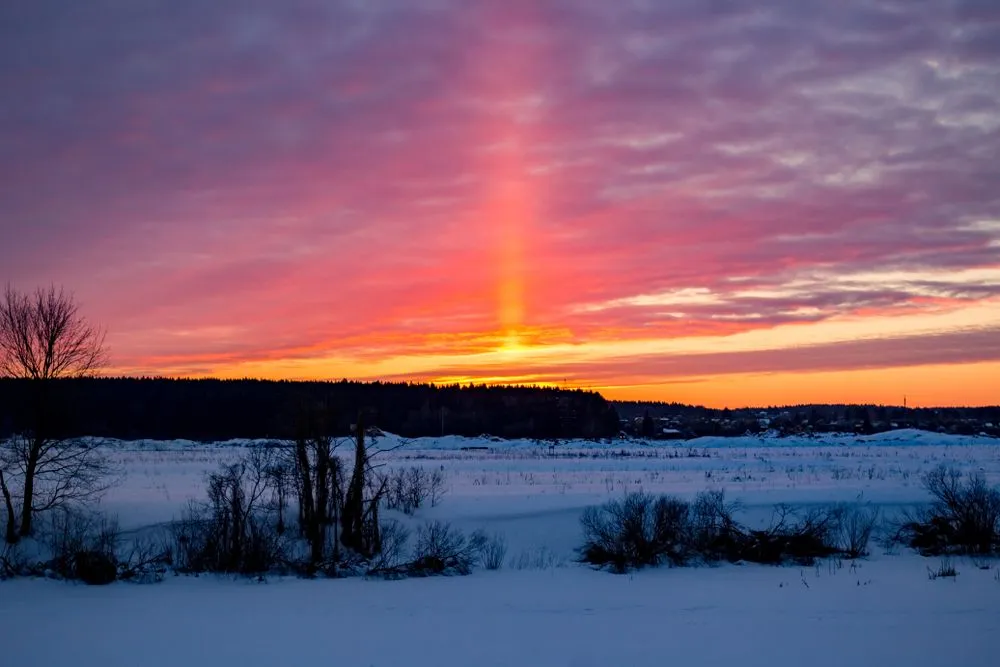
People often confuse this phenomenon with UFOs, as it is quite natural to be scared by an unanticipated beam of light that seems to arise from nowhere. It’s no wonder that some people imagine them to be the lights from an alien ship. Many such false UFO sightings have been reported, particularly near Niagara Falls. The mist around the falls often leads to the formation of ice crystals closer to the ground. These ice crystals reflect off the city lights, creating prominent light pillars that mesmerize observers for miles around.
However, these light pillars are not the evidence of aliens, just a reminder that nature has a unique way of leaving us bewildered with its stunning beauty when we least expect it!
Are Light Pillars The Same As Ice Pillars?
If you have come across this phenomenon described as an ice pillar, don't let the name confuse you: an ice pillar and a light pillar are two names for exactly the same thing. The second name simply gives credit to the tiny ice crystals doing all the work. Most of the time, those crystals are the flat, hexagonal plates we have already met, but on rarer occasions column-shaped (almost pencil-like) crystals can line up and reflect light to build a pillar too.

When the air turns cold enough for these crystals to drift right down near the ground, rather than staying locked inside high clouds, they earn a name of their own: diamond dust. This is a ground-level haze of slowly falling ice crystals that sparkles in any light it catches, and it is exactly the ingredient that lets streetlights throw up their glowing columns. So an ice pillar, a light pillar and a shimmer of diamond dust are all part of the same frosty little drama playing out in the night air.
What Else Could Those Vertical Lights In The Sky Be?
Spotting a bright column standing straight up in the dark can be genuinely startling, and light pillars are far from the only thing that paints strange lights across the night sky. The most common mix-up is with the aurora, or northern lights. The two can even appear on the same freezing night, but they are completely different beasts. An aurora glows high overhead, roughly 100 kilometers (about 60 miles) up in the thermosphere, and forms when charged particles streaming from the Sun collide with oxygen and nitrogen in the upper atmosphere. It spreads across huge stretches of sky in shifting curtains and ribbons of green, red and purple.
A light pillar, by contrast, is a local, low-level affair. It hovers just above a particular light source, borrows that source's exact color, and stays put until the ice crystals drift out of alignment. Searchlights and spotlights cause another common mix-up, but a true beam actually carries light through the air and often sweeps or moves, whereas a light pillar is only a reflection and holds still over its lamp. Once you know that a pillar always sits over a light and copies its color, it becomes surprisingly easy to tell the everyday magic apart from the cosmic kind.
How Can You Spot Light Pillars For Yourself?
Catching a light pillar is mostly a matter of being outdoors on the right kind of night. You want air that is cold and dead calm, with temperatures well below freezing, so that ice crystals can hang in the still air without wind scattering them. Bright, unshielded ground lights help enormously, which is why parking lots, sports fields and the edges of towns tend to be such reliable spots. Regions with long, bitter winters, such as Canada, the northern United States, Scandinavia and Russia, offer the best odds, though a sharp enough cold snap can conjure them almost anywhere.

If it is the Sun rather than a streetlight you are hoping to catch, look for a sun pillar when the Sun sits low near the horizon, either just before sunset or shortly after dawn (it can appear even when the Sun has dipped a little out of sight). These typically stand only about 5 to 10 degrees tall, so a clear view toward the horizon helps. Because the crystals barely move, light pillars are also forgiving subjects for a camera: rest it on something steady for a long exposure, and you can capture the full glowing column even when it looks faint to the naked eye.
References (click to expand)
- Sun Pillars: vertical shafts of light - WW2010. The University of Illinois Urbana-Champaign
- January Phenomenon: The Puzzle of Light Pillars. The University of Notre Dame du Lac
- What Causes Halos, Sundogs and Sun Pillars?. The National Weather Service
- Light pillar - Wikipedia
- What is a sun pillar, or light pillar? - EarthSky
- Light Pillars - Atmospheric Optics
- Aurora - Wikipedia