Salt helps to preserve food by drawing out water and by inhibiting the growth of bacteria.
‘Don’t be salty’ or ‘why so salty?’ isn’t a great comment to receive, but if you happen to be raw meat in a storage unit, waiting to be picked up for someone’s dinner, being salty may be the best thing for you! You probably already know that salt is used to preserve food items like meat, fish and pickles, and are curious about the answers to some other questions. For example… Why is salt used for preservation purposes? How does salt help in the preservation of foods? For those answers and more, read on!
A Brief History Of Salt
Apart from being used to add flavor to food, salt has also played an integral role in world history. Let’s take a trip down memory lane, shall we?
The Egyptians used natron, a naturally occurring salt, in religious rituals and mummification, while the Phoenicians traded salt and salted fish across their Mediterranean network. The Romans valued salt so highly that the Latin word for a soldier’s allowance, salarium, comes from sal (salt), and is the root of the modern English word ‘Salary’ (though the old story that soldiers were literally paid in salt is now considered a myth). The word ‘Salad’ also traces back to salt, from the Latin herba salata, or ‘salted vegetables’. Even the Holy Bible contains references to salt.
Among all of its various uses, people from medieval times found another very important use of salt—to preserve their precious food! This newfound use added to the value and importance of this white granular substance that we now find on every dinner table.
How Does Salt Help In The Preservation Of Food Items?
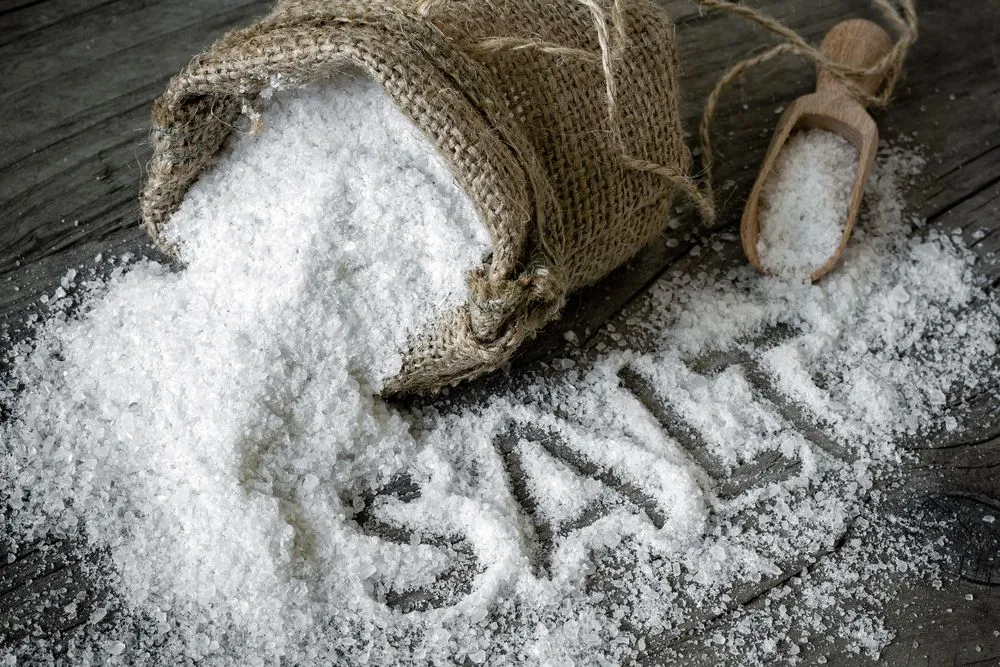
As we already mentioned, the method of adding salt to foods in order to preserve them has been around for centuries. Salting helps to increase the shelf life of certain food items and keeps them safe for future consumption. There are two primary ways in which salt helps in the preservation of food. It does this firstly by drawing out moisture from the food, and also by inhibiting the growth of bacteria and other micro-organisms.
Drawing Out Water (Dehydration)
Osmosis… do you remember that term from your school days?
At some point in our school lives, we all performed the “raisins in water” experiment, right?
A bowl was filled with water and raisins were soaked in the bowl for a few hours. Later in the day, the raisins had swollen up as water moved from the bowl to inside the raisins through their skin. That was the whole experiment. This process of water moving across a semi-permeable membrane (the skin of the raisins in this experiment) from a region of low solute concentration to a region of high solute concentration is called osmosis.
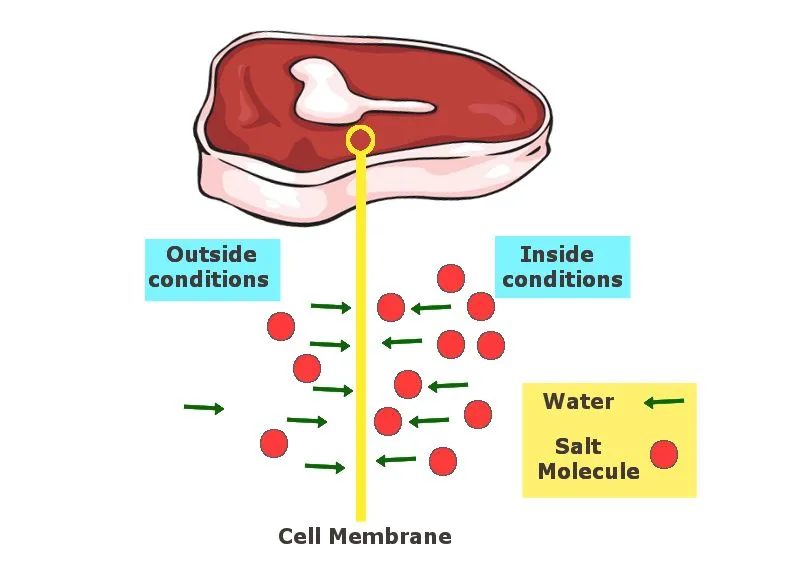
Similarly, salt draws out water from food items and dehydrates them. The salt, either used in solid or liquid form (brine), has the tendency to reach equilibrium with the salt content of the food with which it is in contact. This draws out water from the inside of the food and replaces it with salt. In the absence of water/moisture in the food, food-borne pathogens like Salmonella and other bacteria cannot grow or reproduce. These are the same bacteria that cause food poisoning, along with other serious food-related issues.
Inhibiting The Growth Of Bacteria
Dehydrating the food items alone makes the bacteria’s chance of survival quite bleak. Furthermore, using salt for this purpose makes it even more difficult for the microbes to grow. Salt, chemically known as Sodium Chloride, affects different organisms in different ways.
Based on how micro-organisms react to sodium chloride, they are divided into two categories: Halophiles and Non-Halophiles. ‘Halo’ stands for salt and ‘phile’ for loving. Both words combine to form ‘Salt-Loving’.
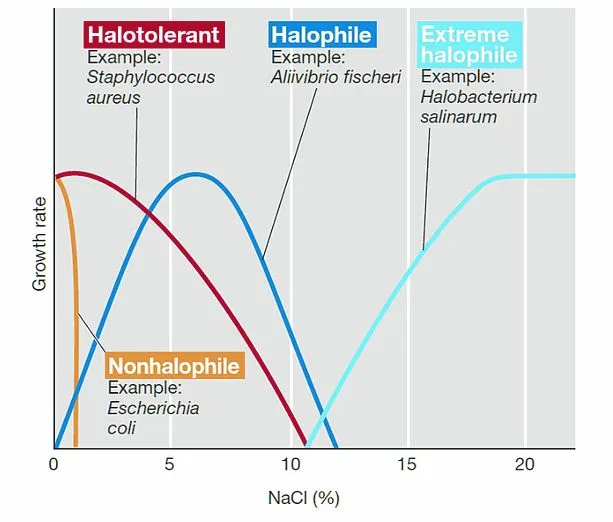
Halophiles are further divided into three types based on their tolerance for sodium chloride: slight halophiles (growing best at roughly 1–5% NaCl), moderate halophiles (5–20%), and extreme halophiles (20–30%). While halophiles love salt, the same environment can be deadly for non-halophiles. Adding salt to a culture of non-halophiles inhibits them from growing. This is also a technique often used by scientists when they want to inhibit the growth of a certain culture medium of non-halophiles. The technique is called ‘selective medium’.
Osmotic Shock
Adding salt to foods causes the microbial cells to experience osmotic shock. This osmotic shock causes them to lose water from cells, resulting in cell death or retarded growth. Some studies also suggest that sodium chloride may limit oxygen solubility inside the microbial cells. It has also been known to interfere with cellular enzymes and forces cells to expend energy to throw out sodium ions from the cell. All of this results in the growth inhibition of the bacteria and ultimately causes their death.
What Is Water Activity, And Why Does Salt Beat Sugar?
So far we have talked about salt ‘drawing out water’, but food scientists prefer a more precise way of describing what is really going on. They measure something called water activity (written as aw). Rather than the total amount of water in a food, water activity captures how much of that water is ‘free’ and actually available for microbes to use. Pure water has an aw of 1.0, while a bone-dry cracker sits close to 0.
Here is the useful part: most bacteria simply cannot grow once aw falls below about 0.91, most yeasts stall below roughly 0.88, and even hardy moulds give up around 0.65. Salt is remarkably good at pushing water activity down. A solution of only about 13% salt by weight already drops aw to around 0.91, whereas you would need a syrupy 55% sugar solution to reach the same point. That is a big reason salt, rather than sugar, became the workhorse of meat preservation.

There is even a name for what happens to a microbe trapped in this salty, hypertonic environment. As water rushes out of the cell by osmosis, the living contents shrink and pull away from the cell wall, a process called plasmolysis. (In animal cells, which have no wall, the equivalent shrivelling is called crenation.) A plasmolysed cell cannot feed, divide or repair itself, so the colony grinds to a halt.
Not every microbe folds so easily, though. Staphylococcus aureus can still grow at an aw as low as 0.86, and Clostridium botulinum, the bug behind botulism, is only held in check once aw drops to about 0.93 or lower. Because many cured meats, especially moist ones, never dry out that far all the way through, they often rely on a second line of defence. That brings us to how meat is actually cured.
How Do You Actually Cure Meat With Salt?
Knowing the chemistry is one thing, but how do people actually turn a fresh cut into something that keeps for months? There are two classic approaches.
Dry curing is the older method: you rub the meat all over with coarse salt (often with a little sugar and spices mixed in) and leave it to rest, wiping away the liquid that seeps out, sometimes for weeks or months. Dry-cured delicacies such as Italian prosciutto, Spanish jamón and American country ham are made this way. A modern, measured version of the technique, known as equilibrium curing, uses roughly 3% of the meat’s weight in salt.

Wet curing, or brining, does the same job by soaking the meat in a strong salt solution, or by injecting that brine straight into it. Because the meat sits in liquid it stays juicier and ends up more evenly seasoned, and the process is usually faster than dry curing. Corned beef, along with many supermarket hams and bacons, is wet cured.
You may have noticed that cured meats are often pink rather than the dull grey you would expect. That colour comes from a companion ingredient: curing salts such as Prague Powder #1, which is ordinary salt blended with about 6% sodium nitrite. Nitrite does two jobs. It locks in that rosy colour by binding to the meat’s myoglobin, and, more importantly, it blocks the growth of Clostridium botulinum, the microbe responsible for deadly botulism. Because nitrite is potent, regulators cap how much may be added; in the United States the limit is 156 parts per million of sodium nitrite for products such as cured sausages. A classic cured ham is therefore a team effort: salt drives down the water activity, while nitrite guards against the one pathogen salt can struggle to fully stop on its own.
Conclusion
These are the two ways in which salt helps to increase the shelf life of various foods, particularly our beloved meat. However, some modern methods like refrigeration have led to a decline in the use of salt as a preservative substance. The major reason for using salt for preservation purposes is because it is non-toxic, inexpensive and easily available. And obviously, because it makes everything taste better!

References (click to expand)
- Preservation and Physical Property Roles of Sodium in ....
- Searing Steak.
- History of Salt.
- Classification of bacteria according to their salt optima.
- Water Activity and its Role in Food Preservation - University of California ANR.
- Water Activity in Food - USDA Agricultural Research Service.
- Plasmolysis - Biology Online Dictionary.
- The Science Of Curing Meats Safely - AmazingRibs.com.
- Dry vs. Wet: How to Cure Any Cut of Meat - Escoffier.
- Clostridium botulinum & Botulism - USDA Food Safety and Inspection Service.