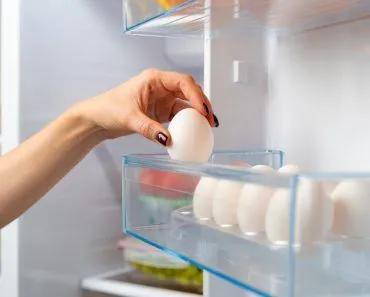
Food in the fridge stays fresh longer because the cold (about 4 °C / 40 °F) sharply slows down both bacterial growth and the enzymatic reactions that ripen and rot food. Bacteria that thrive at body temperature (37 °C) barely divide at fridge temperatures, and ripening enzymes (pectinases, lipases, proteases) slow down too. The food still spoils eventually, just much more slowly.
Fridges are a key element in every kitchen. Almost every household has at least one that is always powered on, working non-stop to preserve everything inside it. We certainly can’t take them for granted, because before refrigerators, people used to bury their food in the snow and hope it wouldn’t be stolen!
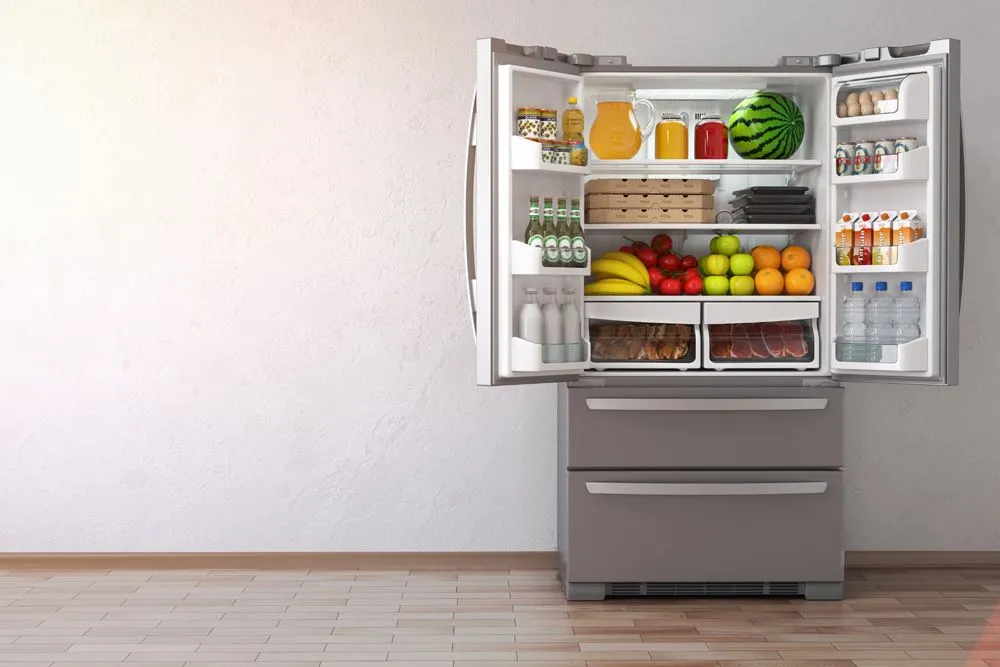
The main reason why fridges are so good at keeping food fresh is because they are designed to maintain a cold environment. Food in cold temperatures stays fresh for longer, which is the secret to refrigeration.
So… why doesn’t food go bad as fast in the cold?
Microorganisms Don’t Grow Well In The Cold
All living things have a preferred temperature at which they like to exist. Take humans, for example, some of us like the cold, while others prefer warmth in the sunshine.
Bacteria and other microorganisms work the same way. They also have a temperature they like best and at which they grow fastest. Bacteria that we come across commonly prefer life at 37°C. Such microorganisms are called mesophiles, meaning that they like mid-range temperatures (20-45°C), neither too hot nor too cold.
Some examples of mesophilic organisms that cause food spoilage are Aspergillus (fungus), Lactobacillus, Leuconostoc, and Pediococcus species (all 3 are bacteria).
The average temperature inside a fridge, however, is 4°C. This is too cold for a bacterium to function effectively.
We often feel lazy and just want to curl up with a good book under a blanket on a cold or rainy day; similarly, bacteria also lose their will to do anything productive. They stop growing as fast as they normally would at such cold temperatures, as most of their energy is used to stay warm.
Thus, at such low temperatures, their growth rate significantly lowers. This is a crucial point, because the doubling time (time taken for a bacterial population to double) can start at about 10 minutes and extend to as long as a day.
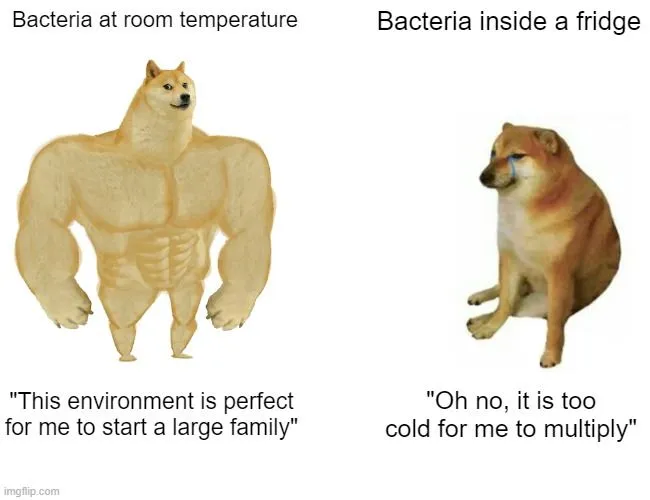
However, this doesn’t mean they don’t grow at all. Food can’t be kept in the fridge indefinitely. I’m sure many of you have seen (and smelled!) opened milk cartons that have gone bad in the fridge.
Remember, bacterial growth has slowed, not stopped.
Does A Fridge Actually Kill Germs?
Here’s a common misconception worth clearing up: the cold doesn’t kill the germs on your food, it just puts them on pause. Refrigeration (and even freezing) is like hitting a giant snooze button on the microbes. The US Department of Agriculture puts it plainly: freezing to 0 °F (-18 °C) inactivates any microbes present in food, but “once thawed, however, these microbes can again become active.” Warm the food back up and the survivors carry on multiplying right where they left off.
That’s exactly why leftovers still have a shelf life, even in a cold fridge. The bacteria haven’t been wiped out; they’ve simply been slowed to a crawl. To actually destroy most food-poisoning bacteria, you need heat, which is why cooking is the real germ-killer, not chilling.

There’s also an unsettling exception to the “bacteria don’t grow in the cold” rule. A small group of cold-loving microbes, called psychrotrophs, are perfectly happy in your fridge. The most notorious is Listeria monocytogenes, a bacterium that causes serious food poisoning and, unlike most pathogens, keeps multiplying at refrigeration temperatures of 38-40 °F (around 3-4 °C), growing even faster once the fridge creeps above 40 °F. Freezing doesn’t finish it off either.
This is why food-safety agencies insist you keep your fridge at or below 4 °C (40 °F) and don’t treat it as an indefinite storage vault. The cold is buying you time, not sterilizing your food.
Food Doesn’t Rot Quickly In The Cold
Apart from slowing down bacterial growth, a fridge’s cold environment also slows down the rotting of fruits and vegetables. Keep a banana long enough and it starts to develop black bruises all over. This isn’t because of a secret banana fight club in your kitchen, but because the banana is over-ripening.
Bananas and other fruits and vegetables are made up of cells that have cell walls. These cell walls are composed of polysaccharides that are broken down by enzymes causing the fruits/vegetables to soften. As these polysaccharides are broken down, the banana gets softer, until the cells are almost completely broken down, and the banana becomes inedible.
The common enzyme culprits responsible for food spoilage are lipases, pectinases and other proteases.
Cold temperatures slow down enzymatic activity and other biological processes responsible for ripening. By keeping fruits and vegetables in the fridge, we basically buy more time before the food begins to rot.
Another example is sweet corn. If you keep it out in the open, it will lose half of its sweetness in a single day, but if kept in the fridge, it can stay fresh for days!
All food is organic, meaning that it will eventually rot, but if kept properly stored in the fridge, it takes longer for it to spoil. This is why so many food items come with an expiration date, along with instructions as to what temperature the food should be stored at.
The Chemistry: Why Cold Slows Spoilage Down
Zoom in far enough and everything we’ve discussed so far, bacteria feeding and dividing, enzymes softening a banana, is really just chemistry. And chemistry has a tidy explanation for why turning down the temperature slows all of it: collision theory.
Reactions only happen when molecules bump into each other hard enough to react. Heat things up and molecules move faster, so they collide more often and with more energy, clearing the “activation energy” barrier that a reaction needs to get going. Cool things down and the opposite happens: molecules slow, collisions become rarer and gentler, and spoilage reactions grind almost to a halt.

Chemists even have a rule of thumb for it, sometimes called the “rule of ten” or the Q10 temperature coefficient: the rate of a reaction roughly doubles for every 10 °C rise in temperature, and halves for every 10 °C drop. For food spoilage, that value is typically around 2. It is only a rule of thumb, not an ironclad law, but it captures the effect nicely.
Run the numbers and the payoff is obvious. Moving food from a roughly 20 °C kitchen counter to a 4 °C fridge is about a 16 °C drop, which slows those spoilage reactions to somewhere near a third of their pace. That single change is what turns “good for a day or two” into “good for the better part of a week”.
Fridges Maintain Humidity Levels
Fridges also come with a way to control humidity levels. Humidity is basically the water vapor present in the air. If there is a lot of water vapor inside the fridge, it can condense to water droplets inside. These small water droplets make excellent minimalistic homes for fungi and bacteria, which can later spoil the food kept inside the fridge.
Does Location Inside The Fridge Matter?
YES! This answer may surprise you, but it’s all based on simple physics.
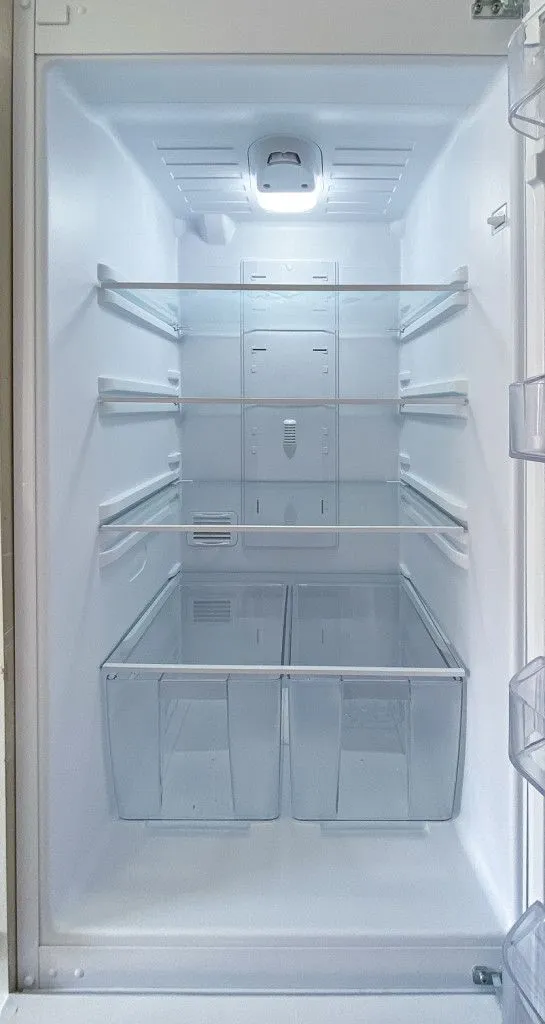
Hot air rises and cold air sinks. A fridge cools the air inside it, so naturally, the slightly warmer air will sit on the top shelves in the fridge, while the coldest air is near the bottom shelves.
Research has found that the temperatures at the top and middle fridge shelves are slightly higher than the bottom-most shelf.
The British Food Standards Agency (FSA) recommends that the top and middle shelves be used to keep all packaged foods like ready-to-eat meals, milk, yogurt and butter. Cooked food should also be kept there.
On the other hand, the bottom shelves should be used to keep uncooked meat, fruits and vegetables. (The raw-meat-at-the-bottom rule isn’t only about the slightly lower temperature; it also stops raw meat juices from dripping onto food below.)
Conclusion
After the first mass-produced fridge was invented in 1913, forever gone were the days of burying food in the snow or storing them in cold caves to last the winter.
The only drawback with using fridges is the electricity consumption. Thanks to technology, we’ve come a long way and have more energy-efficient fridges today. This is critical, as there are about 200 million fridges sold each year! Obviously, it helps if they aren’t power guzzlers.
Household fridges aren’t our only refrigeration sources. Plenty of large-scale refrigeration units are also used in the chemical and pharmaceutical industries to store chemicals, medicines, antibodies, vaccines, and much more.
As you can see, fridges have an incredibly important role to play in our lives. You could say that they are the ‘cold hearts’ that keep our lives going. Plenty of research is focused on making smarter and more energy-efficient fridges because until something more effective comes along, fridges will be an indispensable part of our lives!
References (click to expand)
- Moirangthem, K., & Tucker, G. (2018, April 20). How Do Fruits Ripen?. Frontiers for Young Minds. Frontiers Media SA.
- Food Microbiology. ACS Distance Education (archived)
- Refrigerator and Freezer Storage Chart. US FDA
- James, C., Onarinde, B. A., & James, S. J. (2016, November 30). The Use and Performance of Household Refrigerators: A Review. Comprehensive Reviews in Food Science and Food Safety. Wiley.
- REFRIGERATION AND FREEZING OF FOODS. cold.org.gr
- Microbiology: Canadian Edition – Simple Book Publishing. ecampusontario.pressbooks.pub
- Freezing and Food Safety. USDA Food Safety and Inspection Service (FSIS)
- Foodborne Illness and Listeria monocytogenes. Penn State Extension
- Q10 (temperature coefficient). Wikipedia
- The Effect of Temperature on Reaction Rates. Chemistry LibreTexts