Yes, a microwave can kill bacteria and germs, but only where the food actually gets hot enough. It is the heat, not the microwaves themselves, that does the killing, and food must reach 74°C (165°F) throughout. Because microwaves heat unevenly, cold spots can let bacteria like Salmonella survive.
The invention of the microwave has made life a lot easier, and one is found in almost every household. The microwave produces high-frequency radio waves, or microwaves, that are reflected, transmitted, and absorbed by anything that comes across their path. Those waves make water molecules in the food vibrate, and that vibration is what generates the heat that warms your dinner.
So can that heat kill the bacteria and germs in your food? It can, but with a catch. Heating food to 74°C (165°F) reliably destroys common pathogens like Salmonella, E. coli, and Listeria, and a microwave is perfectly capable of reaching that temperature. The problem is that it rarely does so evenly. A microwave is safe to use if instructions are followed, but it is important to choose when to use a microwave and when to opt for a conventional oven.
Problem Of Uneven Heating In The Microwave
Microwaving food that has been left out can lead to health issues, since bacteria multiply quickly in food kept in the danger zone between 5°C and 60°C (40°F and 140°F). Microwave heat isn’t distributed evenly, so you might occasionally come across cold spots in your food, and that is exactly where the problem begins. Bacteria sitting in a cold spot can survive even when the rest of the dish is steaming hot.
This is why food-safety agencies like the USDA recommend a little extra care with the microwave, especially for dense or meaty food. Microwaves only penetrate the outer 2-3 centimeters (about an inch) of what you put in, so a microwave essentially heats food from the outside in, and the core has to catch up through the slower process of conduction. The combination of heat and radiation penetrates the food differently, as is seen in the study done by Culkin and Fung.
This manner of heating is one reason why pockets deep inside the food might remain untouched by the microwave, creating a suitable environment for bacteria and other microorganisms to ride out the meal. The simplest fix is to stir or rotate the food partway through, let it stand for a minute or two, and then check with a food thermometer that every part has reached 74°C (165°F). The two studies discussed below should help clear up any doubts about how microwave heating affects the bacteria present in food.
The Case Of The Salmonella Outbreak
A study published in the American Journal of Epidemiology analyzed a Salmonella outbreak that occurred due to the reheating of pork in a microwave. Food items, such as meat, if kept un-refrigerated for a long time after cooking, become breeding grounds for bacteria and other microorganisms.
To begin with, you need to choose whether to use a microwave or a conventional oven for reheating meat. If the food has been lying around for a few hours, it is advisable to reheat it in an oven. This was the problem behind a Salmonella outbreak after a community picnic in Juneau, Alaska.
Two roast pigs were delivered to Juneau from a restaurant in Seattle, Washington for the picnic. Pig #2 arrived late and was taken home by many of the guests, who later reheated it in their microwaves. A case-control study indicated that the illness was associated with eating meat from this second pig.
Among the people who took home leftovers and reheated the pork, the contrast was stark: all 10 who reheated it in a microwave fell ill, while none of the 20 who used a conventional oven or a skillet did. The meat was reheated for 3-5 minutes in a microwave with a rotating turntable, and the investigators concluded that microwaving offered no protection at all. One point of concern was that the meat had been transported from Seattle to Juneau in an unrefrigerated cargo plane and reached Juneau after 17-20 hours, owing to a flight delay, giving any Salmonella present plenty of time to grow. Across everyone who ate the pork, 21 of 43 became ill.
The takeaway is not that microwaves are useless against bacteria, but that a few minutes in the microwave could not undo the heavy contamination and uneven heating of an already-spoiled roast. The next study helps explain why some parts of microwaved food end up safer than others.
Presence Of Bacteria In Microwave-cooked Soup
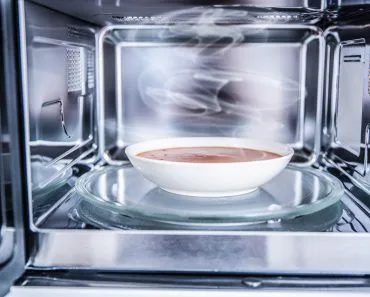
A study was done by Culkin and Fung to check the destruction pattern of Escherichia coli and Salmonella typhimurium in microwave-cooked soup. Cultures of E. coli and S. typhimurium were added into tomato soup, vegetable soup, and beef broth in 3 beakers aseptically.
Temperature-sensitive strips that change from grey to black when the desired temperature had been reached in the soup were added to the 3 beakers.
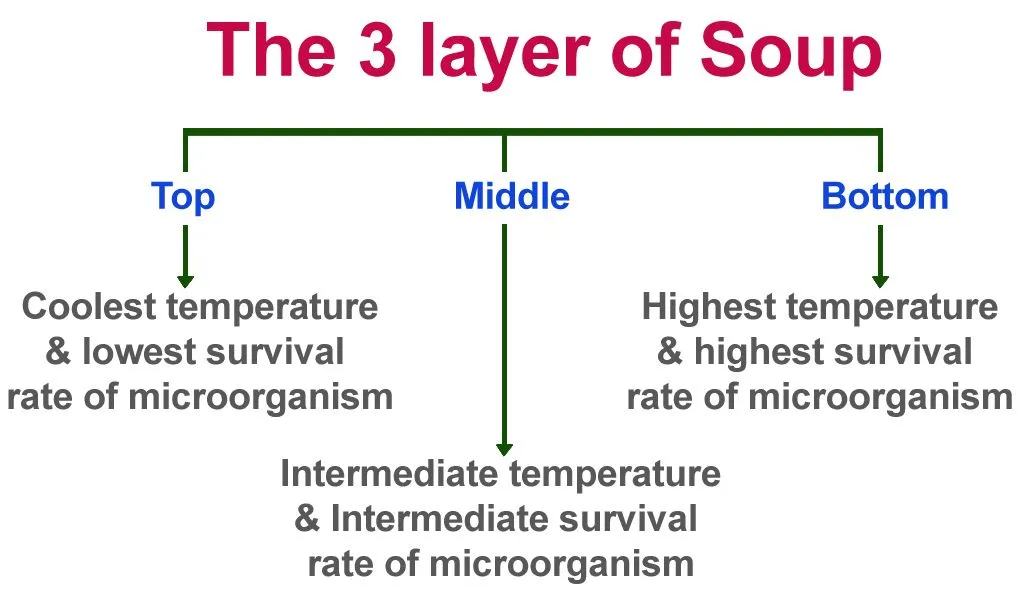
The soup was tested for the survival of any bacterial strains in three regions, namely the top, middle, and bottom. A temperature profile for tomato soup showed that the middle layer reached the highest temperature, the bottom was intermediate, and the top layer stayed the coolest. The graphs plotted for bacterial survival in the three layers showed a very interesting finding: the organisms in the top layer had the lowest survival rate, despite that layer being the coolest. The middle layer had an intermediate survival rate, while the bottom layer had the highest survival of all. The results were similar in vegetable soup and beef broth.
It was observed that the top region of the tomato soup showed no detectable traces of E. coli at 45°C (113°F) or of S. typhimurium at 48°C (118°F), temperatures well below the 74°C (165°F) usually needed to kill them by heat alone. This is the part of the study that has intrigued researchers: if heat were the whole story, the warmest middle layer should have had the lowest survival, not the coolest top layer. The authors suggested that the microwave radiation itself, which is most intense as it enters the food from the top before being absorbed by the layers below, might be contributing to the killing. In other words, the study raised the possibility that factors beyond temperature alone, so-called non-thermal effects, play a role in how microwaves destroy microbes.
It is worth being careful here. The idea of non-thermal microwave effects is still debated, and later reviews have not been able to confirm a destruction mechanism separate from heat. Food-safety authorities like the USDA and WHO take the practical view that it is the heat generated inside the food that kills bacteria, which is why even, thorough heating matters so much. Whatever the exact mechanism, the lesson from Culkin and Fung is the same as the lesson from the Juneau outbreak: a region of food that does not get hot enough is a region where bacteria can survive.
Does A Microwave Kill Viruses And Parasites Too?
When people ask whether the microwave kills “germs,” they usually mean more than just bacteria. Viruses and parasites can hitch a ride on food as well, and the same rule applies to both: it is the heat that does the work, so anything the microwave fails to warm through can survive.
Viruses are destroyed by heat, and thoroughly reheating food to 74°C (165°F) inactivates many of the viruses that cause foodborne illness. Norovirus, the classic culprit behind so-called stomach flu, is a tougher customer. According to the CDC, noroviruses can survive temperatures as high as 63°C (145°F), and the quick steaming often used to cook shellfish will not reliably kill them. Because a virus tucked inside a cold spot is shielded by the food around it, uneven microwave heating is an even bigger problem here than it is for bacteria.

Parasites follow the same logic. Worms such as Anisakis, which live in the flesh of raw marine fish, are killed by cooking to at least 63°C (145°F) or by deep freezing; the CDC lists −20°C (−4°F) for seven days as one safe option. A microwave, though, is not a dependable tool for this job. In laboratory tests, Vidaček and colleagues found that microwaving could kill Anisakis larvae faster than conventional heat when the waves fully penetrated the sample, but they cautioned that ordinary kitchen microwaves leave hot and cold spots and may not reach every part of a thick fillet. That is why, for fish you plan to eat raw or barely cooked, freezing rather than a quick zap is the safeguard food-safety experts recommend.
How Long Should You Microwave Food To Kill Bacteria?
There is no magic number of minutes, and that is the honest answer. How long it takes to make food safe depends on the wattage of your microwave, how dense and how cold the food is, and how much of it you are heating at once. What matters is not the time on the dial but the temperature inside the food, which is why a food thermometer is the only way to be sure.

The USDA advice is straightforward: reheat leftovers until they reach 74°C (165°F), and check with a thermometer in several spots rather than trusting a single reading. Covering the dish helps, since the trapped steam spreads moist heat and cuts down on cold spots, and stirring or rotating the food partway through evens things out further.
One step people often skip is standing time. The USDA recommends letting microwaved food stand for at least 3 minutes after the oven switches off. The molecules that were set vibrating keep releasing heat as they slow down, so the temperature continues to climb and even out during those few minutes, finishing the job in the spots the waves could not reach directly. In short, aim for a temperature, not a timer, and give the food a moment to rest before you dig in.
Conclusion
So, can a microwave kill bacteria and germs? Yes, it can, as long as the heat actually reaches every part of the food. The killing is done by heat, not by some special property of the microwaves, and the magic number to aim for is 74°C (165°F) throughout. The catch is that microwaves heat unevenly, so the safest habit is to stir or rotate your food, cover it, give it a minute to stand, and check it with a food thermometer in a few spots. If you know a food item has been out for a long time and might have been mishandled, it is better to reheat it in a conventional oven, where the heat spreads more reliably, as the Juneau pork showed. So, if you are zapping a fresh bowl of soup because you are eager to get started on your next Netflix series, go for it. But if you’re heating up the leftovers from a summer picnic, you might want to stay loyal to your good old oven and make sure you stay healthy!
References (click to expand)
- CULKIN, K. A., & FUNG, D. Y. C. (1975, January 1). Destruction of Escherichia coli and Salmonella typhimurium in Microwave-cooked Soups. Journal of Milk and Food Technology. International Association for Food Protection.
- Gessner, B. D., & Beller, M. (1994, May 1). Protective Effect of Conventional Cooking versus Use of Microwave Ovens in an Outbreak of Salmonellosis. American Journal of Epidemiology. Oxford University Press (OUP).
- Cooking with Microwave Ovens. Food Safety and Inspection Service. U.S. Department of Agriculture (USDA).
- Radiation: Electromagnetic fields. World Health Organization (WHO).
- Banik, S., Bandyopadhyay, S., & Ganguly, S. (2003, April). Bioeffects of microwave––a brief review. Bioresource Technology. Elsevier BV.
- Norovirus: Facts for Food Workers. Centers for Disease Control and Prevention (CDC).
- Parasites – Anisakiasis. Centers for Disease Control and Prevention (CDC).
- Vidacek, S., de las Heras, C., Solas, M. T., Garcia, M. L., Mendizabal, A., and Tejada, M. (2011, December). Viability and Antigenicity of Anisakis simplex after Conventional and Microwave Heating at Fixed Temperatures. Journal of Food Protection, 74(12), 2119-2126.