Table of Contents (click to expand)
The bloated abdomens of malnourished children are a hallmark of kwashiorkor, a severe form of protein-energy malnutrition. Without enough dietary protein, the body cannot make enough albumin, the main plasma protein that holds water inside blood vessels. Fluid leaks out of the capillaries and pools in the abdomen (ascites) and tissues (edema), producing the distinctive distended belly. An enlarged fatty liver also adds to the swelling.
In the thriving West, corpulence is typically associated with only one thing – excess food… excess fat cells to be more precise. However, pictures of impoverished children living in not-so-thriving nations seem counterintuitive. The children’s appearance run contrary to the most common of adages voiced by parents to guilt-feed their picky children. Malnourishment and a bloated abdomen don’t seem to go hand in hand, so the disturbing images induce what is called cognitive dissonance.
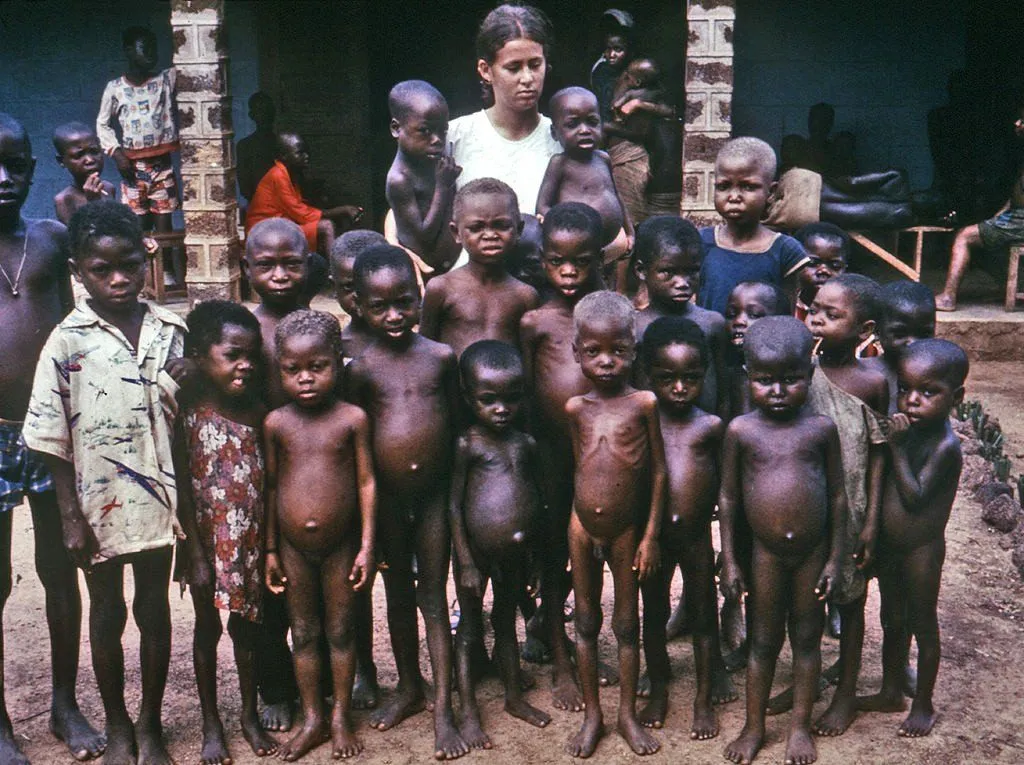
There is no doubt that these children are malnourished. This is evident from their gaunt, twig-like arms and their skin, which wraps their bones so tautly that it seems incapable of being pinched. However, their malnourishment is not like a severe case of anorexia. Malnourishment accompanied by an unusually distended belly is caused by the deficiency of a highly crucial nutrient – protein. This type of malnourishment is known as Protein-energy Malnutrition (PEM).
Kwashiorkor
Undernourished children can be subject to two primary PEMs – marasmus and kwashiorkor. However, it is the latter that leaves children with a swollen abdomen. Kwashiorkor is severe protein-energy malnutrition that is characterized by edema (an unhealthy accumulation of fluids in the cavities of the body) and a liver filled with fatty infiltrates. It is most frequently diagnosed in children dwelling in societies fraught with poverty and famine.
The term was coined by Jamaican pediatrician Cicely Williams, one of the first female graduates of Oxford University and a lauded pioneer in the studies of maternal and child health. Although she had previously introduced it in her academic papers, the word made its first public appearance in a Lancet article written by her in 1935. It is derived from the Ga language of Ghana and roughly translates to “the sickness the baby gets when the new baby comes”. It is named as such because it reflects the development of a condition in an older sibling who is weaned away from breast milk due to the birth of a newborn younger sibling.
Breast milk is an infant’s primary source of protein and amino acids, vital nutrients whose deprivation could gravely threaten physiological and mental development. Despite consuming a diet replete with carbohydrates, it is the scarcity of protein in their diet that makes them a victim of this malady. The children’s calorie intake mainly constitutes the consumption of food like rice, cassava and yams, foods that are rich in carbohydrates, but possess almost no protein. This lack of protein disrupts their lymphatic system.
Liquid Pools
Fluid balance in the body is governed by two opposing pressures inside the capillaries. Hydrostatic pressure (the pressure of blood pushing outward against the capillary wall) tends to force water out into the surrounding tissues. Colloid osmotic pressure, generated mainly by the plasma protein albumin, tends to draw water back into the capillaries via osmosis. Albumin is too big to leak out through the capillary walls, so it acts as a kind of sponge that keeps water in the bloodstream. Any leftover interstitial fluid is mopped up by the lymphatic system, which drains it back into the circulation. In a healthy person, these three systems keep tissues from waterlogging.
In kwashiorkor, the body simply does not have enough amino acids to manufacture albumin, so plasma albumin levels plummet (a condition called hypoalbuminaemia). Without enough albumin, colloid osmotic pressure can no longer pull water back into the capillaries, and fluid leaks out and pools in the abdomen and tissues. This pooled liquid in the abdomen (technically called ascites) makes it bloat outward, while the retained fluid in the tissues spurs edema. Other than edema and a distended abdomen, kwashiorkor patients also suffer from the premature loss of teeth, thinning of hair and depigmentation of the skin. Diagnosis and treatment often leave patients with stunted growth; however, this is much better than a delayed diagnosis, which can be fatal.
Treatment usually entails the reintroduction of a diet that is rich not only in protein, but also in other essential elements, including mineral salts and vitamins. Modern protocols use ready-to-use therapeutic foods (RUTFs) like Plumpy’Nut (a fortified peanut paste developed in 1996), which can be administered at home and have dramatically improved survival in severe acute malnutrition. Research since the 2010s has also pointed to disturbed gut microbiome and oxidative stress as additional factors that may help explain why some malnourished children develop kwashiorkor while equally undernourished siblings develop the wasting form (marasmus). Even so, a dietary deficiency disease can only be treated by adopting a well-balanced diet, something that is currently out of the reach for many of these indigent families.
Kwashiorkor vs. Marasmus: Why Only One Bloats
Earlier we mentioned that severe malnutrition takes two main forms. Only one of them gives a child a bloated belly, and the contrast between the two is the whole reason this question keeps puzzling people. Kwashiorkor is driven by a severe shortage of dietary protein even when calories are roughly adequate. Marasmus, by contrast, is an overall energy famine, a deficiency of everything the body needs, protein and carbohydrate and fat alike.

The two look strikingly different. A child with kwashiorkor often shows bilateral pitting edema, a soft, symmetrical swelling that starts in the feet and ankles and can spread until it puffs out the face and abdomen, sometimes with surprisingly little visible wasting underneath. A child with marasmus shows the opposite: the textbook skin-and-bones look, with sunken cheeks, loose folds of skin and the visible ribs of someone whose body has already burned through its fat and muscle for fuel. The World Health Organization actually uses three yardsticks to diagnose severe acute malnutrition, and any one of them is enough: a weight-for-height score more than 3 standard deviations below the median, a mid-upper-arm circumference under 115 mm, or the presence of bilateral pitting edema. That last criterion is the giveaway for kwashiorkor. Confusingly, a child can have both at once, a mixed picture doctors call marasmic kwashiorkor. The bloat matters as a warning sign, too: the edema, fatty liver and multi-organ stress of kwashiorkor make it the more lethal of the two forms.
Can Adults Bloat From Not Eating, Too?
It is natural to assume this is purely a children-in-famine phenomenon, but the underlying physiology is not picky about age or postcode. Kwashiorkor is, in the words of one case report, "a nutritional syndrome not exclusively found in children in tropical areas." Doctors have documented it in adults with long-standing extreme self-starvation, including a 48-year-old woman with anorexia nervosa in a wealthy country whose abdomen filled with so much fluid that clinicians drained roughly 6.5 liters of ascites; her dangerously low blood albumin returned to normal only after several weeks of careful refeeding.
There is a second, more dramatic way that severe starvation produces swelling, and it strikes precisely when help arrives. When a profoundly malnourished person suddenly starts eating again, the surge of carbohydrate triggers a spike in insulin, which drives glucose, potassium, magnesium and especially phosphate rushing into the body's cells along with water. Blood levels of these minerals can crash, and the body retains sodium and fluid, producing edema, breathlessness and, in the worst cases, heart failure. This is refeeding syndrome, first recognized when starved survivors of the siege of Leningrad and liberated prisoners of war in World War II swelled up and died after being fed too quickly. It is why modern malnutrition protocols reintroduce food slowly and watch electrolytes like hawks.
None of this should be confused with the everyday, harmless bloat a healthy adult feels after skipping meals or fasting. That kind of distension is mostly intestinal gas and gut motility; it comes and goes within a day and leaves no fluid pooling behind. The bloat of kwashiorkor and refeeding syndrome is true fluid retention in the tissues and the abdominal cavity, a medical emergency rather than a passing discomfort.
References (click to expand)
- Kwashiorkor - Wikipedia. Wikipedia
- Why Malnourished People Have Bloated Stomachs. borgenproject.org
- The Bloated Look of the Starving - Indiana Public Media. WFIU
- Severe Acute Malnutrition: Recognition and Management of Marasmus and Kwashiorkor. StatPearls. NCBI Bookshelf
- Kwashiorkor: Definition, Symptoms, Causes & Diagnosis. Cleveland Clinic
- Kwashiorkor: an unexpected complication to anorexia nervosa. BMJ Case Reports
- Refeeding syndrome: an undiagnosed and forgotten potentially fatal condition. PMC / NIH
- Oedema in kwashiorkor is caused by hypoalbuminaemia. PMC / NIH