Table of Contents (click to expand)
The most expensive liquid in the world is scorpion venom (specifically deathstalker venom) at about $10.3 million per litre — roughly $39 million a gallon. The top 10 also includes king cobra venom (~$40,400/L), LSD (~$32,500/L), horseshoe crab blood (~$15,850/L), insulin, Chanel No. 5 perfume, mercury, printer ink, GHB and human blood. Hand-milking, tiny yields, and high medical demand drive these prices.
When the word “expensive” is mentioned, people often imagine a shiny and valuable object made of gold or diamonds. Our brain tends to visualize something solid. However, several other things, in different states of matter, are more expensive than silver or gold.
In this context, let us focus on the state of matter that covers around 71% of Earth’s surface and 70% of the human body—liquids!
List Of Most Expensive Liquids In The World (In Ascending Order)
- Human blood – $400 per liter
- Black printer ink – $720 per liter (typical brand-name cartridge; some premium HP cartridges reach close to $10,000 per liter)
- Mercury – $900 per liter (industrial-grade; laboratory 99.99% purity is closer to $17,500-$20,000 per liter)
- Insulin – $2,500 to $8,200 per liter (US list prices after 2023 industry-wide cuts of about 70-78% and the Inflation Reduction Act's $35/month copay cap for Medicare)
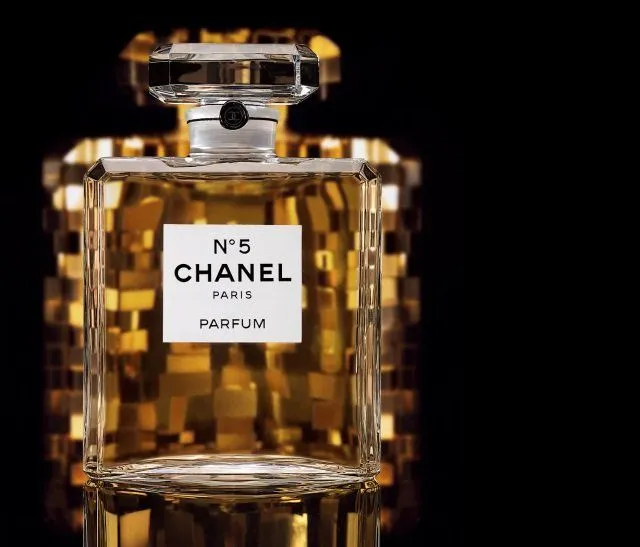
- Chanel No. 5 – $6,900 per liter
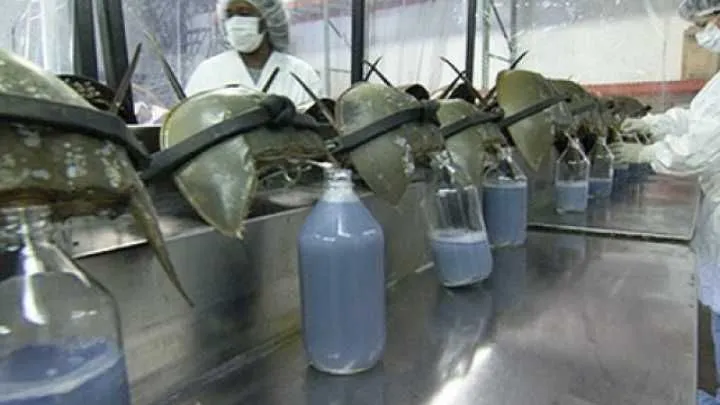
- Horseshoe crab blood – $15,850 per liter
- Lysergic acid diethylamide (LSD) – $32,500 per liter
- King Cobra venom – $40,400 per liter
- Sodium oxybate (medical GHB, sold as Xyrem) – about $40,500 per liter (US wholesale-acquisition cost; illicit street GHB is far cheaper but not a verified market price)
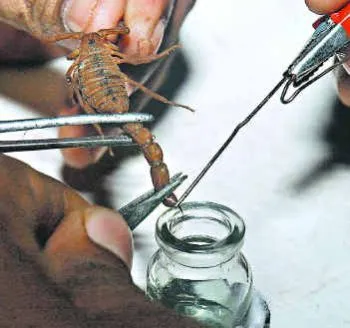
- Scorpion venom – $10,302,700 per liter
Price Comparison Table (Per Liter, Milliliter, Ounce And Gallon)
The same liquid can look cheap or astronomical depending on which unit you read it in. The table below converts each entry above into price per liter, milliliter, fluid ounce (US) and gallon (US), so you can compare them on whichever scale you intuitively use. Conversions assume 1 L = 33.814 fl oz and 1 gallon (US) = 3.7854 L.
| Liquid | Per liter | Per mL | Per fl oz (US) | Per gallon (US) |
|---|---|---|---|---|
| Human blood | $400 | $0.40 | $11.83 | $1,514 |
| Black printer ink (typical) | $720 | $0.72 | $21.29 | $2,725 |
| Mercury (industrial) | $900 | $0.90 | $26.62 | $3,407 |
| Insulin (post-cut US list) | $2,500–$8,200 | $2.50–$8.20 | $73.93–$242.48 | $9,464–$31,041 |
| Chanel No. 5 | $6,900 | $6.90 | $204.06 | $26,119 |
| Horseshoe crab blood | $15,850 | $15.85 | $468.74 | $60,000 |
| LSD | $32,500 | $32.50 | $961.14 | $123,026 |
| King cobra venom | $40,400 | $40.40 | $1,194.77 | $152,930 |
| Sodium oxybate (Xyrem, medical GHB) | $40,500 | $40.50 | $1,197.73 | $153,309 |
| Scorpion venom (deathstalker) | $10,302,700 | $10,302.70 | $304,690 | $39,000,000 |
Scorpion venom dominates by such a margin that it has its own units in many price discussions: a single milliliter (about 20 drops) is worth roughly $10,000, and a gram of dried deathstalker venom has been quoted at $39,000 or more in research-supply listings. Even king cobra venom, second by venom volume, would only fill half a soda can for a price tag higher than a luxury car.
Human Blood
Price: ~$400 per liter (~$0.40 per mL, ~$1,514 per US gallon).
We all have blood running through our arteries and veins. However, despite some people donating it every month for free, it is still quite expensive. When people donate blood directly, it is called ‘Whole Blood.’ Nowadays, however, most blood banks split the whole blood into two or more components, usually red blood cells and plasma. Blood becomes expensive due to the processing that takes place after donation and the amount of work that goes into it.
Even though many people donate their ‘Whole Blood’ for free, the cost of processing it can reach up to $400 per liter.
Black Printer Ink
Price: ~$720 per liter for a typical brand-name cartridge (~$0.72 per mL, ~$2,725 per US gallon); premium HP cartridges reach ~$10,000 per liter.
It sounds absurd, but the ink in an office inkjet really does land on lists of the world's most expensive liquids. Consumer Reports has found that brand-name cartridges cost anywhere from about $13 to $95 per ounce, which works out to roughly $440 to $3,200 per liter. The most expensive cartridge they have measured (one HP 65 tri-color unit) lands closer to $10,000 per liter. Even a mainstream $720-per-liter figure is, ounce for ounce, more expensive than vintage champagne. Two things keep the price up. First, printers are sold at thin margins under a "razor-and-blades" model, and manufacturers earn their profit on consumables. Second, the cartridge is not just a small bottle of dye: the formulation includes specialized pigments, surfactants, and anti-clog chemistry, and on many designs the print head itself is integrated into the cartridge. Refillable ink-tank printers (and aftermarket bottles) deliver the same ink for a fraction of the cost, which is why inkjet printer economics have come under regulatory scrutiny in the U.S. and E.U.
Mercury
Price: ~$900 per liter for industrial-grade (~$0.90 per mL, ~$3,407 per US gallon); laboratory 99.99% purity runs ~$17,500 to $20,000 per liter.
Mercury is the only metal that is liquid at room temperature, with a melting point of -38.83 °C (-37.89 °F). It is also one of the densest common liquids: a single liter weighs about 13.5 kg (29.8 lb), which is why even a small amount in a thermometer feels surprisingly heavy. The price depends a lot on what you are buying. Industrial-grade mercury, historically traded by the standard 34.5 kg "flask," settled around $1,500 to $2,000 per flask in the late 2010s, which works out to roughly $800 to $900 per liter. Laboratory-grade 99.99% mercury costs much more, around $1,300 to $1,500 per kilogram, which is about $17,500 to $20,000 per liter once the density is factored in. Global supply is shrinking under the 2013 Minamata Convention on Mercury, ratified by more than 140 countries, which restricts mining, trade, and the use of mercury in thermometers, batteries, switches, and dental amalgam. That regulatory squeeze, combined with how little legitimate mercury the world still needs, is what keeps it on the expensive-liquids list despite mercury being a relatively abundant element in the Earth's crust.
Insulin
Price: ~$2,500 to $8,200 per liter at post-2023 US list prices (~$2.50 to $8.20 per mL, ~$9,464 to $31,041 per US gallon).
Insulin is the hormone that lets the body's cells take up glucose, and people with type 1 diabetes (and many with type 2) depend on injected insulin to survive. For decades the US list price of brand-name analog insulin drifted steadily upward, peaking at $274.70 for a single 10 mL vial of Eli Lilly's Humalog before three shifts converged. First, the 2022 Inflation Reduction Act capped insulin out-of-pocket costs at $35 a month for Medicare beneficiaries. Then, through 2023, Eli Lilly, Novo Nordisk, and Sanofi each cut US list prices on their flagship insulins by roughly 70 to 78%. Humalog dropped 70%, from $274.70 to roughly $82 a vial, Lilly's non-branded Insulin Lispro Injection was priced at $25 a vial, and Sanofi cut the list price of Lantus by 78%. All three manufacturers extended the $35 monthly copay cap to most commercially insured patients. At today's post-cut list prices, a liter of insulin works out to roughly $2,500 (non-branded Insulin Lispro at $25 a vial) to about $8,200 (branded Humalog after its 70% cut), which is still high enough to rank insulin among the most expensive medical liquids by volume. The reason is not the molecule itself, which is cheap to produce, but a combination of patent thickets on delivery devices, complex regulatory approval for biosimilars, and a US drug-pricing system that has historically rewarded list-price growth.
Chanel No. 5
Price: ~$6,900 per liter (~$6.90 per mL, ~$26,119 per US gallon).
This list mainly includes liquids that are used for medicinal purposes. However, one member of the list is not used as a medicine but for a completely different purpose. Chanel No. 5, one of the most iconic and best-selling perfumes in history, is marketed as the flagship product that has withstood generations of rivals. It was first produced in 1922 through the collaboration of chemist Ernest Beaux and Coco Chanel. Beaux used aldehydes to create an unmistakable and fantastic scent. The cost of this perfume is $6,900 per liter.
Horseshoe Crab Blood
Price: ~$15,850 per liter (~$15.85 per mL, ~$60,000 per US gallon).
Extracting the horseshoe crab’s blood involves catching and ‘bleeding’ the animals, after which they are released. Their blood does not contain hemoglobin but instead has hemocyanin, which makes the color of their blood blue. Their blood is used for the detection of bacterial endotoxins in medical applications. However, in a significant development, the U.S. Pharmacopeia officially approved synthetic alternatives (called Recombinant Factor C, or rFC) for endotoxin detection in May 2025. This could reduce the need to bleed horseshoe crabs by up to 90%, potentially affecting both the price and availability of natural horseshoe crab blood in the future. Cost = $15,850 per liter.
Lysergic Acid Diethylamide (LSD)
Price: ~$32,500 per liter (~$32.50 per mL, ~$123,026 per US gallon).
LSD, also known as acid, is a type of drug known for its psychological effects, including hallucinations, changes in awareness, and paranoia. It is commonly synthesized by reacting diethyl amine with lysergic acid. A single dose of LSD is between 40-500 micrograms, roughly equal to one-tenth the mass of a grain of sand, but that’s enough to send Alice on a trip to Wonderland and back! Cost = $32,500 per liter.
King Cobra Venom
Price: ~$40,400 per liter (~$40.40 per mL, ~$152,930 per US gallon).
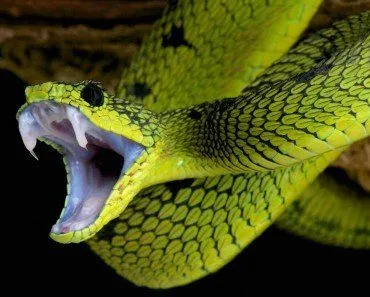
With the potential to kill a full-grown elephant, this venom is one of the deadliest in the world. Even so, people take the risk and harvest this venom, as it contains a very unique protein, Ohanin. Ohanin is best used as the raw material to manufacture a painkiller that is 20 times more potent than morphine without any of its observable side effects. Cost = $40,400 per liter.
Gamma Hydroxybutyric Acid (GHB)
Price: ~$40,500 per liter for medical sodium oxybate (Xyrem) at US wholesale-acquisition cost (~$40.50 per mL, ~$153,309 per US gallon).
GHB is a naturally occurring compound found in the central nervous system and in small amounts in foods like wine and beef. As a regulated medicine, its sodium salt is sold under the brand name Xyrem (sodium oxybate), an FDA-approved treatment for cataplexy and excessive daytime sleepiness in narcolepsy. The legal version is the only reliable basis for pricing it: a 180 mL bottle of Xyrem at 500 mg/mL retails for around $7,300, putting the wholesale-acquisition cost near $40,500 per liter. The lower $660-per-liter figure that circulates in older "expensive liquids" lists refers to illicit street GHB, which is not a verified or comparable market price. Several factors keep the legal formulation expensive: a single-source supply chain through certified specialty pharmacies, the FDA Risk Evaluation and Mitigation Strategy (REMS) program required for dispensing, and intensive patient monitoring. Outside of medicine, GHB is a Schedule I controlled substance in the U.S. due to its history of misuse as a club drug and in drug-facilitated assault.
Scorpion Venom
Price: ~$10,302,700 per liter for deathstalker venom (~$10,302.70 per mL, ~$39,000,000 per US gallon).
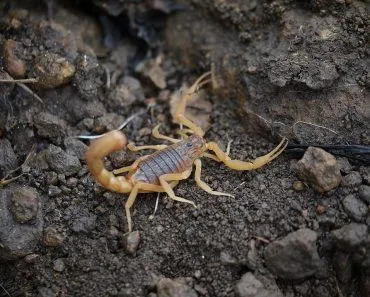
Scorpions have venom, which they primarily use to kill or paralyze their prey. Although they could use brute force to kill their prey, venom is a reliable and handy tool. For humans, the proteins found in scorpion venom are used to treat autoimmune disorders such as rheumatoid arthritis, inflammatory bowel disease, and multiple sclerosis. The cost of one liter of this venom is $10,302,700.
Last Updated By: Ashish Tiwari
References (click to expand)
- Uzair, B., Bint-e-Irshad, S., Khan, B. A., Azad, B., Mahmood, T., Rehman, M. U., & Braga, V. A. (2018, September 6). Scorpion Venom Peptides as a Potential Source for Human Drug Candidates. Protein & Peptide Letters. Bentham Science Publishers Ltd.
- Where the Printer Gets His Ink.
- O'CONNELL, T. E. D., Lily Kaye, and JOHN J. PLOSAY III. "Gamma-hydroxybutyrate (GHB): a newer drug of abuse." American family physician 62.11 (2000): 2478-2482.
- Gorman, Richard. "Atlantic horseshoe crabs and endotoxin testing: perspectives on alternatives, sustainable methods, and the 3Rs (replacement, reduction, and refinement)." Frontiers in Marine Science 7 (2020): 582132.
- Pung, Y. F., Wong, P. T. H., Kumar, P. P., Hodgson, W. C., & Kini, R. M. (2005, April). Ohanin, a Novel Protein from King Cobra Venom, Induces Hypolocomotion and Hyperalgesia in Mice. Journal of Biological Chemistry. Elsevier BV.
- Baskaran, M., et al. "A critical analysis of lysergic acid diethylamide in the present light!."
- Insulin Affordability and the Inflation Reduction Act. ASPE/HHS.
- U.S. Pharmacopeia OKs Synthetic Alternatives to Horseshoe Crab Blood. MBL (2025).
- Pharmaceutical industry must embrace synthetic alternatives. Nature (2024).
- The High Cost of Wasted Printer Ink. Consumer Reports.
- Minamata Convention on Mercury. U.S. Environmental Protection Agency.
- $25 List Price + $35 Copay Caps: Lilly's New Insulin Cost Reductions. Beyond Type 1.
- Lilly Cuts Insulin Prices by 70% and Caps Patient Insulin Out-of-Pocket Costs at $35 Per Month. PR Newswire / Eli Lilly and Company (March 2023).
- Sodium Oxybate. StatPearls. NCBI Bookshelf.
- Xyrem Prices, Coupons, Copay Cards & Patient Assistance. Drugs.com.