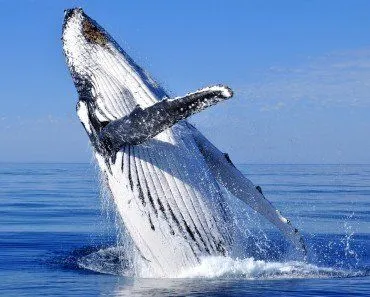
Ambergris is a waxy substance that forms in the intestines of sperm whales around indigestible squid beaks, and is passed out with their feces — so despite the popular nickname “whale vomit”, it is technically closer to whale poop than vomit. Found in only 1–5% of sperm whales, it floats at sea for years, where sunlight and salt water transform it into a fragrant, grey-white substance prized in perfumery as a long-lasting fixative.
When you think of buying perfume, I’m pretty sure whale vomit isn’t the first thing that pops into your mind. However, the perfumers of the world beg to differ. As it turns out, ambergris (whale vomit) is one of the most exotic and expensive fragrances available. Ambergris is worth as much as gold, and at different points in history, it was actually worth three times as much!
Ambergris has been used for its aroma for centuries. In ancient Egypt, ambergris was used as incense. The Chinese called ambergris the “dragon’s spittle fragrance”. During the Black Death in Europe, people believed that carrying ambergris would prevent them from catching the plague. Some cultures considered it an aphrodisiac, while others used it to treat headaches, colds, epilepsy and other diseases.
But what makes whale vomit smell so great? And why does it cost so much?
What Is Ambergris?
Ambergris is a waxy solid substance formed by the secretion of the bile duct in the intestine of a sperm whale. Even though ambergris is regarded as “whale vomit”, it isn’t technically vomit at all — it’s closer to whale poop — and here’s why.
The sperm whale has a multi-chambered stomach (typically three to four compartments) that looks broadly similar to a cow’s, a relic of cetaceans sharing an ancient ancestor with hoofed mammals. Despite the resemblance, sperm whales are obligate carnivores, not true ruminants — they don’t chew cud or ferment plants. Their diet consists mostly of deep-sea squid (including the giant and colossal squid), along with the occasional fish or shark. As food passes from one stomach chamber to the next, the sharp, indigestible beaks of squid form a dense mass that irritates the stomach lining. The whale often vomits this beak-laden slurry straight back into the ocean. This slurry, however, is NOT ambergris.

Some of the undigested squid beaks enter the intestinal tract of the sperm whale. In the gut, the whale’s body produces a waxy substance that wraps around the prickly mass of beaks in order to protect the intestinal lining.
This waxy substance is a fatty mixture of bile-duct secretions, ambrein and feces. As the mass keeps growing, it moves further along the intestinal tract, where it starts obstructing the rectum. It acts like a dam, causing feces to pile up behind it. Most of the time, the whale eventually manages to pass the whole greasy lump out with its stool. In rare cases, marine biologist Robert Clarke hypothesised, the mass grows so huge that it fatally ruptures the rectum on its way out — though this gory exit is a hypothesis, not an established cause of death.
In other words, ambergris is essentially a very large, very long-aged sperm-whale poop — usually passed naturally, occasionally with rather more drama.

Does Ambergris Come From Blue Whales, Or Only Sperm Whales?
Search for “whale vomit” and you will find plenty of people crediting blue whales, the largest animals ever to have lived. In reality, ambergris comes almost exclusively from the sperm whale (Physeter macrocephalus), and only a small share of them ever produce it (estimates put the figure at roughly 1–5% of the population).

The reason comes down to diet. Sperm whales are toothed whales that hunt deep-sea squid, and it is the sharp, indigestible squid beaks piling up in the gut that trigger the waxy secretion in the first place. No squid beaks, no ambergris. Blue whales, by contrast, are baleen whales. Instead of teeth, they have fringed plates of keratin that strain enormous mouthfuls of seawater for tiny, shrimp-like krill. Their meals contain nothing hard or spiky to wrap in ambrein, so a blue whale simply has no raw material from which to build a lump of ambergris.
So if you ever see a perfume described as containing “blue whale vomit”, you can safely raise an eyebrow. The floating treasure is a sperm-whale specialty.
How Does Whale Poop Turn Into An Aromatic Rock?
The freshly defecated ambergris is a black, waxy solid and naturally has a strong fecal odor. It is slightly less dense than the seawater, so it slowly rises above and floats on the water surface for years until it lands on some seashore.
Like a good wine, ambergris has to age well before turning into a poop rock with a lovely smell. While drifting in the sea, the fresh ambergris is baked under the sun, oxidized by the salty water and eroded by the wild tidal waves. Only after undergoing years of chemical hardships does the black whale poop turn into grey, fragrant ambergris.
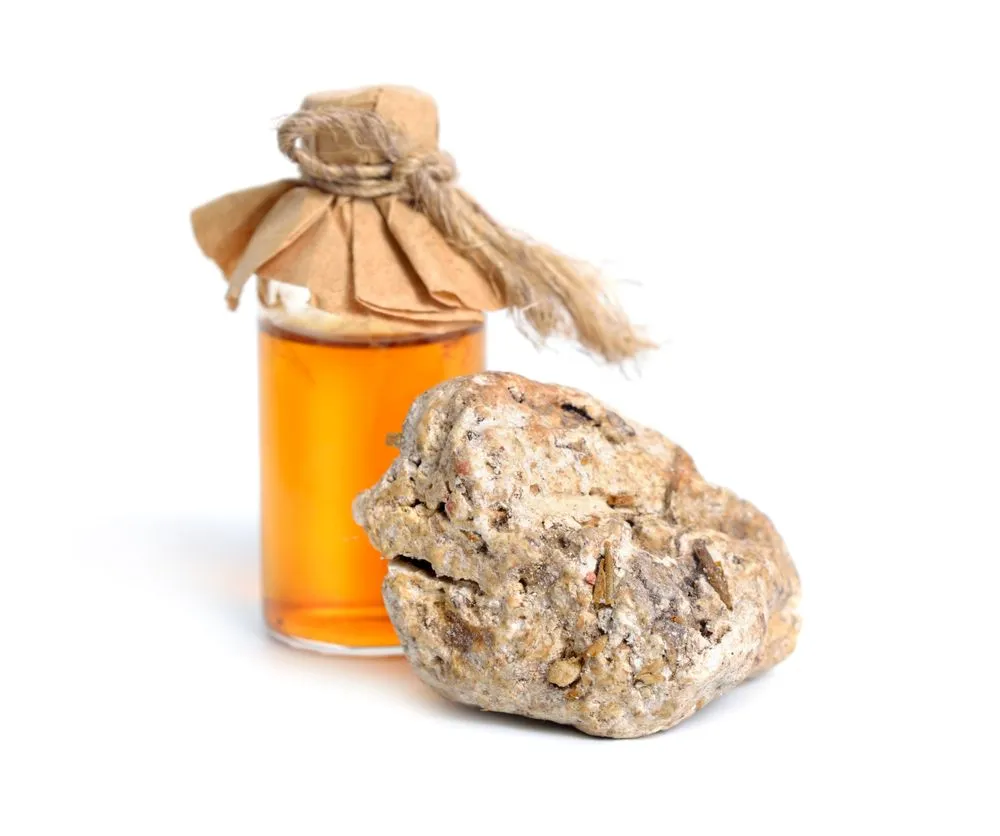
Chemically, ambergris is dominated by ambrein — a triterpene alcohol (C30H52O) derived from squalene — alongside steroids like epicoprostanol and coprostanone (a reminder of its fecal origins). Curiously, ambrein itself is virtually odorless. The famous fragrance only appears as the lump bobs around at sea: years of sunlight, oxygen and salt water slowly break ambrein down into smaller, intensely aromatic molecules — most notably ambroxide (ambroxan) and ambrinol — which are the real source of that prized scent.
How Does Ambergris Smell?
For centuries, people have struggled to give a unanimous answer to that question. Behind every aroma there are many complex chemicals at play, and ambergris has its own quirky cocktail of them. The trouble is that nothing else really smells quite like it — there is no easy point of reference for the odor — which is exactly what makes ambergris such a novelty in the perfumer’s arsenal.
To make things even more complex, the presence of adulterants complements the aroma of ambergris. Some ambergris has a slight undertone of tobacco, seawater, feces, vanilla, hay or damp earth.
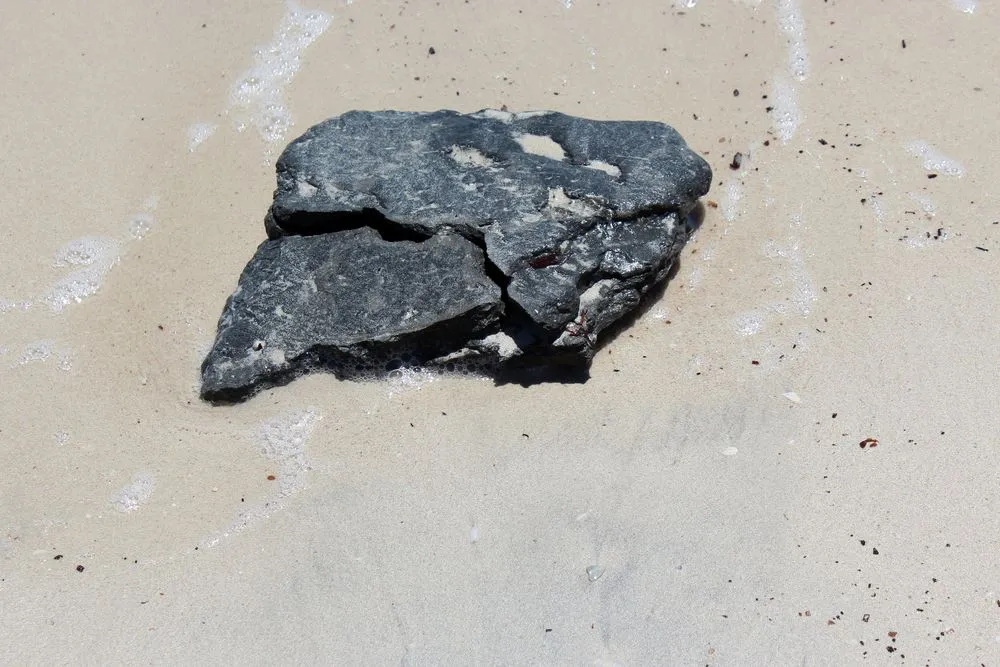
Fresh black ambergris has an animalistic, pungent fecal smell. This is low-grade ambergris that has not matured in the sea for a long enough time and contains less ambrein. The standard ambergris is grey-white in appearance and has aged well in the sea. It has a rich, earthy and salty aroma.
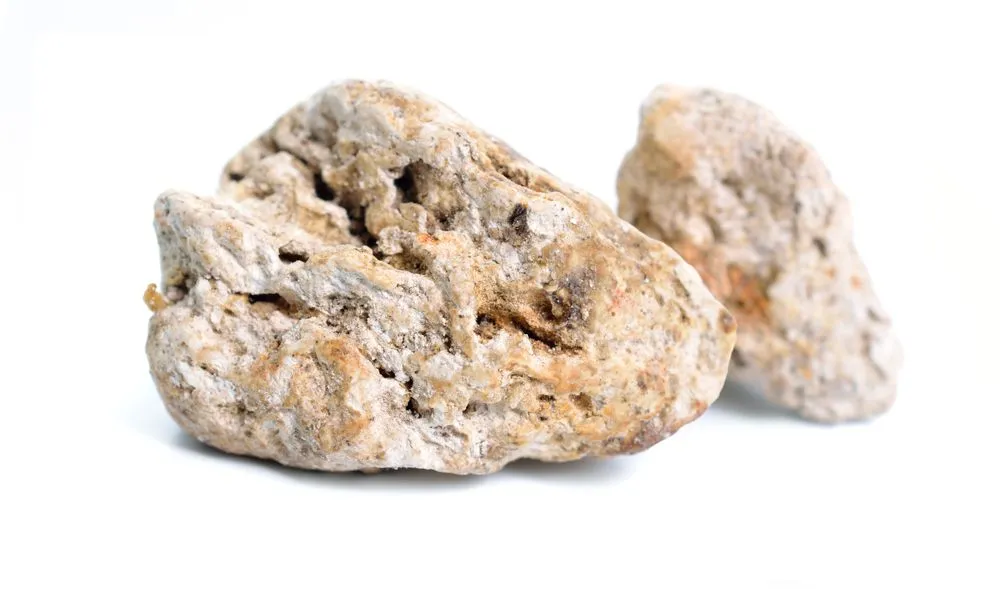
White ambergris has the most refined fragrance of all. A tincture made from it has a sweet and bright scent. White ambergris acts as a fixative and to magnify other notes in the perfume.
Use Of Ambergris In Perfumes
Perfumers use ambergris whenever they can, as it is a good fixative and has a distinctive odor. Ambergris has a strong fixative quality, which allows the fragrance to last longer when applied.
Fun Fact: Queen Elizabeth I used to apply ambergris to her gloves. She did this not only for its exquisite fragrance, but also because of its longevity. Once applied, it would last for years, even after many washes.
Ambergris also acts as a primary note in perfumes. There are many takers of this unique and complex scent in the cosmetic and perfume industry. The scent profile depends on the grade of ambergris used. its indescribable aroma makes it the most sought-after luxury perfume.
What Else Is Ambergris Used For Besides Perfume?
Long before it became a perfumer’s fixative, ambergris was treated as a cure-all, an incense and even a foodstuff. Early Arab traders called it anbar and burned it as incense, while also prescribing it as a medicine for the brain, heart and senses. In medieval Europe, people reached for ambergris to treat headaches, colds, epilepsy and other ailments, and during outbreaks of plague they carried lumps of it in the belief that its scent could keep disease at bay.

Stranger still, ambergris spent centuries in the kitchen. In 18th-century Europe it was used to flavour hot chocolate, and in the Ottoman world it was added to coffee. According to popular accounts, a dish of eggs and ambergris was a favourite of King Charles II of England, and historic recipes folded a thread of it into blends of rum, almonds, cloves and orange peel.
Several traditions also prized ambergris as an aphrodisiac, a reputation echoed in Chinese, Ayurvedic and Islamic writings. Modern science has not confirmed most of these medicinal claims, and in many countries trading ambergris is now restricted anyway, so today its role has narrowed almost entirely to fragrance. Still, the fact that people once happily ate their “floating gold” makes its perfume career look rather sensible by comparison.
How Much Is Ambergris Worth?
Ambergris earns its nickname “floating gold” honestly. High-grade material can change hands for tens of thousands of dollars per kilogram, and a single lucky beachcomber or fishing crew can land a life-changing sum.

Take the Thai fisherman who, in 2021, picked up a roughly 30-kilogram (66-pound) chunk that experts valued at up to $1.2 million, based on prices of as much as $40,000 per kilogram. That same year, a group of fishermen off the coast of Yemen recovered about 127 kilograms (280 pounds) of ambergris from a dead sperm whale, reportedly worth around $1.5 million.
Why such staggering numbers? It comes down to scarcity and demand. Only a small share of sperm whales ever produce ambergris, and a lump must bob around at sea for years before it matures into the prized grey, fragrant variety. Add a steady appetite from luxury perfume houses, plus the fact that hunting whales for it is both impractical and illegal, and you have a substance whose supply is essentially left to chance. The result is a natural material that, gram for gram, has at times rivalled or even exceeded the price of gold.
Conclusion
Only about 1–5% of sperm whales examined are found to produce ambergris, so hunting one in the hopes of striking it rich would be quite stupid (and, of course, illegal — sperm whales are themselves protected). Sperm whales sit in Appendix I of CITES (the Convention on International Trade in Endangered Species of Wild Fauna and Flora), but CITES doesn’t specifically rule on ambergris; legality is instead decided country by country. In the United Kingdom, most of the EU, New Zealand and the Maldives, beach-found ambergris can legally be sold. In the United States (under the Marine Mammal Protection Act and Endangered Species Act), Australia (under the EPBC Act) and India (under the Wildlife (Protection) Act, 1972), it is illegal to collect, possess or trade ambergris — even if it washes up on a beach — and people are regularly arrested for smuggling it.
So, the next time you decide to take a walk by the beach, keep an eye out for a weird-smelling rock. If you’re lucky, you might come across a million-dollar poop rock!

References (click to expand)
- What is ambergris? | Natural History Museum. The Natural History Museum in London
- Miracle, B. (2018, August 21). Potential Benefits of Ambergris Beyond Perfume. Journal of Complementary Medicine & Alternative Healthcare. Juniper Publishers.
- Ambrein – Molecule of the Week. American Chemical Society.
- Brito, C., Jordão, V. L., & Pierce, G. J. (2015, June 29). Ambergris as an overlooked historical marine resource: its biology and role as a global economic commodity. Journal of the Marine Biological Association of the United Kingdom. Cambridge University Press (CUP).
- What is ambergris? – Baleines en direct (GREMM).
- ‘Whale vomit’ windfall could net Thai fisherman up to $1.2 million. The National (2021).
- Ambergris. Wikipedia.