Table of Contents (click to expand)
- Why Do Mosquitoes Buzz?
- Who Buzzes More: Male Or Female Mosquitoes?
- ‘Buzzing Mosquitoes Don’t Bite.’ Is That True?
- Why Mosquitoes Buzz More In My Ears Than In My Friends’?
- Why Do Mosquitoes Always Fly Around Your Head And Ears?
- Why Do You Notice That Buzz More At Night?
- What If A Mosquito Actually Flies Into Your Ear?
That buzz is simply the sound of a mosquito’s wings, which beat roughly 200 to 800 times a second. Both males and females buzz, but male mosquitoes also listen to it, homing in on the female’s wingbeat tone to find a mate. So when one whines past your ear, it is flying (not biting yet), and it is not singling you out on purpose.
Short answer: The buzz is the sound of a mosquito flapping its wings hundreds of times a second. Both sexes buzz, and males use that tone to home in on females to mate with.
Mosquitoes are one of the most hated creatures on the planet. They pack a potential to ruin a good night’s sleep, dine on people’s and other animals’ blood and spread a number of dreaded diseases that kill hundreds of thousands of people every year. Believe it or not, in terms of the number of human deaths they cause, mosquitoes are the deadliest creatures on Earth, deadlier than snakes, sharks or any large predator.
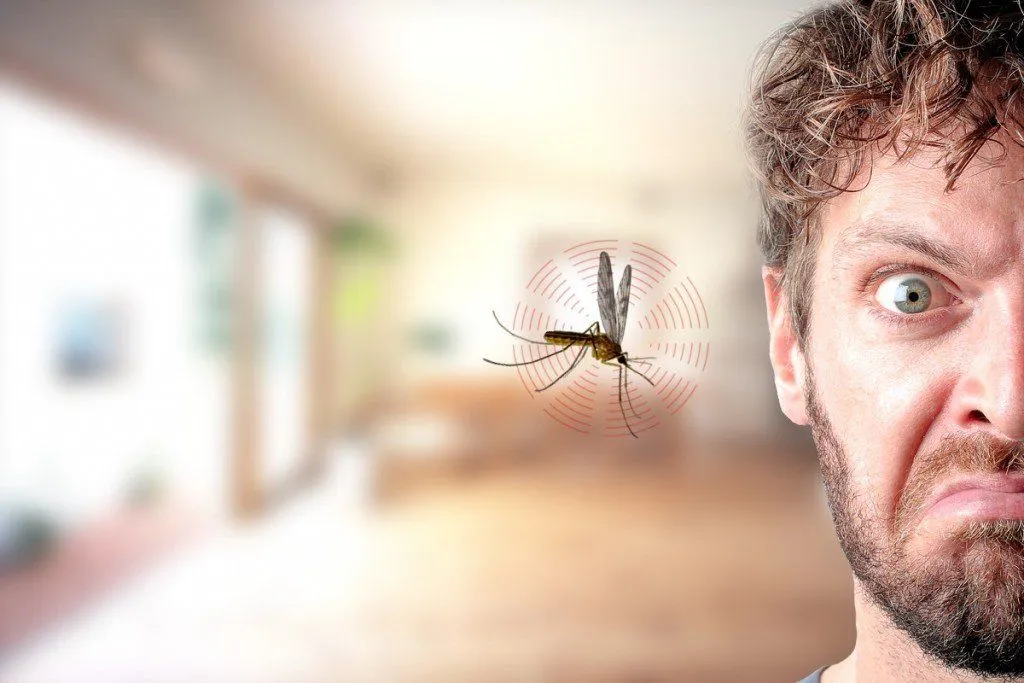
Not only that, but mosquitoes also do a fantastic job of pissing people off. As if sucking people’s blood wasn’t enough, they buzz in our ears incessantly!
Why do mosquitoes do that? Are they just cruel sadists that take pleasure in annoying other living beings, or is there a more ‘sensible’ reason behind this irritating habit?
Why Do Mosquitoes Buzz?
The buzz is nothing more than the sound of a mosquito’s wings slicing through the air. A mosquito beats its wings somewhere between 200 and 800 times every second, and it is this blur of tiny wingbeats, not a voice or any deliberate noise, that your ear registers as that high-pitched whine.
Here is the twist, though: for mosquitoes, the buzz is not just a side effect of flying. It is also how they find a date. Each sex flaps at its own characteristic frequency (females tend to beat their wings a little slower than males), and a male can actually hear the tone of a passing female’s wingbeat. When a male detects it, he chases the sound and the two adjust their wingbeats until their flight tones line up, a courtship duet that biologists call “harmonic convergence.”
This is not new knowledge. Way back in the 1940s, Louis M. Roth, who studied yellow fever mosquitoes (Aedes aegypti) for the U.S. Army during World War II, showed that male mosquitoes ignored resting, silent females but were powerfully drawn to the sound of a flying one. He could even lure males with a tuning fork humming at the right pitch. In other words, to a male mosquito, a buzzing female is the whole point.
Who Buzzes More: Male Or Female Mosquitoes?
Of the roughly 3,500 known species of mosquitoes, not a single male feeds on blood (males get by on flower nectar). Knowing this, most people assume that female mosquitoes buzz in our ears far more than males do, and some even think male mosquitoes don’t buzz at all.
This is not true. Both sexes have wings and both have to fly for a living (pun intended), so both flap their wings and both buzz. If anything, males beat their wings faster and so produce a higher-pitched tone. What is true is that only the female lands on you to bite, so the buzz you swat at by your ear is more likely to be a female on the hunt for blood than a male simply passing through.

‘Buzzing Mosquitoes Don’t Bite.’ Is That True?
There’s a common belief among people that mosquitoes buzzing in your ear don’t end up biting you, but is this belief biologically correct?
In a way, yes. You see, if a mosquito is buzzing in your ear, it means that it’s airborne in the region near your ear. This, quite logically, means that it’s not sitting on your skin, so it’s not going to bite you while it’s buzzing. However, once it lands on your body, you sure need to watch out!
Why Mosquitoes Buzz More In My Ears Than In My Friends’?
It may often seem like mosquitoes bother you more than your friends (or the other way round). There are actually a number of reasons behind that. You may run warmer and sweatier, breathing out more carbon dioxide and giving off more body heat (both of which mosquitoes home in on from a distance), or you might just be wearing a dark-colored t-shirt, which they find easier to spot. Even your skin chemistry plays a part: lab studies have found that mosquitoes land on people with type O blood roughly twice as often as on those with type A. So yes, your blood may genuinely taste sweeter to them than your friend’s does.

All these reasons may cause female mosquitoes to target you more often than your friends. The result? The perpetual nasty whining that you hear in your ear.
As it happens, there’s no cure to shut out that annoying buzzing sound of mosquitoes. Bug repellent might keep them at a distance where they don’t irritate your ears, but even that won’t always work! The best you can do is put on a pair of headphones and play some music.
Why Do Mosquitoes Always Fly Around Your Head And Ears?
If it feels like a mosquito makes a beeline for your face and then circles your ears, you are not imagining it. A mosquito hunts mostly by smell, and the single biggest clue it follows is the carbon dioxide you breathe out. Every exhale sends up a plume of CO2 that rises from your nose and mouth, and that plume is densest right around your head. So as a mosquito tracks the gas back to its source, the trail leads it straight to your face, where your ears happen to be waiting on either side.

Research at Caltech has mapped out how this plays out in stages. From roughly 10 to 50 meters (33 to 164 feet) away, a mosquito simply smells your CO2 plume. Once it closes to within about 5 to 15 meters (16 to 50 feet), it starts using its eyes to spot you. Only in the last meter or so does it switch to sensing your body heat to pick a landing spot. The smell of CO2 also primes the insect, making it far more likely to fly toward a nearby object it would otherwise have ignored.
The ear itself is not the target. Your head is. But because the buzz arrives right next to one of the most sound-sensitive parts of your body, you notice it there far more than you would if the same mosquito were circling your knee.
Why Do You Notice That Buzz More At Night?
That lone mosquito whining over your pillow at 2 a.m. feels like a special kind of torment, and there is a real reason the buzz seems louder after dark. The CDC notes plainly that mosquitoes can bite day and night, but different species keep different schedules, and many are programmed to be busiest at exactly the hours you are trying to sleep.
Which species is humming past your ear depends partly on the clock. Anopheles mosquitoes, the ones that carry malaria, are classic night feeders that hunt from dusk until dawn. Aedes aegypti, the yellow fever and dengue mosquito, is mostly a daytime biter. Research published in the journal Current Biology showed that this split is hard-wired: a circadian clock running in opposite phase in the two species drives one to seek hosts by day and the other by night, and scrambling that internal clock with constant light erased the difference. So the timing of your unwelcome visitor is not random; it is built into the insect.
The other half of the answer is you. At night a quiet, dark bedroom strips away the distractions, so a thin high-pitched whine that you would never catch during a noisy day suddenly has the stage to itself. The mosquito is not necessarily buzzing any louder after sunset. You are simply far better at hearing it. (If you have ever wondered where the daytime crowd disappears to, we cover that in where mosquitoes go during the day.)
What If A Mosquito Actually Flies Into Your Ear?
Once in a while the buzzing stops being a fly-by and the insect blunders straight into your ear canal. It is alarming, the sound is suddenly enormous, but it is rarely dangerous. The ear canal is a short dead-end tunnel that stops at the eardrum, so a mosquito cannot travel anywhere near your brain, no matter how loud it gets in there.

The Mayo Clinic gives a simple first-aid routine for an insect in the ear. Tilt your head so the affected ear faces upward and let gravity help. If the insect does not drop out, you can pour a little warm (not hot) oil, such as mineral, olive or baby oil, into the ear to drown it and float it back out. One firm warning: do not do this if you might have a hole in your eardrum or have ever had ear tubes fitted, because liquid can do real harm in those cases.
What you must not do is dig for it. Poking with a cotton swab, a matchstick or a fingertip tends to shove the insect deeper and can scratch the canal or rupture the eardrum. If the mosquito will not come out, or if you notice pain, bleeding or discharge, stop and let a doctor flush it out properly. For something as small and soft as a mosquito, though, a tilt of the head usually settles the whole drama in seconds.
References (click to expand)
- Why do mosquitoes buzz in our ears? - Live Science. Live Science
- Why do mosquitoes bite me and not my friend? Everyday Mysteries: FunScience Facts fromthe Library of Congress - webarchive.library.unt.edu
- Cator, L. J. et al. Harmonic convergence in the love songs of the dengue vector mosquito. Science (PMC, NIH).
- Fighting the World’s Deadliest Animal. CDC Global Health.
- Mosquitoes Use Smell to See Their Hosts. California Institute of Technology (Caltech).
- About Mosquitoes. Centers for Disease Control and Prevention (CDC).
- Baik, L. S. et al. Circadian Regulation of Light-Evoked Attraction and Avoidance Behaviors in Daytime- versus Nighttime-Biting Mosquitoes. Current Biology (PMC, NIH).
- Foreign object in the ear: First aid. Mayo Clinic.