Table of Contents (click to expand)
Aircraft detect submarines mainly with SONAR (SOund NAvigation And Ranging), delivered through sonobuoys. A patrol aircraft drops a passive sonobuoy that listens for the submarine and radios the acoustic data back to the plane. If the operator suspects a match, an active sonobuoy is dropped to ping the water and bounce sound waves off the hull, confirming and locating the target.
Submarines have a crucial advantage over ships – they can quickly disappear. The ability of a submarine to dive and travel while remaining underwater makes it one of the most coveted machines operating in the world’s waters.
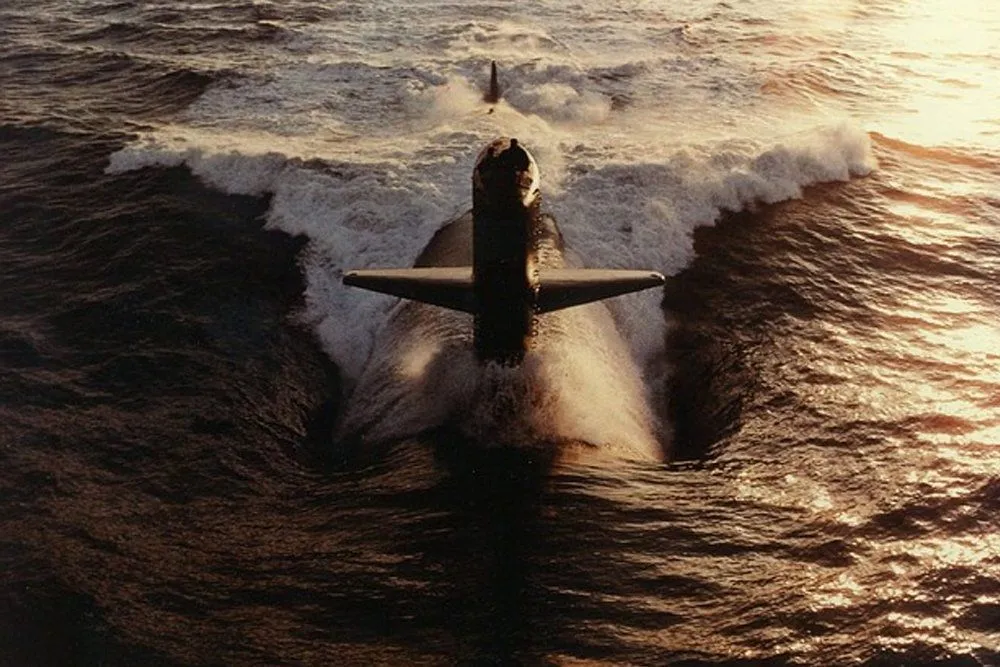
However, thanks to sonar and other military technology development, submarines can now be located much more precisely. They can be detected by ships in the vicinity and aircraft flying thousands of feet above the water’s surface.
There are several ways to detect the presence of submarines underwater, but in this article, we will discuss the one used by most military aircraft to detect and confirm the presence of a submarine in a given area.
The primary method of airborne anti-submarine warfare involves using SONAR – SOund NAvigation and Ranging. Simply put, SONAR is a technique that relies on sound waves to detect/locate objects in a particular region. You can read about SONAR in more detail in this article.
There is a specially-designed object – called a sonobuoy – that actually implements the SONAR principle to detect submarines underwater.
What Is A Sonobuoy?
A sonobuoy is a portable sonar system that can be dropped from an aircraft or a ship to detect submarines and conduct underwater research.
Sonobuoys are packed in canisters and installed in aircraft. They are ejected from the aircraft when it passes over a specific region above the water.
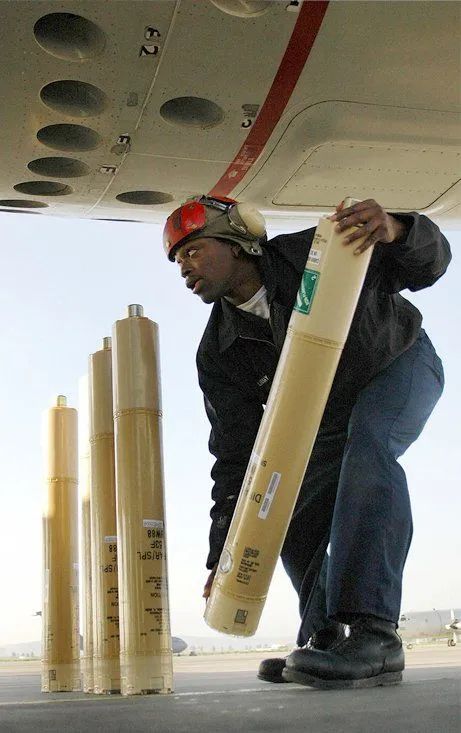
There are three main types of sonobuoys: active, passive, and special-purpose sonobuoys, which are used according to the nature of the mission.
How Sonobuoys Work
During an anti-submarine mission, aircraft are assigned a specific ‘target area’ to search for any underwater operating submarines. The size of the target area varies based on the type of submarine being searched for.
For instance, if a nuclear submarine is a target, the aircraft crew must search a larger target area due to its higher mobility.
Once the aircraft reaches the designated target area, it conducts a radar search, followed by a visual search using sensors and onboard equipment to locate the submarine on the surface. If the submarine cannot be found on the surface, the aircraft crew then releases sonobuoys from the bottom of the aircraft to continue the search.
The moment a sonobuoy splashes on the water’s surface, it deploys. Depending on the model, it can be pre-programmed to lower its sensor to a chosen depth, typically anywhere from 90 to 1,500 ft (27–457 m). Each buoy has three main pieces: a surface float at the top that holds the radio transmitter and antenna, a suspension system (a compliant decoupler) just under the surface that isolates the sensor from wave motion, and at the end of a long cable, a hydrophone (in passive buoys) or a transducer (in active buoys) that converts acoustic energy in the water into electrical signals. Those signals are radioed up to the aircraft through the antenna on the float.
The data that the deployed sonobuoy transmits will show up on the onboard computers of the aircraft. The operator then compares this data with their database, and if a match is found, it’s assumed that there is a submarine nearby.
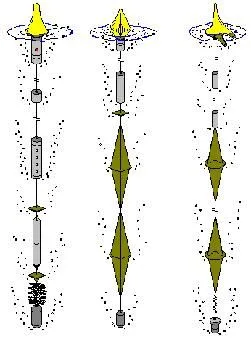
However, in order to actually confirm the submarine’s presence in that region, another buoy, this time an active one, must be deployed. This buoy emits acoustic waves in all directions underwater. When these waves hit a submarine nearby, they bounce back and return to their ‘parent’ buoy.
This not only confirms the presence of a submarine in the vicinity, but also helps ascertain its position underwater, which is the best piece of information the aircraft crew on an anti-submarine mission could hope to obtain.
Drawbacks Of Sonobuoys
One of the biggest drawbacks of sonobuoys is that they are designed to be used only once. They cannot be recovered after deployment; once a mission is over, the buoy floods and sinks to the seabed on purpose. This automatic self-scuttling (usually after 1 to 8 hours of operation, or when the battery runs low) is itself a feature, since it prevents a working buoy from being picked up and exploited by a hostile force.
The other catch is that you need a lot of them. A single anti-submarine sortie can involve dozens of buoys laid out in a pattern across a search area, which makes sonobuoy stockpiles a significant logistical and budgetary line item for navies.
To corroborate sonobuoy contacts, aircraft can use complementary sensors, such as Magnetic Anomaly Detection (MAD), an airborne magnetometer that looks for tiny distortions in Earth’s magnetic field caused by a submarine’s steel hull. MAD was a fixture on older platforms such as the P-3 Orion. The US Navy’s newer P-8A Poseidon, however, does not carry a MAD boom; the requirement was dropped because modern, increasingly stealthy submarines reduced its usefulness, and the P-8 instead leans on dense sonobuoy fields, surface-search radar, and electro-optical sensors. Some export variants (notably the Indian Navy’s P-8I) still fly with MAD installed. Either way, sonobuoys remain the first and most popular choice for finding enemy submarines.
Last Updated By: Ashish Tiwari
References (click to expand)
- Iqbal, K., Zhang, M., Piao, S., & Ge, H. (2020, January). Evolution of Sonobuoy through History & its Applications: A Survey. 2020 17th International Bhurban Conference on Applied Sciences and Technology (IBCAST). IEEE.
- Dosso, S. E., & Collison, N. E. B. (2002, May 1). Acoustic tracking of a freely drifting sonobuoy field. The Journal of the Acoustical Society of America. Acoustical Society of America (ASA).
- What is sonar?. NOAA Ocean Service.