Table of Contents (click to expand)
Your ears hurt or pop underwater because water pressure climbs with depth, so the surrounding water soon presses much harder on your eardrum than the trapped air on the inside. That imbalance bends the eardrum inward, and because it is packed with nerves, you feel pain. Doctors call this ear barotrauma, or "ear squeeze."
Your ears pop when you dive deep underwater because the (water) pressure at greater depths is higher than the pressure at the surface. Since your ears are used to the atmospheric pressure at sea level (about 14.7 psi, or 101 kPa), the eardrum bends inwards due to the pressure difference between the middle ear and the surrounding water. Since the eardrum is packed with nerves that communicate with the brain, you perceive this inward bending of the eardrum as pain. Divers and doctors call this ear barotrauma, or “ear squeeze.”
I had heard and read about this ear-aching phenomenon countless times, but never got a chance to experience it first-hand. However, I did experience it a few months ago when I first started to learn swimming. I went into the deep end of the pool and, sure enough, I felt the discomfort in both my ears. A lot of others report the same symptoms; some even observe that their ears “pop” when they go into the deep end of the pool.

So, why does that happen? Why do the depths of a pool (or any deep water body) do that to our ears?
The Eardrum
If you’ve ever stuck your finger inside your ear, you know what the ear canal is. Also known as the external acoustic meatus, it is a passage comprised of skin and bone that leads to the eardrum.
You also probably know about the eardrum; it’s a thin sheet of tissue that separates the middle ear from the external ear. Technically known as the tympanic membrane, it is actually a cone-shaped membrane that vibrates when a sound wave reaches it. Its primary function is to pass those vibrations on to the three tiny bones of the middle ear (the malleus, incus and stapes), which in turn drive the signal into the fluid-filled cochlea of the inner ear.
The Importance Of Equal Pressure On Both Sides Of The Eardrum
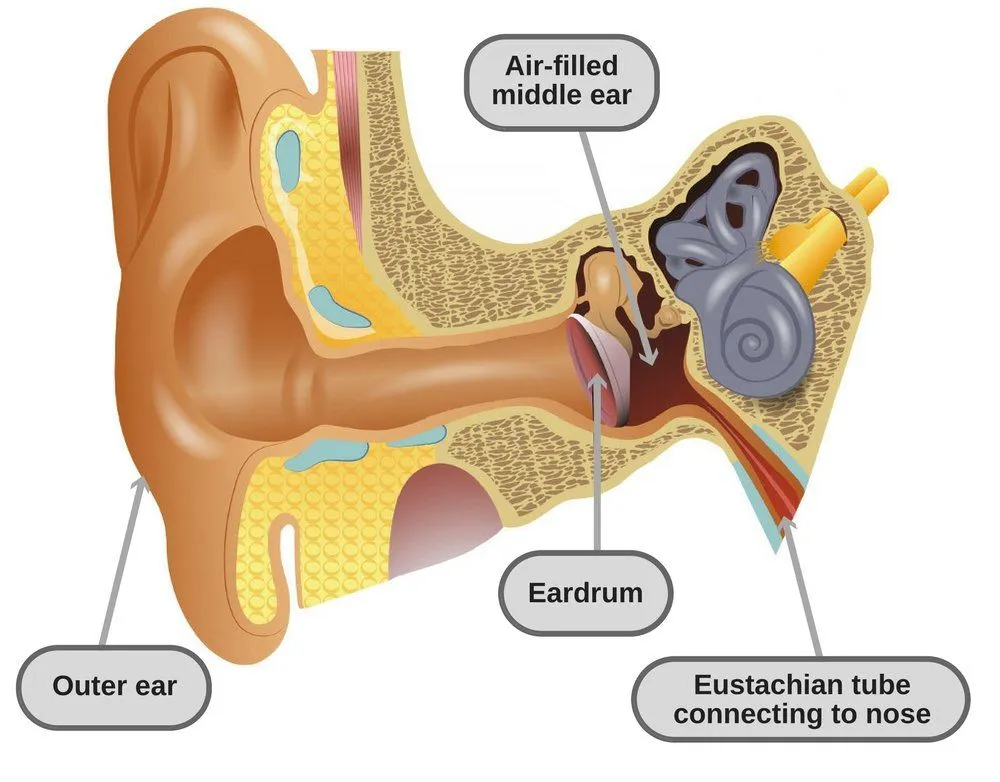
As you can see in the image above, on one side of the eardrum is the ear canal, and on the other side is a hollow space filled with air. You want to keep the pressure on both sides of the eardrum equal, because when that happens, the eardrum remains ‘normal’ and everything works as usual.
In fact, in order to make sure that the pressure on both sides of the eardrum remains equalized, there’s a tube called the Eustachian tube that connects the throat to the middle ear’s air pocket.
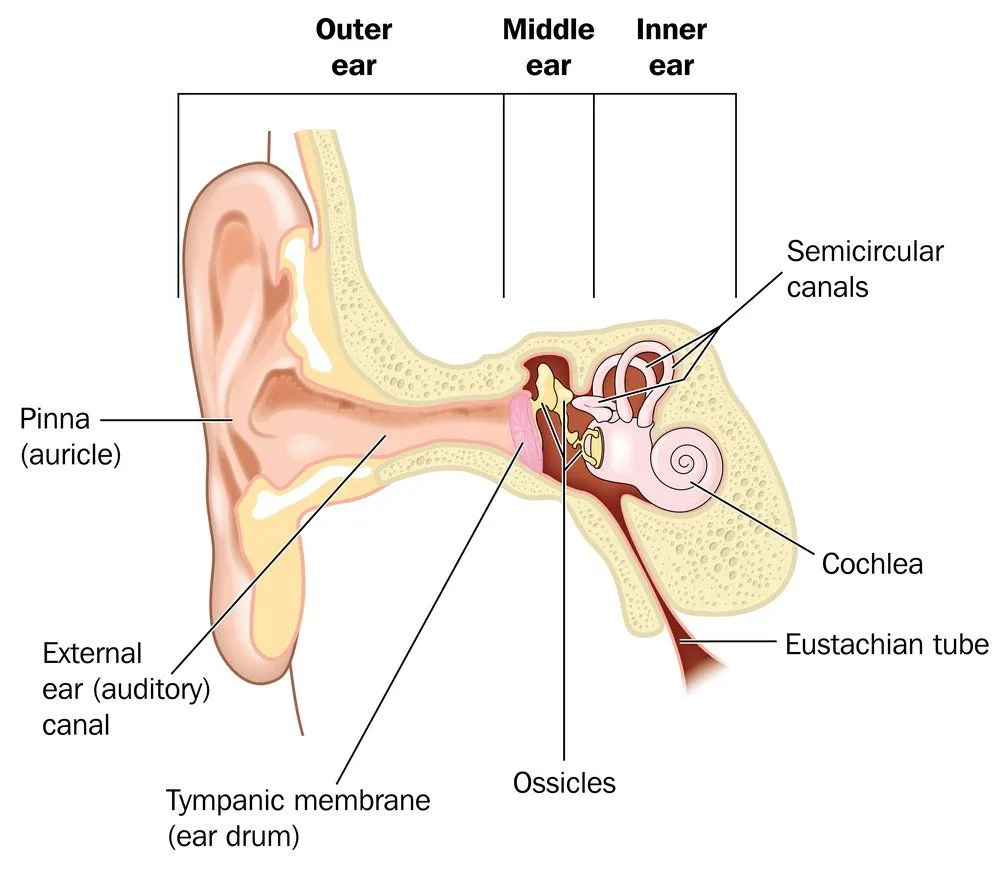
The tube normally stays collapsed shut, but it flicks open for a moment every time you swallow or yawn. Each of those little openings lets a puff of air move in or out, topping up the middle ear so the pressure on the inside of the eardrum keeps pace with the pressure outside.
What Happens When You Go Deep Underwater?
As you go deep underwater, the water pressure increases, because there is the weight of more and more water pushing down on you (note: water pressure always increases with depth, a phenomenon that has a number of practical applications).
Here’s the catch: that normally-closed Eustachian tube does not pop open on its own when the outside pressure rises. The growing pressure actually squeezes the soft tube shut even more firmly, so air can no longer sneak in to top up the middle ear. In fact, once the pressure difference reaches only about 4.4 psi (30 kPa, equal to roughly 3 m or 10 ft of water), the tube locks closed and ordinary swallowing will not budge it.
With the tube sealed, the middle ear is left holding air at close to surface pressure (about 14.7 psi, or 101 kPa), while the water pressing on the eardrum from the ear-canal side keeps climbing. Due to this inequality in pressure on either side of the eardrum, it bows inwards, causing mild to moderate discomfort in the ears. Push deep enough without equalizing (the pressure gap reaching roughly 100 kPa, or about 33 ft / 10 m of water) and the eardrum can tear, which is why divers take pressure equalization so seriously.

A simple way to get around this is to force the Eustachian tube back open and equalize the pressure on either side of the eardrum. The popular trick is to pinch your nose shut with your fingers, close your mouth, and gently try to exhale through your nose. This is the Valsalva maneuver, and the puff of pressure nudges the tube open so air can flow into the middle ear. You will hear your ears pop and the pain will quickly subside. Divers do this early and often on the way down, before the pressure difference gets big enough to seal the tube; swallowing, yawning, or wiggling your jaw can do the job too.
Do Your Ears Pop In A Submarine?
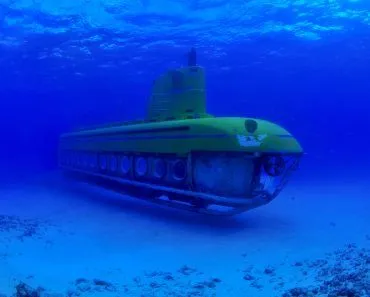
You might expect the deepest dive of all, a submarine, to be brutal on your ears. Oddly enough, it isn’t. A submarine has a rigid pressure hull, and the cabin inside is kept at roughly normal sea-level pressure no matter how deep the boat goes. The hull, not your eardrum, takes the strain of the water outside. Since the air around you barely changes, there’s no pressure difference across the eardrum, so your ears have nothing to equalize and they don’t pop.
Contrast that with scuba diving or free-diving, where the water (or the breathing gas) presses directly on you and rises with every meter of depth. That’s the real difference: ears hurt when the pressure around you changes, not simply when you go deep. The same logic explains why your ears pop in a descending airplane or a fast elevator, but stay quiet inside a submarine.