Table of Contents (click to expand)
- How Does A Submarine Maintain Pressure Equivalent To The Atmosphere?
- What Are Pressure Hulls And Why Are They So Important?
- How Do They Store Breathable Oxygen Inside A Submarine?
- Why Don't Submarines Implode Under Normal Conditions?
- Implosion vs. Explosion: What Does It Mean When A Submarine Implodes?
- What Can Cause A Submarine To Implode?
- A Final Word
A submarine implodes when external seawater pressure exceeds the strength of its rigid pressure hull, collapsing the hull inward in a matter of milliseconds. The trigger is usually diving past the hull's crush depth, or material fatigue, design flaws, or hidden defects that quietly lower that depth — as in the 2023 OceanGate Titan submersible loss, where a composite pressure hull failed at around 3,300 metres.
Humans have tried to explore the sea since at least 300 B.C. Legend has it that the first attempt at something submarine-like was by Alexander the Great, lowered into the water at the siege of Tyre inside a glass diving barrel.
That said, venturing into the sea inside a glass barrel hardly seemed like an effective method to explore the underwater world.
In 1578 A.D., the English mathematician and former naval gunner William Bourne sketched the first known design for a submersible vessel — a wooden-framed boat covered with waterproof leather and rowed underwater — though the craft was never built. The first submarine actually known to have been built and successfully demonstrated was Cornelis Drebbel's leather-covered rowboat, which made trips beneath the Thames in the 1620s. Around 150 years later, the “Turtle” — built by David Bushnell during the American Revolutionary War in 1775–76 — became the first submarine used in combat. Submarines only matured into practical vessels in the late 19th century, with the arrival of dependable propulsion systems and steel hulls.
How Does A Submarine Maintain Pressure Equivalent To The Atmosphere?
Submarines are designed to keep the inside of the crew compartment at roughly sea-level atmospheric pressure, regardless of how deep they dive. The rigid pressure hull takes the full load of the surrounding water on its outside, while the air inside stays at about 1 atm.
Why bother keeping the interior at 1 atm? Because if the inside matched the outside, the crew would need decompression every time the vessel surfaced — like deep-sea divers. Holding the interior at sea-level pressure means the only thing absorbing the squeeze of the deep ocean is the steel (or titanium, or composite) shell around it.
When a submarine is on the surface, its ballast tanks are filled with air, making the vessel less dense than the water around it and letting it float. To submerge, valves open and the ballast tanks fill with seawater, increasing the vessel's average density until it sinks. To resurface, compressed air is blown back into the ballast tanks, pushing the water out. The ballast tanks themselves are open to the sea and equalize with outside pressure; only the inner pressure hull stays at 1 atm.
That distinction matters: the pressure hull is what keeps the crew alive. In deep-diving research submersibles (such as the bathyscaphes Trieste and DSV Alvin), this innermost compartment is shaped as a sphere — a 'personnel sphere' — because a sphere is the strongest shape against uniform external pressure. Cylindrical military submarines use stiffening rings and reinforced bulkheads to achieve a similar effect.
What Are Pressure Hulls And Why Are They So Important?
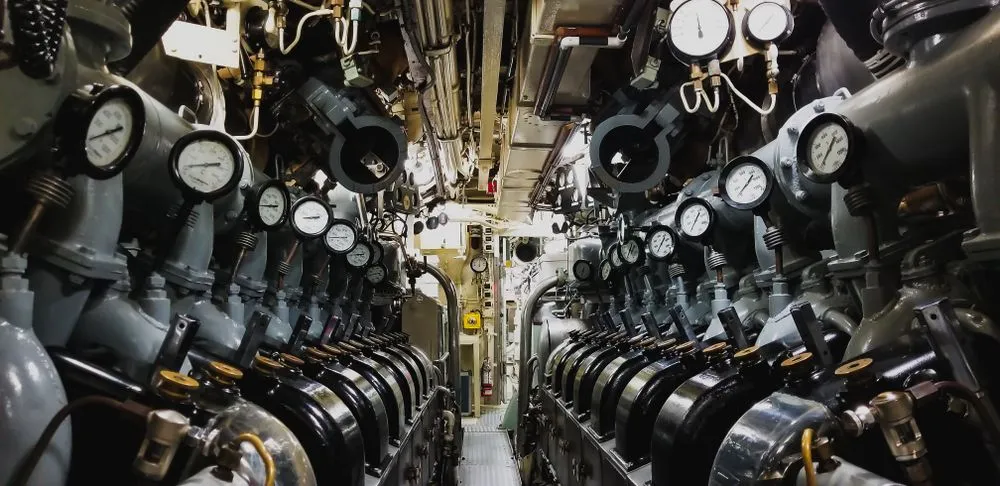
It is evident that “pressure hulls” are important structures inside a submarine, but what exactly are their functions?
The pressure hull is the main watertight structure that provides strength to the main skeleton of a submarine. It is constructed in such a way that it can withstand external pressure exerted by the ocean depths to protect the crew and systems inside.
One of the most important tasks that engineers need to be wary of when designing a submarine is making sure that the pressure hulls are resistant to leaks. It must cope with the external hydrostatic pressure without collapsing or deforming, while maintaining the overall integrity of the pressure hull.
How Do They Store Breathable Oxygen Inside A Submarine?
Modern nuclear submarines generate most of their oxygen onboard by electrolysing seawater — splitting H2O into hydrogen and oxygen, then venting the hydrogen and feeding the oxygen into the cabin. For backup and on smaller boats, 'chlorate candles' are also carried: cartridges of sodium chlorate and iron powder that, once ignited, undergo a chemical reaction that releases breathable oxygen.

Since there is no direct access to the atmosphere, submarines need to store sufficient breathable oxygen for extended periods underwater. A system that generates oxygen onboard and stores it for later use is installed inside the submarines.
Compressed oxygen cylinders are also carried as a third source. Electrolysis is the primary method on nuclear-powered submarines because their reactors produce abundant electricity; diesel-electric boats, with much tighter power budgets, lean more on stored oxygen and chlorate candles, and routinely snorkel close to the surface to refresh cabin air directly from the atmosphere.
Why Don't Submarines Implode Under Normal Conditions?
The ocean does not go easy on anything that ventures into it. Pressure climbs by roughly one atmosphere for every 10 metres (about 44 psi for every 100 feet) of depth, so a hull sitting beside the wreck of the Titanic, around 3,880 metres (12,730 feet) down, is squeezed by about 375 atmospheres, or roughly 5,500 lb of force on every square inch. The remarkable thing, then, is not that submarines occasionally implode, but that they routinely survive at all. They manage it through three things working together: shape, material, and a generous safety margin.

The part that keeps the crew alive is the inner pressure hull (engineers nickname it the "people tank"), and its cross-section is a near-perfect circle. A curved, circular wall turns the inward push of the sea into compression, which steel copes with far better than bending. The hull is built from very high-yield steels such as HY-80 and HY-100 (the "HY" stands for high yield, and the number is the steel's yield strength in thousands of pounds per square inch), and the design keeps the metal safely below that yield stress even at maximum depth. Some Russian submarines go further still and use titanium. Closely spaced circular ribs, called ring frames or transverse stiffeners, brace the cylinder from the inside so that it cannot buckle, while the plating itself is made thick enough for the boat's intended diving depth.
Roundness matters enormously. According to U.S. Naval Academy course material, a deviation of just 0.5% from a perfect circle can cut a hull section's pressure-bearing capacity by more than 35%. That is why a submarine's rated operating depth is set well above its collapse depth, leaving a deliberate safety margin, and why corrosion, fatigue, or manufacturing defects that quietly distort the hull are treated as such serious threats.
Implosion vs. Explosion: What Does It Mean When A Submarine Implodes?
The two words sound alike, but they describe opposite events. An explosion bursts outward, driven by high pressure inside pushing out. An implosion is the reverse: the structure collapses violently inward because the pressure outside vastly exceeds the pressure within. A submarine is the perfect setup for the second kind. Its interior is held at about 1 atmosphere while the sea outside may be pressing in at hundreds of atmospheres, so the instant the hull can no longer hold that difference, the wall is driven inward rather than blown apart. That is why submarines implode rather than explode.

The collapse is almost unimaginably fast. The water rushing in moves far quicker than human reflexes, and the whole event is over in a few milliseconds, faster than the people inside could perceive it. As the hull caves in, the air trapped in the cabin is compressed almost instantly. Because there is no time for the heat to escape, this adiabatic compression drives the trapped air's temperature up sharply in that final instant, which is part of what makes an implosion at depth so destructive.
The most discussed recent case is OceanGate's Titan. The U.S. National Transportation Safety Board found that the probable cause was an inadequate engineering process that left the carbon-fibre composite pressure vessel with delamination damage, which worsened until a local buckling failure triggered the implosion. The submersible's last recorded depth was 11,032 feet (3,363 metres) on its descent toward the Titanic, and all five people aboard were killed instantly.
What Can Cause A Submarine To Implode?
Submarines are built to withstand enormous external pressures — at 1,000 metres, the surrounding water pushes in at roughly 100 atmospheres, or about a tonne per square centimetre. Despite this, the risk of implosion remains one of the central concerns in any submarine's design. An implosion happens when the pressure outside the submarine exceeds the structural strength of its pressure hull, causing the hull to collapse violently inward.
Every hull has a 'crush depth' (or collapse depth) — the depth at which it is expected to fail catastrophically. The vessel's rated operating depth is set well above this, with a safety margin. When a submarine descends past its crush depth, or when the effective crush depth has been lowered by fatigue, manufacturing defects, or design flaws, the hull buckles and collapses inward. The collapse is essentially instantaneous: the wall of water rushing in moves faster than human reflexes, and the cabin contents are crushed and ignited by adiabatic compression of the air in milliseconds.
The 2023 loss of OceanGate's Titan submersible — on a dive to view the wreck of the RMS Titanic — is the clearest recent example. The U.S. Coast Guard and NTSB investigations concluded that Titan's carbon-fibre-and-titanium pressure hull suffered a catastrophic implosion at a depth of roughly 3,300 metres, killing all five people aboard. The composite hull had been weakened by repeated dive cycles, a failure mode that classification societies had warned the company about for years.
Other contributing causes of implosion across submarine history have included welding flaws, corrosion, battle damage, and explosive shock from depth charges or torpedoes that compromised the hull. Every operational submarine is therefore subjected to rigorous structural testing, periodic hull surveys, and strict depth limits to keep that catastrophic threshold safely out of reach.
A Final Word
Keeping the crew compartment at sea-level pressure — even as the outside world climbs to a hundred atmospheres or more — is what makes a submarine a habitable vessel rather than a diving bell. The rigid pressure hull around that interior is the single most critical safety system on board, and the breathable-oxygen systems keep the air inside fit to use for weeks or months at a time.
Implosions are rare, but they remain the worst-case failure for any underwater vessel. The Titan disaster of 2023 is a stark reminder that the margin of safety beneath a kilometre of ocean is measured in millimetres of hull thickness — and that no shortcut on testing, materials, or certification is worth taking when the stakes are this absolute.
References (click to expand)
- Kim, J.-H., & Shin, H.-C. (2008, June). Application of the ALE technique for underwater explosion analysis of a submarine liquefied oxygen tank. Ocean Engineering. Elsevier BV.
- Keith, M., Haase, K. M., Schwarz-Schampera, U., Klemd, R., Petersen, S., & Bach, W. (2014, June 30). Effects of temperature, sulfur, and oxygen fugacity on the composition of sphalerite from submarine hydrothermal vents. Geology. Geological Society of America.
- KW Donald. (1979) Submarine escape breathing air. A review and analysis .... Europe PubMed Central
- Submarines and Submersibles (Chapter 10). EN400 Course Notes. United States Naval Academy.
- See How Crushing Pressures Increase in the Ocean's Depths. Scientific American.
- Hull Failure and Implosion of Submersible Titan. NTSB Marine Investigation Report MIR-25/36.