Table of Contents (click to expand)
Skyscraper window cleaning is done from one of three main rigs: a single-occupant Bosun's chair (rope descent), a multi-person suspended swing-stage scaffold, or a permanent roof-mounted Building Maintenance Unit (BMU) whose telescoping boom rolls on a rooftop carriage and lowers a powered cradle down the building's face. The 828-metre Burj Khalifa, with 24,348 windows, has a custom BMU system and a roughly 36-person team that takes 3 to 4 months to clean every pane.
Try to imagine that you’re on vacation. You’re sitting in a chair in a hotel room, looking out the window and thinking about the meaning of life. Suddenly, from out of nowhere, you see a man appear outside the glass window from the outside!
An instinctive yell escapes your mouth, but before you call for help, you realize that it’s not an assassin or a burglar. In fact, it’s just a window washer!
Window washing is a tiresome and time-consuming task, but whether you want to do it or not, it has to be done rather regularly. It may be relatively easy to wash the windows of your house, but it’s a bit more challenging when you’re hanging hundreds of meters above the safety of the ground.
So, how is skyscraper window washing – one of the most dangerous jobs in the world – carried out?
Window-Cleaning Equipment
Since window cleaners have to work at such great heights, there’s an array of tools and equipment that they have to carry while working on buildings. A typical window cleaner’s equipment consists of a rope protector, a safety rope, a rope-grabbing tool, a descent mechanism, lanyard and suction cups. These tools not only protect workers from any untoward incidents, but also help them clean a building’s facade at a rapid speed with great efficiency.
While working on the facade of a building, the worker is attached to an anchor, which is mounted on the roof. This anchor ensures that the workers can clean windows as they descend vertically. You have probably noticed that window cleaners don’t descend smoothly; they proceed to the next, lower floors in a fashion that appears as though they are ‘dropping’ through each floor one at a time. The height of a single drop – the measurement of one vertical cleaning operation from the roof to the floor below – varies according to the building in question.
Window Washers At Work
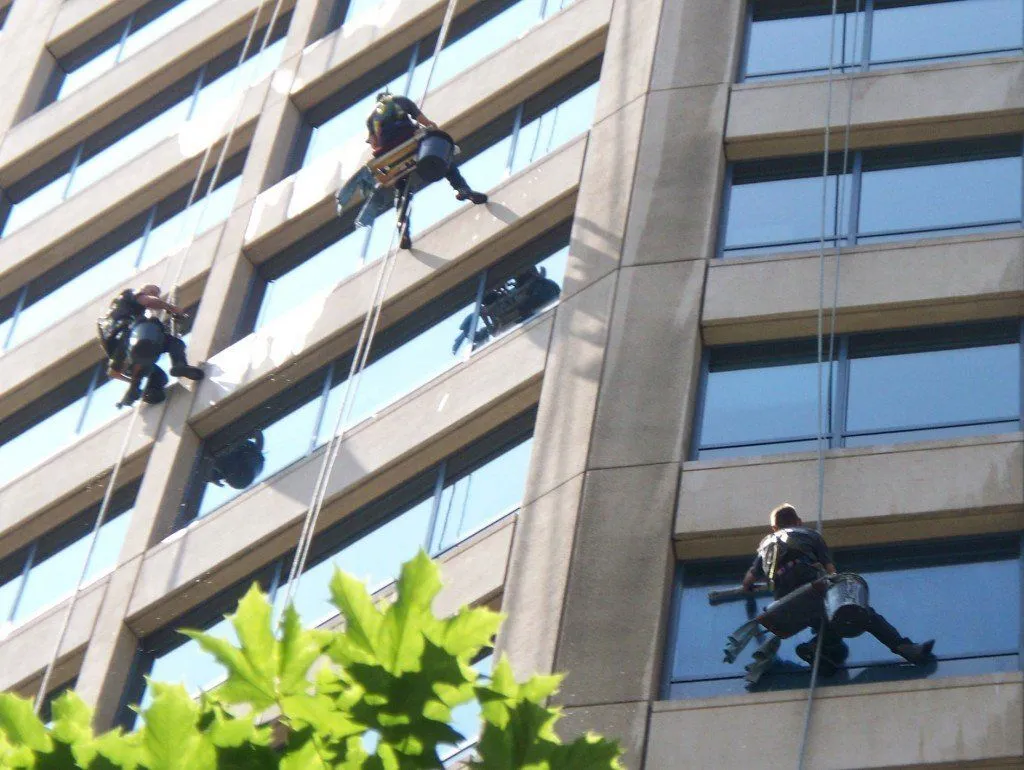
At first, cleaners used to stand on the window ledges and hold onto the frame for support to clean windows. Imagine that! This was obviously not a very safe method to clean the windows of tall buildings, so leather belts were eventually introduced. These belts, attached to anchor bolts, held the worker safely in air. Later still, scaffolds were introduced for even more safety and convenience.
Nowadays, there are different ways in which window cleaning is done based on certain requirements. The type of working mechanism depends entirely on how the work is to be done. The most common window-washing mechanisms are: Bosun’s chair, boom, carriage and portable davit.
Bosun's chair is actually a centuries-old idea borrowed from sailing ships, where boatswains (bosuns) sat in a rope-rigged plank seat to inspect and repair the masts. The high-rise version is meant for a single washer and offers access to tight areas of the facade while keeping the worker safely seated. It is ideal for prolonged, dedicated window cleaning where a full scaffold would be overkill.
The suspended swing-stage scaffold is the workhorse of the trade: a powered platform that hangs off the roof from steel cables and carries a small crew along the facade. The earliest skyscraper window washers, however, did not use anything this elaborate. They simply climbed onto the window ledge and clipped a leather safety belt (the so-called Chicago belt) into anchor bolts in the masonry, a method that was standard from the late 1800s into the mid-20th century.
For tall and architecturally complex buildings, the modern standard is a Building Maintenance Unit (BMU): a permanent crane-like structure mounted on the roof. A telescoping boom swings out over the parapet, and the whole assembly rolls along a rooftop monorail (the carriage) so the cradle below it can reach every face of the building. BMUs are built into almost every supertall tower at the design stage. A portable davit system is the budget option for shorter or simpler buildings: a removable outrigger that anchors into roof sockets and supports a suspended cradle.
One growing modern addition: robotic window cleaners. Skyline Robotics' Ozmo system was deployed in August 2024 on a 45-storey tower in midtown Manhattan, becoming the first robotic arm to clean a working New York skyscraper. The robot uses LiDAR and computer vision to track windows and runs several times faster than human teams, though a supervisor still operates it from the roof rather than fully autonomously.
Challenges Of High-rise Window Cleaning
It goes without saying that cleaning skyscraper windows is, for obvious reasons, completely unlike cleaning the windows of your room or home. Dusting or cleaning a window in your room only takes a piece of cloth, soapy water and a little motivation. However, when you are doing the same thing on the 100th floor of a building at a dizzying height of more than half a kilometer above the ground, things change… drastically!
Furthermore, environmental conditions at such great heights are fairly different from what you experience on the ground. Wind, for example, is a pleasant companion when you’re washing one of your windows on a warm, sunny day, but up on the side of a skyscraper, wind generally flows at much higher speeds, which makes it absolutely essential for cleaners to carry the necessary equipment that guards against it.
Workers also bump into the surprising fauna of the upper atmosphere: aeroplankton, the catch-all term for the small insects and ballooning spiders that drift up on warm updrafts, plus the more obvious nuisance of pigeons, gulls, and the occasional peregrine falcon, none of which is a welcome distraction when you’re hanging 100 stories up.
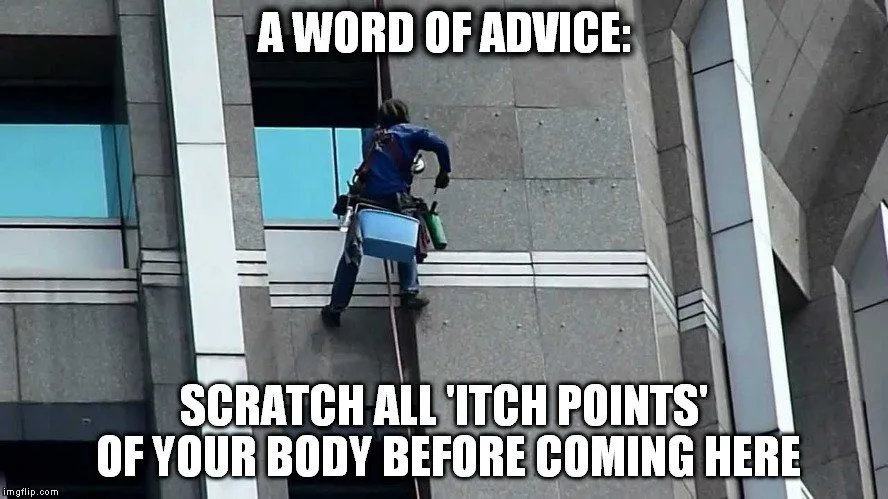
Window cleaning, as you can see, is not an easy job. In fact, it is considered to be one of the most dangerous jobs in the building trade. The US Occupational Safety and Health Administration has recorded multiple fatal high-rise window-cleaning incidents each year, almost all of them falls from a suspended platform. Despite all the safety measures, at the end of the day, it all comes down to the cool-headedness of the workers hanging hundreds of meters above ground, making sure that all of those tall, majestic buildings look great in the sunshine!