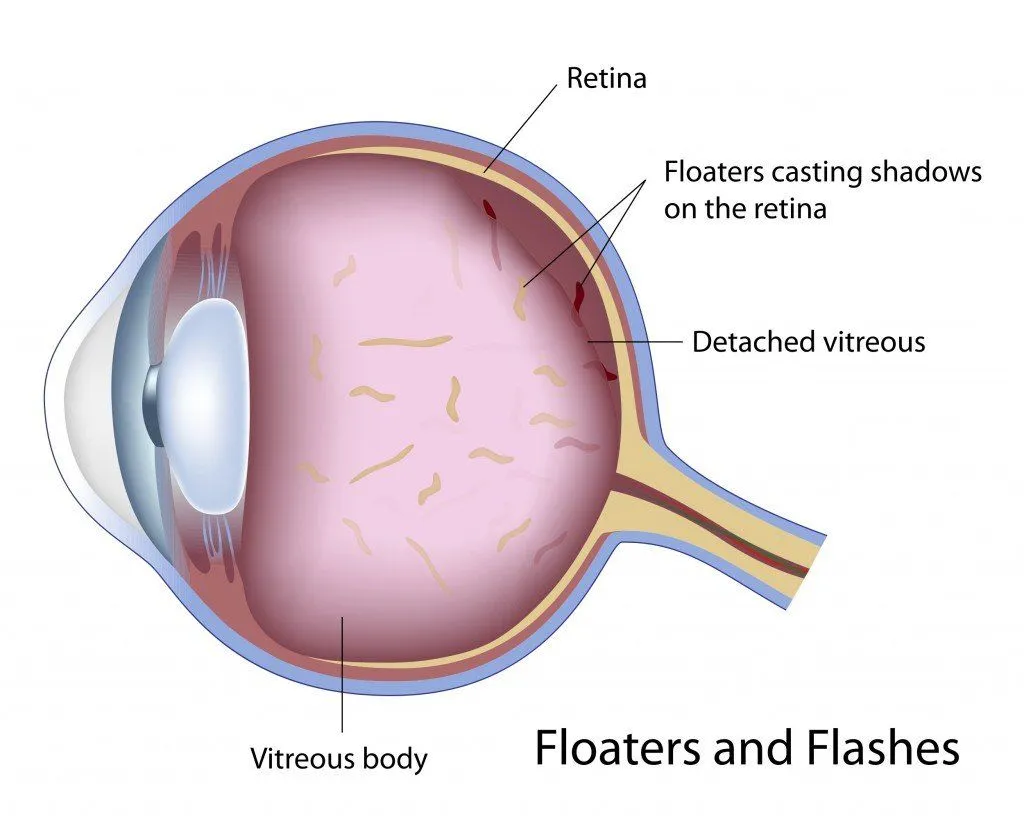
Those drifting squiggles, dots, and threads you sometimes see in your vision are called eye floaters (Latin: muscae volitantes, “flying flies”). They are tiny clumps of collagen and cellular debris suspended in the vitreous gel inside your eyeball, and what you’re actually seeing are the shadows those clumps cast on your retina.
We see them all the time! They’re floating in the sky, on the walls of our bedroom, even on an empty screen! However, the more you try to focus on them, the more they seem to slip away from your attention, annoyingly enough, only to reappear when you shift your glance again. Transparent, shape-shifting and ever-moving, these floating objects have all of us confounded!
So what are they and why can we see them everywhere? Are they magical fairies flitting through your field of vision? Are they micro-organisms that are somehow visible to us? Or are they ghosts returning from the dead to haunt the living?

Well, let’s start with the basics. They’re real (they’re physical objects sitting inside your eyeball), but they don’t exist out there in the world. They live exclusively in your eye, which is why nobody else can see your floaters and you can’t see anyone else’s.
So… are we all seeing things that aren’t there?

No, don’t go rinsing out your eyes just yet! You’re definitely not the only one who sees them. The reason floaters feel so strange is that they’re fundamentally a personal phenomenon: each person sees their own private little zoo of shapes drifting around their own field of view, and no two eyes have the same set.
What Are They?
What you’re seeing is a common phenomenon called Floaters. The official Latin name for these weird objects is Muscae Volitantes, which, when translated in English, mean Flying Flies. Quite an apt name, don’t you think? They really are as annoying as pesky flies zipping around your vision. However, they’re not insects at all! In fact, they live exclusively inside your eyeball.

The reason why most of us are so curious about these objects is because they seem so active and alive, as though they’re deliberately trying to evade our understanding. They move and change shape seemingly independently. Nonetheless, they are not alive, no matter how convinced you may be of their magical existence.
Floaters are tiny objects found inside the eyeball. They are not a foreign object, however, but rather something that exists naturally in your eye. In the vast majority of healthy eyes, what you’re seeing is a microscopic clump of collagen, the same structural protein that makes up much of your skin and connective tissue. Stray cells and the occasional bit of cellular debris can show up too. (Red blood cells can appear as floaters if you’ve had a small bleed inside the eye, called a vitreous hemorrhage, but that’s a medical condition, not a normal floater.) Whatever the source, the clumps float freely in the vitreous humour, the clear gel-like fluid that fills the space between your lens and your retina.
As these tiny floating objects move around the vitreous humour, when you see them, they seem to be drifting along aimlessly. This is also why they seem so frustratingly defiant and always just out of your reach! The second you try to observe them, they seem to bounce slightly and then settle at the fringe of your vision. You never seem to be able to get a good glimpse of them because they move every time you move your eye.

Why Are Some Brighter While Others Are Not?
Floaters cast shadows at the back of the eye, i.e. the retina. The retina happens to be the light-sensitive part of your eye. The closer they are to the retina, the clearer you are able to see them.
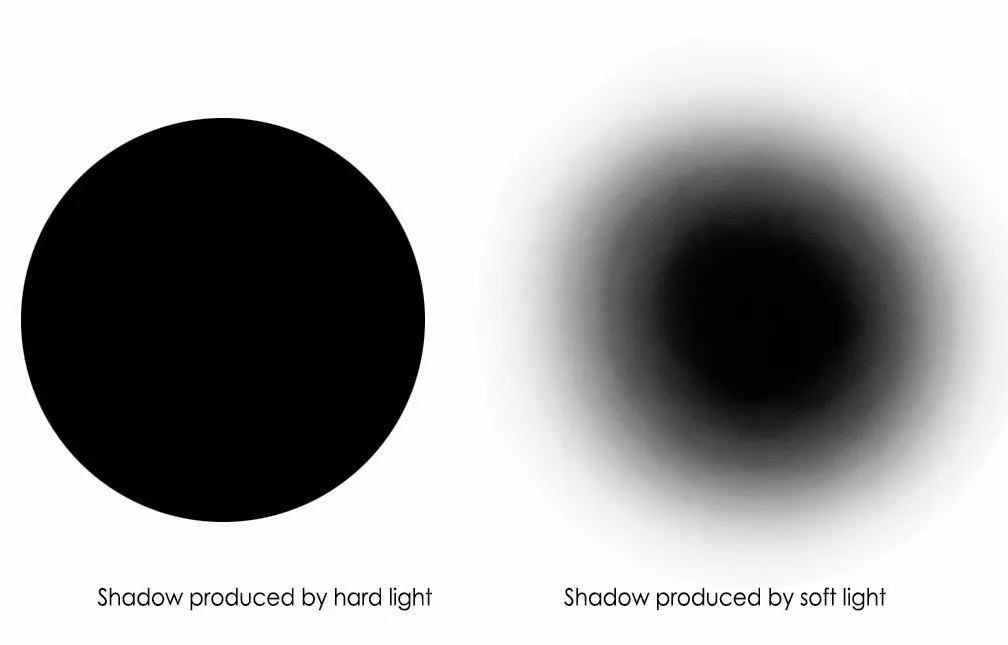
Think of it this way. If you were standing close to a wall with a source of light in front of you, then your shadow would be clear and defined. The farther you moved away from the wall and towards the source of light, the shadow you cast on the wall would become increasingly hazy and vague.
Floaters seem to be particularly visible if you are staring at a bright uniform surface, such as the sky or a whitewashed wall. However, this is not because looking at these objects would spur your eyes to produce floaters, but rather because the floaters are more noticeable against a bright, uniform background. The consistency of such a monochrome backdrop makes it easier for us to distinguish a floater.

Another reason for this is that in the face of a bright light source, your pupils contract. Remember the light-wall-shadow analogy I mentioned before? Now imagine what would happen if you changed the brightness of the source of light. If the light is diffused, then your shadow would be equally diffused. However, a concentrated bright source of light would lead to a sharper shadow on the wall.
A wide pupil is equivalent to a diffuse source of light, but when your pupil narrows to regulate the brightness of the uniform context in front of you, the shadows of the tiny objects in your eye become more distinct and thus, more visible.
Isn’t it amazing how our minds can simply conjure up such wonderful illusions? Next time someone complains about the strange floating visions in their eyes, you can proudly claim that you know all about these curious little illusions of the human body!
What Causes Eye Floaters?
So why do these collagen clumps form in the first place? The honest answer: aging, mostly. When you’re young, the vitreous gel inside your eye is clear and uniform, with collagen fibers spread evenly through a thick jelly of water and hyaluronic acid. As the decades pass, the gel begins to liquefy and the collagen fibers slowly aggregate into thicker bundles, a process eye doctors call vitreous syneresis. Those bundles are big enough to cast shadows on the retina, so you start noticing them as floaters.
The more dramatic version of this story is posterior vitreous detachment, or PVD. As the vitreous shrinks, it can pull away from the surface of the retina at the back of the eye, often producing a sudden burst of new floaters and sometimes brief flashes of light. PVD is so common it is essentially a normal part of getting older: it affects roughly 40% of people in their 60s and over 80% of people past 80.
A handful of other things speed up the process or add more floaters to the pile:
- Nearsightedness (myopia). A longer, more stretched eyeball has a vitreous that liquefies earlier in life, so myopic people often start noticing floaters in their 20s or 30s.
- Eye surgery. Cataract surgery, in particular, can accelerate vitreous changes.
- Eye injury or inflammation (uveitis, infection).
- Diabetic retinopathy can cause bleeding into the vitreous, which shows up as a sudden shower of dark floaters.
In children and teenagers, occasional floaters are usually just leftover developmental tissue (called Mittendorf dots or remnants of the embryonic hyaloid artery) and are completely harmless.
When Are Eye Floaters A Medical Emergency?
Most floaters are harmless, even if they’re annoying. But there is one situation where you should put this article down and call an ophthalmologist today: a sudden change.
The classic warning combination is sometimes summarized as the “three Fs”:
- A sudden burst of new floaters (a shower of new dots or cobwebs that appear out of nowhere).
- Flashes of light, especially in your peripheral vision, that look a little like lightning streaks and are most noticeable in the dark.
- A field defect, like a dark curtain or shadow creeping in from one side of your vision.
That combination can be a sign of a retinal tear or retinal detachment, where the retina is pulling away from the back wall of the eye. Detachments need surgical repair, and the sooner they’re caught, the better the outcome. Major eye centers like Duke Health and the U.K.’s NHS advise being seen the same day if these symptoms appear together.
By contrast, a few stable, longstanding floaters you’ve had for years, with no new flashes and no vision loss, are almost always nothing to worry about. If you’re unsure, an ophthalmologist can dilate your pupils and look inside in a 10–15 minute exam.
Can You Get Rid Of Eye Floaters?
The short answer most patients hate to hear: in the vast majority of cases, no, and you don’t really need to. The brain is remarkably good at editing them out, a process called neural adaptation. The floaters don’t actually disappear; your visual cortex just stops flagging them as worth your attention, the same way you don’t consciously feel your watch on your wrist after a few minutes.
For floaters that are genuinely disabling (large, central, blocking reading vision), eye surgeons can offer two interventions:
- YAG laser vitreolysis. An ophthalmologist uses a focused laser to break up the bigger collagen clumps into smaller pieces. It’s an in-office procedure, but it works best for a single large floater that sits comfortably away from the lens and retina; results are mixed for diffuse, multi-floater cases.
- Pars plana vitrectomy. A surgeon removes the vitreous gel itself and replaces it with a saline-like fluid. It is highly effective at eliminating floaters, but it is real eye surgery, with non-trivial risks of cataract, retinal detachment, and infection, so most surgeons reserve it for severe cases.
No supplement, eye drop, or eye exercise has been shown in well-designed trials to dissolve floaters. So if a wellness site promises to make them vanish overnight, take it with the same skepticism you’d take any other miracle eye cure.
References (click to expand)
- Floaters. National Eye Institute (NEI), NIH.
- Bergstrom, R. & Czyz, C. N. Vitreous Floaters. StatPearls, NCBI Bookshelf.
- Akarsu Acar, O. P. & Vural, B. Posterior Vitreous Detachment. StatPearls, NCBI Bookshelf.
- Souza, C. E. et al. Nd:YAG laser vitreolysis versus pars plana vitrectomy for vitreous floaters. NIH/NCBI PMC.
- How to Get Rid of Floaters in My Eyes? University of Utah Health.