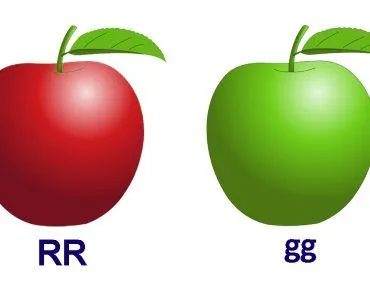
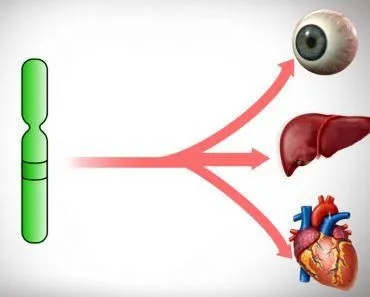
Mendel’s Laws of Inheritance are the Law of Segregation, the Law of Dominance, and the Law of Independent Assortment. These laws state that alleles will segregate during the formation of gametes, one allele will mask the effect of the other, and the alleles of one character will segregate independently of the other character.
Genetics is probably one of the most interesting part of biology. It can be connected to almost every field in animal and plant studies and is also a great field in terms of its research scope. It is comparatively new and honestly, the basics are quite easy! I can say this with complete conviction because the person who started it all was a monk!
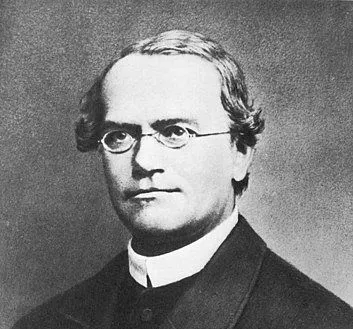
Father Of Genetics – Gregor Mendel
Gregor Johann Mendel is famously known as the Father of Genetics. Hailing from Austria, he excelled in physics and maths and eventually joined a monastery to avoid his otherwise imminent fate of running the family farm. Even as a monk, he never lost his interest in science. He performed experiments on pea plants (Pisum sativum) in the monastery garden. Based on his observations, he framed 3 laws, known as Mendel’s Laws of Inheritance. These laws set the basis for all further studies in genetics, but before we get into these laws, let’s get our basics right.
Mendel’s Laws Of Inheritance
Without any context, understanding these laws can be challenging, to say the least, but what better way to understand them than to retrace Mendel’s steps, right? So, let’s start where he did!
Mendel performed his studies using the pea plant, which he chose for a number of reasons. Pea plants can finish one life cycle pretty quickly, so it was the perfect plant to use in order to observe a number of generations. Mendel observed certain traits in the plants, like the fact that purple flowers were much more common than white ones, round seeds were more common than wrinkled, etc. To understand these things better, he used crossbreeding.
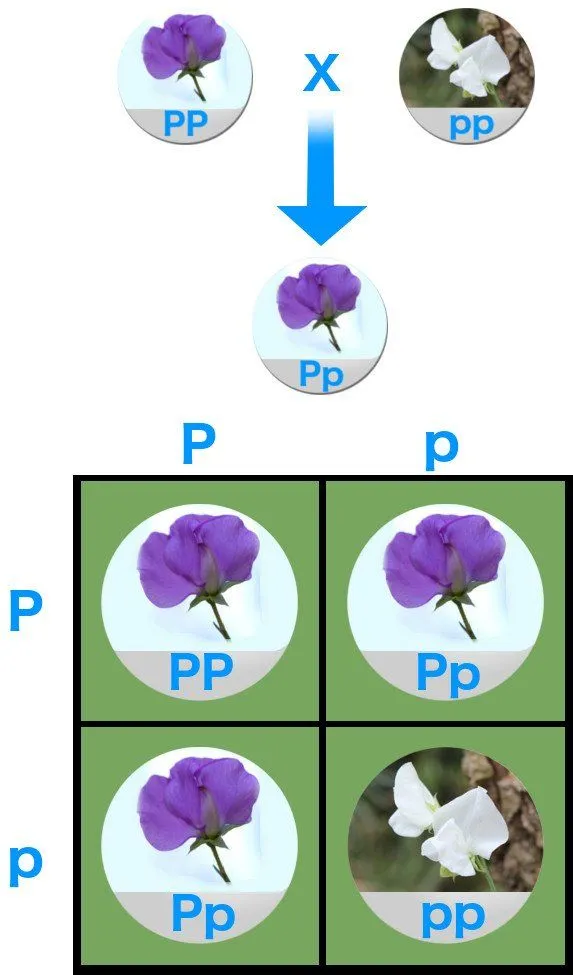
He started by taking 2 plants that were almost the same, but differed in just one trait, for example, flower color. One plant had purple flowers and the other had white flowers. When he bred these 2 together, all the plants of the 1st generation (called F1) had purple flowers. He then bred 2 plants from this F1 generation. Of the four plants that he got, 3 had purple flowers and 1 had white flowers. This is called the F2 generation.
This type of cross or breeding is called a monohybrid cross. This simply observes the inheritance pattern of one character. Based on this cross, Mendel came to certain conclusions. He realized that purple flowers were dominant over white flowers, meaning that even if one gene for purple flowers was present in the plant, as is the case in the first generation, the flowers were purple. It essentially masked the effect of the gene for white flowers. These genes are known as alleles. They both decide the flower color, but will give different colors to the plant. Therefore, “P” represents the dominant allele and “p” represents the recessive allele.
Another observation that Mendel made was that at every stage, the effect of P and p individually remained the same. The recessive allele p still gave a white color to the flower, while P gave a purple one. There was no blending in their effects.
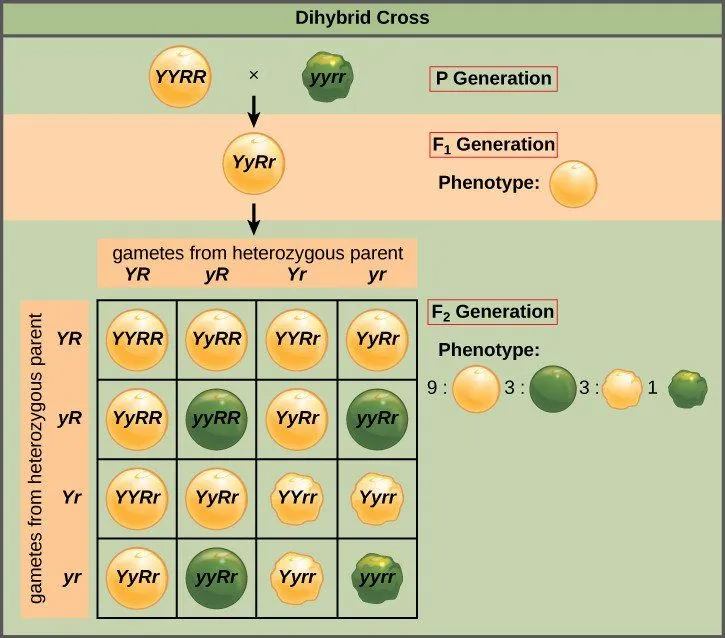
Now, let’s go one step further. Earlier, we looked at 2 plants differing in just one character. Now, let’s take 2 plants differing in 2 characters. This is called a dihybrid cross, because who doesn’t love a challenge, right?!
The 2 characters are seed shape and seed color. One plant had round yellow seeds, while the the other had wrinkled green seeds. When he bred these 2 together, the first generation gave him round yellow seeds. He then bred 2 plants of this generation with each other. The 2nd generation had 16 plants. 9 had round yellow seeds, 3 had round green seeds, 3 had wrinkled yellow seeds, and just one plant had wrinkled green seeds.
Along with all his previous observations, he noticed something new. The inheritance of seed color and seed shape was not dependent on each other. The frequency of round and yellow seeds was highest since both of them were dominant traits, while the wrinkled and green frequency were the lowest, since both of them were recessive traits. However, the frequency of round green seeds and wrinkled yellow seeds was the same.
Based on these experiments and their observations, Mendel devised the following 3 laws.
The Seven Traits Mendel Studied In Pea Plants
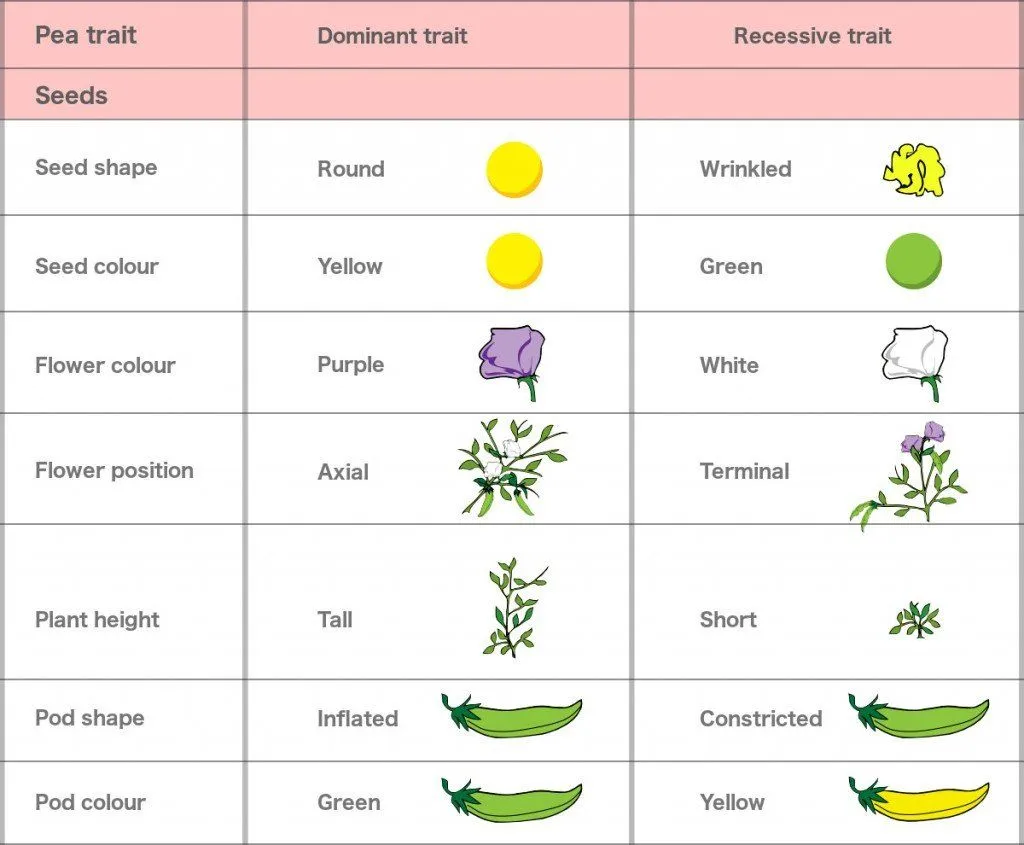
We have been talking about flower color and seed shape, but Mendel did not stop there. He actually tracked seven different characters in his pea plants, and he chose them carefully. Each one showed up in just two clear, easy-to-tell-apart forms, with no in-between versions to muddy the results. For every character, one form turned out to be dominant (the form that appeared in every plant of the F1 generation) and the other recessive (the form that disappeared in F1 and reappeared in roughly a quarter of the F2 plants).

Here are the seven characters, along with the dominant and recessive form of each:
| Character | Dominant form | Recessive form |
|---|---|---|
| Seed shape | Round | Wrinkled |
| Seed (cotyledon) color | Yellow | Green |
| Flower color | Purple | White |
| Pod shape | Inflated | Constricted |
| Pod color (unripe) | Green | Yellow |
| Flower position | Axial (along the stem) | Terminal (at the tip) |
| Stem length | Tall | Dwarf |
One detail trips a lot of people up: for the seeds, yellow is dominant and green is recessive, but for the unripe pods it is the other way round, with green dominant over yellow. The two are controlled by separate genes, so there is no contradiction. Because all seven characters behaved in this same neat, predictable way, Mendel could repeat his crosses again and again and trust the patterns he saw, and that is exactly what let him work out the three laws below.
Law Of Dominance
This is the first law. It states that when there are 2 different alleles in a cell, one will mask the effect of the other. This is the dominant gene, while the gene whose effect is masked is known as the recessive gene. In the F1 generation of the monohybrid cross, the plants had Pp alleles, but were still purple in color. Traits are alphabetically depicted by the first letter of the dominant allele.
Law Of Segregation
This law states that during the formation of the gamete or reproductive cell, the genes will segregate, without any mixing or blending of their effects. Put another way, every plant carries two alleles for each character, but those two alleles separate during gamete formation so that each gamete carries only one allele for that character. This is the law people are pointing to when they ask which of Mendel’s principles says that gametes carry just one allele for each trait. This was based on Mendel’s second observation. In all the generations, there was no mixing of the flower colors; they were either white or purple.
Law Of Independent Assortment
This law states that during the formation of the gamete, the alleles of one character will segregate independently of the other character. Therefore, the color and shape of the seeds were not dependent on each other.
These are the 3 basic laws of Inheritance. They can be applied not only to plants, but to all living organisms. These laws prepare us to make predictions on the transfer and inheritance of various traits, diseases, etc. There are certain traits, like blood group, which do not comply with these laws, but instead have their own scientific explanation. Although there are exceptions, these laws still form the basis of genetic studies and are an essential part of Genetics 101.
Law Of Segregation vs Law Of Independent Assortment
These two laws sound similar and are easy to mix up, but they answer different questions. The simplest way to keep them straight is to remember that the Law of Segregation deals with one character at a time, while the Law of Independent Assortment deals with two or more characters at once.
The Law of Segregation says that every plant carries two alleles for a single character, and that those two alleles separate during the formation of gametes so that each gamete receives only one of them. That is why Mendel’s monohybrid cross, which follows just one character such as flower color, gives a tidy 3:1 ratio of dominant to recessive in the F2 generation.
The Law of Independent Assortment goes a step further and looks at two characters together. It says that the alleles for one character sort into the gametes independently of the alleles for another character, so seed color has no say over seed shape. This is the law behind Mendel’s dihybrid cross, and it is what produces the famous 9:3:3:1 ratio in the F2 generation. In short, segregation explains how a single pair of alleles splits up, while independent assortment explains how different pairs split up without influencing one another.
References (click to expand)
- Biffen, R. H. (1905, January). Mendel's Laws of Inheritance and Wheat Breeding. The Journal of Agricultural Science. Cambridge University Press (CUP).
- Yule, G. U. (1902, December). Mendel'S Laws And Their Probable Relations To Intra‐Racial Heredity. New Phytologist. Wiley.
- Gregor Mendel - Wikipedia
- Garden Pea Characteristics Revealed the Basics of Heredity - Biology LibreTexts