Table of Contents (click to expand)
A baby’s gut microbiome is largely seeded at birth, then reshaped by breast milk, solid foods and everyday exposure to microbes. Bacteria shift steadily through the first months, and by about age 3 a toddler’s gut bacteria broadly resemble an adult’s and become relatively stable.
An unborn baby gets all the nutrients it needs from the placenta, but as soon as it leaves the womb and enters the world, everything changes.
They must get used to eating and digesting all kinds of different foods, which naturally affects their gut. In fact, a variety of liquids and solid foods is important for a baby’s gut to properly develop as the baby matures.
The Gut Of A Newborn
The bacteria that settle in a newborn’s gut play a crucial role in their overall health throughout their life. The gut bacteria continuously evolve and change as the baby is introduced to different foods, which is why it’s so important to feed babies the right food.
Other factors that can influence the way babies’ guts develop include whether they were breast-fed or bottle-fed, as well how they were born – naturally or by C-section.
The most common strains of gut bacteria in newborns are Enterobacteriaceae and Staphylococcus; over time, the gut also fills with Bifidobacteria. These bacteria carry a dedicated set of genes that let them digest human milk oligosaccharides, the special sugars in breast milk that the baby cannot break down on their own. That metabolic edge is a big reason Bifidobacteria come to dominate the gut of a breast-fed infant.
Breast Milk Affects The Baby’s Gut
After birth, many babies get their nutrients from breast milk. Breast milk contains fats, proteins and carbohydrates (everything a little one needs to grow big and strong), all tuned to their changing nutritional needs.

Breast milk also delivers antibodies that the mother’s immune system built to fight the microbes in her environment. The main one is secretory IgA, an antibody that coats the lining of the baby’s gut and stops bad bacteria from latching onto the intestinal wall. A newborn cannot make much of its own secretory IgA yet, so this borrowed defense can ward off a wide range of harmful germs the baby’s immune system has never met. That protection is crucial to preventing tummy troubles in the early months and years.
In addition to antibodies, breast milk is loaded with human milk oligosaccharides (large sugar molecules that the baby cannot digest, but that feed the good bacteria in their gut). These same sugars also help train and switch on the baby’s gut immune system.
By feeding these specialized sugars to Bifidobacteria while starving most other microbes, breast milk effectively stacks the deck in favor of the good bacteria.
But how did these gut bacteria enter the baby’s gut in the first place? For years the popular idea was that microbes reached the baby in the womb, but the weight of current evidence points to a largely sterile womb, with the gut getting seeded at birth. As the baby passes through the birth canal it picks up the mother’s vaginal and gut bacteria, while a baby born by C-section tends to be colonized first by skin and hospital microbes instead. Breast milk and skin contact then keep adding to that starter community, which is why an infant’s early gut bacteria often resemble their mother’s.
Breast-fed Vs. Bottle-fed
Plenty of research has documented the benefits of breastfeeding over using formula. Why one is better than the other is a long story, but if you want more information about why this is so, you can read this excellent review.
Breast milk is rich in good gut bacteria. By switching to formula, those potentially good bacteria are lost. Fortunately, there is now a variety of probiotic formula milk options that come packed with the goodness of gut-colonizing bacteria.
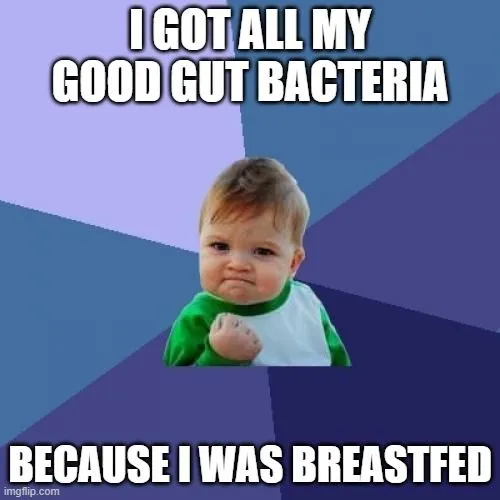
It is quite a task to make the perfect formula for milk that offers everything that breast milk does. This influence of breast milk on gut development is the reason why breast milk is recommended over formula.
Breast milk itself is extremely dynamic in its composition and changes based on the mother’s diet, age and environment, among many other factors. Therefore, it is difficult to pin down a standard recipe for formula milk that is ideal for an infant’s gut.
The Baby’s Gut At 6 Months
At about 6 months of age, when a baby begins to eat solid food, things get interesting. This new world of food contains a wide range of bacteria that can set up shop in a baby’s gut.
Bacterial species, such as those of the genera Bacteroides, Ruminococcus and Clostridium, all seek a place in the empty real estate of the baby’s developing gut. These bacteria have genes that break down difficult-to-digest food molecules and synthesize vitamins that the body cannot produce.
The Toddler’s Gut
By around the age of three, a toddler’s digestive system hosts a community of bacteria that broadly resembles an adult’s. The colonies established in these early days will go on to influence their digestive health and immunity for years to come. (More recent research suggests the microbiome keeps maturing in smaller ways well past age three rather than freezing in place, but the first 1,000 days still do most of the heavy lifting.)
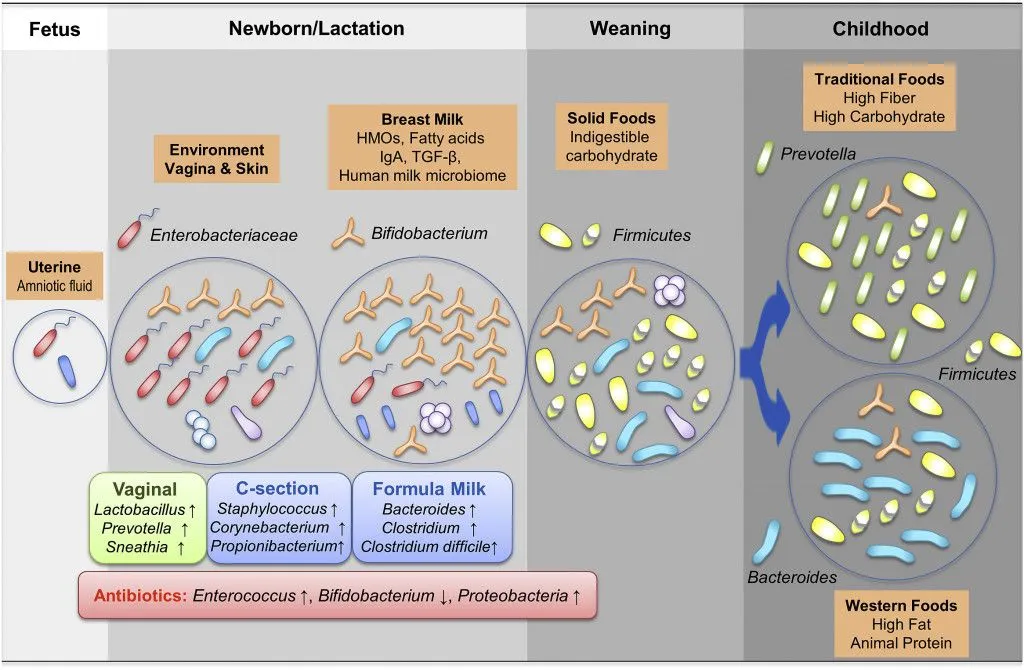
Once established by the age of three, the infant’s gut bacteria (or microbiome) remains relatively stable and only changes in the event of disease, infection, poor nutrition or antibiotic use.
Conclusion
As we age and try new foods, some of which may be rather questionable, not much changes in our gut. Our innards are more or less stable by the time we reach the age of three.
Most changes that occur after the age of three affect the gene expression of established gut bacteria. As a growing body of research continues to shed light on this topic, we are understanding more and more how important gut bacteria are for our lives.
It is fascinating to see how much of our health depends on gut bacteria. Gut bacteria not only affect digestion, but also our sleep patterns, the immune system, our metabolism, mental health and much more. As a result, the probiotic industry is growing tremendously and companies are always looking for ways to promote gut health and immunity in order to keep the little critters in our gut happy and thriving.
References (click to expand)
- Kent, R. M., & Doherty, S. B. (2014, October). Probiotic bacteria in infant formula and follow-up formula: Microencapsulation using milk and pea proteins to improve microbiological quality. Food Research International. Elsevier BV.
- Tanaka, M., & Nakayama, J. (2017, October). Development of the gut microbiota in infancy and its impact on health in later life. Allergology International. Elsevier BV.
- Andreas, N. J., Kampmann, B., & Mehring Le-Doare, K. (2015, November). Human breast milk: A review on its composition and bioactivity. Early Human Development. Elsevier BV.
- Robertson, R. C., Manges, A. R., Finlay, B. B., & Prendergast, A. J. (2019, February). The Human Microbiome and Child Growth – First 1000 Days and Beyond. Trends in Microbiology. Elsevier BV.
- Pannaraj, P. S., Li, F., Cerini, C., Bender, J. M., Yang, S., Rollie, A., … Aldrovandi, G. M. (2017, July 1). Association Between Breast Milk Bacterial Communities and Establishment and Development of the Infant Gut Microbiome. JAMA Pediatrics. American Medical Association (AMA).
- Perez-Muñoz, M. E., Arrieta, M.-C., Ramer-Tait, A. E., & Walter, J. (2017). A critical assessment of the “sterile womb” and “in utero colonization” hypotheses: implications for research on the pioneer infant microbiome. Microbiome.