For most of us, our nose is a feature we either love or hate about our face. However, if you lose it, could you also lose the ability to smell? Potentially!
If you were a prisoner of some crime in, say, the Babylonian empire (around 1700 B.C.E) or in Medieval Europe, as punishment, your nose could have been amputated, or more precisely, the cartilage part of the nasal arch would be chopped off. This would probably have left you with two gaping holes in your face, and a view of the interior of your nose.
Today, one might probably lose a nose in extreme circumstances. But, if you did lose a nose, either because of punishment or because you lost a duel, would you then be able to smell even in the absence of that nose?
The Anatomy Of The Nose
How you smell is a byproduct of the shape of your nose. So, before we proceed, you need to understand the anatomy of the nose to piece together whether we (or someone like Lord Voldemort) could smell noseless or not.
When we speak about losing a nose, we’re only referring to the outside of the nose. This nasal arch consists of the two nostrils, separated by the septum. It is composed of two-thirds cartilage (the flexible tip of the nose) and one-third bone, which is the upper, more rigid part of the nose.
When we breathe through the nostrils, a concentrated stream of air makes its way to the airways. The nostrils widen into the wide nasal arches, like a narrow tunnel opening into a cave. The nasal canal is where most of the smelling takes place.
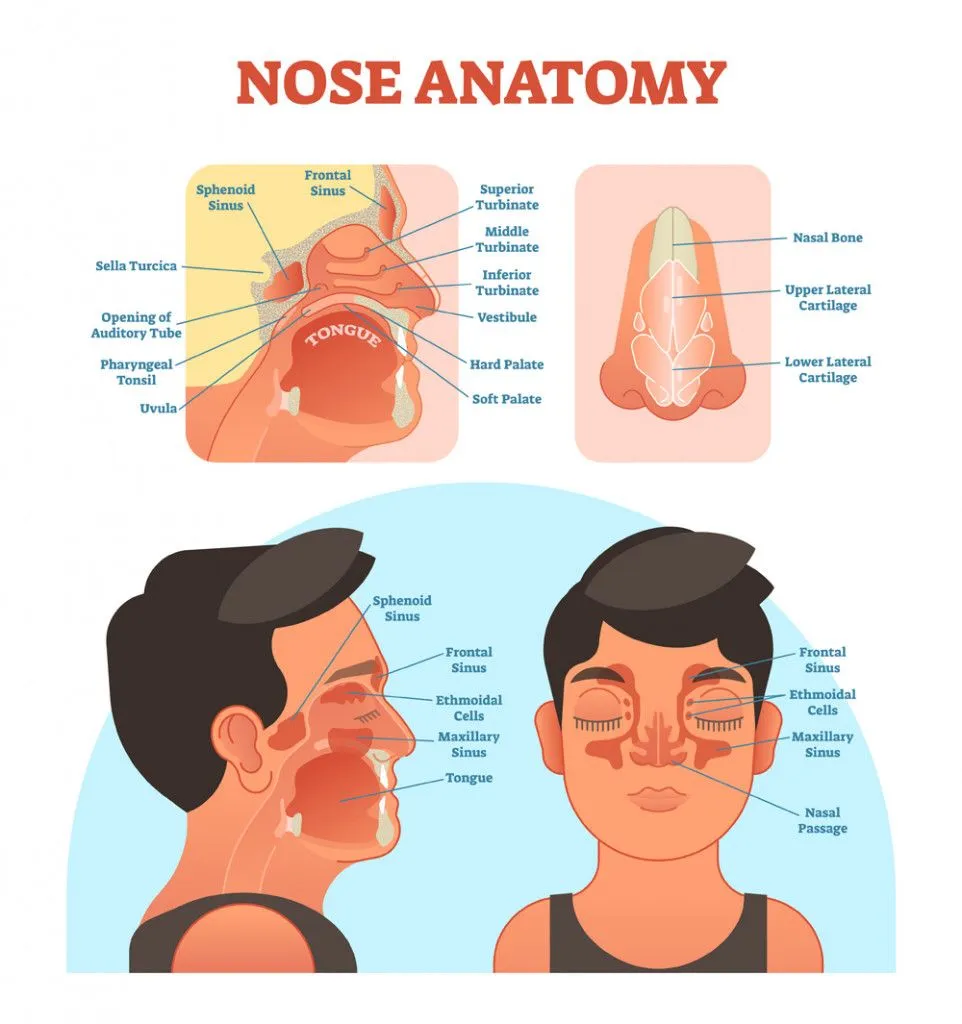
Ridges within the nasal canal, called conchae (or turbinates), help direct airflow toward the olfactory region. Higher up in the nasal cavity, the olfactory epithelium contains millions of smell-detecting receptor neurons. When odor molecules floating in the air (like those in a sweet-smelling rose or in sweaty socks) reach these receptors, they get activated and send signals about the smell to the brain via the olfactory nerve.
The nasal canal extends downward into the throat, from where the esophagus and the trachea separate. Because of this connection between the mouth and the nasal canal, whenever you eat, you’re also smelling your food, as the odor molecules in food make their way into the nasal cavity and activate our receptors. This is called retronasal olfaction and plays a huge part in how we experience flavor.
Smelling Without A Nose… Possible, But Difficult
Since the smelling region of the nose is located deeper in the head, the nostrils and septum have very few olfactory receptors (if any). You might therefore assume that losing the nasal arch would not affect your sense of smell too much. Your assumption would be both right and wrong.
Individuals who have undergone a nose-related surgery, or have injured their nose severely, do lose part of their sense of smell. As the nose heals the sense of smell returns. Many individuals with a deviated septum, where the septum isn’t straight, have also been found to have a compromised sense of smell.

We don’t have much direct evidence of whether fully losing the nose would permanently alter one’s ability to smell, but most of the change in smell seems to occur for two reasons. The first is inflammation due to the injury and the second is a disruption of airflow.
The nasal arch may seem like just a straw that sucks air into the airways, but it is far more than that. It is a straw that filters out dirt and other irritants from the air while moistening dry air, as well as directing air into the olfactory region.
Disrupting airflow would lead to changes in how the air reaches the nasal canal. Without a nasal arch, airflow wouldn’t be able to make its way adequately into the olfactory region of the nose, and dry and dusty air would be able to directly assault your inner nasal cavity, affecting how much you can smell!
The nostrils also seem to play a role in perceiving where a smell is coming from. If you smell something burning, you can pinpoint where the smell is coming from in part because of which nostril receives more of the burning smell. This ability is even more profound in dogs, who have such a finely calibrated smelling nose that their nostrils can work individually to figure out where a smell is coming from!
Can You Live Without A Nose?
Smell is only one item on the nose’s job list, so losing the nasal arch raises a bigger question: can you live without a nose at all? The reassuring answer is yes. People can and do survive without an external nose, because the mouth offers a backup route for air. What you mainly lose is not your life, but a remarkably good air-conditioning system.

Every breath you draw through your nose is quietly filtered, warmed, and humidified before it reaches your lungs. As air winds past the conchae, it picks up moisture and warms to close to body temperature (about 37 °C, or 98.6 °F), arriving in the airways at nearly 100% humidity. Mucus lining the nasal cavity traps dust, pollen, and microbes, while a carpet of tiny hair-like cilia sweeps the debris toward the throat to be swallowed or coughed out. That same mucus is part of your immune defense, carrying antibodies such as immunoglobulin A that meet incoming germs at the front door.
Strip the nose away and cold, dry, unfiltered air heads straight for the lungs, which is harsher on the airways and offers far less protection. The good news is that reconstructive surgeons can rebuild a nose from cartilage and skin grafts, so the loss is rarely permanent today. History even offers a famous survivor: the astronomer Tycho Brahe, who lost the bridge of his nose in a youthful duel and went on living for more than three decades behind a metal prosthesis, charting the heavens just fine. So the nose is far from optional for comfort, but it is not, strictly speaking, a life-support organ.
What About People Born Without A Nose?
Everything so far assumes you started life with a nose and lost it later. But a tiny number of people are born without one at all, through a condition called congenital arhinia. It is staggeringly rare: only around 80 cases were reported in the entire past century. Instead of a nasal arch and nostrils, an affected baby has smooth skin where the nose would be, and often no nasal cavities or sinuses behind it either.
In its better-studied form, arhinia shows up as part of Bosma arhinia microphthalmia syndrome (BAMS), which also features unusually small or absent eyes and, later, delayed or absent puberty. In 2017, researchers traced the syndrome to spontaneous (de novo) mutations in a gene called SMCHD1, which helps switch other genes on and off while the face is taking shape in the embryo. The condition follows an autosomal dominant pattern, meaning a single altered copy of the gene is enough to cause it.
Can these individuals smell? Generally not. Many are also missing the olfactory bulb, the brain structure that processes smell signals, so both smell and much of our sense of taste are absent from birth. The more urgent problem at birth is breathing: newborns breathe mainly through the nose, so a baby with no nasal airway often needs a surgically created airway (a tracheostomy) to breathe and feed safely. One widely reported case was Eli Thompson, born in Alabama in 2015 with complete arhinia, who received a tracheotomy at just five days old. Cases like his are why arhinia, despite its rarity, has taught scientists a surprising amount about how the human face is assembled.
A Final Word
So, could Voldemort smell like a normal human? Probably. He did have two slits for nostrils, but nothing much by way of a nasal arch. With magic, I suppose anything is possible.
Unfortunately, for us and this article, medieval punishers didn’t think to perform scientific research before dealing out punishments (the scientific method wasn’t exactly a concept back then). Even more unfortunately, the only recorded scientist in history to have lost a part of his nose (in a duel with his third cousin over who was better at math), Tycho Brahe, didn’t seem to have much to say about his sense of smell. He went about his merry way, observing stars and wearing a prosthetic nose. While it was long believed to be made of gold and silver, chemical analysis of his exhumed remains in 2012 revealed that the prosthesis was actually made of brass!
References (click to expand)
- Berkiten, G., Kumral, T. L., Saltürk, Z., Atar, Y., Yildirim, G., Uyar, Y., … Arslanoğlu, A. (2016, July). Effect of Deviated Nasal Septum Type on Nasal Mucociliary Clearance, Olfactory Function, Quality of Life, and Efficiency of Nasal Surgery. Journal of Craniofacial Surgery. Ovid Technologies (Wolters Kluwer Health).
- (2022) The Olfactory Epithelium and Olfactory Receptor Neurons - NCBI. The National Center for Biotechnology Information
- Choi, R., & Goldstein, B. J. (2018, February). Olfactory epithelium: Cells, clinical disorders, and insights from an adult stem cell niche. Laryngoscope Investigative Otolaryngology. Wiley.
- Sperati, G. (2009). Amputation of the nose throughout history. Acta Otorhinolaryngologica Italica.
- Anatomy, Head and Neck, Nasal Cavity. StatPearls. NCBI Bookshelf.
- Bosma arhinia microphthalmia syndrome. MedlinePlus Genetics. U.S. National Library of Medicine.
- Shaw, N. D., et al. (2017). SMCHD1 mutations associated with a rare muscular dystrophy can also cause isolated arhinia and Bosma arhinia microphthalmia syndrome. Nature Genetics.
- 'Miracle baby' Eli, born without a nose, dies at 2. WJLA / ABC7.