Table of Contents (click to expand)
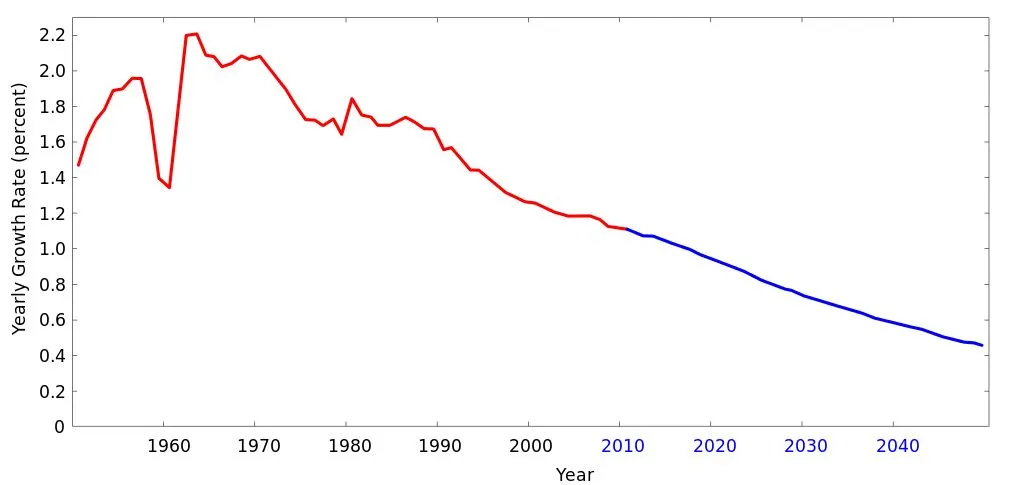
A Malthusian catastrophe is Thomas Malthus’s 1798 prediction that population, growing geometrically, would inevitably outpace food supply, which grows only arithmetically, leading to famine. It hasn’t materialized: technology and the Green Revolution kept food ahead of people, and global population growth has slowed from a 2.3% peak in 1963 to about 0.9% today.
Whenever a child is born, the new parents and the rest of the family are often in a state of ecstasy, as a new member joins the clan. To experience the entrance of a new life into one’s family is a joyful moment that is difficult to describe.

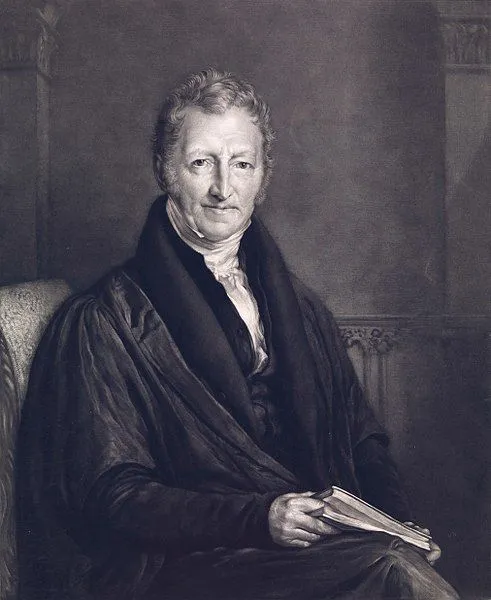
However, a few economists have a dissenting outlook on procreation. When it comes to economists talking about demographics, one of the first names that come to mind is that of Thomas Malthus, who had a decidedly grim outlook on the rising birth rates of humanity.
What Is Malthusian Catastrophe?
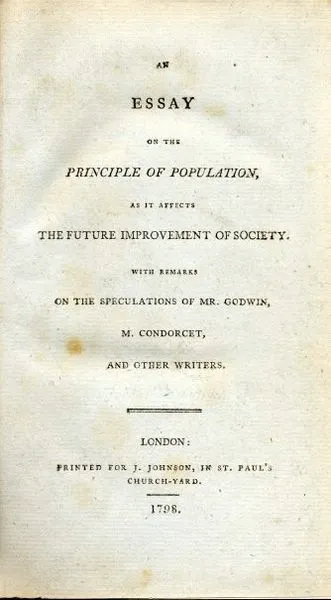
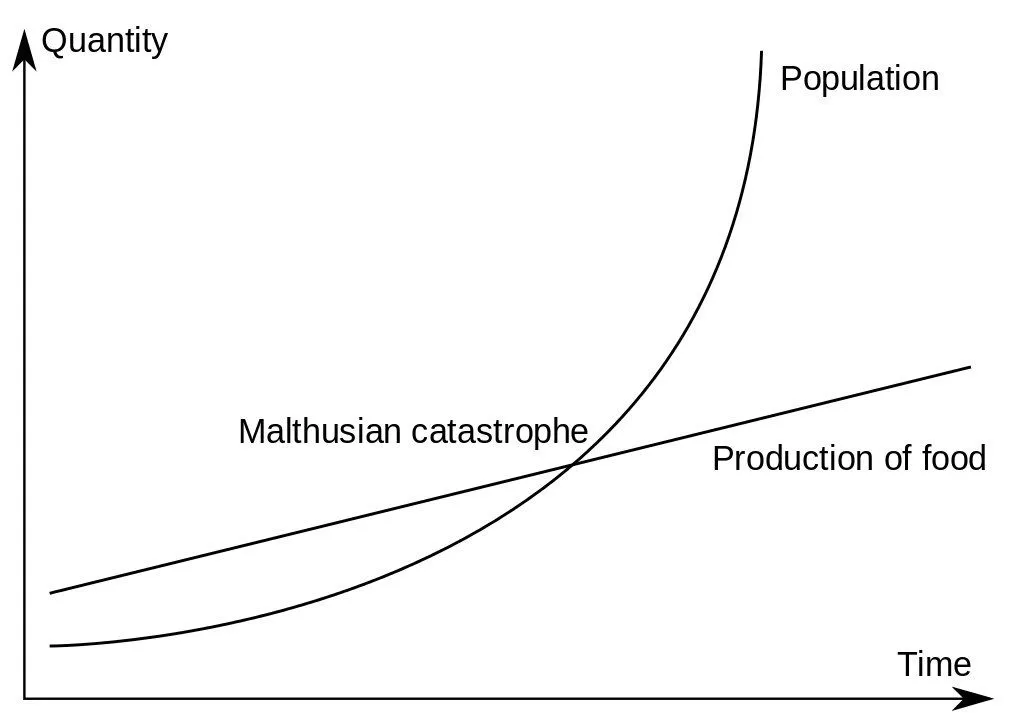
In his seminal book An Essay on the Principle of Population, first published in 1798, Thomas Robert Malthus predicted a grim future based on his theory, which is popularly referred to as the Malthusian Catastrophe. A Malthusian catastrophe (also called a Malthusian check, Malthusian specter or the Malthusian crunch) is a prediction that a growing population will soon outpace the planet’s agricultural production capacity. In other words, at some point in the near future, there will be far too many people and too limited a food supply, leading to great unrest.
Malthus was of the opinion that the growth of the human population is geometric, whereas food production would grow arithmetically, which would ultimately lead to famine and starvation, lest the births be controlled in some way.
Some of you may need a refresher on geometric and arithmetic progression to understand Malthusianism better. Here it is:
A geometric progression refers to the mathematical sequence of numbers wherein each term (number) after the first term is derived by multiplying the previous term by a (positive) integer called the common ratio. An example of a geometric sequence:
3, 9, 27, 81, 243
Here the common ratio is 3. Subsequent numbers after ‘3’ in the above sequence are obtained by multiplying with 3 (the common ratio).
Arithmetic progression, on the other hand, is the mathematical sequence wherein there is a constant difference between consecutive terms. For example, an arithmetic sequence would be something like:
4, 7, 10, 13, 16, 19
Here the common difference is also 3. You see, when you subtract the next term by the previous term, the difference (‘3’ in this case) remains constant throughout.
Now, coming back to the Malthusian Catastrophe, Malthus opined that population growth would be geometric, i.e., growing rapidly over time, whereas food resources would only grow in an arithmetic (or linear) progression. At some point, population growth would overwhelm agricultural output, creating the crisis of a limited supply of food for the sea of mouths to feed.
Malthus argued that the short-term gains of an improved standard of living would soon be undermined as human population growth would exceed the production capacity of food, forcing the living standard back to mere subsistence.
Preventive And Positive
Malthus believed two types of population checks could defer such a Malthusian catastrophe: preventive and positive.
A preventive check is one in which people make the voluntary decision to delay marriage and abstain from mating or procreation, citing the lack of resources for future generations to survive. Malthus felt that humans could not simply turn a blind eye to the consequences of uncontrolled population growth and would need to take voluntary actions to keep population growth under control.
A positive check, on the other hand, is an event or condition that shortens the life span of human beings through something drastic, such as wars, epidemics, pandemics, floods, famine, etc. Malthus also included poor health and economic conditions as a part of positive checks.

Proponents Of Malthusian Thought
Malthusianism influenced the work of two famous biologists, Charles Darwin and Alfred Russel Wallace. In On the Origin of Species (1859), Darwin described the struggle for existence as “the doctrine of Malthus applied with manifold force to the whole animal and vegetable kingdoms.” His point was that animals and plants have it even harder than humans, since they can neither increase their food supply artificially nor show “prudential restraint from marriage.” Wallace, for his part, credited the long accounts of war, famine and disease in An Essay on the Principle of Population (the book in which Malthus proposed the theory of Malthusian Catastrophe) with leaving “a deep and permanent impression” on his mind, which, he later recalled, helped him arrive at the key insight behind natural selection: the individuals that survive such relentless checks must, on the whole, be the better-adapted ones.
Was Malthus Right About The World Before 1800?
Here is the irony that trips up many of his critics: Malthus did a rather good job of describing the world that came before him. Economic historian Gregory Clark of the University of California, Davis, calls it the Malthusian economy (often called the Malthusian trap), a system in which technology improves so slowly that any extra food simply turns into extra mouths, pushing incomes back down to subsistence. According to Clark, almost every society until 1800 worked this way, from the foragers of the African savannah 50,000 years ago to England, France, China and Japan in 1800.

The numbers are striking. Clark estimates that the world’s population grew by an average of just 0.05% a year from 10,000 BC to AD 1800, which means the typical woman raised only about two children (2.02, to be exact) who survived to have children of their own. Egypt, for example, had an estimated 4 to 5 million people around 1000 BC, roughly the same number a thousand years later, and about 4.5 million in its first modern census in 1848. That’s nearly 3,000 years of going nowhere.
The trap also worked in reverse, in a way that feels deeply unfair. When the Black Death reached England in 1348, the population fell from about 4.8 million to 2.6 million in just three years. The survivors, now sharing the same land and tools among far fewer people, saw their incomes rise by almost 50% within half a century, as Max Roser of Our World in Data points out. Clark states the grim logic bluntly: in a Malthusian world, good governments that reduced deaths through order and security made people poorer, while bad governments that raised mortality through warfare and banditry made them wealthier.
So why didn’t the trap hold? Because the escape began almost exactly as Malthus was writing. England, the first country to break out, started growing both its population and its income per person at the same time from around 1685 onwards. As Clark notes, Malthus’s ideas were being built into classical economics by thinkers like David Ricardo just as technological progress, for the first time, became fast enough to bring the Malthusian era to a close. In other words, Malthus wrote a near-perfect description of a system that was already on its way out.
Problems With Malthusianism
Economists and critics of the Malthusian Catastrophe have long contended that food can indeed grow geometrically. For the past two centuries, many scientists have argued that Malthus overlooked technological advancement, which would allow humans to stay ahead of the population curve. Food production can also grow in geometric proportions because it is not only about the land, but also about the scientific and technological know-how to utilize the land more efficiently. Advances like seed breeding, soil nutrient replenishment, irrigation, and agriculture mechanization are some of the examples that serve as a good advocate for this claim. Furthermore, the advances in technology in other sectors, such as energy, manufacturing, transport, communications, etc. could help to keep food production on par with the surging population.
Another important element that Malthus failed to factor in was demographic transition, wherein population growth trajectory would cease to grow in geometric progression. In such a demographic transition, societies move from a state of high fertility rates (roughly offset by a high mortality rate) to a state of low fertility rates (accompanied by a low mortality rate).
Malthus failed to foresee advancements in the public health system, the imposition of strict family planning policies by governments, and modern contraception, all of which could result in a dramatic decline in the population growth rate.

How Have We Fared With This Malthusian Portending?
Back in my college years, when we used to study social science, our economics professor mocked Malthusian reasoning. He once said that a Malthusian Catastrophe is a classic example of a naïve forecast gone wild. He argued that it has been more than 200 years since Malthus first proposed this idea and the population has catapulted from around 1 billion back then to roughly 8.2 billion today (2025), yet we haven’t witnessed the “subsistence crisis” predicted by Malthus.
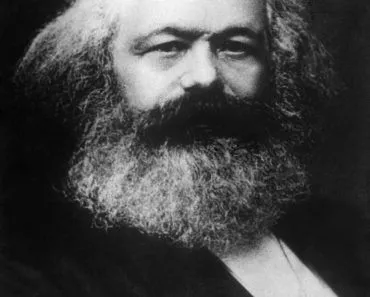
Eminent economists like Karl Marx and Henry George were amongst the early critics of Malthus’s work. George argued that humans are distinct from other species, and can use their brains to leverage even the reproductive forces of nature to their advantage, unlike any other animal. He justified this argument by giving an example of the Jayhawk. George noted that both the Jayhawk and humans eat chickens, but if there are more Jayhawks, there would be fewer chickens. However, if there are more men, there won’t be fewer chickens, as humans, through ingenious methods like poultry farming, would scale up the breeding of chickens to match the rising demand.
As mentioned earlier, Malthus probably couldn’t account for technological advancement that humanity has been able to achieve, which has facilitated us to substantially improve agricultural and food output. In fact, our increase in know-how is not just about getting more output from the same input, but also about exploring new avenues for input.
Industrial Revolution
Watt’s steam engine ushered in the era of the Industrial Revolution, wherein humans mastered the art of using fossil fuels (specifically coal) to power industries. Subsequently, we have discovered methods to harness other forms of energy like oil and gas, electricity, wind, etc. In the last few decades, we have learned to dig deeper in our quest for minerals and precious metals, developed methods to fish with larger nets in the vast oceanic water, discovered ways to divert and control rivers by building dams and canals. In innumerable ways, we have cleverly gotten not just more for less, but also more for more, as we discovered ways to harness power from natural capital to fuel our consumption and thereby improve our living standards.
Green Revolution
The Green Revolution of the mid-20th century, which began in Mexico in 1943 and later spread to India and beyond, introduced high-yield varieties of wheat and rice, backed by chemical fertilizers, pesticides and irrigation, which dramatically bolstered our proceeds from farmland. Norman Borlaug, the American scientist credited with propelling it, won the Nobel Peace Prize in 1970. The Green Revolution has substantially improved crop yield, expanding our food supply and helping to reduce food prices. Thanks to the Green Revolution and other advancements in technology, our food production thus far has mostly stayed ahead of the population growth.
The Population Growth Rate Is Declining
According to Stewart Brand, the editor of Whole Earth Catalogue magazine, Malthusian wariness has been proven wrong since 1963, when the population growth rate peaked, after which it has consistently declined. According to Brand, 1963 was an inflection point, wherein the purported “J-curve” of human population explosion prognosticated by Malthus and his ilk ceased to be true, as the population growth rate lost steam. The annual growth rate peaked at about 2.3% in 1963 and has since more than halved, sliding to roughly 0.9% today. So although the population is still increasing, it is doing so at a steadily slower pace, and we aren’t staring down an imminent food crisis.
Was The Covid-19 Pandemic A Sign Of Malthusian Catastrophe?
Supporters of Malthusian theory argue that Malthus was actually right in many ways. His warnings of “positive checks”, wherein wars and pandemics wipe off big chunks of the population as nature’s way of maintaining balance have turned out to be true. Deaths of millions of people during the two major World Wars are examples they cite to back their stance. Also, many claim that the Spanish flu pandemic of 1918, which killed an estimated 50 million people (roughly 2.5% of the world’s population at the time), was also nature’s positive check. Similarly, the Covid-19 pandemic, which killed an estimated 7 million people worldwide between 2020 and 2023, was perceived by many to be part of a positive check of the kind Malthus described, an event that nature uses to keep the population from overwhelming the food and other resources on the planet.

That being said, the actual catastrophe that he felt was imminent didn’t really materialize. Despite over 200 years having passed since the time he presaged the catastrophe, the world has fed a population eight times larger than the one Malthus knew, without the wholesale collapse he reckoned was inevitable. World hunger is far from solved, of course. After decades of decline, hunger rose again after the Covid-19 pandemic, and it remains above pre-pandemic levels, with high food inflation, the war in Ukraine and extreme weather among the pressures. The UN’s latest estimate is that about 673 million people, or 8.2% of humanity, went hungry in 2024, down from 8.5% in 2023. Crucially, though, this is a problem of distribution, poverty and access, not of the planet running out of calories, which is precisely the runaway scarcity Malthus predicted. The United Nations now expects the global population to peak at around 10.3 billion in the 2080s before it starts to fall, so even the headcount Malthus feared looks set to level off on its own. So while his supporters can argue that the “positive checks” he described are still with us, the actual “catastrophe” he warned about hasn’t materialized.
What Happened To The Population Bomb?
Malthus’s ideas didn’t die with him. In the 20th century, they returned in a louder, more urgent form known as neo-Malthusianism, and its most famous voice was Stanford biologist Paul R. Ehrlich. In May 1968, Ehrlich released The Population Bomb, a quickly written paperback he drafted with his wife, Anne, although only his name appeared on the cover. Its very first sentence set the tone: “The battle to feed all of humanity is over.” In the 1970s, the book warned, “hundreds of millions of people are going to starve to death.”

The book sold some 2 million copies, and Ehrlich became a regular guest on Johnny Carson’s Tonight Show. Yet the mass die-off never came. Famines did strike India, Bangladesh, Cambodia and parts of Africa in the 1970s, but a widely accepted count by British economist Stephen Devereux puts starvation deaths in that decade at 4 to 5 million, mostly caused by warfare rather than overpopulation. Meanwhile, farmers adopted improved seeds, high-intensity fertilizers and better irrigation, and the world today can produce almost three times as much cereal from a given area of land as it did in 1961.
The most famous test of neo-Malthusian thinking was, fittingly, a bet. In 1980, economist Julian Simon challenged Ehrlich to pick any natural resources whose prices should rise over the next decade if shortages were real. Ehrlich chose five metals: copper, chromium, nickel, tin and tungsten. By 1990, the prices of all five had fallen, and Ehrlich mailed Simon a check for $576.07.
To be fair to the Ehrlichs, they later owned up to some of the book’s flaws. In a 2009 look back, they admitted that its opening lines “proved to be among the most troublesome in the book,” and that in 1968 they had not properly emphasized how much education and job opportunities for women, along with access to contraception, could lower birth rates. They still maintain, however, that the book’s core warning about Earth’s finite capacity to sustain civilization holds true.
How Could Society Prevent A Malthusian Catastrophe?
If you strip away the doom, Malthus’s equation has only two sides: the number of mouths and the amount of food. Keeping the second ahead of the first, which is exactly what humanity has managed since his day, comes down to a handful of levers.
- Grow more food on the same land. Rising crop yields are the single biggest reason Malthus’s arithmetic failed. Our World in Data estimates that without the yield gains made since 1961, humanity would have needed extra farmland roughly the size of the United States and India combined to grow the same amount of cereal.
- Waste less of what we already grow. According to the UN Environment Programme’s Food Waste Index Report 2024, the world wasted 1.05 billion metric tons (about 1.16 billion US tons) of food in 2022, nearly one-fifth of all food available to consumers, or 132 kg (291 lb) per person. Households were responsible for 60% of it. The good news is that it can be cut; Japan and the UK have reduced their food waste by 31% and 18%, respectively. (Much of that waste doesn’t simply vanish, either; it can end up choking lakes and seas.)
- Educate girls and expand access to contraception. Think of this as Malthus’s “preventive check,” minus the moral lecture. A 2020 forecasting study published in The Lancet concluded that continued gains in female education and access to contraception will hasten declines in fertility and slow population growth. If the UN’s Sustainable Development Goals for education and contraception were met, the study projected a global population of about 6.3 billion in 2100, compared with 8.8 billion in its reference scenario.
- Fix access, not just production. Today’s hunger is largely a problem of poverty and affordability. The UN’s 2025 report on world food security found that 2.3 billion people faced moderate or severe food insecurity in 2024, 335 million more than in 2019, with high food inflation among the main culprits. Making food reachable for the world’s poorest matters as much as growing more of it.

None of these levers is exotic. They are, in a sense, the very things Malthus couldn’t foresee: human ingenuity on the supply side, and voluntary, informed choices on the demand side.
References (click to expand)
- (2001) Can South Africa Avoid a Malthusian Positive Check? - jstor. JSTOR
- Klyve, D. (2013, August 15). Darwin, Malthus, Süssmilch, and Euler: The Ultimate Origin of the Motivation for the Theory of Natural Selection. Journal of the History of Biology. Springer Science and Business Media LLC.
- WORLD POPULATION TO 2300 - esa
- Darwin, C. (1859). On the Origin of Species, Chapter 3 excerpt. History 60, University of California, Irvine.
- Wallace, A. R. Note on the Passages of Malthus’s Principles of Population. The Alfred Russel Wallace Page, Western Kentucky University.
- Clark, G. Malthusian Economy. University of California, Davis.
- Roser, M. Breaking out of the Malthusian trap: How pandemics allow us to understand why our ancestors were stuck in poverty. Our World in Data.
- Global population growth peaked six decades ago. Our World in Data.
- Green revolution. Encyclopaedia Britannica.
- Mann, C. C. (2018). The Book That Incited a Worldwide Fear of Overpopulation. Smithsonian Magazine.
- Ehrlich, P. R. and Ehrlich, A. H. (2009). The Population Bomb Revisited. The Electronic Journal of Sustainable Development. Hosted by MAHB, Stanford University.
- Simon Says: Meet the Smith School Economist Who Took on the Doomsayers and Won. Robert H. Smith School of Business, University of Maryland.
- Yields vs. land use: how the Green Revolution enabled us to feed a growing population. Our World in Data.
- World squanders over 1 billion meals a day: UN report (Food Waste Index Report 2024). UN Environment Programme.
- Vollset, S. E. et al. (2020). Fertility, mortality, migration, and population scenarios for 195 countries and territories from 2017 to 2100: a forecasting analysis for the Global Burden of Disease Study. The Lancet.
- Global hunger declines, but rises in Africa and western Asia: UN report (SOFI 2025). Food and Agriculture Organization of the United Nations.
- UN projects world population to peak within this century (World Population Prospects 2024). United Nations.