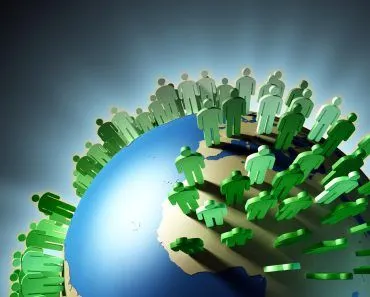
The 8 billionth baby was Vinice Mabansag, born in Manila on 15 November 2022. With around 4 babies born every second, no one can identify the real 8 billionth person. The UN uses population projections to predict the day humanity crosses each billion-person milestone, then designates a symbolic baby born around that date.
The United Nations announced that November 15, 2022 is the day of 8 billion; the total population of the world now numbers in the 8 billion range. A baby girl named Vinice Mabansag, born at Manila’s Dr. Jose Fabella Memorial Hospital at 1:29 AM local time that day to a family from Tondo, was announced to be the 8 billionth human on the planet. After her, all babies born will be 8,000,000,001, and then 8,000,000,002, and then 8,000,000,003, and so on.
However, there are 4 babies born every second. See how fast this world population ticker is ticking? How then can we possibly know which baby marks our jump into the next billion?
To even begin dreaming of pinpointing the 8-billionth baby, we need to see how we calculate populations and then project their numbers in the future.
Getting Statistics On The Population
Governments have been keeping census tallies for thousands of years; the first known census was taken by the Babylonian empire in 3800 BCE.
A census is a survey about the population of an area. It contains a count of the total population, as well as information about the population, such as gender and sex, religious affiliations, socio-economic information, sizes of families, and more. This helps governments, organizations, and policy makers identify problems or shortcomings, make better decisions to address issues, and identify the effects of existing policies.
Countries typically take a census every 5 to 10 years.

Through census data, statisticians, data analysts and population experts infer a number of statistics, such as the birth rates (number of individuals born per 1000 population within a time frame, usually a year), total fertility rates (the average estimate of how many children a woman will have over her lifetime), mortality rates (the number of deaths within a population during a period of time), and net migration rates (the difference between the number of people who immigrated out of the country and those emigrating to the country).
Governments will often release this data for the public, researchers, think tanks, policy organizations, and the United Nations.
Projections Of The Future Population
The United Nations is who we can credit for announcing our 8 billion person day. Since 1946, the United Nations has been collecting and analyzing data of the world’s population. In the same year, they set up the Population Division, which is still the division today that analyzes global population trends. The important one for this article is population projections.
Projecting the trends of future populations became important when we realized that the world might become so populated with humans that it would cause an economic and social crisis.
In 1798, Thomas Robert Malthus, an English economist (among other things), published ‘An essay on the principles of population’ where he states (in essence) that we won’t be able to feed a population that is exponentially growing, eventually leading to some catastrophe. If that sounds too dire then you have company, as the idea has been and is still being debated.
Nonetheless, some experts argue that our planet can support no more than about 11 billion human beings. The good news is that we’re unlikely to test that ceiling. The UN’s World Population Prospects 2024 now projects the global population will peak at around 10.3 billion in the mid-2080s and then slowly decline (an earlier and lower peak than the 11 billion figure floating around in older estimates).
That’s something to look forward to, provided technology has figured out how to cryogenically freeze us.
There are many methods and models out there to project the future population. Besides the United Nations, there are four other institutes across the world performing their own population projections.
However, what all these models need are some key factors to base their model upon. Projections are based on past demographic data, as well as present data. The data is essentially all the information in a nation’s census that we spoke about earlier. Comparing our current data with past data, we see that the overall world population increase is slowing down, and that population expansion is currently at its slowest rate since 1950.
Out of these data points, fertility rates are the most important. Decreasing fertility rates will also predict how rapidly a population will grow in the future.
This decrease in overall population growth resulted from advancements in science and technology, which allowed individuals to live longer through access to preventative health care, such as vaccines, as well as better treatment for diseases. Standard of living and literacy rates have also increased overall, and as people move up the socioeconomic scale, the fewer children they are likely to have.
Knowing how such factors affect the population helps project the future of the population.
According to the United Nations’ current estimates, we could have our 9 billion day sometime in 2037 (give or take a few years).
Is The 8-billionth Baby REALLY The 8-billionth Baby? Or Is It Just Symbolic?
We know of four “x billionth babies”, each of them brought into the world with differing levels of fanfare. You’ve met the eight billionth baby. The seven billionth was Sadia Sultana Oishee, born in Bangladesh on 31 October 2011. The six billionth was Adnan Mević, born in Sarajevo, Bosnia and Herzegovina, on 12 October 1999, just minutes after midnight (then-UN Secretary-General Kofi Annan was photographed cradling him). The five billionth was Matej Gašpar, born in Zagreb (then part of Yugoslavia) on 11 July 1987. And the list ends there; no one bothered to crown a “four billionth baby” when the world quietly crossed that mark around 1974.
The United Nations may have predicted when the world would hit the next population milestone, but no amount of data collecting and analysis could ever tell you exactly which baby is the x-billionth. That level of accuracy would require a preposterous level of unnecessary and constant monitoring to be accurate about which new human gets an arbitrary title that we’ve constructed for our own entertainment.
These babies are symbolic, probably chosen by an official sitting at some desk in one of the United Nations offices. Considering that the media is already on the scene at the time of birth tells us that it is probably pre-determined that a particular baby from a country and region will be chosen.
Usually, the children are born at the same time Cinderella leaves the ball, as soon as possible after the clock strikes 12.
When Did The World Reach Each Billion?
If you have ever searched for "the 1 billionth person" or "the 4 billionth baby" and come up empty-handed, there is a good reason. The tradition of crowning a symbolic billionth child is surprisingly new. For most of these milestones, the world simply ticked past a round number with no name attached to it at all.
Here is roughly when demographers reckon we crossed each threshold:
- 1 billion, around 1804
- 2 billion, in 1927, some 123 years later
- 3 billion, in 1960, just 33 years after that
- 4 billion, in 1974
- 5 billion, in 1987
- 6 billion, in 1999
- 7 billion, in 2011
- 8 billion, on 15 November 2022

Notice how the gaps shrink and then begin to stretch out again. It took over a century to add the second billion, but only about a dozen years each to add the fifth, sixth and seventh. That acceleration through the twentieth century is exactly why population growth became such an anxious topic. The very first person handed a "billionth baby" title was Matej Gašpar, born in Zagreb on 11 July 1987, the day the United Nations Population Fund marked as the Day of Five Billion. The crossings of one, two, three and four billion all came and went with no ceremony and no chosen child, which is why there is no "1 billionth person" or "4 billionth baby" for you to look up. The whole ritual is younger than most of the milestones it celebrates.
How Many People Are In The World Right Now?
Short answer: a little over 8.2 billion. The United Nations Population Fund put the world total at about 8.23 billion for 2025, and the UN’s World Population Prospects 2024 pegged the planet at 8.2 billion in 2024. Because births still outnumber deaths across the world, that total keeps climbing, and live counters such as Worldometer had already nudged past 8.3 billion by 2026.

The exact figure is always an estimate rather than a literal headcount. No one is standing at the door of the planet with a clicker; the number is stitched together from national censuses, birth and death registrations, and survey data, then projected forward to today. That is also why two reputable sources can quote figures tens of millions apart on the same afternoon and both be right.
The more interesting part is the trend. Growth is still positive, but it is the slowest it has been since 1950, and the UN expects the population to peak at around 10.3 billion in the mid-2080s before it starts to fall. So the number you see ticking upward today is, in the grand scheme, already coasting toward its high-water mark.
Conclusion
For the UN and the world, population projections serve to guide us into the future, and to better plan for the Sustainable Development Goals. The projections aren’t perfect. They have high confidence over 20 to 30 years; in other words, we can be pretty sure what the population of a country will look like in 2050, but the longer one projects into the future, the less confident we can be about the estimate.
The UN does keep refining and reanalyzing their projections when new data comes in. Its 2019 revision had pegged the eight-billion mark for sometime in 2023, but the 2022 revision (released that July) pulled the date forward to 15 November 2022 as better data on births and deaths came in. The 2024 revision then bumped the projected ten-billion day three years later, to 2061, after fertility rates in China and several other large economies fell faster than expected.
There are many events no one can foresee, no matter how sophisticated our data analysis models become. Think of the unpredictability of wars, famine, pandemics, and outer space colonization (if Elon Musk and Jeff Bezos have their way). We only now have a decent understanding of how the COVID-19 pandemic has affected the population, and even though some individuals had warned us about an imminent pandemic, they had no idea when it would come or how deadly it would be.
References (click to expand)
- World Population Prospects 2024. United Nations Department of Economic and Social Affairs, Population Division
- International Data Base: Population Estimates and Projections .... The United States Census Bureau
- Population Facts - www.un.org
- Five key findings from the 2022 UN Population Prospects. Our World in Data
- Adam, D. (2022, November 15). World population hits eight billion — here’s how researchers predict it will grow. Nature. Springer Science and Business Media LLC.
- Lutz, W., & KC, S. (2010, September 27). Dimensions of global population projections: what do we know about future population trends and structures?. Philosophical Transactions of the Royal Society B: Biological Sciences. The Royal Society.
- Day of 8 Billion | United Nations. The United Nations Mission in South Sudan
- Population Growth. Our World in Data
- World Population Dashboard. United Nations Population Fund (UNFPA)