No one counts every person directly. The world population (about 8.2 billion in 2025) is estimated by the UN, which combines each country’s census data with ongoing birth, death and migration records. Because counts are uneven and constantly changing, there is a 1-2% margin of error, so an exact figure is impossible.
There has been a lot of talk regarding global population in recent years, particularly in terms of sustainability, resources and the future of our planet. The global population currently hovers around 8.2 billion, according to multiple sources, and continues to increase, which is worrying to many people.
However, with 193 United Nations member states (and a couple of widely recognized non-members, such as Vatican City and, for those who count it, Taiwan), it seems impossible to accurately assess how many people there truly are at a given moment. Obviously, there are people dying and being born every second of every day, so how is the global population measured?
Short Answer: By combining national census data with birth, death and migration records, the UN produces a rough estimate of global population and growth, but there is still a 1-2% margin of error, making a definite population number impossible to determine.
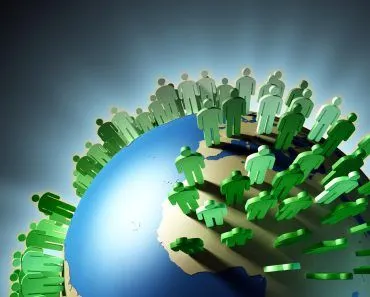
Welcome To Earth: Population… ?
For approximately the past 700 years, since the Great Famine of 1315 and the Black Death in 1350, the population of the planet has experienced continuous growth, meaning that the total number of people on the planet has steadily increased. Estimates are that the global population back then was around 370 million people. Since then, the growth rate hovered between 1-2% for decades, with fluctuations occurring at regular intervals, before slowing sharply in recent years to under 1%.
Notably, the highest population growth rates occurred in the late 1960s, when the rate climbed over 2% for a brief period of time. Independent nations had a multitude of ways to measure population, from door-to-door censuses to vague estimates based on reported births and deaths. However, it wasn’t until 1946, when the United Nations established the Population Commission (now known as the Commission on Population and Development), that we began to have a more comprehensive picture of global population numbers.

The total tally of people on Earth is dependent on many different things, primarily the reliability of nations reporting their own population totals. Every couple of years, the UN updates its country-by-country population growth estimates (the latest revision, World Population Prospects 2024, came out in 2024), based on figures collected directly from governments, as well as numbers from the World Health Organization (WHO), UNICEF, Demographic and Health Surveys (DHS), and the UN Refugee Agency (UNHCR). By combining these numbers and estimates, an overall growth rate is established for the planet, which is used as the metric until the next revision. If you visit a “Global Population Counter” and see the number continually tick upwards, often multiple times per second, that is generally following the rate established by the UN’s Population Division.
Which Countries Have The Most People?
So where do all of these 8.2 billion people actually live? The answer is surprisingly lopsided. Just two countries, India and China, are home to more than a third of everyone on the planet. As of 2023, India officially overtook China to become the world’s most populous nation, and the gap has kept widening ever since. India now has roughly 1.43 billion people, with China close behind at around 1.41 billion, although China’s total has actually begun to shrink as its birth rate falls.

After that titanic pair, the numbers drop off a cliff. The United States sits in third place with about 342 million people, followed by Indonesia (roughly 285 million), Pakistan (around 240 million), Nigeria (about 224 million), Brazil (roughly 213 million) and Bangladesh (about 170 million). In other words, the ten largest nations together account for well over half of humanity, while the remaining 180-plus countries share the rest. This lopsidedness is also why the accuracy of the global count leans so heavily on a small handful of governments, and why a shifting demographic balance ripples so far. If India or China revises its census figures even slightly, the world total lurches by millions.
Uncertainty In All Things
While collecting all of these numbers is the most accurate way to count the global population, and improvements are constantly being made to the system, there is still a huge level of uncertainty to every metric and estimate. The UN admits a margin of error of 1-2% in most cases, which seems negligible, until you remember how big of a number 8.2 billion people truly is. Even a 2% error represents roughly 160 million people! That’s more than the entire population of Bangladesh, one of the most populous countries in the world.
The inaccuracy of these numbers is unavoidable for many reasons. Depending on where you live, the infrastructure and effort to accurately count population will be vastly different. In the US and the UK, for example, a national census is conducted every 10 years; Germany ran full censuses in 2011 and 2022, while Italy switched in 2018 to a “permanent census” that samples a slice of households every year rather than counting everyone at once. Other countries take a full census more regularly, such as Australia, which has one every 5 years.
Those countries that have censuses are the most accurate, although strict documentation of births and deaths can also give a relatively honest picture of a nation’s population, and these numbers are actually updated more regularly. Another crucial metric to factor in is migration and refugee crises, as this can diminish one nation and bolster another, often without formal documentation. In certain cases, this can be in the millions (e.g., 1979 – 6.3 million people moved from Afghanistan to Pakistan and Iran; 2011 – 12 million displaced from Syria to Turkey, Lebanon, Jordan and Western Europe).
Finally, in many developing nations, there is simply not a reliable system in place to document births and deaths, resulting in estimates being made, but their accuracy is hardly credible. Furthermore, many countries have difficult to reach areas, so door-to-door censuses overlook large swaths of the population.
By making these predictions in five-year chunks, these projections discount factors that can change birth and death rates. if fertility rates drop even incrementally, it can cause a huge change in national population growth, just as small increases in birth rates. This can be caused by economic instability, resource limitations, climate change, conflict, disease outbreaks, etc. For example, the WHO factors in AIDS outbreaks and epidemics in its numbers for African population change and growth, which will subsequently change the remaining population’s ability to reproduce (e.g., fewer people means fewer babies being born, thus changing the overall rate).
Fertility rates across Asia, where contraception and family planning are widely available, now average around 1.9 births per woman, whereas in sub-Saharan Africa that rate climbs to roughly 4 births per woman. These average rates can change quickly, however, based on a regime change, or policies regarding abortion and contraception. If a country sharply restricts or expands access to contraception or abortion services, its fertility rate can shift well before the next UN revision lands.
To put it simply, population analysts do the best they can with the information available to them from a wide range of sources, but making a firm statement on total growth rate or population is genuinely difficult. The UN settled on November 15, 2022, as the symbolic “Day of Eight Billion,” yet it freely admits the real date could have been months earlier or later. The annual growth rate has now slipped below 1% (around 0.85%), and the UN projects the population will peak at just under 10.3 billion around 2084 before starting to decline. Frankly, given the margin of error, we won’t ever really know the exact figure on any given day!
If you’re still curious about population growth and dynamics, here is a helpful video explaining a bit more about the history of people on Earth….
How Do We Know The Population Of The Distant Past?
None of this modern machinery existed in 1350: no national censuses, no systematic birth and death registries, no UN revisions. So how can anyone claim that the world held around 370 million people back in 1350, long before any of it existed? The honest answer is that historians and demographers are making careful, educated estimates rather than reading a number off a ledger.
The trick is to hunt for any old record that counted people, or the things attached to them. Tax rolls are the goldmine here, because governments have always wanted to know who owes them money. The most famous example is England’s Domesday Book, a sweeping survey commissioned by William the Conqueror and completed in 1086. It never set out to count people at all (it recorded landholdings and their value), but in doing so it tallied nearly 269,000 households. Historians multiply that figure by an estimated household size and add back the groups the survey skipped, arriving at a total English population of somewhere between 1.2 and 1.6 million.

Beyond tax records, researchers lean on church parish registers of baptisms, marriages and burials, which let them reconstruct entire family trees and work out historical birth and death rates. They also draw on poll-tax returns and archaeological clues about the size of ancient settlements. Every one of these sources is patchy and covers only part of a country, so the further back you go, the wider the error bars grow. A modern estimate might be off by 1 or 2 percent; an estimate for the year 1350 could easily be off by tens of millions. That is why historical population figures are almost always quoted as rounded ranges rather than exact counts. Nobody claims to know precisely how many people were alive during the Black Death, only roughly how many.
References (click to expand)
- United Nations, Department of Economic and Social Affairs, Population Division - www.un.org
- Exponential growth & logistic growth (article) - Khan Academy. Khan Academy
- World Population Clock (LIVE). Worldometer
- World Population Prospects 2024. United Nations, Department of Economic and Social Affairs, Population Division
- Day of 8 Billion. United Nations
- Peak global population and other key findings from the 2024 UN World Population Prospects. Our World in Data
- List of countries and dependencies by population. Wikipedia
- Domesday Book. Wikipedia