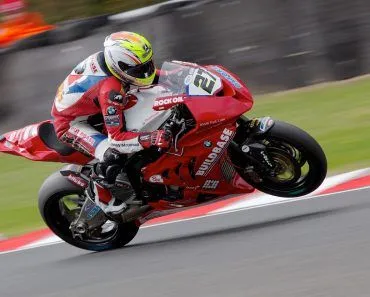
Leaning is what keeps a motorcycle from tipping over on a sharp turn. In the rider's turning frame, the centrifugal force (the ‘center-fleeing force’) pushes outward, away from the center, and tries to topple the bike. Leaning in lets gravity create an opposing torque about the tires' contact point that cancels it, so the bike stays upright.
If you’ve ever watched motorbike racing events, you would have marveled at how the motorcyclists manage to bend so far, so close to the ground, and still not tip over. God help you, if ever you tried to do that, the outcome may not set a great example for your friends and maybe everyone else (the ones not even related to you).
Have you ever thought about that? How do bikes manage to bend so much without tipping over?
Well, it’s time to unravel this strange asphalt mystery.
An important factor in this is the angle of banking. You would have seen roads which have sharp turns are built a bit higher along the outer edge, so the surface tilts down toward the inside of the bend. This is called‘banking of roads’. Banking of roads also facilitates maneuvering tight turns without tipping over. But let’s talk about the forces which act on a motorbike when it takes a sharp turn.
Newton’s Second Law
As if the real ones were not good enough, there is a whole other world, a world of “fake” forces. But before we get to the fakes, let’s be clear about the real one. We know that when a force is applied to an object, its motion (or the way it is moving) is impacted. For example, when you ride a bicycle that is moving slowly, it attains speed and begins to move faster. This is how force impacts motion; it has a direct relationship with the acceleration of a body, according to Newton’s Second Law:
F = m × a
In plain words, the net force on an object equals its mass times its acceleration. Flip that around and it says something important: if an object is accelerating, there must be a net force on it. Hold on to that, because a motorcycle rounding a bend is accelerating the whole time, even when the speedometer needle never moves.
Introducing Fake Forces
Newton’s second law, in its simple F = ma form, only works cleanly in non-accelerating (inertial) reference frames. But when you are sitting inside an accelerating car, you naturally want the law to hold from your point of view too, as it always seems to. The trick physicists use is to add a fake (fictitious) force to the whole system so the bookkeeping still balances.
This fake force acts in the direction opposite to the acceleration. Think of a small toy hanging from the rear-view mirror. When the car accelerates forward, the toy swings backward; in the car’s frame, it is as if an invisible force is shoving the toy back. The string then tilts until its tension lines up to support the toy against both gravity and that backward fake force. As long as the car cruises at a steady speed in a straight line, there is no acceleration and the toy simply hangs straight down.
How This Applies To Motorcycles
When a motorcycle rounds a bend (taking a turn usually means following a circular path on the road) it is constantly accelerating. Even at a steady speed, its direction keeps changing, and that change is an acceleration pointed toward the center of the circle. We call it centripetal acceleration. In the rider’s rotating frame, the fake force points the opposite way, outward, away from the center, exactly as it should.
This outward fake force has a name: the centrifugal force, also known as the ‘center-fleeing force’. It is the same sensation that seems to throw you against the car door when you swing around a tight corner.
Bending The Motorcycle
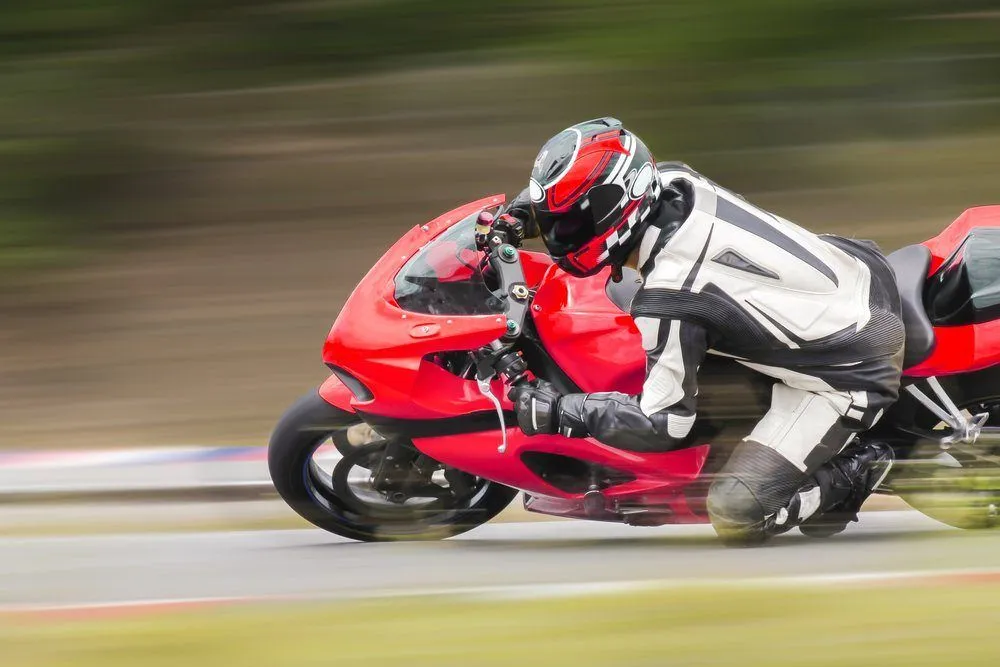
There is a torque acting on the bike when it moves in a circular path. Torque is a measure of how much a force acting on an object tends to rotate it about a pivot. In the case of a motorcycle, the real inward (centripetal) force that bends its path toward the center of the circle is supplied by the friction between the tires and the road. That friction is what actually turns the bike; the centrifugal force is simply how that same situation feels from the rider’s point of view.
Leaning With The Motorcycle
The frictional force (caused due to the contact between the tires and the road) and the normal force (caused by the ground pushing the motorcycle up) have zero torque, since they are both applied at the point where torque is calculated. Look at the figure below:
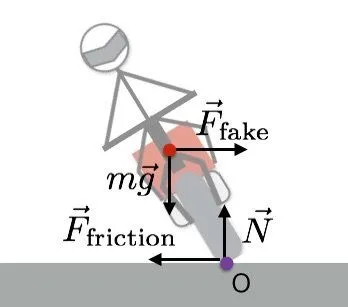
That leaves just the torque from the fake (centrifugal) force and the torque from gravity. These two torques act in opposing directions, so at the right lean angle they cancel out, leaving the bike in balance. Now picture a bike taking the same sharp turn while staying bolt upright: gravity then acts straight down through the contact point, the very point about which we measure torque, so it produces zero torque. With no gravitational torque to oppose it, nothing cancels the torque from the centrifugal force, and the bike is thrown off balance.
In a few words, the torque from the gravitational force cancels out the torque from the fake force, so you don’t tip over. It means that leaning helps a rider stay on the bike while taking a turn at a significant speed. It may sound very strange, but it’s actually true.
In other words, leaning helps because the laws of physics are protecting you!
How Far Does A Motorcycle Lean?

So leaning cancels the centrifugal torque, but by how much do you actually have to lean? Physics hands us a wonderfully tidy answer. The lean angle (measured from the upright) works out to θ = arctan(v²/rg), or equivalently tan θ = v²/(rg), where v is the bike's speed, r is the radius of the turn and g is the acceleration due to gravity. Notice that the rider's mass drops out completely, so a heavy cruiser and a featherweight race bike lean by the same angle through the same corner at the same speed.
Plug in some numbers and it comes alive. A bike holding a steady turn of 10 meters (33 feet) radius at 10 meters per second (36 km/h, or 22 mph) has to sit at roughly 45.6° from the vertical. Raise the speed or tighten the corner and that angle climbs fast, because it depends on the square of the speed. That is exactly why racers on a circuit end up with a knee, and sometimes an elbow, scraping the tarmac: they carry enormous speed through corners, and the geometry demands a huge lean to match.
What About Banking The Road?

Remember the banking of roads we mentioned at the start? Here is where it earns its keep. On a flat road, the entire inward (centripetal) force has to come from friction between the tires and the tarmac. Tilt the road inward, though, and the surface itself starts pitching in. The normal force (the push of the road at right angles to its surface) now points slightly toward the center of the curve, so a slice of it supplies centripetal force for free, without leaning on friction at all.
There is even an ideal speed for a given bank. Engineers call it the rated or design speed, and it obeys the same neat relationship as the lean angle: tan θ = v²/(rg), where θ is now the banking angle of the road. Take the corner at exactly that speed and the tilt alone bends your path around the curve, so in principle you would need no friction whatsoever. Go faster and friction has to keep you from sliding outward; go slower and it keeps you from slipping down the bank. This is why racetracks and highway on-ramps are built with their outer edge raised.
When Grip Runs Out: Why Bikes Skid
This whole balancing act rests on one thing: the friction gripping the tires to the road. And friction has a ceiling. On a flat road, the fastest you can hold a corner of radius r is v = √(μrg), where μ (the Greek letter "mu") is the coefficient of friction between rubber and road. There is a matching limit on lean, too: the tangent of the steepest angle you can hold equals that same coefficient, so tan θmax = μ.
Put numbers to it. Dry asphalt gives a good tire a coefficient close to 1, which works out to a maximum lean of about 45°. That is a lot, but it is a hard wall. Ask for more lean or more speed than the grip can supply and the tires simply let go. On loose gravel, oil, or wet leaves the coefficient plummets, which is why a scooter that felt planted on dry tarmac can skid away on a greasy bend. When the front or rear tire loses its grip mid-corner, the bike drops onto its side and slides, a spill riders call a lowside. It is often the result of carrying too much speed into a turn, or braking hard while already leaned over.
Countersteering: How Riders Start The Lean
One question is still hanging: if leaning is the whole trick, how does a rider get the bike to lean in the first place? The answer is one of the most delightfully counterintuitive facts in everyday physics. To lean (and turn) to the right, a rider briefly steers the front wheel to the left. This is called countersteering, and riders sum it up as "push left, go right".
Here is why it works. Nudging the bars left for a moment steers the contact patch of the front tire out to the left, sliding the wheels out from under the combined center of mass of bike and rider. Gravity does the rest, tipping the machine over to the right and into exactly the lean angle the corner needs. Once the bike has settled at the correct angle, the rider eases the pressure off and the tires track around the curve. Countersteering is at work at every speed, but at a walking pace it is buried under so many tiny balance corrections that most riders never notice they are doing it.
References (click to expand)
- Bicycle and motorcycle dynamics - Wikipedia. Wikipedia
- Steering in bicycles and motorcycles - socrates.berkeley.edu:80
- Why Do Cyclists Tilt When Turning? - Physics Van. The University of Illinois Urbana-Champaign
- How Do Motorcycles Lean So Far Without Tipping Over?. Wired
- Countersteering - Wikipedia. Wikipedia
- Banked turn - Wikipedia. Wikipedia
- Lowsider - Wikipedia. Wikipedia
- Turn Radius, Speed, Lean Angle - Steve Munden