Table of Contents (click to expand)
- Background
- Basis Of Comparison
- Depiction In The Movie And Assumptions
- Scientific Accuracy Of The Electricity Generation Scene In The Movie
- What Kind Of Turbine Would Spin Behind The Waterfall?
- Timeline Of Execution And Other Details
- Could 20 Kilowatts Really Light Up A Whole Village?
- Final Verdict
- Miscellaneous Trivia
- A Final Word
The electricity scene in Swades, where Mohan channels a waterfall to a turbine and lights up his village, is broadly accurate. It depicts a real micro-hydroelectric plant, and the physics holds up: a 30 m (98 ft) head and a roughly 20 kW generator are plausible. The main liberties are the few-week build time and the mystery water source.
Movies are amongst the most potent sources of entertainment, but every once in a while, a movie comes along that is more inspirational than entertaining, leaving us with a zeal to aspire towards causes greater than ourselves.
One such movie from the Indian box offices is Swades. Released in 2004 and directed by Ashutosh Gowariker, it stars Bollywood superstar Shah Rukh Khan and went on to accrue critical acclaim and a cult following. For readers outside India, the film follows an Indian-born NASA engineer who returns to a struggling village and brings it electricity (bijli, in Hindi) by building a small hydropower plant. That electricity scene is what we are putting under the microscope here.
Background
Swades (Hindi for one’s own country) is the story of Mohan Bhargava, a successful project manager at NASA. He gives up his cushy job at the prestigious space agency in pursuit of bettering his village, Charanpur, in India.

The salient feature of the movie is the establishment of a self-sustaining hydroelectricity plant in Charanpur without government aid. As the process was recreated in the movie in some detail, its scientific accuracy begs attention, and was the source of some debate.
Basis Of Comparison
A micro-hydroelectricity plant set up in Bilgaon Village, Maharashtra, India is the closest precedent to the movie. However, the set of the fictitious village, Charanpur, is based in another Maharashtrian Village called Wai.
To test the depiction’s accuracy, it is important to know the essential features of such a plant (source).
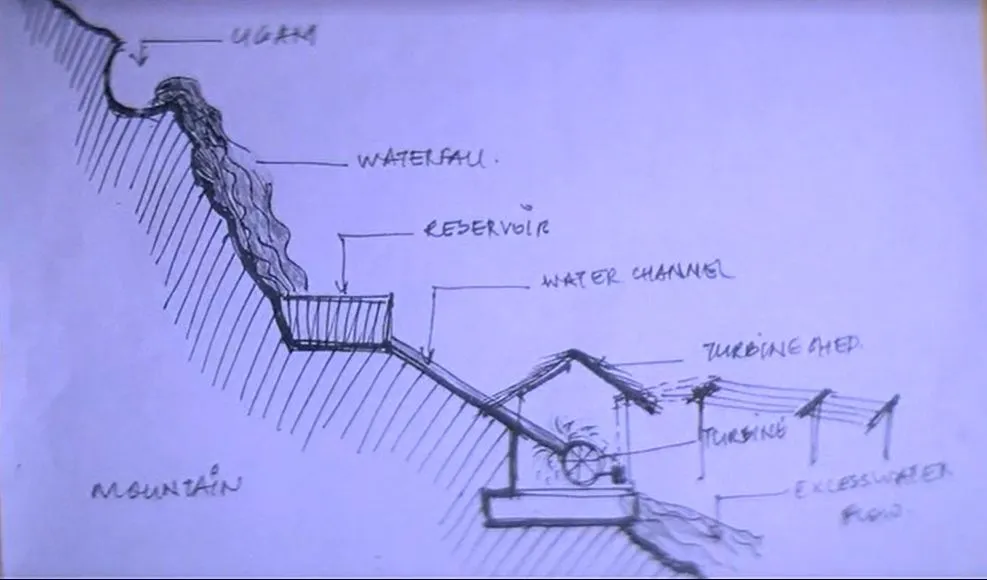
A micro-hydroelectricity plant uses the mechanical energy of water to generate electricity. It consists of a perennial reservoir (tank, waterfall etc.) that can release water from a certain height. This water is channelled to drive a turbine, which in turn moves a generator.
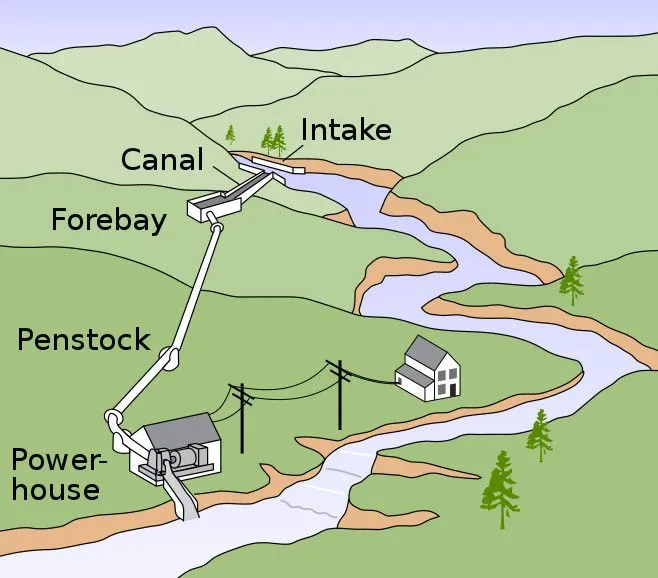
This generator converts the turbine’s motion into electricity, and then supplies it using electrical lines. Here are some noteworthy features of a micro-hydroelectricity plant:
- These plants typically generate a power output in the range of 5 kW to 100 kW.
- The water source must be situated higher than the generator and turbine, in order to provide the necessary head or pressure differential. The height of the water column causes this pressure differential, giving water its potential energy. Thus, hilly outcrops are preferable for such projects.
- The design of the turbine depends on the pressure differential caused by the reservoir’s height.
- Water is fed to the turbine using a penstock. Penstocks are high-pressure pipelines made of steel. Alternatively, wood and concrete may also be used.
- After the water has moved the turbine, it is removed from the power house through a tail race.
- Micro-hydroelectric power plants are relatively inexpensive to set up and are often done by voluntary laborers, as opposed to contracting agencies.
Depiction In The Movie And Assumptions
The project is initiated with the construction of a square reservoir supplied from a waterfall of dubious origins. This reservoir, measuring 5 m (16 ft) along each side and 1 m (3.3 ft) in depth, has a volume of 25 m3, or 25,000 liters (about 6,600 US gallons).
It supplies a generator rated at 20kW using a metal penstock. This pegs the power generation capacity at 20kW.

Scientific Accuracy Of The Electricity Generation Scene In The Movie
The scientific accuracy of representation is solely judged on inputs from the movie, and corollaries drawn from that point.
Here is a small snippet of the electricity generation scene from the movie.
Flowing Water For Hydro-electricity
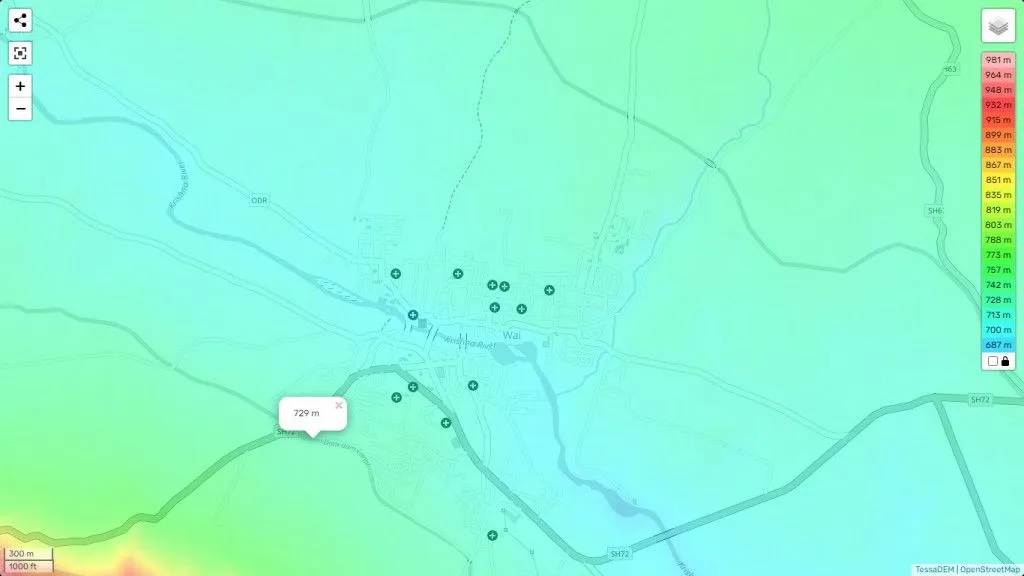
The placement of the reservoir is in accordance with the design of a micro-hydroelectricity plant. To establish the pressure head of water owing to the reservoir’s height, we must consider the topographical situation of Wai.
As the reservoir was fed by a waterfall, it can be assumed to be in the vicinity of the modern-day Dam Dam Canal, at a height of 726 m (2,382 ft) above sea level.
Similarly, the generator can be assumed to be located in the vicinity of the settlements, to reduce transmission losses. The settlements are found at a height of 696 m (2,283 ft) above sea level.
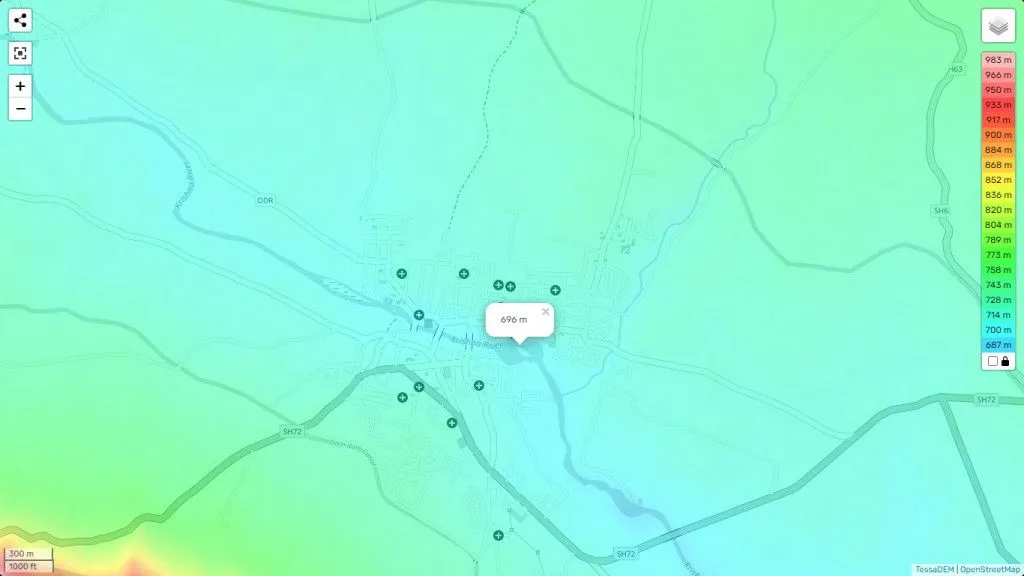
The difference between the lowest and highest altitudes gives us a pressure head of 30 m (98 ft). This head amounts to a total pressure of about 294 kilopascals (43 psi) using the formula P = ρgh, where:
- P = Resultant pressure
- ρ = density of water (1000 kg/m3)
- g = acceleration due to gravity (9.81m/s2)
- h = head (30m)
Furthermore, the hydraulic power available is the product of the resultant pressure and the volumetric flow rate of water. Treating the output as capped at 20 kW (and ignoring turbine and generator losses), a flow rate of roughly 0.07 m3/s (about 70 liters, or 18 US gallons, per second) is obtained.
However, this flow rate would drain the 25m3 reservoir in a little under 6 minutes. As the source of water replenishing the reservoir is of inexplicable origins, there is certain doubt regarding the sustainability of the film’s operation.
Transmission Of Electricity
Electricity passes through a series of contraptions like surge arrestors and transformers for regulated and even transmission. However, micro-hydroelectric plants may often get away without having to use them. The 230V the movie shows is, in fact, bang on the standard: India's domestic single-phase supply is specified at 230V (Indian Standard IS 12360), with the line voltage allowed to drift roughly between 207V and 253V in practice. So the figure itself is realistic, even if the everyday voltage at the socket is often loosely called "220 volts."
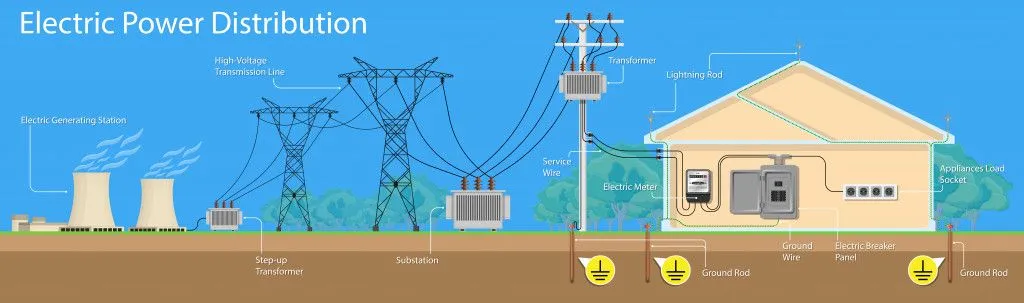
It may be assumed that some voltage is lost in transmission. Yet, if the operating voltage is assumed to be 230V, it does have some implications. If the houses are connected in parallel, this implies a greater load on common appliances, like fans and tube lights. If connected in series, the houses furthest from the grid risk receiving less voltage.
The absence of further clarity, like the electrification of individual homes, makes the practicality of this setup unclear. Another misrepresentation is the dramatic moment where the bulbs snap on only once the meter hits 230V. In reality, an incandescent bulb's tungsten filament does not wait for a threshold; it begins to glow a dull red at a small fraction of its rated voltage and simply gets progressively brighter and whiter as the voltage climbs. The all-or-nothing flicker shown on screen is dramatic license.
What Kind Of Turbine Would Spin Behind The Waterfall?
Have you ever wondered what the spinning heart of Charanpur's little power plant would actually look like? The film keeps its camera on the waterfall and the glowing bulbs, but the real work happens at the turbine, and the type an engineer would pick is far from arbitrary. As the U.S. Department of Energy notes, the choice of turbine rests mainly on the head (the height of the standing water) and only secondarily on the flow rate.

At the extremes, a Pelton wheel, an impulse turbine that fires jets of water at spoon-shaped buckets, is built for very high heads, often several hundred meters. A Kaplan or propeller turbine sits at the opposite end, handling very low heads (below roughly 30 m) fed by large volumes of water. The Francis turbine, the workhorse inside most conventional dams, covers the middle ground, from about 40 m up into the hundreds.
Charanpur's estimated 30 m (98 ft) head with its modest flow lands right on the boundary between these families, which points to the obvious candidate: a crossflow turbine, also known as a Banki turbine. Here a flat sheet of water passes through a drum-shaped runner twice, once on the way in and once on the way out. Crossflow turbines work across an unusually wide span of heads, from under 2 m to around 200 m (though they are usually chosen below 40 m), at outputs of 5 to 100 kW, exactly the bracket the film is in. They are also simple, cheap and easy to maintain, which is precisely why they dominate the kind of community-built micro-hydro scheme Swades depicts.
Timeline Of Execution And Other Details
The timeline of establishing the power plant (in less than 3 weeks) is very exaggerated. There is also no mention of the diameter of the pipe used to make the penstock.
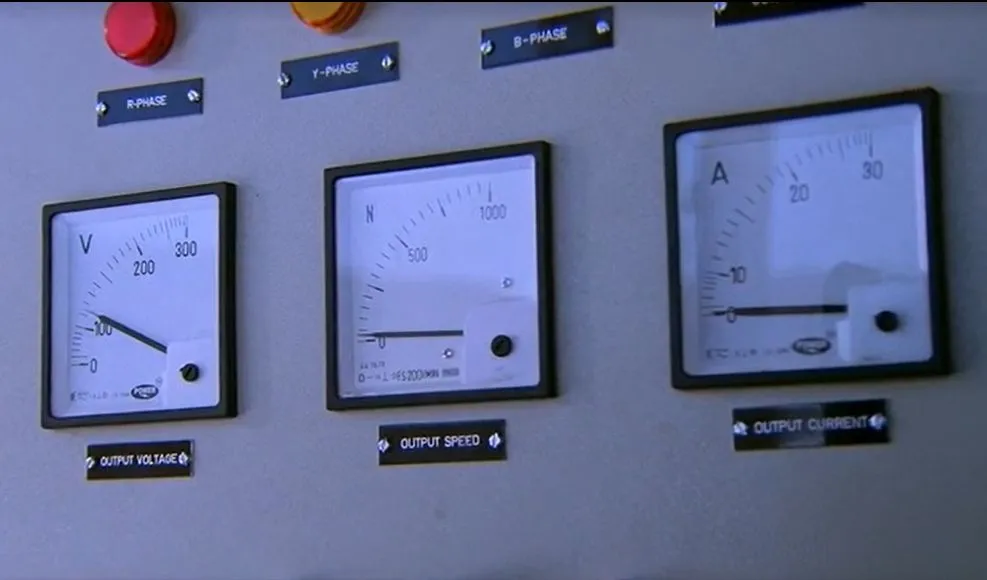
The distribution board attached to the generator has 3 gauges that read voltage, current and output speed in RPM at the generator shaft. However, only the voltmeter is shown to be functional, even though current is being drawn by test bulbs and the house light.
Similarly, there is no mention of the tailrace to which water is directed after passing the turbine stage. It is assumed to be diverted to the Krishna River in Wai, where the movie is directed.
Could 20 Kilowatts Really Light Up A Whole Village?
So could a single waterfall and a 20 kW generator genuinely light an entire village, or is that the film's biggest stretch? Here the arithmetic is surprisingly forgiving. A rural home running a handful of LED or CFL lamps and a ceiling fan draws only tens to a few hundred watts, and, crucially, not every household pulls its peak at the same instant. Allow for that diversity and 20,000 watts comfortably stretches across well over a hundred homes for lighting and light appliance use.

We do not have to take this on faith, because the scene has a real-world twin. Swades was inspired by a micro-hydro plant that villagers built themselves at Bilgaon in Maharashtra, the very plant this article uses as its benchmark. On 14 January 2003, a single 15 kW generator there lit every house in the village, some 180 to 190 tribal households, plus a residential school of 300 children, all drawing on a waterfall just 9 m (30 ft) high.
In other words, a plant smaller than the one in the film had already electrified a whole village in real life. The premise that Charanpur could be lit on roughly 20 kW is, if anything, one of the most defensible things in the entire sequence. What the movie stretches is not the energy budget but the few-week timeline and that mysterious, never-explained source of water, as we have seen.
Final Verdict
To appeal to the masses, the electrification of Charanpur is described succinctly. Omission of certain essential details leaves a lot to assumption, making accurate scientific appraisal difficult.
However, there are no glaring inaccuracies from a scientific standpoint. It is possible to establish a micro-hydroelectric plant along the lines of the movie. Occasional leeway like visible arcing during power transmission can be granted for representation’s sake.
Miscellaneous Trivia
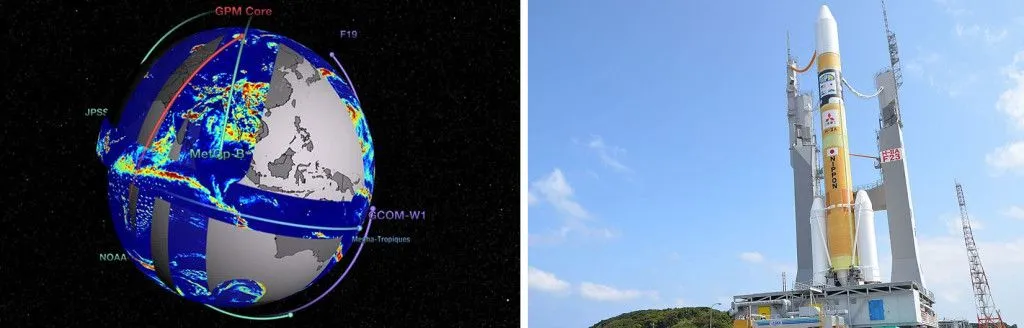
- Mohan was working on a Global Precipitation Measurement (GPM) satellite at NASA. The film shows it being deployed aboard a Space Shuttle.
- Satellites do not need space shuttles to be put into orbit. This task is achieved by satellite launch vehicles, also known as SLVs. However, space shuttles are the face of global outer-space operations. Thus, its inclusion is essential to establishing gravitas for Mohan’s role at NASA.
- The Global Precipitation Measurement mission is a real NASA-JAXA project. Its Core Observatory was not funded by NASA until 2007 and did not actually launch until February 27, 2014, riding a Japanese H-IIA rocket from the Tanegashima Space Center, a full decade after the movie is set. So it would not have been possible for Mohan to oversee its launch in the film's early-2000s timeline.

However, in the wake of the Space Shuttle Columbia disaster on February 1, 2003, the Shuttle fleet was grounded for over two years, with crewed flights only resuming on July 26, 2005 (mission STS-114). A Shuttle launch set in 2004, as the movie implies, would therefore have been impossible.
A Final Word
From a scientific perspective, the movie leaves a lot of holes we wished were plugged. However, as the story of a privileged man abandoning his comforts to uplift the disadvantaged, it is certainly an inspirational tale!
References (click to expand)
- The Bilgaon model - www.hinduonnet.com
- (2009) Micro hydroelectric power plant development in the west .... African Journals OnLine
- (2019) Electricity Generation from Micro Hydro Power Plant at MGM .... ripublication.com
- Archetti, R. (2011). Micro Hydroelectric Power: Feasibility of a Domestic Plant. Procedia Engineering. Elsevier BV.
- (2007) the sustainable management of micro hydropower systems for. The California State University
- Hydroelectric Power. The Bureau of Reclamation, and formerly the United States Reclamation Service
- Hydropower Head and Flow - Renewables First. renewablesfirst.co.uk
- Wai topographic map, elevation, terrain - en-in.topographic-map.com
- GPM Launches at 1:37pm EST 2/27/14 - NASA Global Precipitation Measurement Mission
- STS-114 (Return to Flight after Columbia) - NASA
- Columbia disaster - Encyclopaedia Britannica
- Types of Hydropower Turbines - U.S. Department of Energy (energy.gov)
- Crossflow turbine - Energy Education (University of Calgary)