We notice scalp hair loss because each scalp follicle stays in its growth (anagen) phase for 2 to 7 years, so any lost hair is a long-lived, easily visible strand. In genetically susceptible men, dihydrotestosterone (DHT) gradually miniaturizes scalp follicles, leading to male pattern baldness. Body hair sheds just as routinely, but its growth phase is only weeks to a few months, so the hair is short, fine and replaced before you notice.
As we get older, one of the biggest fears many people have is of losing all the hair on their head. In humans, males tend to lose their hair and go bald much sooner and more frequently than females, and baldness remedies and prevention has become a major industry.
However, the rest of the hair on our body doesn’t seem to suffer the same fate. Most men have arm hair, leg hair, and everywhere-else hair well into their old ages, once the hair on their head is long gone. Why is there such an unfair balance in men?
Well, the truth is, humans do lose their body hair, but based on the different genetic, physical, and chemical processes in the body, it’s hard for us to notice!
A Brief History Of Human Hair
Human beings evolved from primates (monkeys), which are mammals, just like us. It’s important to remember that all mammals are covered in body hair (mostly in the form of fur). Humans, however, aren’t covered in fur for a number of reasons, namely that it makes it harder to cool the body. Our ancient ancestors, traveling long distances (perhaps while persistence hunting) in the hot summer sun, would have needed a way to cool their bodies as they moved. Sweating is the most effective form, which happens in the skin, which fur blocks. Therefore, humans evolved to fill their mobile needs by losing the fur over the course of generations.
That being said, primates and other mammals do experience thinning of the hair or hair loss, and in some primate species, they experience something akin to balding.
Why Do We Have Hair On Our Head?
The hair on human heads has stuck around over millions of years for a different reason. Since the head is the part of the body most commonly exposed to sunlight (and the Equatorial sun of Africa while we were first evolving, no less), hair protects the scalp from overheating, and also reflects much of the UV radiation away from the head.
Recent research has put a sharper point on this. In a 2023 study published in the Proceedings of the National Academy of Sciences, biological anthropologist Tina Lasisi and her colleagues used a heated manikin and human-hair wigs to measure exactly how much solar heat reaches a bare scalp compared with a covered one. They found that even a modest layer of hair sharply cut the solar radiation reaching the skin, and that tightly curled hair blocked the most of all. The likely evolutionary payoff was cooling: as our ancestors stood upright under the equatorial sun with ever-larger, heat-sensitive brains, a built-in parasol over the scalp reduced how much they had to sweat to keep that brain from overheating, conserving precious water in the process.
The hair on the top of the head, the sides of the head, and the rest of the body are all slightly different, but we’ll get into that in the next section…
Why Do We Have Hair On The Rest Of Our Body?
If we shed the fur to keep cool, why hang on to the fine, wispy hair that still covers almost every inch of us? It turns out those barely-there hairs earn their keep. Each one is wrapped in nerve endings, which turns your skin into a sensitive early-warning system. In a 2012 study in the journal Biology Letters, researchers at the University of Sheffield placed a hungry bed bug on volunteers’ forearms and found that people detected it far faster on an unshaved arm than on a freshly shaved one. The hair both slows a crawling parasite down and amplifies the tiny tug of its movement, giving you a better chance of feeling and swatting a bug before it bites.

Body hair also helps with temperature. When you get cold or scared, tiny muscles at the base of each follicle contract and pull the hairs upright, the effect we call goosebumps. In a furry ancestor, that fluffed-up coat trapped a thick layer of warm air against the skin; in us it is mostly a leftover reflex, but the fine hairs still hold a thin insulating layer close to the body.
Finally, the coarser hair in your armpits and groin sits directly over apocrine sweat glands. That hair traps and slowly releases your natural scent, which many researchers think plays a role in the subtle chemistry of human attraction, and it also cuts down on skin-to-skin chafing when you walk or run. So the body hair we kept is not just evolutionary leftovers; it is quietly pulling several small but useful shifts.
So Why Do We Lose Our Hair?
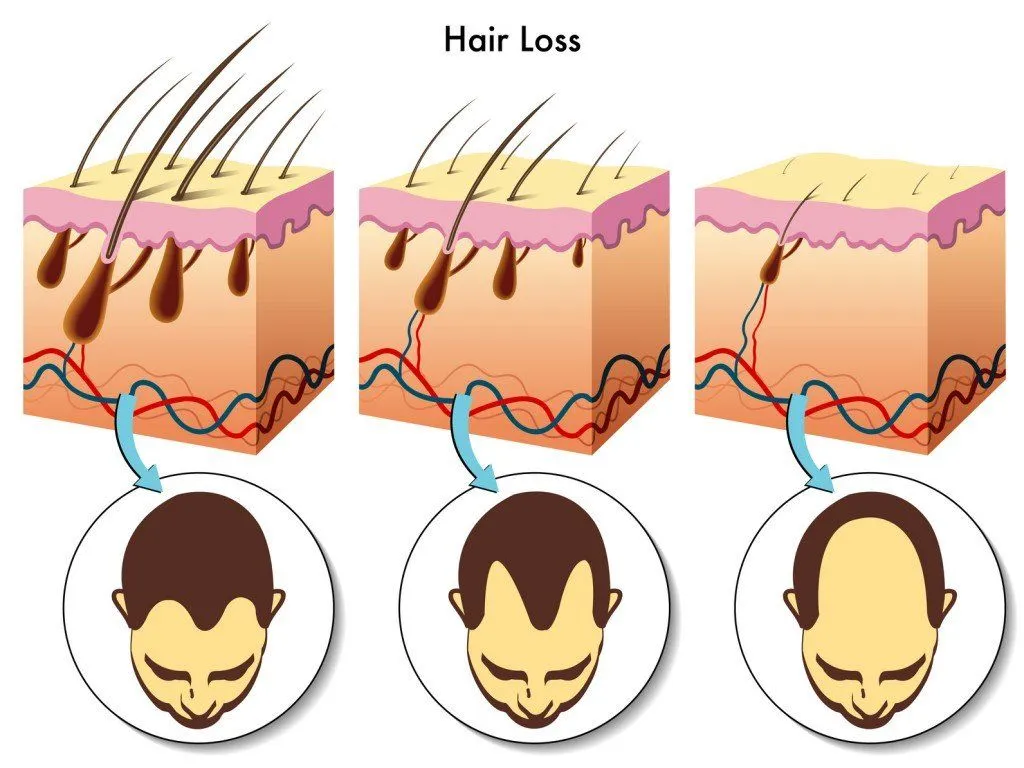
The hair follicles on our head go through what are known as growth cycles, where hair is grown and extended from a single site for roughly 2 to 7 years (typically 3 to 5). At that point, the hair will stop growing and fall out. That particular follicle will then “take a break” for a while, before restarting the entire process. Most hair follicles can go through a handful of these growth cycles over the course of a lifetime.
The ‘No Hair On Head’ Scenario
There is strong evidence that genetics determine the longevity of your hair, a subject that is closely connected to DHT. DHT stands for dihydrotestosterone, a powerful sex steroid. Testosterone is converted into DHT throughout life, and this steroid is important for male sexual development, libido, reproduction, etc. However, in genetically susceptible follicles on the top of the scalp, DHT binds to the androgen receptor, progressively shortens the growth phase, and miniaturizes the follicles until they produce only fine, wispy hairs. That is the actual mechanism behind male pattern baldness. Crucially, DHT levels themselves stay roughly stable through young and middle adulthood; what changes with age is the sensitivity of the follicles to it. The androgen receptor gene sits on the X chromosome (inherited from your mother), which is why your maternal grandfather is a useful clue. But baldness is highly polygenic; genome-wide studies have linked more than 250 variants spread across many chromosomes to it, so genes from your father’s side matter too: sons of bald fathers carry roughly a 5-6 times higher risk.
The frustrating thing is that body hair never seems to fall out, but some people try to do everything possible to hide their baldness – from silly toupees to experimental hair growth products. Now, the key word there is SEEMS. You’ll have likely noticed that most of the hair on your body grows to a certain length and then stops, which is why you never need to get a haircut on your forearms! This has led to the belief that our body hair is permanent, but in fact, we lose our body hair just as frequently as the hair on our head, if not more often!
The difference is that body hair is miniaturized, less dense, and spread across our body rather evenly. In other words, when we lose body hair, it’s much harder to notice. The other key difference is that the growth phase for body-hair follicles is far shorter than for scalp follicles: arm and leg hair stays in anagen for only a few weeks to a few months, while eyebrows and eyelashes cycle in about 30 to 120 days. That short anagen is why body hair grows to a certain length, stops, falls out and gets replaced before you ever need a haircut for it. You might find long strands of hair in your brush and freak out that you’re getting old, but you’re also normally losing 50 to 100 hairs from your scalp every day, and a similar number from across the rest of your body; you just don’t worry about it as much as your empty scalp!
All hair follicles eventually get older and stop working, which is why our body hair does thin over time, but this process is much slower in body hair follicles than on the head, based on their slightly different protein makeup and varied susceptibility to environmental and steroidal effects. It’s highly unlikely that you’ll live to the point where you’re completely bald from head to toe, but if you lived long enough, it could happen!
References (click to expand)
- What is the latest theory of why humans lost their body hair .... Scientific American
- Hair loss: MedlinePlus Medical Encyclopedia. MedlinePlus
- Human hair growth - Wikipedia. Wikipedia
- Women's Hair Loss / Causes of Hair Loss. americanhairloss.org
- Body hair - Wikipedia. Wikipedia
- Human fine body hair enhances ectoparasite detection. Biology Letters (PubMed)
- Human scalp hair as a thermoregulatory adaptation. PNAS (PMC)
- What Is Body Hair and Why Do We Have It? Cleveland Clinic
- Why Do We Have Armpit Hair? Healthline