We talk with our hands because gesturing does two jobs at once: it helps us pack our thoughts into words and sentences, and it adds meaning for the listener. Talking with your hands isn't a flaw or a sign of nervousness. Researchers see it as a normal feature of speech, and people who gesture as they talk tend to come across as clearer and more persuasive.
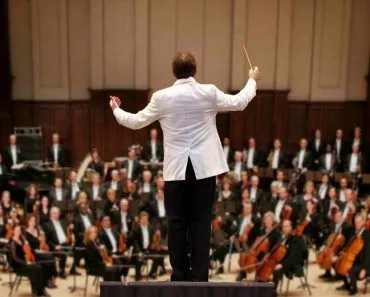
In a live orchestral performance, a conductor stands in front of the orchestra and begins to move her hands. Sometimes the hands are raised high, or one hand is low and another is high, or both are low. The permutations and combinations of these intricate movements may perplex a musically illiterate person, but each gesture communicates an instruction to the orchestra.
In our daily life, we also gesture, much like a conductor. When we speak, our hands move with the tune of our words, mimicking our emotions and acting out our tales, conducting the changes in our words and thoughts.
Gesturing is so important to how we talk that if you actively prevent yourself from doing it, you’ll find that you speak slightly differently. You become more conscious of your words and it takes more effort to find the right thing to say. When I tried it, I found myself stuttering, scrambling my ideas all over the place. But once I freed my hands, voila! my speech flowed as freely as wine at Dionysus’ table.
So… why does this happen? If we already have the words to say what we want, why do we gesture at all? And what exactly are we communicating with our gestures?
Non-verbal Or Paralinguistic Communication
Words and sentences aren’t the only things that form language. The entire range of meaning behind our words emerge when we use the rest of our body (our body language, so to speak).
Don’t like someone? Sit with your toes pointing away from them.
Lying? Your pupils will dilate.
Confused? Furrow your eyebrows, frown a little, and scratch your head.
All these fall under non-verbal language.
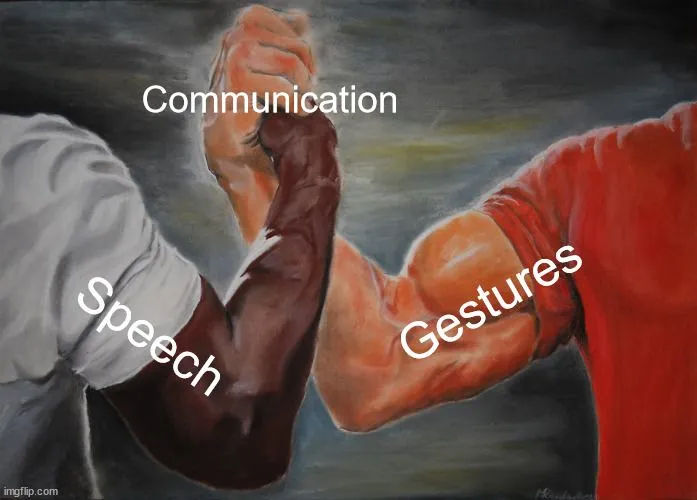
Gestures, like words, are composed of a rich vocabulary. But unlike our words, our gestures don’t fit neatly into a dictionary. Most gestures have meaning in the context of speech (like pointing to your sister as you complain to your parents about her) and in how we’re saying it, such as angry, sharp hand movements.
Gestures enrich our spoken language, which is why researchers call this paralinguistic; everything outside spoken language.
On a side note, sign language is a complete language, while gestures are side dishes that accompany a main language. Sign language has a rich vocabulary and grammar that can be codified using similar rules to spoken language.
Types Of Hand Gestures
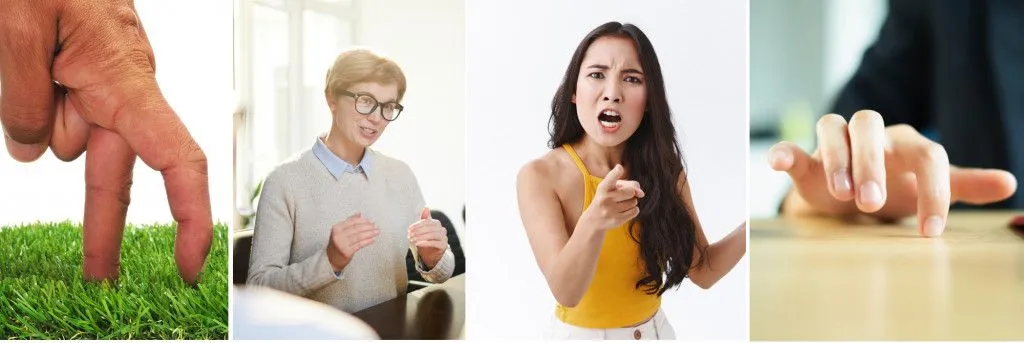
Hand gestures, just like side dishes in a meal, come in many varieties. According to researcher David McNeill’s classification of hand gestures, there are four kinds: iconic, metaphoric, deictic, and beat.
Iconic Gestures
Iconic gestures are visual images of what we’re talking about. For example, if you were talking about how great it is to walk barefoot on grass, you might form your index and middle fingers into “legs” and walk them through the air.
Iconic gestures don’t have any meaning on their own. A spinning finger might mean someone pirouetting or a tornado; the meaning will depend on the context.
Metaphoric Gestures
Metaphoric gestures are visual metaphors. These gestures come up when we have to talk about abstract ideas, such as philosophy or math. When people are asked to describe algebra problems (“how many hours would it take for x workers to complete a construction” type question), they gesture using long sweeping motions to show “change” or small taps or zig zags for other elements of the problem.
Deictic Gestures
Deictic gestures are pointing gestures. They indicate a direction of something, somewhere or someone.
Beat Gestures
Lastly, beat gestures consist of tapping to the beat of your speech. Every time you stress a word, your hand might move downwards to enhance the effect of what you’re saying.
Hand Gestures Help Us Think
These gestures help us communicate with other people, but gestures might also help us think and make our spoken language more coherent.
The information packaging hypothesis suggests exactly this. It says that gestures help us package (spatially) the information we want to talk about. So, if you were to describe how two objects differ, or how one thing changes into another, your gestures might help you find the words.
To probe a little deeper, researchers are looking into how gestures and language are linked in the brain. In 2009, a group of researchers found that gestures are decoded by the same parts of the brain that decode spoken and sign language, suggesting that gestures are crucial to language and our understanding of it.
This link isn’t only important for the language we already possess. Researcher Manuela Macedonia at the Max Planck Institute for Human Cognitive and Brain Sciences in Leipzig found that gestures also help us learn languages. Learning how to gesture in a new language (gestures can vary depending on the culture and language) can help students remember vocabulary and actively converse in their new language.
Does Talking With Your Hands Mean You’re Smart?
If you’re a hand talker, you’ve probably wondered whether all that gesticulating says something about you. The honest answer is that talking with your hands isn’t a personality test, and it certainly isn’t a sign of nervousness or low intelligence. It’s a normal feature of how humans speak, and how much you gesture depends a lot on what you’re describing, how hard it is to put into words, and the culture you grew up in.
That said, gesturing does seem to travel with good communication. Children who gesture more as toddlers tend to have larger vocabularies later on, and students who move their hands while working through a math problem understand it better than those who keep their hands still. So while waving your hands won’t raise your IQ, it does line up with the kind of active, hands-on thinking that helps ideas stick.
It also changes how other people see you. In a 2025 study from the University of British Columbia’s Sauder School of Business, researchers analyzed more than 200,000 hand movements across over 2,000 TED Talks and ran follow-up experiments with identical scripts. Speakers who used illustrators (gestures that visually depict what they’re saying) were judged as more knowledgeable, easier to understand, and more persuasive than speakers who stayed still or made random movements. Simple pointing didn’t help much. So if you’ve ever wondered whether it’s good to talk with your hands, the evidence says that purposeful, meaningful gestures are an asset, not a habit to suppress.
An Evolutionary Perspective Of Hand Gestures
Scientists think that our gestures preceded verbal language. In fact, many believe that our primate ancestors used gestures to communicate with each other, before language of any kind had developed. We still see primates using gestures to communicate today!
Ape gestures won’t look anything like ours, but they might just be the precursor to our language-based gesticulation!
As the brains of our human ancestors got bigger, we began communicating with sounds. Those sounds matured to form complex languages of the world. But, we also kept our gestures.
A Final Word
Interestingly, you gesture when you talk to yourself. Even if there is no audience, our hands accompany our words and thoughts, and for someone with a stutter, gestures only accompany and facilitate fluent speech.
All this goes to show just how important gestures really are! So, the next time you’re talking to someone, remember that your hands and body are saying things too, reinforcing or explicating whatever is coming out of your mouth!
References (click to expand)
- Goldin-Meadow S. (2005). Hearing Gesture: How Our Hands Help Us Think. Harvard University Press
- L., M., & R., A. (2013, June 19). Shared Neural Correlates for Speech and Gesture. Functional Brain Mapping and the Endeavor to Understand the Working Brain. InTech.
- Words and Gestures Are Translated by Same Brain Regions. National Institutes of Health (NIH).
- Want to be more persuasive? Talk with your hands, study finds. University of British Columbia (UBC) News, 2025.