Table of Contents (click to expand)
The technological singularity is a hypothetical future point at which artificial intelligence matches and then races past human intelligence, triggering runaway, self-improving growth that reshapes civilization in ways we cannot predict or control. The term was popularized by Vernor Vinge in 1993, building on I.J. Good’s 1965 idea of an “intelligence explosion.”
We live in a world of unprecedented possibilities. Never has there been a time where an individual holds so much power… a single look in your pocket is proof of this claim. That is where most of us hold a device with access to virtually any kind of content, the collected knowledge of human history in the palm of your hand. From this device, you can order any product and have it delivered at your doorstep in a day. You don’t really need to go to college to learn something; the internet provides endless resources for you to up-skill yourself. There is no distance between places anymore; it only takes a single click of a button to speak with people on the other side of the world.

Exponential Nature Of Technological Growth
We take these abilities for granted all too often and forget that they have only been available to humans for a mere blip of our species’ existence. These technologies were not around as few as 20 years ago, but have since piled on top of each other, further accelerating the pace of technological growth. This trend is seen in humanity’s technological growth as a whole. It is an exponential form of growth, rather than a linear one.
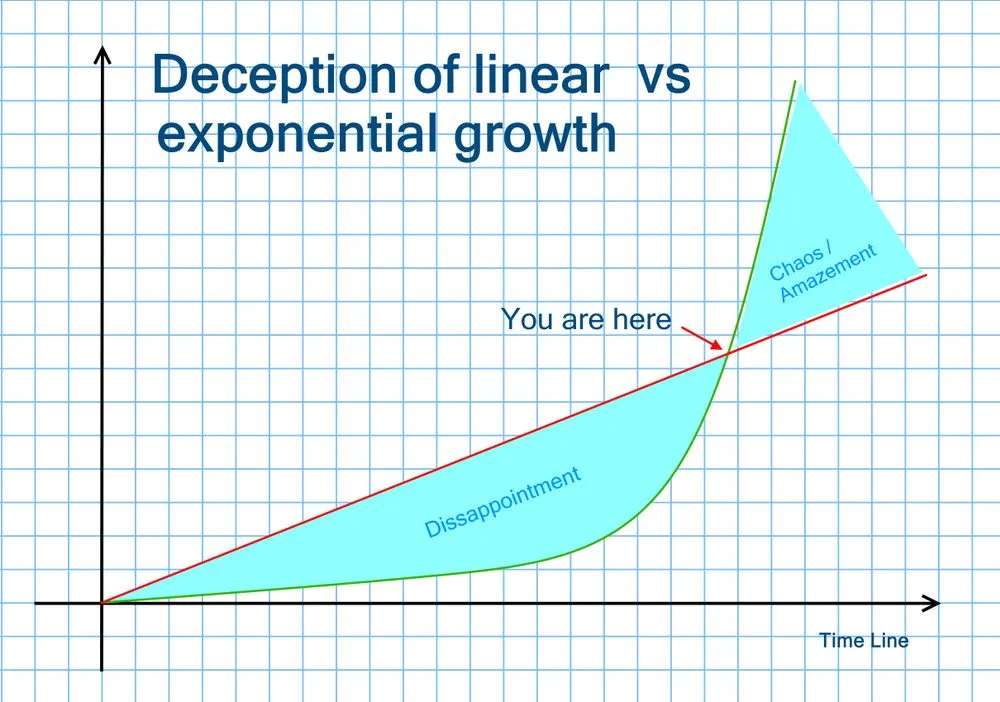
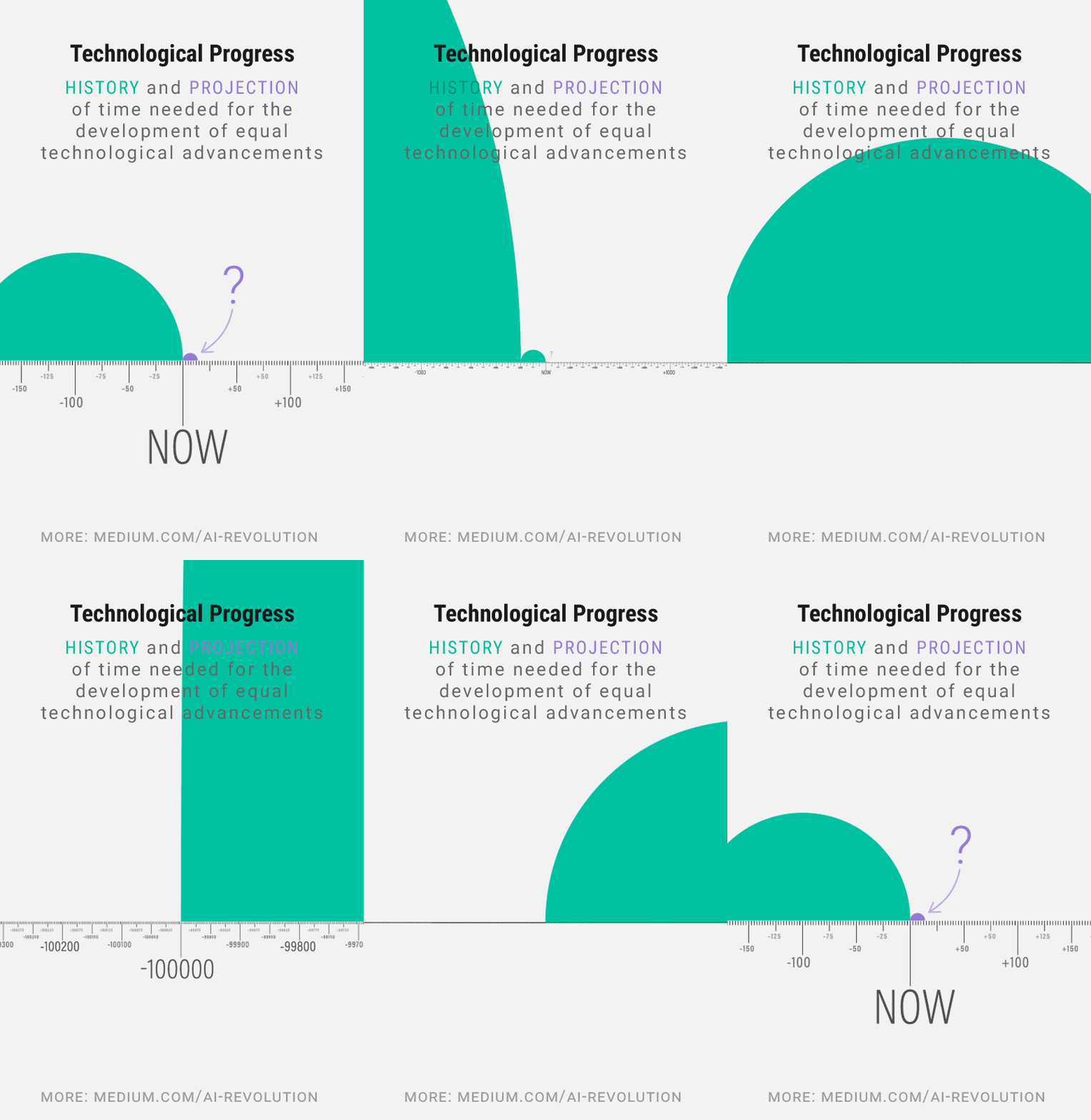
This exponential growth curve occurs when the rate of advancements keeps doubling as time progresses, giving us increasingly better hardware and software capabilities. However, we are very bad at judging exponential growth, because for a long time, it appears that nothing significant is happening. Then, suddenly, the curve moves up and we are taken by surprise.
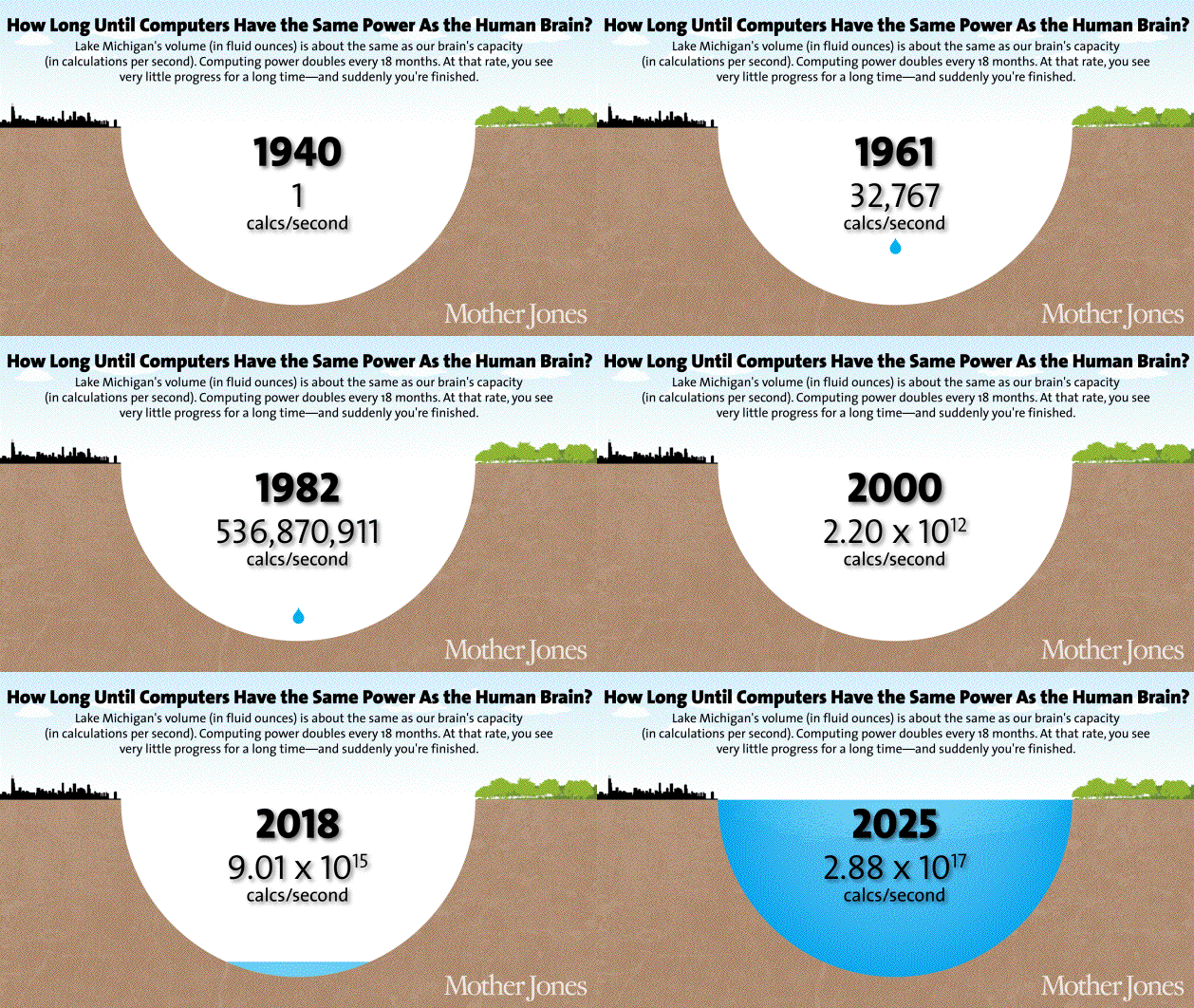
Each generation builds on the growth of the preceding generation and pushes the curve further up. This makes the time it takes to reach the previous level of advancement even smaller; for example, 50 years of advancements (in the past) now take only 10 years to achieve.
As new innovations build upon previous innovations and this growth curve reaches the tipping point, there could come a time where humanity is able to build an artificial intelligence on par with the cognitive and functional abilities of a human. This is referred to as the Technological Singularity, after which all models of growth stop working and an era of uncontrollable and irreversible advancement begins, resulting in unfathomable changes to human civilization.
This could be humanity’s last invention and may result in complete annihilation or unthinkable prosperity. To properly understand this singularity, we must first understand how we could get there, possibly even in this century.
The Intelligence Explosion
The current revolution in artificial intelligence has come about for three reasons:
Increase In Computing Power Due To High-performance GPUs
According to Moore’s Law, the number of transistors in a densely integrated circuit doubles about every two years, thus increasing the computing power in hardware. That pace has slowed since around 2010 as chipmakers approach the physical limits of silicon, but the broader hunger for compute has not let up. The doubling has led to graphic processing units (GPUs) that make parallel processing possible. For the algorithms to recognize patterns in a hoard of data, massive computing power is required, and GPUs and cloud computing make that possible.
Availability Of Labeled Data
We live in a digitized world. Almost every prominent business has moved its operations to digital avenues and the businesses that haven’t will inevitably be forced to… or fail. Coupled with users storing and leaving massive amounts of data online, there is an abundance of labeled data to be analyzed. This data is used to train programs to recognize scenarios and improve in a desirable task.

Innovative Ways Of Training A Program
Armed with tons of data and ample computing power, deep learning has made a comeback in the mainstream AI arena. Its algorithms are inspired by the actual structure and function of the human brain. Pathways based on artificial neural networks are used to train programs to make intelligent programs without the need to manually code them. Deep learning powers many of the most commonly used applications today, enabling cars to drive themselves, detecting cancer cells in X-rays and so much more.
Our current AI capabilities have shown outstanding performance in narrow tasks, better even than humans, at times. By 2026, large language models like GPT-5, Google’s Gemini and Anthropic’s Claude can write code, pass professional exams and reason through problems, and specialized systems have even reached gold-medal standard at the International Mathematical Olympiad. Yet all of these remain narrow, brittle tools rather than minds; none has reached genuine general intelligence. This exponential technological growth points to a possible time when computers surpass humans, not only in narrow tasks, but also in general cognitive faculties. There could be a time when a program is on par with human intelligence and reaches artificial general intelligence (AGI). AGI is the stepping stone to the Singularity, not the event itself.
The question surrounding AGI is increasingly framed as a matter of “when”, not “if”, though plenty of serious researchers caution that it may never arrive at all. Experts remain sharply divided on the timing. Futurist Ray Kurzweil, among the most optimistic, has long predicted human-level AI by 2029 and the Singularity itself (when humans merge with machine intelligence) around 2045, a forecast he reaffirmed in his 2024 book The Singularity Is Nearer. Large surveys of AI researchers tend to be more conservative, clustering their median estimates for human-level machine intelligence somewhere between the 2040s and 2060s.
When we reach the singularity and unlock AGI, the rate of technological growth will become dizzying. AGI would rapidly work on its own development, making iterations to enhance its own intelligence, moving far past not only the intelligence of a human, but the collective intelligence of humanity. The intelligence that comes from this would be greater than anything we have ever seen before, exceeding even our comprehension. It would become what is called an Artificial Super Intelligence (ASI).
The Last Invention
The premise of such a Singularity sounds really “out there”, which it is because of our inability to properly judge an exponential growth curve. It sounds like science fiction, but given the way things are going, it could definitely become a reality. The result of this Singularity would be an artificial super-intelligence, one who could essentially play God on this planet.
With enormous computing power and the ability to design and upgrade itself, it could constantly grow more intelligent. We would be to ASI what ants are to us, negligible obstacles. It could turn hostile towards us and annihilate the entire species. However, if we manage to tame it in some way, it could usher in an era of enormous prosperity for the world, the likes of which humans have never experienced.
It could design completely new ways of doing things that are essential for us to survive, including breakthroughs in energy generation, transportation, housing, farming, and global warming, etc. It could help us become a multi-planetary species and unlock physical capabilities currently beyond our wildest imagination.
Even if we think we’re playing with fire, the benefits are far too great for organizations to back down. No government has actually banned AGI research; instead, regulators have started fencing in the most powerful systems. The European Union’s AI Act and U.S. state laws such as California’s frontier-AI rules now require safety testing and risk disclosures from the biggest developers, but the race to build human-level digital intelligence carries on, because the rewards are seen to far outweigh the risks.
It could be our last invention, possibly creating a utopia on earth. The fate of humanity truly lies in how we manage to co-exist with ASI, because there seems to be no way of stopping us from reaching that singularity, whether sooner or later.
References (click to expand)
- The coming technological singularity: How to survive in ....
- Arguments for feasibility of singularity.
- The Technological Singularity.
- Kurzweil R. (2006). The Singularity Is Near: When Humans Transcend Biology. National Geographic Books
- Bostrom N. (2014). Superintelligence: Paths, Dangers, Strategies. Oxford University Press
- Singularity. Encyclopaedia Britannica.