Yes, real cyborgs already exist. Anyone with a cochlear implant, pacemaker, or neural prosthesis qualifies, and Kevin Warwick controlled a robot hand through a nerve implant in 2002. In 2024, Neuralink's first patient moved a cursor by thought alone. We still cannot regrow biological parts or fully explain how electrical signals become feelings, but the technology keeps advancing.
Salamanders are amphibians that can regrow many body parts, including whole limbs and tails, if they get sliced off. Although technology has not yet advanced to a level where humans can regrow their biological parts, a mechanical replacement is definitely a possibility thanks to cybernetics and bioengineering. Humans have been obsessed with the notion of prolonging their lives, rejuvenating or arresting degeneration due to old age, imagining life continuing through artificially created human beings, or turning into cyborgs to live for eternity. This obsession is shown through the themes of our sci-fi literature, with books and movies such as Bicentennial Man, AI, The Terminator series, Borgs from Star Trek, and the not so fictional ‘I, Cyborg’ by Kevin Warwick.
What is a Cyborg?
The word cyborg is a shortened version of ‘cybernetic organism’. The term was coined in 1960 by Manfred Clynes and Nathan S. Kline in an article on space travel for Astronautics magazine. A cyborg is any living being that has both organic and mechanical/electrical parts that either restore or enhance the organism’s functioning. Robots and droids do not fall into this category.
With such an all-encompassing definition, even people with the most common technological implants, such as prosthetic limbs, pacemakers, and cochlear implants, can also be considered “cyborgs”. Not only that, but people who receive organ implants developed from artificially cultured stem cells can also be placed in this category. However, artificially-grown organ implants lie outside the scope of the current article and will not be discussed in depth.
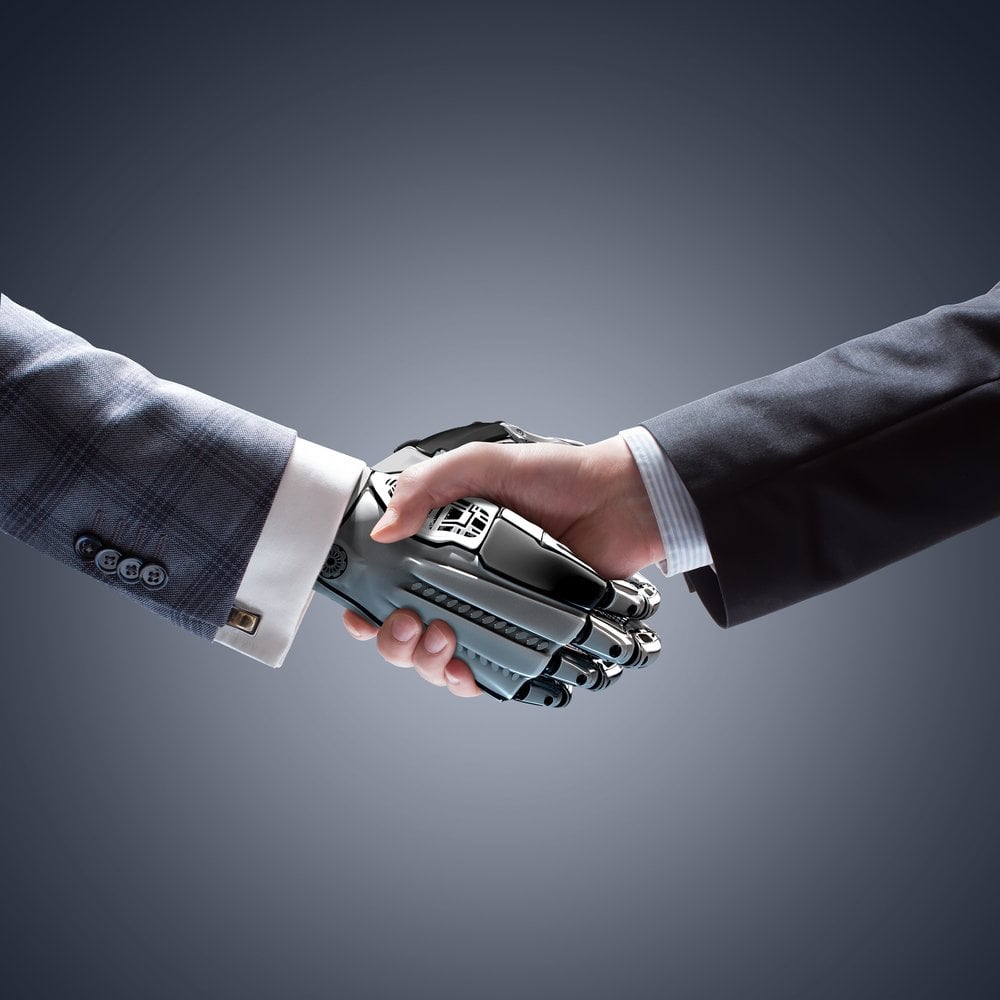
source: Williyam Bradberry/shutterstock.com
The Marvels of Brain Computer Interaction
Technological advances to aid in human functioning have been on the rise since the late 1970s. The impetus to increase human computer interaction was possibly to help people with deficits to function optimally. One of the earliest cyborgs was a lab rat at New York’s Rockland State Hospital, part of an experimental program in the late 1950s. The rat had a tiny osmotic pump implanted that injected chemicals in controlled doses, thereby altering various physiological parameters. It was this work that led Clynes and Kline to coin the word “cyborg” in 1960.

The image features Neil Harbisson, a British colour blind artist who wears an eyeborg to help him perceive colours through hearing.
In humans, William Dobelle, a private researcher, helped restore sight to a man blinded in adulthood. A single type of brain computer interaction device, commonly referred to as a BCI, comprising 68 electrodes was implanted in the patient’s visual cortex, which succeeded in creating sensations of seeing light. Since then, there have been countless attempts, some of which have been successful, of restoring lost function in vision, motor movements, hearing and limbs by using various kinds of prosthetics.
Kevin Warwick: Project Cyborg 1.0
One project that pushes the boundaries between human, computer and robotic interaction is Kevin Warwick’s work, which began in 1998. Warwick was a Professor at the Department of Cybernetics at the University of Reading. In that first phase, known as Project Cyborg 1.0, he had a silicon chip transponder implanted in his left arm. The chip used a radio-frequency identification (RFID) signal, so that as Warwick moved around the building, sensors could detect his presence. Using this, he was able to remotely control electrical devices, such as lights, heaters and doors, simply by walking near them.
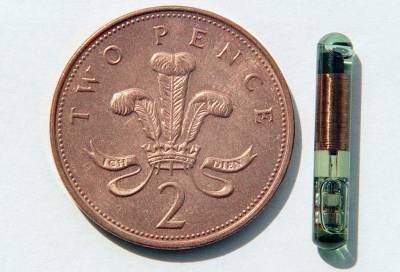
The transponder implanted in Kevin Warwick’s arm along with a penny for size comparison. ( www.terasemjournals.com)
Kevin Warwick: Project Cyborg 2.0
In 2002, he was implanted with a hundred-electrode array in his median nerve fibers, the ends of which were connected to a computer. He succeeded in controlling the hand of a robot in the UK from Columbia University in New York using Internet connectivity. Prosthetics, even the newest ones that can perform relatively flexible movements, such as the C-Leg system, require that the device be connected to a healthy body part or that the patient flip between switches to achieve movement and control. In short, it still doesn’t feel like an extension of the natural arm and is prone to errors in movement.
However, the technology implanted in Professor Warwick’s arm may be a breakthrough in this field, since this new BCI affords the movements of an external mechanical arm through neural signals alone. Additionally, Warwick reported receiving feedback from the robotic arm, such as feelings of pressure and force, which is the most unique feature of this technology. Thus, if designed as a prosthetic for amputees, connecting nerve clusters at the end of a still healthy stump, all they would have to do is normally think of moving their limb and it could be achieved.
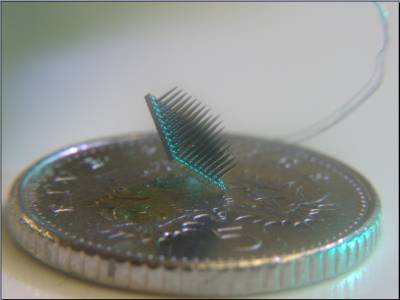
The hundred electrode array implanted in Warwick’s arm. (www.terasemjournals.com)
Electrical Impulse ≠ Feelings
As for the feeling and interpretation of sensations from the robotic limb…there is one unsolvable debate. The experiment so far only suggests that the arm sends back electrical impulses, which are then registered in some area of the brain (mostly the somatosensory cortex). For centuries, there has been an active debate in neuroscientific, cognitive and psychological circles regarding how a brain receiving electrical signals differentiates between them and recognizes which subjective feeling is being experienced, such as pain or a tickle or touch. There is no single neuron, cluster of neurons or brain region that, if activated, reliably results in the sensation of pain. Therefore, how something as concrete as nerve impulses translates into something as abstract as feelings remains an open question.
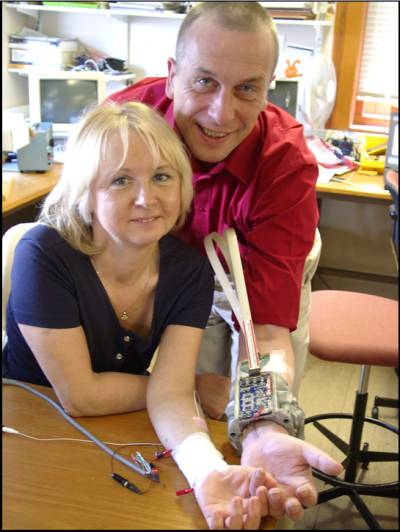
Professor Kevin Warwick and wife Irene Warwick neurally connected via implants. (www.terasemjournals.com)
Another part of Warwick’s experiment demonstrates this point very clearly. In order to understand what happens when the apparatus was connected to another human limb, instead of an artificial limb, Warwick’s wife, Irene, was implanted with a similar array of fewer electrodes. Both their sensors were connected to the Internet and, using it as a mediator, they began to communicate with their implanted hands. Irene reported only a jolt in her hand when Warwick moved his hand. Gradually, these jolts were interpreted as movements by Irene’s brain.
After these experiments, Warwick went on to explore how information from different “sensory organs” could be integrated for a robot, and he has since become a vocal commentator on the future of human-machine integration.

source: VLADGRIN/shutterstock.com
What The Future Holds…
The decades since Warwick’s experiments have turned a lot of this science fiction into something far closer to reality. In January 2024, the company Neuralink implanted its first brain-computer interface in a human, a man named Noland Arbaugh who had been paralyzed below the shoulders after a diving accident. His N1 implant carries 1,024 electrodes on 64 hair-thin threads placed in the motor cortex, and within weeks he was moving a computer cursor, browsing the web and playing online chess using nothing but his thoughts. Several more people have since been implanted, and rival labs are running their own trials. Researchers have even used brain implants to translate intended speech back into words for people who can no longer talk. None of this lets us regrow a limb or upload a mind, but the gap between a wired-up lab volunteer and an everyday cyborg is narrowing fast.
Apart from giving more hope to amputees about an independent future, such technological advances give rise to the possibility of a technical clone of yourself in the near future. Imagine sitting in the office and being connected to your bot at home, making it do chores in precisely your chosen way. Also, who wouldn’t want an extra set of hands? In the future, maybe we will even be able to connect to a technological collective consciousness. Maybe through such connectivity, the members of the human race would become a little more empathetic and tolerant of each other!
References (click to expand)
- Cyborg. Encyclopaedia Britannica
- The application of implant technology for cybernetic systems. Archives of Neurology (2003). PubMed.
- Neuralink’s First User Describes Life with Elon Musk’s Brain Chip. Scientific American
- William H. Dobelle. Wikipedia
- Neil Harbisson. Wikipedia
- Brain–computer interface. Wikipedia