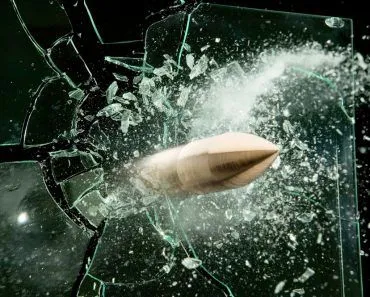
Liquid body armor uses a shear-thickening fluid (a non-Newtonian fluid of silica nanoparticles in liquid polymer) soaked into Kevlar. It stays soft and flexible, but the instant a bullet strikes, the particles jam into rigid clusters and the fluid turns solid, spreading the impact. This makes the armor lighter and more flexible than plain Kevlar.
For every action, there is an equal and opposite reaction. This is a fundamental law of physics. Similarly, for every object in the world, there must be another object that nullifies/negates the effect of the former.
For example, because there are guns and bullets, there are also bulletproof vests.
A bulletproof vest (also known as a ballistic vest or bullet-resistant vest) is an important component of personal armor that helps absorb the impact from firearms (revolvers, rifles etc.) and shrapnel from explosions, and is worn on the torso.
What’s Liquid Armor?
Traditional bullet-resistant vests are made of Kevlar, a synthetic fiber that is woven into a fabric and layered, making it about five times stronger than steel by weight. Although Kevlar does a good job of blocking the oncoming bullets, the fabric still flexes inward when struck. The US National Institute of Justice lets this "backface deformation" reach up to 44 millimeters (1.7 inches) in a vest that passes its standard, and that punch of blunt force can bruise, break ribs, or in severe cases prove fatal even when the bullet never breaks the skin.
To overcome these inherent challenges, scientists have developed a liquid that can function to enhance the strength and flexibility of these traditional vests. The liquid is a non-Newtonian fluid. A Newtonian fluid, like water, keeps the same viscosity no matter how hard you stir or strike it, but a non-Newtonian fluid changes its viscosity when put under stress. Some everyday examples of non-Newtonian fluids are blood, ketchup, yogurt, and a stirred paste of cornstarch and water.
How Does Liquid Armor Work?
The liquid we are talking about here is a shear thickening fluid (or STF). An STF is a special type of fluid that changes its structure (i.e., thickness) when sudden stress is applied to it. The version used in armor research is a thick suspension of hard silica nanoparticles (around 450 nanometers across) packed into a liquid polymer such as polyethylene glycol. In other words, while the fluid will usually move around leisurely in a liquid state, as soon as something hits it, then Boom! It becomes a solid (immediately and temporarily). Pretty impressive fluid, huh?
How Can A Substance Change Based On Stress?
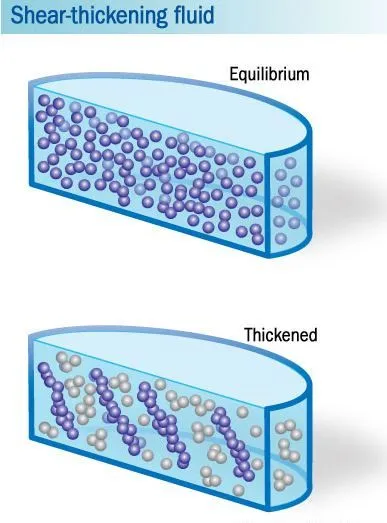
The fluid is a colloid, something that is in a liquid state, but has tiny solid particles suspended in it. Under normal conditions, it remains in that liquid state, as the solid particles suspended within it repel each other.
However, when a sudden force is applied to it (like a bullet hitting the fluid) the force generated by the sudden impact is enough to overcome the repulsive forces between the suspended solid particles, causing the solid particles to lump together (forming masses called hydroclusters) and change the state of the material from a liquid to a solid. As soon as the energy from the impact dissipates, the lumps disintegrate and the fluid returns to its liquid state.
It sounds almost too good to be true, right?

A Vest With STF
Now, let’s talk about how this fluid would work in a bulletproof vest. To build one, researchers dilute the STF, soak it into Kevlar fabric, and dry off the solvent so the fluid stays locked between the fibers. Treated this way, the Kevlar barely stretches on impact, so the bullet does not push as deep into the vest (or the body behind it). Tests at the US Army Research Laboratory and the University of Delaware found that just four layers of STF-soaked Kevlar can absorb as much energy as 14 layers of untreated Kevlar, which means a thinner, lighter and more flexible vest. In 2010, engineers at the UK defense firm BAE Systems demonstrated their own Kevlar-and-STF material (nicknamed “bulletproof custard”), reporting that it stopped bullets faster and let them penetrate less than 31 layers of ordinary Kevlar.
Can A Non-Newtonian Fluid Stop A Bullet On Its Own?
Here’s the question almost everyone asks after watching a tub of cornstarch and water go solid under a punch: if the goop can stop your fist, surely it can stop a bullet too, right? It’s a fair guess, but the honest answer is no, not on its own. A bare puddle of shear-thickening fluid is the same stuff that lets you run across a pool of cornstarch and water (often called oobleck) yet sink if you stand still: a quick, hard impact jams the particles together into a momentary solid, while a slow, gentle load lets them slide right past one another.

The trouble is speed. A fist travels a few meters per second, but a typical 9mm handgun round leaves the muzzle at roughly 300–360 meters per second (around 1,000–1,200 feet per second), and rifle bullets go far faster still. When physicists Scott Waitukaitis and Heinrich Jaeger filmed a rod striking a dense cornstarch suspension, they found the impact sends a jamming front racing outward from the contact point, transiently freezing the liquid into a solid that can briefly support large loads. That front is exactly what holds up your foot, but it spreads at a finite speed, and a thin layer of fluid runs out of jammed material long before it can swallow a bullet’s kinetic energy. With no solid wall behind it, the round simply punches through.
That’s the part the viral demonstrations leave out: the shear-thickening fluid is a helper, not the wall. It only earns its keep when it is locked into the fibers of a tough fabric like Kevlar, so the fluid stiffens the weave at the instant of impact while the fabric does the actual stopping. And even then the benefit is finicky. A 2024 ballistic study found that, depending on the formulation and exactly where the treated layers sat in the stack, soaking Kevlar in shear-thickening fluid sometimes worsened its performance, with only a narrow window of designs that genuinely helped. So while a non-Newtonian fluid is a brilliant trick, on its own it’s a science-fair toy, not body armor.
Why Isn’t Ketchup A Liquid Armor?
If cornstarch goop can harden on impact, why not the ketchup in your fridge? It’s a non-Newtonian fluid too, after all. The catch is that ketchup behaves in exactly the opposite way to the fluid in body armor. Shear-thickening fluids like the cornstarch mixture get thicker when you hit them. Ketchup is shear-thinning: the harder you push it, the runnier it gets.

You’ve felt this every time you’ve wrestled with a glass bottle. Ketchup sits almost solid at the bottom, refusing to pour, until you give it a sharp whack or a hard squeeze. That sudden shear stretches and lines up the long polymer molecules inside so they slide past each other easily, the viscosity drops, and the sauce squirts out all at once (usually onto your plate, occasionally onto your shirt). A shear-thinning fluid is the last thing you would want between you and a bullet, because the more violently it was struck, the less it would resist. So no, ketchup is not bulletproof. It is a perfect everyday example of a non-Newtonian fluid doing the precise opposite of what liquid armor needs.
We’ve already entered a world where liquid (coupled with other factors) is able to ward off bullets. At this rate, perhaps we’ll eventually get to the point where we can protect ourselves from bullets with a wave of our hand or a magnetic field generated around our bodies! Who knows what we’ll come up with next!
References (click to expand)
- Fabric Impregnation with Shear Thickening Fluid for Ballistic Armor Polymer Composites: An Updated Overview. Polymers (PMC), NCBI.
- Stab Performance of Shear Thickening Fluid (STF)-Fabric Composites. University of Delaware (Wagner Group).
- Overview of Body Armor. National Institute of Justice (NIJ.OJP.gov).
- British-Designed ‘Bulletproof Custard’ Liquid Armor Is Better than a Kevlar Vest. Popular Science.
- Non-Newtonian fluid. Wikipedia.
- Messy Experiment Cleans Up Physics Mystery of Cornstarch (Waitukaitis & Jaeger). University of Chicago News.
- Experimental Investigations on Shear Thickening Fluids as “Liquid Body Armors”. Polymers (PMC), NCBI.
- Ketchup Is Not Just a Condiment: It Is Also a Non-Newtonian Fluid. Scientific American.