Table of Contents (click to expand)
An OLED (Organic Light Emitting Diode) is a display technology built from thin layers of carbon-based (organic) molecules that emit their own light when an electric current is passed through them. Because each pixel makes its own light — no backlight required — OLEDs can switch individual pixels completely off, giving them true blacks and effectively infinite contrast, plus wide viewing angles, fast response times, and thinner, more flexible panels than LCD or backlit LED displays. The trade-offs are higher cost, sensitivity to moisture, and the risk of permanent burn-in.
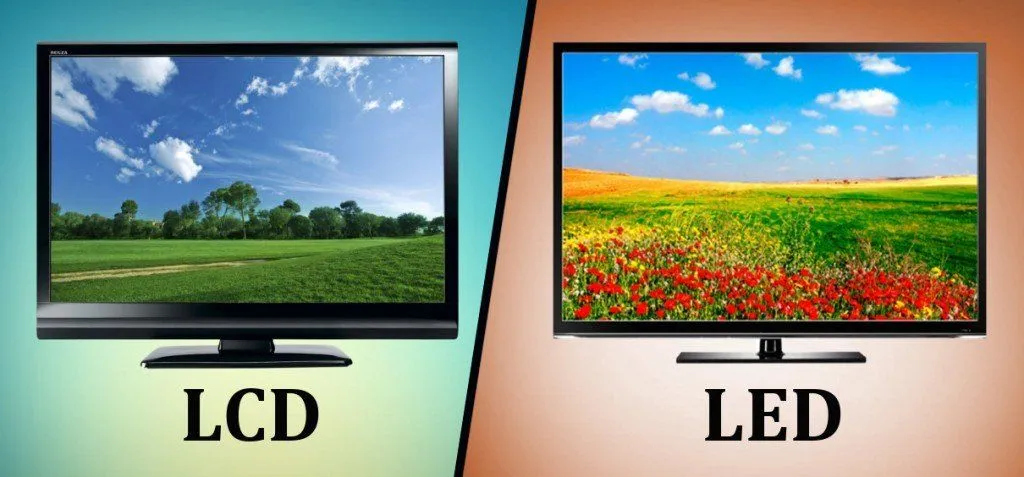
A decade or two ago, televisions and computer screens used to be big and bulky, due to the CRT technology that was used in them. Then came LCD screens, and the size of electronic displays shrunk dramatically. Next up were LED screens. These were not so different from their predecessors (i.e., LCDs) in terms of appearance (you couldn’t tell an LED from an LCD just by looking at them), but they significantly reduced the electricity consumption of electronic displays (along with a few other differences).
Over the past decade, the display technology that has steadily taken over premium TVs, flagship smartphones, computer monitors, and VR headsets is OLED, or Organic LED. In this article, we are going to look at what an OLED really is, how it works, and what's so "organic" about it.
What Is An OLED?
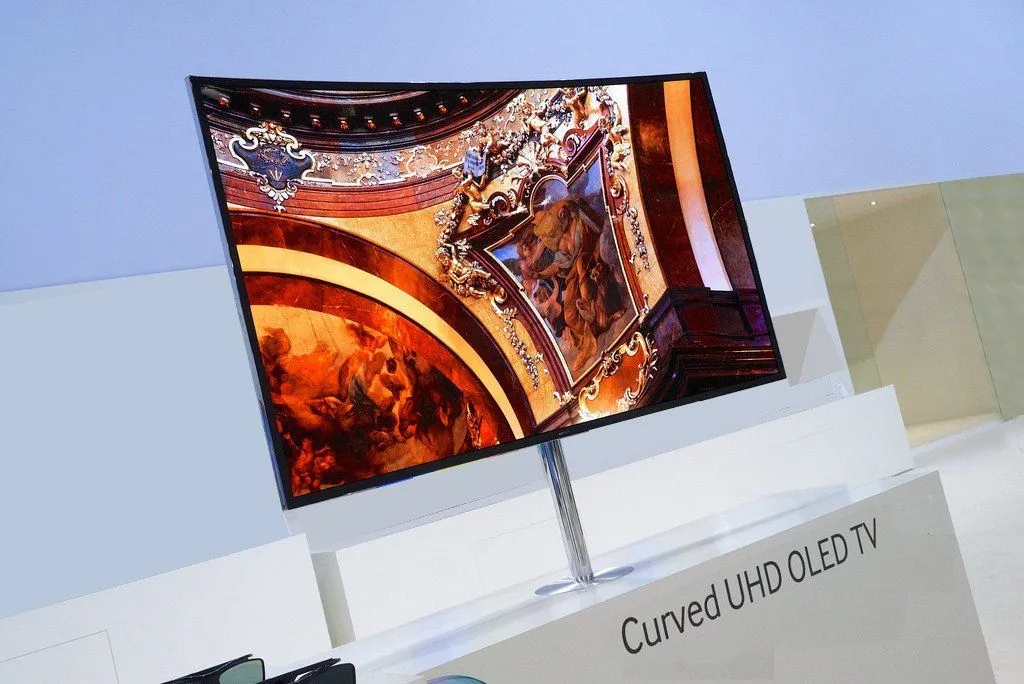
OLED stands for Organic Light Emitting Diode, or Organic LED, if you will. It is a display technology consisting of OLED panels that emit their own light when an electric current is passed through them. As a result, OLEDs are super-light, have a true contrast ratio (i.e., their whites are brighter and blacks are darker than other electronic displays), wide color gamut, deep color saturation and wide viewing angle.
What’s ‘Organic’ About OLEDs?
We generally tend to associate the word ‘organic’ with food articles and various other objects produced in an environmentally friendly manner. However, in OLEDs, the prefix ‘organic’ has an altogether different meaning. In chemistry, organic compounds are those that contain lines or rings of carbon atoms. Everyday items like plastics, wood, sugar and gasoline are all organic compounds.
OLEDs consist of an organic film/layer that sits inside the panel in front of the glass screen, which is why they are called ‘organic’ LEDs.
How Does An LED Work?
Since the working of an OLED is quite similar to an LED, it’s important that you first understand how a basic LED works before tackling OLED systems.
An LED is built from two slabs of compound-semiconductor material — typically gallium arsenide (GaAs), gallium nitride (GaN), indium gallium nitride (InGaN), or aluminum gallium phosphide, depending on the color of light needed. (Plain silicon and germanium, by contrast, don't emit light efficiently because of their indirect bandgaps.) One slab is "doped" so that it has extra free electrons (the n-type); the other is doped so that it has extra holes — empty spots in the lattice where an electron should be, which behave like positive charge carriers (the p-type). Both slabs are electrically neutral overall; only the type of charge carrier differs. Where they meet, you get a narrow depletion region in which electrons and holes have recombined and cancelled each other out.
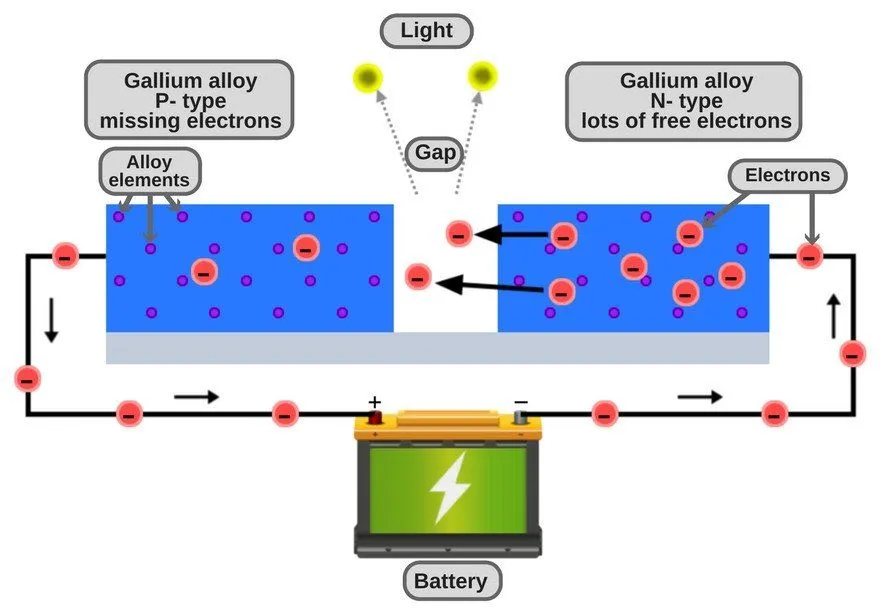
When you wire up the slabs and pass a current through them in the forward direction, electrons from the n-type side cross the junction and drop into holes on the p-type side. Each electron-hole recombination releases the bandgap energy as a photon — that's the light you see. The exact bandgap (and so the color of the light) is set by the choice of semiconductor materials.
OLEDs work on the same principle, but they use organic molecules in lieu of n-type and p-type semiconductor materials to release holes and electrons.
Parts Of An OLED
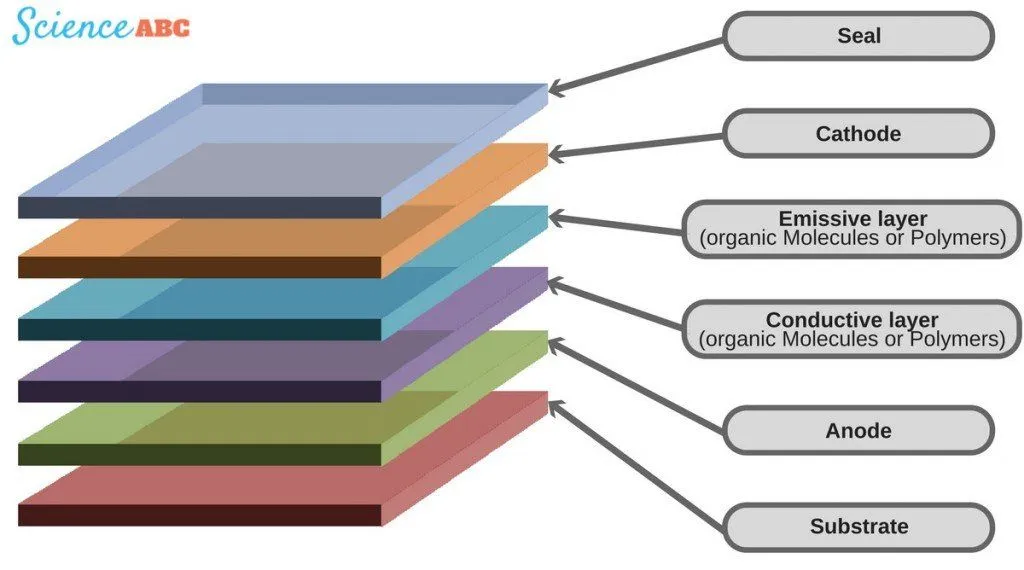
A typical OLED consists of six layers – the outermost layers are called the seal (the top layer) and the substrate (the bottom layer). Next come the anode (a positive terminal) and cathode (a negative terminal). Sandwiched between these layers are the emissive and conductive layers.
How Does An OLED Work?
When the power is switched on, the cathode (the negative terminal) starts receiving electrons from the power source and the anode (the positive terminal) starts losing them. As a result of this, the emissive layer, which is adjacent to the cathode (refer to the above figure), starts becoming more negatively charged (due to the increase in the supply of electrons) and the conductive layer becomes more positively charged (more holes).
Holes injected from the anode drift through the conductive layer and meet electrons injected from the cathode in the emissive layer. Every time a hole and an electron recombine, a quick burst of energy is released as a photon (a fundamental particle of light), and lo and behold — light is produced. Holes and electrons keep meeting and producing light for as long as the power stays on. The moment you cut the power, the transfer stops and the pixel goes completely dark.
Note that there’s another type of OLEDs that use polymers in place of organic molecules, and are aptly called light-emitting polymers or simply polymer LEDs. You can read more about them here.
Advantages Of OLEDs
From a consumer perspective, the most obvious advantage that OLED screens offer above LEDs and LCDs is that they have a much better contrast between lights of different colors and therefore offer a significantly superior picture quality, due to the fact that OLED pixels produce light themselves, rather than depending on the backlight (as is the case with LED and LCD screens).

OLED panels also offer wider viewing angles, faster pixel response times (good for fast-moving sports and gaming), and a thinner, more flexible form factor — flexible and foldable OLEDs are what makes phones like the Samsung Galaxy Z Fold series possible. Two variants you'll see in modern TVs: WOLED (white-OLED with a color-filter array, popularized by LG Display) and QD-OLED (a blue OLED paired with quantum-dot color converters, introduced commercially by Samsung Display in 2022) — each takes a different route to wide color gamut and high peak brightness.
The trade-offs are real, though. OLEDs are still more expensive to manufacture per square inch than LCDs, they're sensitive to moisture (the organic layers degrade in air), and the blue subpixels age faster than red and green, which can lead to color shift or permanent burn-in if static images sit on the screen for long stretches. Manufacturers have largely addressed these issues with pixel-shifting algorithms, encapsulation, and improved materials, but they're still worth knowing about.
References (click to expand)
- OLED - Wikipedia. Wikipedia
- Light-emitting diode - Wikipedia. Wikipedia
- Why OLEDs. The University of Washington
- . (2013). Assessment of Advanced Solid State Lighting. []. National Academies Press.
- Organic Light-Emitting Diodes (OLED) | USC Stevens | USC - stevens.usc.edu
- How OLEDs (organic LEDs) work - Explain that Stuff. explainthatstuff.com
- Organic electroluminescent diodes - Tang & VanSlyke (Applied Physics Letters, 1987 — the founding OLED paper)
- Light-emitting diode (Encyclopaedia Britannica)