Most countries (including the United States, Canada, Australia, and India) use 10-digit mobile numbers because 10 digits give 10 billion (1010) unique combinations, comfortably more than the world's roughly 8.6 billion mobile subscriptions, while still being short enough for people to remember and dial. A few countries, such as China and the UK, use 11-digit numbers.
Imagine you have two cards and two envelopes (2 are blue, and two are yellow). Now, how many possible ways can you arrange them in a pair?
Blue card-Yellow card, Blue card-blue envelope, Blue envelope-yellow envelope, blue envelope-blue card; 4 ways.
This answer could also be predicted using ‘Permutations and Combinations,’ simply math combined with logic.
Simply put, the equation is this: 2 (no. of cards) x 2 (no. of envelopes) = 4.
Phone Numbers And Population Explosion
It may not seem related, but the same principle can be applied to the number of digits in mobile phone numbers. This depends on the number of mobile phone users, as there should be more available mobile numbers than users.
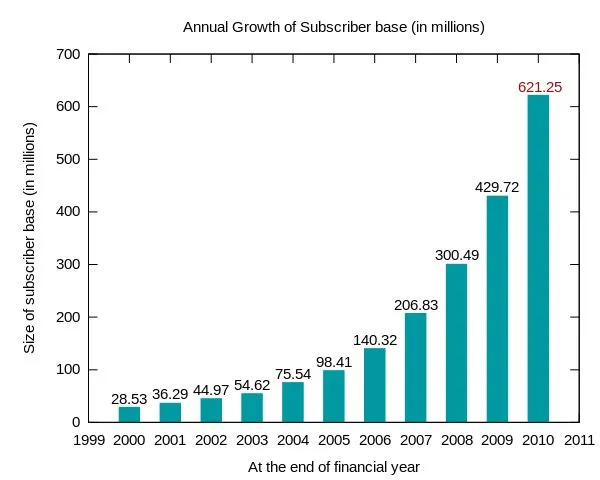
As of 2025, the GSMA estimated about 5.8 billion unique mobile subscribers worldwide (and roughly 8.6 billion active SIM-card connections, since many people carry more than one). With the global population still growing toward 9–10 billion by mid-century, any national numbering plan has to leave plenty of room: there must be far more available numbers than there are people who might ever need one.
All About Numbers
Returning to Permutations and Combinations, how many single-digit numbers do we know? 10.
Thus, if phone numbers were to have two digits, how many different number combinations would be available? 10 x 10 = 100.
Similarly, if phone numbers were only nine digits long, that would cap us at one billion subscribers (109), which the world's mobile network already exceeds many times over.
Hence, the 10-digit mobile number. This offers 10 billion different combinations (1010), comfortably larger than the global population, with plenty of headroom for spare and reserved blocks that the regulator can't actually assign to subscribers.
What Do The Digits Of A Mobile Phone Number Represent?
What does a 10-digit phone number actually represent?
Well, it's not just a group of numbers strung out at random. The exact breakdown depends on the country, but the digits always carve up into a few meaningful chunks. In the United States and Canada (which share the +1 North American Numbering Plan), a 10-digit number splits 3-3-4: a 3-digit area code (NPA), a 3-digit central office prefix (NXX), and a 4-digit line number. For example:
(210) 745-7467
Area code (NPA) = 210 (San Antonio, Texas)
Central office prefix (NXX) = 745
Line number = 7467
India uses a different 2-3-5 split (a 2-digit access code, a 3-digit operator code, and a 5-digit subscriber code), and the UK uses 4-3-4 or 5-3-3 for landlines, with mobile numbers all starting with 07. The exact slicing differs, but the principle is the same: the digits route your call from a country, to a network, to a specific line.
The Need For Eleven Digits
Mobile Numbers Made In China
However, like all mundane things, there are exceptions to the 10-digit mobile number, and no, it’s not because of the country code.
China has 11-digit mobile numbers (excluding the country code +86). The country code +1, by the way, isn't just for the United States; it's the North American Numbering Plan, shared by the US, Canada, and most Caribbean nations. In China, all mobile numbers begin with the digit 1 (landlines do not), so two systems aren't actually in conflict.
Let's take an example Chinese mobile number:
135 6435 467X
The first three digits identify the service provider. Looking at the 135 prefix, we can tell the carrier is China Mobile. Different leading triplets (such as 130–139, 150–159, 170–179, 180–189, 199) were allocated to different carriers (China Mobile, China Unicom, and China Telecom) over the years as China's mobile network grew. The 139 prefix was the first GSM range issued by China Mobile (in 1994), with 138 following in 1997, and the 137/136/135 ranges added later as demand exploded.
Unlike Chinese landlines, mobile numbers in China do not require a leading "0" trunk prefix or a city code; you dial the full 11-digit number directly, anywhere in mainland China. (The leading-0 + area-code rule only applies to landlines.)
Numbers From The UK
Most UK phone numbers are 11 digits when written domestically (starting with a leading "0" trunk prefix), which becomes 10 digits in international format after the +44 country code.
UK landlines use a geographic area code followed by a local subscriber number, with the two chunks splitting 3+8, 4+7, or 5+6 depending on the city's code length. For example, Leicester landlines use the area code 0116, so a Leicester landline might be dialed as 0116 986 6574.
UK mobile numbers are different: they don't use geographic area codes at all. Every mobile number starts with the prefix 07 (followed by 9 more digits), for example 07700 900123. In international form, drop the leading 0 and prepend +44, giving +44 7700 900123.
Are All Phone Numbers 10 Digits Around The World?
Short answer: no. Ten digits is common, but it is far from universal. Once you set aside the country code, the length of the national number (the part you actually dial within a country) varies a lot from one numbering plan to the next, because each country sized its plan to its own population and history.

Plenty of countries get by with fewer than 10 digits. Iceland uses just 7. Norway, Denmark, Singapore, and Hong Kong use 8. Spain, Australia, and the Netherlands use 9 (an Australian mobile is written 04xx xxx xxx, which is a single leading 4 plus 8 more digits once you strip the trunk "0"). Small island nations can go shorter still, with some Pacific territories using only 4 or 5 digits, since a few thousand combinations are more than enough for the whole country.
At the other end, China's mobile numbers run to 11 digits, and a handful of plans push higher once you count every chunk. So the United States, Canada, Australia, India, and many other large economies happen to land near the 10-digit mark, but there is no single global rule that says a phone number must be 10 digits. The only hard ceiling is the international one: under the ITU's E.164 numbering plan, a full international number (country code plus national number) can be at most 15 digits, a limit that has stood since 1997. Everything below that line is each country's own choice.
Why Were Old Phone Numbers Only 7 Digits?
If you have ever wondered why your grandparents rattled off a phone number that was clearly shorter than today's, you are remembering the seven-digit local number. For decades, that was all you needed to call a neighbor.

When the North American Numbering Plan was laid out in the 1940s, a local number was a 3-digit central office code plus a 4-digit line number (the familiar NXX-XXXX format), and you only dialed the 3-digit area code in front of it for a long-distance call. Within your own area, seven digits were enough, because seven digits give 10 million combinations (107), comfortably more than the phones in any single region at the time.
So what changed? The same thing that drives the whole 10-digit story: numbers ran out. As populations and second lines, fax machines, and eventually mobile phones multiplied, regulators added new area codes on top of old ones in the same region (called an "overlay"). Once two area codes share the same streets, a bare 7-digit number is ambiguous, so callers have to dial the area code every time. In the United States, the shift to mandatory 10-digit dialing rolled out region by region, and a large batch of area codes was forced over by 24 October 2021 so that the new 988 mental-health hotline could work without clashing with local numbers. The 7-digit number didn't get longer; the area code simply stopped being optional.
Understanding Numbers
Mobile numbers are sometimes referred to as the address of a person for a very good reason.
When speaking globally, the Mobile Station International Subscriber Directory Number (MSISDN) and the International Mobile Subscriber Identity (IMSI) identify mobile subscribers internationally.
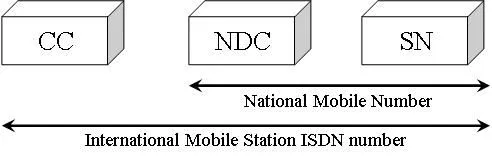
Let’s consider the following mobile number:
+1-210-745-7467
MSISDN = CC + NDC +SN
CC (Country Code: Specific for every country) = +1 (US)
NDC (National Destination Code: Area code) = 210
SN (Subscriber Number) = 7457467
Last Updated By: Ashish Tiwari
References (click to expand)
- Holt, J., & Palm, M. (2021, March 7). More than a number: The telephone and the history of digital identification. European Journal of Cultural Studies. SAGE Publications.
- ITU-T Recommendation E.164: The international public telecommunication numbering plan
- North American Numbering Plan. Wikipedia
- Telephone numbers in China. Wikipedia
- Telephone numbers.
- Ten-Digit Dialing. Federal Communications Commission (FCC).
- National conventions for writing telephone numbers. Wikipedia