Table of Contents (click to expand)
- Meet The All-female Lizard Species
- How Do They Reproduce Without Sperm?
- Why Do We Need Sex At All?
- How Do These All-female Lizards Manage To Survive Without Sex?
- How Did The Lizards Evolve In The First Place?
- The New Mexico Whiptail And Its “Lesbian Lizard” Behavior
- Other All-Female Species Besides Lizards
- A Final Word
An all-female species might sound like wishful fiction, but whiptail lizards are one of the few all-female species on the planet. They don’t need males to reproduce, as they reproduce parthenogenetically.
Almost every species in the animal kingdom that we can think of come in a male and female pair. Most are sexually dimorphic too, wherein males can be easily set apart from their female counterparts. The two parents of opposite-sex mates produce offspring that are a mix of traits from both parents.
However, in the diverse habitats of Northern Mexico and the southwest regions of the United States, there is a species of lizard that is entirely female. How do they reproduce without males? How haven’t they gone extinct yet? And most importantly, are they happy?
Let’s find out.
Meet The All-female Lizard Species
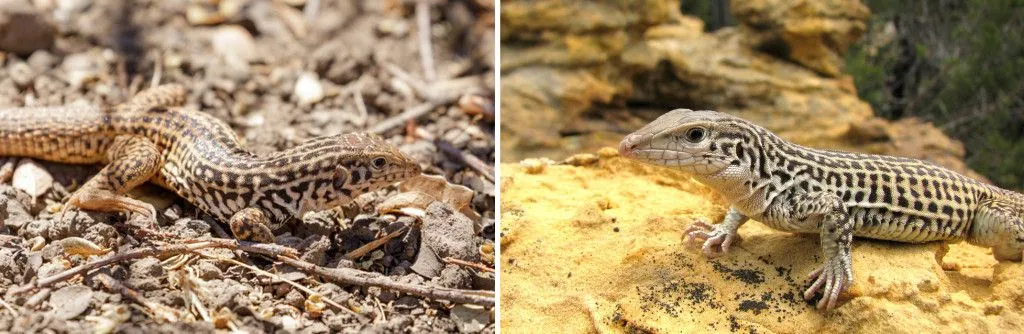
At least 13 all-female lizard species (of the Aspidoscelis genus) have a strict “no boys allowed” policy in their genetic code.
They are like most lizards in many aspects. These species are spread throughout the diverse habitats of Northern Mexico and the southwest regions of the United States.
These species appear quite distinct morphologically, as they’ve evolved to morph depending on their surrounding areas. They can usually be identified by the presence of scaly skin and a tail that is whip-like and longer than their body. Like most lizards, they also possess a forked tongue. They snack on insects, fruits, berries and small mammals, depending on what’s available. They are what biologists call opportunistic feeders.
However, unlike most lizards, they attain sexual maturity at the age of two and give birth to young ones all by themselves!
How Do They Reproduce Without Sperm?
The all-female whiptail lizards are parthenogenic, which means that they do not develop from the fusion of egg and sperm as a zygote. This kind of development is also seen in about 80 taxa of fish, reptiles and amphibians.
There are two types of parthenogenic species: obligatory (unable to reproduce sexually) and facultative (that is, capable of switching between parthenogenesis and sexual reproduction, depending upon environmental conditions). Whiptail lizards are among the most famous obligate parthenogens, but they are not the only ones. The marbled crayfish (Marmorkrebs, Procambarus virginalis) and several mole salamander populations also reproduce as all-female clones.
A new baby whiptail lizard’s development happens from an unfertilized egg, where both copies of the chromosomes come from a single parent. They reproduce through solely asexual means. If animals can reproduce through parthenogenesis, why do we need sex at all?
Why Do We Need Sex At All?
Genetic diversity is very important for any species to evolve and adapt to their continually changing environments.
In sexually reproducing organisms, a female will pass half her set of chromosomes, and a male will share the other half. Upon fusion, the genetic material of both the egg and sperm will merge, form a zygote, and develop into a fetus. The offspring will have increased genetic variability, as it has a random mix of genes from its mother and father. This genetic variability results in new combinations of traits among different individuals in the population, and improves the species’ chances of survival.
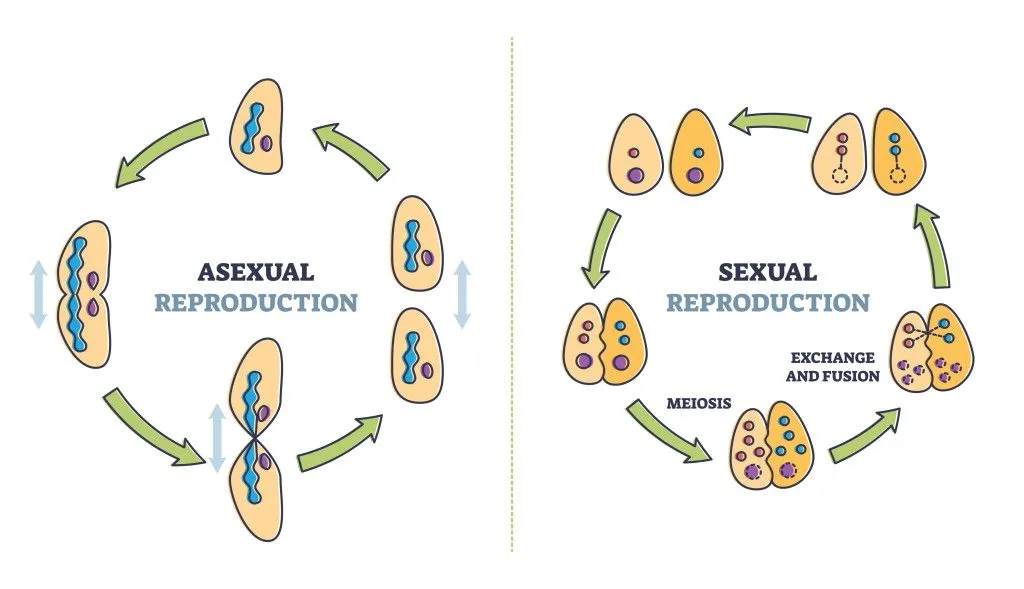
However, in asexual reproduction, there is no mixing of genes. All offspring from asexual reproduction are clones of the mother. They have the same genetic make up as their mother, meaning that a disease or predator could wipe out the entire population quickly, since there are no outlier traits that might help the species survive.
How Do These All-female Lizards Manage To Survive Without Sex?
So, without sex helping to add genetic diversity, how do these all-female lizards survive?
Exceptionally, the A. tesselata species has evolved in a way that curbs any shrinkage in their gene pool.
The females of this whiptail lizard species will produce eggs that have two times the standard amount of genetic material. With more chromosomes, there is a greater variety of genes, as well as the traits that result from those genes. In more scientific words, they display a high degree of heterozygosity between generations. In terms of flexibility and evolutionary advantage, heterozygosity is typically seen as “better“; a variety of traits helps to keep things fresh.
How Did The Lizards Evolve In The First Place?
Close to one-third of all species of whiptails in the wild are ladies-only. Since they belong to the same family, chances are that at some point during evolution, the male of one of the species mated with a female of another.
This “hybridization event” likely occurred when the females of one species became isolated from the respective males of the same species, and instead mated with the males of another species of whiptails. This created a horde of offspring or hybrids that carry two different sets of chromosomes from two uniquely different species.
Researchers say that the evolution of a unisex species, such as the whiptails lizard, needs a genetic distance of about 10 million years. This means that after the hybridization of the common ancestors, it took an estimated 10 million years for the species of all-female whiptail lizards to come into existence.
The New Mexico Whiptail And Its “Lesbian Lizard” Behavior
If you want to meet a single, famous member of this all-female club, look no further than the New Mexico whiptail (Aspidoscelis neomexicanus). It is so celebrated that in 2003 it became the official state reptile of New Mexico, signed into law by Governor Bill Richardson. Every individual is female, and the species arose from a hybridization between two sexual species, the little striped whiptail (A. inornatus) and the western whiptail (A. tigris). That mismatched cross is exactly why no healthy males ever form.

Here is the part that earns the nickname “lesbian lizards”: even though they reproduce without males, these whiptails still go through the motions of mating. Two females will pair up, and one takes on the typical male role, wrapping around her partner in a behavior biologists call pseudocopulation (literally, false mating). No sperm changes hands and no fertilization occurs, so why bother? The leading explanation is that the courtship physically stimulates ovulation. Behavioral studies of these whiptails found that females who go through this “mating” lay more eggs than those that do not, so the ritual seems to switch the reproductive cycle on. It is a striking reminder that even an all-female species can keep an ancient mating script alive, just rewritten for a world without males.
Other All-Female Species Besides Lizards
Whiptails get most of the attention, but they are far from the only animals living a strictly female existence. A handful of other species manage it too, each with its own twist on cloning.

- The Amazon molly (Poecilia formosa): First described in 1932, this little fish was the very first all-female vertebrate that science recognized. It reproduces by gynogenesis, a curious halfway house. The females still need to “borrow” sperm from a male of a related molly species to kick-start their eggs, but that male’s DNA is normally discarded, so the babies are clones of their mother.
- The marbled crayfish (Procambarus virginalis): Pictured above, this freshwater crustacean appeared in the German aquarium trade in 1995 and is the only known crayfish (out of roughly 15,000 decapod species) that clones itself. Every marbled crayfish is a triploid female, carrying three sets of chromosomes, and a single individual can found an entire invasive population.
- The Brahminy blindsnake (Indotyphlops braminus): Often called the “flowerpot snake,” this tiny burrower is the only snake known to reproduce exclusively by parthenogenesis. It is an all-female, triploid species that has hitchhiked across the globe in the soil of potted plants, reaching every continent except Antarctica.
- The mourning gecko (Lepidodactylus lugubris): A small, widespread gecko of the Pacific that is overwhelmingly female and parthenogenetic. Like the whiptails, females sometimes court one another, and the rare males that do turn up are sterile.
The pattern is hard to miss: all-female animals show up across fish, crustaceans, snakes and lizards, and most of them trace back to a hybridization event followed by a switch to cloning. (If you have ever wondered whether the reverse is possible, some creatures can actually change sex entirely.)
A Final Word
Even though there are 80 or so taxa of animals that can clone themselves, whiptail lizards are probably the only ones that do it regardless of other circumstances. Other unisex species resort to parthenogenesis when there is a shortage or unavailability of males.
This characteristic feature of whiptail lizards brings it a lot of academic attention, but asexual reproduction could never compete with sexual reproduction in terms of the genetic variability it brings to the table. It’s possible that a constantly changing environment could demand a more resilient level of offspring with a set of genes that can never be produced by a single parent’s genetic information. This could, in turn, pose a risk of extinction for these species.
References (click to expand)
- Crow, J. F. (1994). Advantages of sexual reproduction. Developmental Genetics. Wiley.
- Booth, W., Smith, C. F., Eskridge, P. H., Hoss, S. K., Mendelson, J. R., III, & Schuett, G. W. (2012, September 12). Facultative parthenogenesis discovered in wild vertebrates. Biology Letters. The Royal Society.
- Tilquin, A., & Kokko, H. (2016, October 19). What does the geography of parthenogenesis teach us about sex?. Philosophical Transactions of the Royal Society B: Biological Sciences. The Royal Society.
- Sakata, J. T., Woolley, S. C., Gupta, A., & Crews, D. (2003, May). Differential effects of testosterone and progesterone on the activation and retention of courtship behavior in sexual and parthenogenetic whiptail lizards. Hormones and Behavior. Elsevier BV.
- Crews, D. (2005, October). Evolution of neuroendocrine mechanisms that regulate sexual behavior. Trends in Endocrinology & Metabolism. Elsevier BV.
- Picard, M. A. L., Vicoso, B., Bertrand, S., & Escriva, H. (2021, July 27). Diversity of Modes of Reproduction and Sex Determination Systems in Invertebrates, and the Putative Contribution of Genetic Conflict. Genes. MDPI AG.
- Wennstrom, K. A., & Crews, D. (1995, September). Making Males from Females: The Effects of Aromatase Inhibitors on a Parthenogenetic Species of Whiptail Lizard. General and Comparative Endocrinology. Elsevier BV.
- CREWS, D. (1997, January). Species Diversity and the Evolution of Behavioral Controlling Mechanisms. Annals of the New York Academy of Sciences. Wiley.
- Culicchi, A. (2022). Hybridisation and two potential consequences: speciation and reverse speciation.
- Lutes, A. A., Baumann, D. P., Neaves, W. B., & Baumann, P. (2011, May 4). Laboratory synthesis of an independently reproducing vertebrate species. Proceedings of the National Academy of Sciences. Proceedings of the National Academy of Sciences.
- Barley, A. J., Cordes, J. E., Walker, J. M., & Thomson, R. C. (2021, October 19). Genetic diversity and the origins of parthenogenesis in the teiid lizard Aspidoscelis laredoensis. Molecular Ecology. Wiley.
- State Reptile (New Mexico Whiptail). New Mexico Secretary of State.
- How an Asexual Lizard Procreates Alone. National Geographic Education.
- Warren, W. C., et al. (2018). Clonal polymorphism and high heterozygosity in the celibate genome of the Amazon molly. Nature Ecology & Evolution.
- Vogt, G., et al. The marbled crayfish as a paradigm for saltational speciation by autopolyploidy and parthenogenesis in animals. PMC, NIH.
- Khedkar, G., et al. (2022). The draft genome sequence of the Brahminy blindsnake Indotyphlops braminus. Scientific Data. PubMed, NIH.
- Trifonov, V. A., et al. (2015). Comparative Chromosome Painting and NOR Distribution Suggest a Complex Hybrid Origin of Triploid Lepidodactylus lugubris (mourning gecko). PMC, NIH.