Table of Contents (click to expand)
Many aquatic animals, including sea turtles, salmon and sharks, navigate underwater through magnetoreception, the ability to sense Earth’s magnetic field. Because the field’s strength and angle vary from place to place, animals use it as both a compass and a map to find their way across thousands of kilometers of open ocean.
71% of the Earth’s surface is water. Now imagine that you’re a fish, a shark, a turtle, or some other aquatic animal swimming in the vast oceans. How do you navigate through this enormous pool of water that stretches thousands of kilometers across the globe? After all, there are no road signs or maps to guide these creatures.
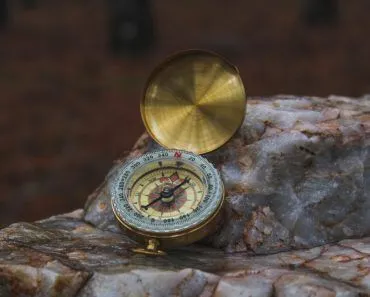
They manage to find their way with the help of a built-in compass attuned to the Earth’s magnetic field.
Earth’s Magnetic Field
The Earth has a magnetic field generated by its core.
Inside the core, radioactive decay and chemical reactions generate tremendous amounts of heat. Along with this heat comes a strong magnetic field. In addition, the iron present in the core generates its own electric current in the presence of the magnetic field. This electric current causes its own magnetic field, creating an endless cycle.
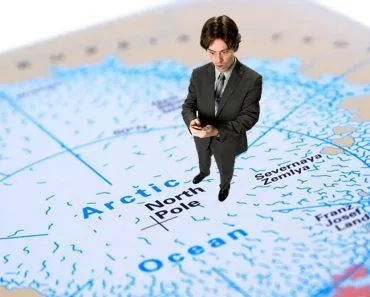
Just like any other magnet, this field has two magnetic poles. Confusingly, they don’t sit exactly on the geographic poles, and they’re named the opposite way to what you might expect. The magnetic pole near the geographic North Pole is actually a magnetic south pole, which is precisely why the north-seeking end of a compass needle swings to point at it.
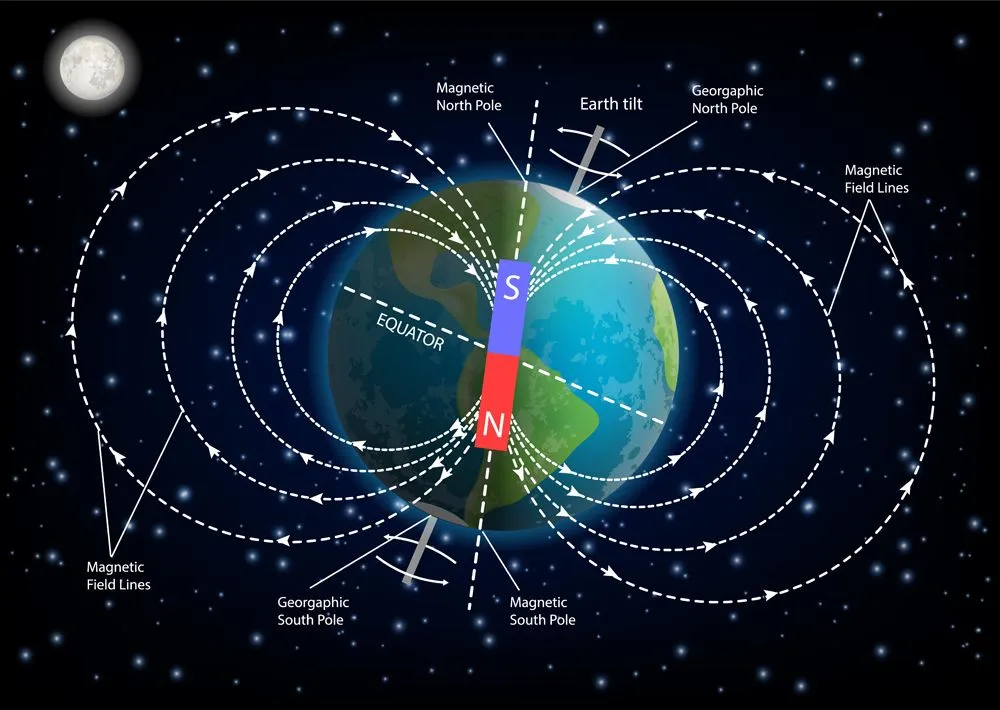
For years now, scientists have been pondering how marine creatures know where to go and how to continue their journeys. For example, newly hatched turtles on land have never been to sea. Nevertheless, they know their way to the popular breeding and mating areas where they can catch up with their friends and relatives.
Studies have suggested that turtles use Earth’s magnetic field to navigate.
Magnetoreception
In 1957, Hans Fromme, a researcher at the Frankfurt Zoological Institute in Germany, noticed that the caged robins he kept in his office became restless, fluttering incessantly towards the southwestern part of the cage. This behavior lasted during the migrating season of the robins, who are known to migrate southwestwards to Spain for winter.
Fascinatingly, the caged birds had never been outside. Neither had they seen other free robins flying southwest, nor used other navigational aids like the sun or stars. So, what was guiding them in their distress?
Fromme thought it could be the Earth’s magnetic field.
Later, it was proven true that birds use Earth’s magnetic field for navigation, so what if marine life did the same?
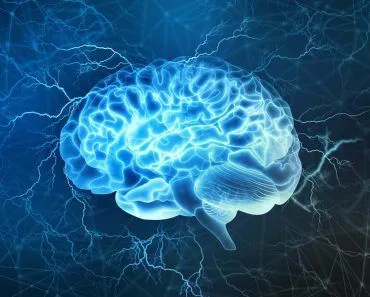
Like turtles, aquatic animals such as salmon, whales and sharks have something like a built-in compass in their heads. They can sense Earth’s magnetic field and use it to find their way. This ability to detect a magnetic field is called magnetoreception.
So how does this biological compass actually work? Honestly, scientists are still arguing about it, but there are three leading explanations. The first relies on tiny crystals of a magnetic mineral called magnetite, which can twist like microscopic compass needles when the field shifts. The second is light-dependent: a protein called cryptochrome in the eye undergoes a chemical reaction whose outcome is subtly altered by the surrounding magnetic field, so some animals may literally “see” direction.
Sharks and rays use a third trick entirely. As a shark glides through the ocean, moving through Earth’s magnetic field generates a faint electric voltage across its body. Sharks happen to be superb electricity detectors, thanks to a network of jelly-filled pores around the snout called the ampullae of Lorenzini. By reading these induced voltages, a shark can work out which way it is heading.
And a magnetic compass is only half the story. Because the field’s strength and tilt change gradually as you move across the planet, each patch of ocean carries a slightly different magnetic “signature.” Sea turtles and salmon appear to memorize the signature of their home beach or river and use it like a map to return there years later, a feat known as geomagnetic imprinting.
Navigation Problems
One observation that puzzles scientists is that Earth’s magnetic field is “acting up”.
The molten iron inside the core is swirling around in different directions, causing the poles to flip. Basically, north is becoming south and vice versa. Don’t be alarmed, this is perfectly normal. Full reversals have happened hundreds of times in Earth’s history, irregularly spaced anywhere from every 10,000 years to every 50 million years. The last one was about 780,000 years ago, and a reversal unfolds gradually over hundreds to thousands of years, so there’s no way to predict exactly when the next one will begin.
On top of that, the field itself is steadily weakening. It has lost around 9% of its strength over the past two centuries, and the slump is especially pronounced over the South Atlantic, where a vast dent called the South Atlantic Anomaly has been spreading westward. This is driven by the restless churning of the molten iron in Earth’s core, not by the Sun, though a weaker shield does leave the planet more exposed to solar storms.
These erratic changes in the magnetic field can disrupt the navigational ability of all these animals. With their internal compass thrown off, they might find it more difficult to figure out which path to take during their migrations.
Could this be one of the reasons why whales are increasingly becoming lost and ending up on land?
Conclusion
Biologists are still trying to figure out how animals are able to understand this magnetic information, but all we know is that many marine animals have been able to read this information since birth and do not need to be taught this ability in any way.
In the meantime, scientists are also trying to figure out why the Earth’s magnetic field is behaving so strangely. Animals will not only have a less accurate form of navigation, but so will we! Our satellites will also be affected by these changes, which will impact the navigation of our ships, airplanes and any map apps on our smartphones!
What can be said for certain is that we’re all highly dependent on the Earth having a stable magnetic field!
References (click to expand)
- Keller, B. A., Putman, N. F., Grubbs, R. D., Portnoy, D. S., & Murphy, T. P. (2021, July). Map-like use of Earth’s magnetic field in sharks. Current Biology. Elsevier BV.
- Naisbett-Jones, L. C., Putman, N. F., Scanlan, M. M., Noakes, D. L. G., & Lohmann, K. J. (2020, January 1). Magnetoreception in fishes: the effect of magnetic pulses on orientation of juvenile Pacific salmon. Journal of Experimental Biology. The Company of Biologists.
- NOVA | Magnetic Storm | Impact on Animals - PBS. The Public Broadcasting Service
- Lohmann, K. J. (2007, February). Sea Turtles: Navigating with Magnetism. Current Biology. Elsevier BV.
- Witze, A. (2019, January). Earth’s magnetic field is acting up and geologists don’t know why. Nature. Springer Science and Business Media LLC.
- Reversing the Geomagnetic Field | News - NASA Astrobiology. The NASA Astrobiology Institute
- Anderson, J. M., Clegg, T. M., Veras, L. V. M. V. Q., & Holland, K. N. (2017). Insight into shark magnetic field perception from empirical observations. Scientific Reports. Nature Publishing Group.
- Magnetoreception. The Lohmann Lab, University of North Carolina at Chapel Hill.
- Swarm probes weakening of Earth’s magnetic field. European Space Agency (ESA).
- Is it true that Earth’s magnetic field occasionally reverses its polarity? U.S. Geological Survey (USGS).