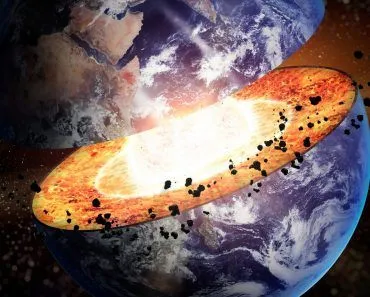
Iron loses its ferromagnetism above its Curie point of about 770 °C, and Earth’s core is far hotter than that, so the planet’s magnetic field cannot come from iron acting like a bar magnet. Instead, the swirling, electrically conducting fluid in the outer core works like a self-sustaining dynamo: convection and rotation move molten iron through a weak seed field, generating electric currents that produce and reinforce the magnetic field we measure at the surface.
Iron loses its magnetism when it’s heated to a few hundred degrees, yet Earth’s core – which produces a strong enough magnetic field to hold the planet together – is made of iron that’s so hot it is in a liquid state!
Why then, does the molten iron in Earth’s core produce a magnetic field?
Let’s start right from the bottom of this entire mystery.
Ferromagnetic Materials
Ferromagnetic materials are those that are strongly magnetized in an external magnetic field, and retain their magnetic moment even after the magnetic field is removed. Iron is a good example of a ferromagnetic material.
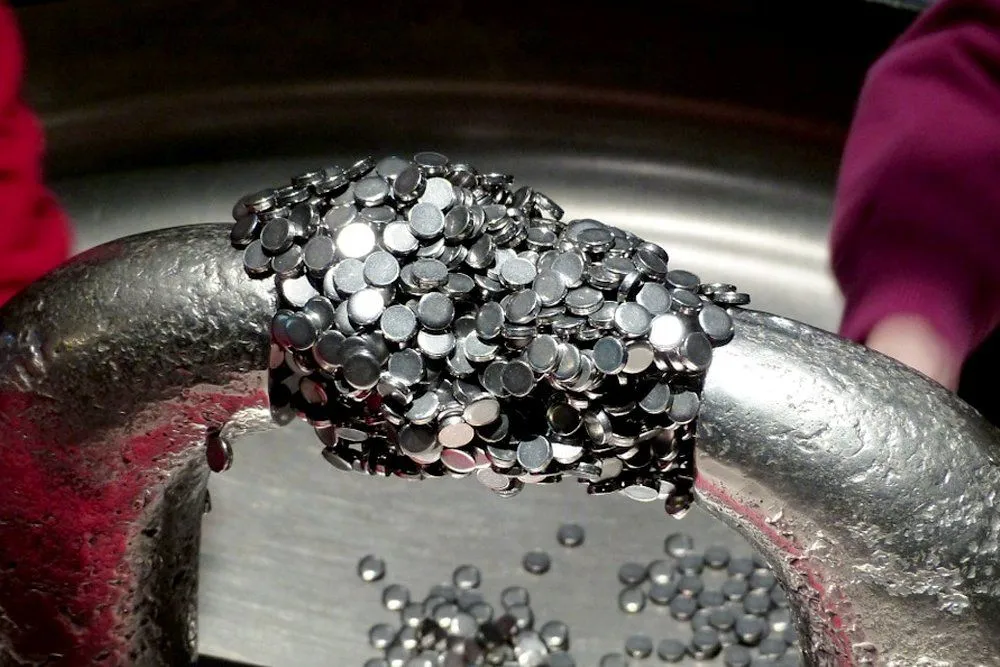
In order to explain the ferromagnetism of iron to you in simple terms, I’d say that iron is made of tiny ‘things’ (atomic moments, to be precise), atoms that act like tiny magnets, as all of them have north and south poles (like regular magnets).
When you hold up a magnet near an iron object, these tiny magnets present ‘inside’ the object align themselves or line up. This is what makes that object magnetic, and any object that behaves like this in the presence of an external magnetic field is called a ferromagnetic material.
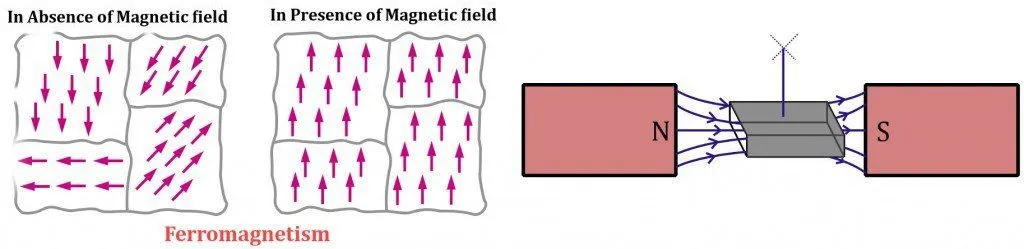
However, when you heat a ferromagnetic material, like iron, things start to change.
What Happens When You Heat A Ferromagnetic Material?
When you heat iron, what you essentially do is supply additional thermal energy to it. This makes the tiny magnets in iron become promoted to high-energy states, pointing in the opposite direction with respect to their neighbors. This means that they are less aligned than before, so their ‘combined’ magnetism reduces. This goes on if you continue to heat iron until a point is reached beyond which iron loses its ferromagnetic properties and ceases to be a ferromagnet.
Iron stops being ferromagnetic at 1043 K (around 770 °C / 1418 °F).
This particular temperature, i.e., the temperature at which a certain material loses its permanent magnetic properties is known as the Curie temperature. Its value is different for different materials.
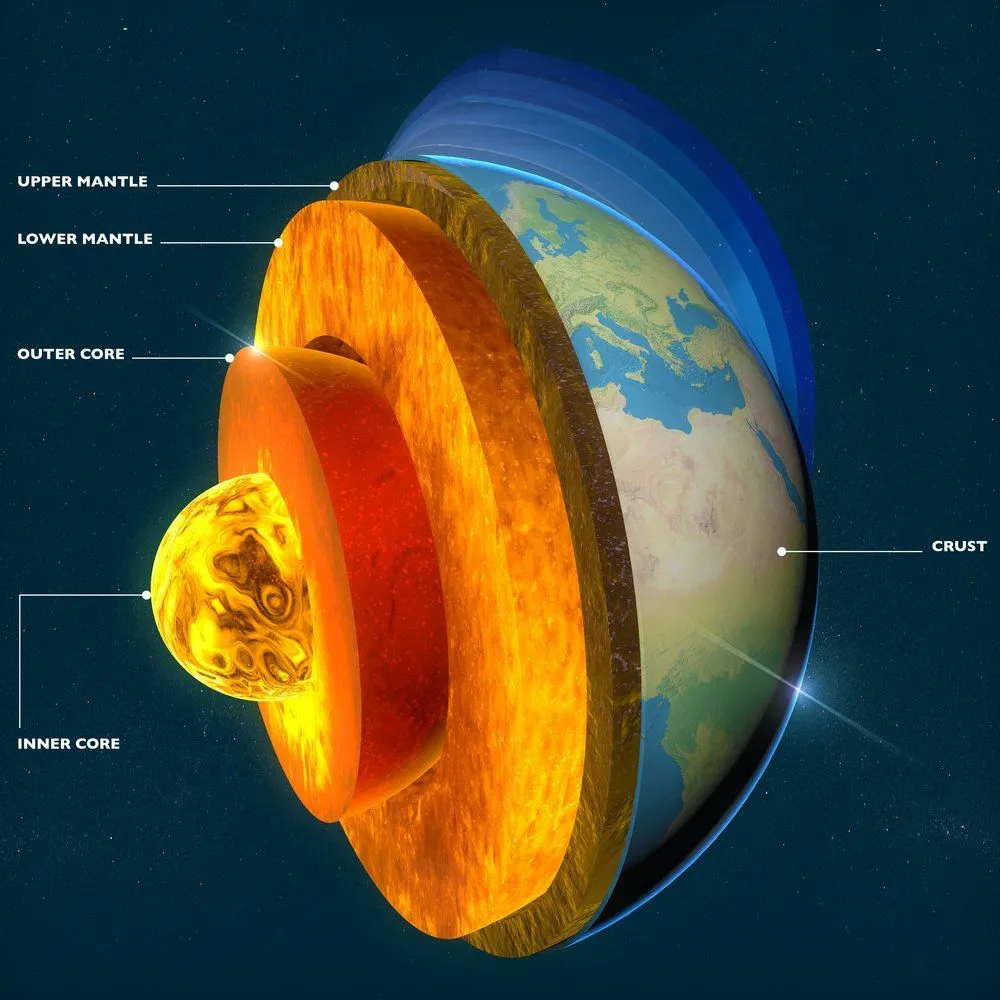
So, it’s pretty evident that iron ceases to be a ferromagnetic material beyond 770 degrees Celsius. However, we also know that Earth’s core consists of molten iron, which is so incredibly hot (nearly 6000 degrees Celsius) that it makes the core as hot as the surface of the sun itself! Not only that, but the molten iron core produces a very strong magnetic field (the magnetosphere) that shields the atmosphere from the solar wind and helps keep Earth habitable.
But isn’t that contradictory in itself? If iron loses its ferromagnetic properties and ceases to be a magnet at a (relatively) paltry temperature of 770 degrees Celsius, then how does Earth’s core, which is primarily made of iron, produce such a strong magnetic field?
How Does Earth’s Core Produce A Magnetic Field?
Scientists and researchers have put forth a number of hypotheses in a bid to explain how Earth’s magnetic field is generated, but the only one that is considered plausible (at the time of writing this article) is the one that claims that the core behaves as a dynamo to produce a self-sustaining magnetic field. This is also known as the dynamo theory.
A dynamo is a device that converts mechanical energy into electrical energy. If you know the physical conditions of Earth’s core, then you would be able to understand the dynamo theory in no time.
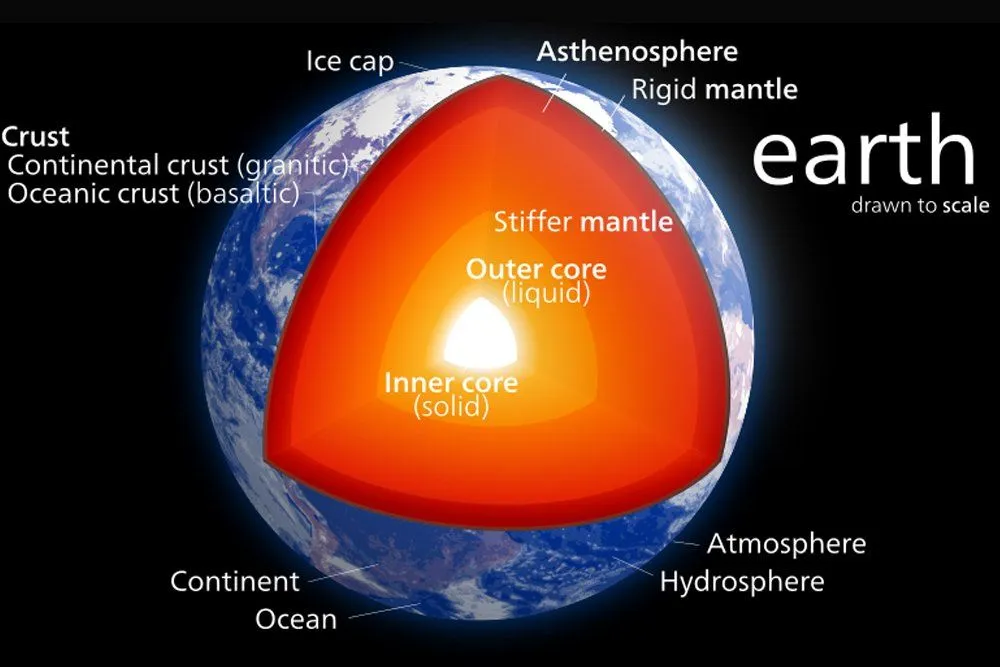
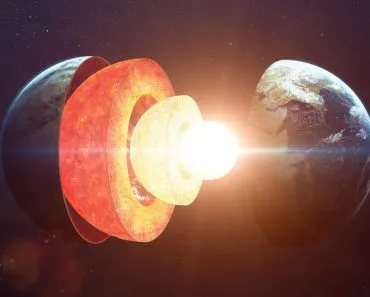
Earth’s core has two segments: the inner and outer core. The outer core is so hot that it exists in a liquid state, but the inner core is solid, due to the extremely high pressure conditions (Source). Also, the outer core is constantly moving, due to Earth’s rotation and convection.
Now, fluid motion in the outer core moves molten iron (i.e., a conducting material) across an already existing, weak magnetic field. This process generates an electric current (due to magnetic induction). This electric current, then, generates a magnetic field that interacts with the fluid motion to produce a secondary magnetic field.
The secondary magnetic field reinforces the initial magnetic field and the process becomes self-sustaining. Unless the fluid motion in the outer core stops, the core will keep producing a magnetic field. This is exactly the premise of the 2003 science fiction movie The Core.
To put it all in simple words, molten iron present in the core doesn’t produce a magnetic field directly; rather, it produces an electric current, which in turn produces an electromagnetic effect, which ultimately produces the strong magnetic field of the Earth’s core.
Is Molten Iron Magnetic?
Here’s the question that trips people up: if you melt a chunk of iron, does it still cling to a magnet? The short answer is no, not in any useful sense. Long before iron melts, it sails past its Curie point of about 770 °C (1418 °F) and stops being ferromagnetic altogether. So molten iron, which only forms at much higher temperatures, was never going to behave like the iron filings on your fridge magnet.

That said, hot iron above its Curie point isn’t completely indifferent to magnets. It switches to a much weaker behaviour called paramagnetism. A paramagnetic material is only feebly pulled toward a strong magnet, and it loses that pull the instant the magnet is taken away (Source). There’s nothing left of the strong, self-retained magnetism that lets a cold iron bar become a permanent magnet. The same logic applies to molten steel, which is mostly iron: it’s hot enough that any ferromagnetism is long gone, leaving only weak paramagnetic behaviour.
So when we say Earth’s liquid outer core is iron, we are not saying it acts like a giant fridge magnet. The planet’s magnetic field comes from that iron moving as an electrical conductor, not from the iron being magnetic itself.
What Is Earth’s Core Made Of?
If iron in the core isn’t a magnet, it helps to know exactly what the core is. Earth’s core is overwhelmingly metallic, made mostly of two substances: iron and nickel (chemists sometimes shorten the alloy to “NiFe”). It comes in two parts. The outer core is a roughly 2,200 km (1,367 mi) thick shell of liquid iron and nickel, while the inner core is a solid ball, also mainly iron and nickel, kept solid by crushing pressure despite being scorchingly hot (Source).

The core isn’t pure metal, though. The liquid outer core also holds a few percent of lighter elements such as oxygen, sulfur, silicon and carbon, which is why it isn’t quite as dense as pure iron would be (Source).
You might wonder how anyone can be confident about a region nobody has ever drilled to. The answer is mostly seismology. When earthquakes ring the planet like a bell, the shear (S) waves they produce cannot travel through liquid, so the “shadow” where these waves vanish reveals a liquid outer core, while the way waves speed up again deeper down betrays the solid inner core. Danish seismologist Inge Lehmann used exactly this trick to identify the solid inner core in 1936. Scientists cross-check the metallic recipe against iron-rich meteorites, thought to be leftovers from the same material that built the planets, and against Earth’s overall density.
How Hot Is Molten Iron?
So how hot does iron have to get before it turns to liquid in the first place? Pure iron melts at about 1,538 °C (2,800 °F), and once liquid it stays that way over a huge range, only boiling away near 2,860 °C (5,180 °F) (Source). Steel and cast iron, being alloys, generally melt a little lower than the pure metal.
Now compare that with magnetism. Iron loses its ferromagnetism at roughly 770 °C, which is only about half the temperature it needs to even start melting. In other words, by the time iron is molten it has been non-ferromagnetic for a long while already, which is the whole point of this article.
Earth’s core is in a different league again. The outer core sits somewhere around 4,500–5,500 °C, and the boundary with the solid inner core may reach close to 6,000 °C, roughly as hot as the surface of the Sun (Source). At those temperatures, asking whether the iron is “magnetic” the way a bar magnet is misses the point entirely. The field is generated by motion, not by magnetised metal, which is the elegant idea behind the geodynamo and why Earth’s core stays so hot in the first place.
References (click to expand)
- Dynamo Effect. The University of Oregon
- Geodynamo - Earth and Planetary Science. The University of California, Santa Cruz
- Generation of the Earth's magnetic field. Natural Resources Canada
- Heating Magnet | Physics Van | UIUC. The University of Illinois Urbana-Champaign
- Curie Point: Magnetism & Physics Science Activity. The Exploratorium
- Curie Point. UCSC Physics Demonstration Room. University of California, Santa Cruz
- Inside the Earth. This Dynamic Earth. U.S. Geological Survey
- Core. National Geographic Education
- Iron. NIST Chemistry WebBook. National Institute of Standards and Technology