Table of Contents (click to expand)
- India’s History With The Royal Bengal Tiger
- Royal Bengal Tiger Facts
- How Does The Bengal Tiger Represent Physical Beauty And Appeal?
- How Can A National Animal Be Endangered?
- Why The Tiger And Not The Lion?
- Why Is It Called The "Royal Bengal Tiger"?
- Which Other Countries Have The Tiger As Their National Animal?
The Royal Bengal Tiger (Panthera tigris tigris) is the national animal of India. It was declared so in 1972, replacing the Asiatic lion, and Project Tiger was launched the following year to save the species from extinction. India now hosts roughly 75% of the world’s wild tigers, with the 2022 census counting 3,682 Bengal tigers across 58 tiger reserves.
In 1972, the Royal Bengal Tiger was declared to be the national animal of India. The national animal of a country is often a symbolic representation of the country’s rich heritage and culture. With that in mind, there are several criteria for choosing a national animal.
A country should identify itself with the characteristics displayed by the animal. The animal should naturally be indigenous to that country, be in abundance, and be a symbol of the history of the country, as well as add to the visual beauty and appeal of the nation. A country can also select a national animal on a conservation basis if it needs to be protected in order to continue its survival.
India’s History With The Royal Bengal Tiger
India’s association with the Bengal tiger dates back to 25th century BCE, when it was carved on the Pashupati seal of the Indus Valley Civilization. The tiger, along with many other animals like peacocks and cows, were worshipped in that pre-Aryan society.
Siva, the ancient god of the pre-Aryan society, always had a tiger beside him, which is seen in the seals engraved of Mohenjodaro. A small community in Northern India called Baghel Rajputs are descendants of the tiger worshippers, so they never hunt them. The tiger was also a symbol of the Chola Empire (300CE-1279 CE). In Indian mythology, Goddess Durga uses the tiger as her vehicle.
The Royal Bengal Tiger is also displayed on Indian currency notes and postal stamps. Prior to the Royal Bengal Tiger, the lion was the national animal of India.
Royal Bengal Tiger Facts
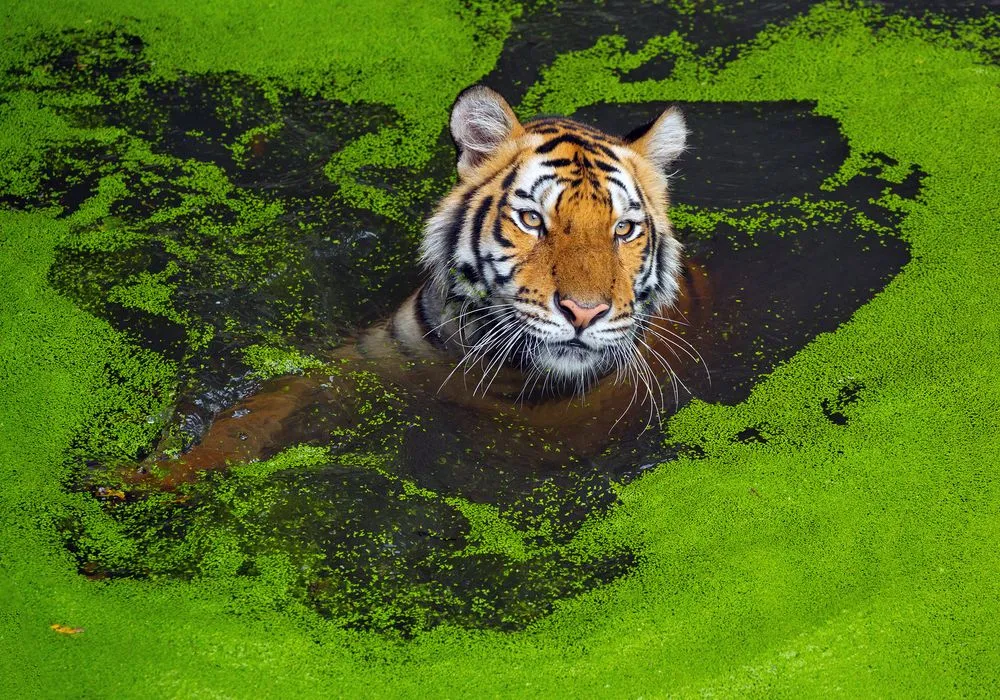
The Bengal Tiger goes by the scientific name Panthera tigris tigris. For India, the Royal Bengal Tiger symbolizes strength, grace, and agility. It is one of the most lethal and majestic carnivores of the Indian fauna, with an average lifespan of 8–10 years in the wild (and up to about 20 in captivity). It is the only one of the six surviving tiger subspecies found in India today, and one of the four largest big cats in the world (alongside the lion, jaguar, and leopard). They are solitary animals that mark their territory with urine and claw marks, and they are largely nocturnal in nature, meaning that they are most active during the night.
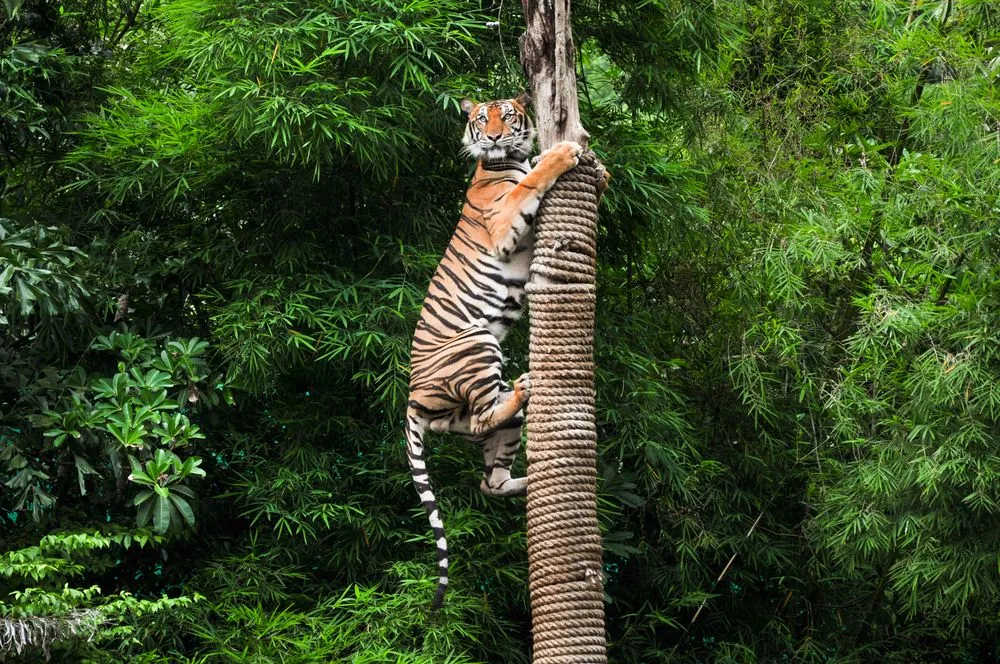
They lounge around during the day and hunt once the sun goes down. Bengal tigers also have the ability to climb trees and swim. They hunt their prey by pouncing on them and severing the spinal cord! Clearly, an impressive animal like this demands respect.
Distribution
Royal Bengal Tigers are spread across the Indian subcontinent, except for the northwestern region of India. They are found in good numbers in the states of Madhya Pradesh, Karnataka, Uttarakhand, Maharashtra, Tamil Nadu, and Kerala. This species is also found in the neighboring countries of Nepal, Bhutan, Bangladesh, and Myanmar; Sri Lanka, despite its proximity, is not part of the modern Bengal tiger range.
According to the latest All India Tiger Estimation released in 2023, there are an estimated 3,682 Bengal tigers in the country (up from 2,967 in 2018 and just 1,706 in 2010), with India alone now holding roughly 75% of the global wild tiger population. The state of Madhya Pradesh has the highest count at around 785 tigers, followed by Karnataka (∼563), Uttarakhand (∼560), and Maharashtra (∼444). This statistic comfortably fulfills the “abundance” criterion of the national animal.
How Does The Bengal Tiger Represent Physical Beauty And Appeal?
Without a doubt, the Royal Bengal Tiger is a majestic carnivore. It even has an adjective attached to its name! They have vertical black stripes on their reddish-brown to golden orange-colored fur, along with a white belly. The colors themselves speak for the animals’ personality of power, strength and grace. An interesting observation is that the Royal Bengal Tiger has saffron (orange) and white on its body, which are two of the colors of the Indian national flag.
Are Bengal Tigers Also White? How!
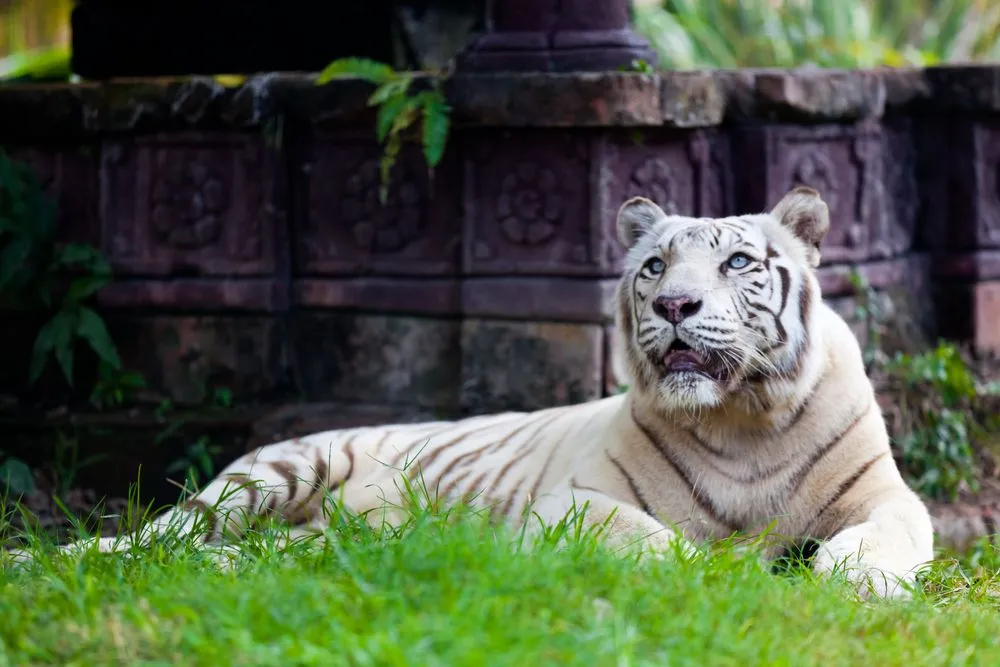
Some Royal Bengal Tigers also have white fur and dark brown stripes instead of black. However, this does not make them a separate species. The white coat is the result of a recessive mutation (the A477V change in the SLC45A2 gene) that blocks the production of pheomelanin, the orange-yellow pigment, while leaving black-pigment eumelanin intact. That is why white tigers still have stripes. Just as our fingerprints are unique, each Bengal Tiger can be identified by its own pattern of stripes; no two Bengal tigers have the same arrangement of stripes on their body.
How Can A National Animal Be Endangered?
Actually, because the Royal Bengal Tiger was growing endangered, it was made the national animal in 1973 to raise awareness and gain more help in conserving the species. Prior to the Bengal tiger, the lion was the national animal of India. The Bengal Tiger was being poached for its beautiful fur, bones and teeth, which were used as coats, rugs, jewelry and for the production of various medicines. Along with illegal poaching, the tigers were losing their natural habitat due to increased urbanization, deforestation and pollution.
‘Project Tiger’ was launched by the government of India on April 1, 1973, to save the Royal Bengal Tiger from extinction. Serious law-enforcement policies were put in place to ban poaching inside the national parks. Villages were relocated to minimize human–animal conflict, which often resulted in tigers being shot for safety. Damage to natural habitats like the Sundarbans was rectified, and more wildlife reserves were created across the country. As of 2024, India has 58 notified tiger reserves spanning more than 75,000 km², and the tiger population has more than doubled from around 1,706 in 2010 to roughly 3,682 in 2022.
Why The Tiger And Not The Lion?
Here is a twist that surprises a lot of people: the tiger was not India's first national animal. That title belonged to the Asiatic lion until the Indian Board for Wildlife handed it to the Bengal tiger in 1972. So why the switch?

The biggest reason was reach. The Asiatic lion clings on in the wild in just one corner of the country, the Gir Forest of Gujarat, where the entire wild population is concentrated in a single pocket of one state. A national animal is meant to stand for the whole nation, and on that score the tiger won easily. Bengal tigers ranged across almost the entire subcontinent, from the mangroves of the Sundarbans in the east to the foothills of the Himalayas in the north, which made the cat a far better emblem of India's geographic and biological variety.
The second reason was urgency. By the early 1970s, decades of hunting and shrinking habitat had pushed the tiger toward extinction. Crowning it the national animal turned the species into a matter of national pride and helped rally support for saving it. That momentum fed straight into Project Tiger, launched the following year, in 1973, to pull the Bengal tiger back from the brink.
Why Is It Called The "Royal Bengal Tiger"?
The name splits neatly in two. "Bengal" points to the region where the animal was first formally described by science. Biologists call this cat Panthera tigris tigris, the nominate (or first-named) tiger subspecies and the continental tiger of mainland Asia, and the population that lives on the Indian subcontinent is the one we know as the Bengal tiger. Because the original type specimen traces back to the Bengal region, that common name stuck.
And the "Royal"? That part is an honorary flourish rather than a scientific label. It is not part of the animal's Latin name, and researchers usually just say "Bengal tiger." The regal prefix simply reflects the cat's commanding, majestic presence, the same quality that made it such an obvious pick for a national emblem. Whether you call it the Bengal tiger or the Royal Bengal tiger, you are talking about the very same animal.
Which Other Countries Have The Tiger As Their National Animal?
India is the most famous example, but it is far from the only nation that has put the tiger on a pedestal. The big cat is a national symbol across several Asian countries.

Bangladesh shares both the tiger and its habitat with India. The Royal Bengal Tiger is Bangladesh's national animal too, and the same Sundarbans mangrove forest that shelters tigers on the Indian side runs across the border, where the cats are now largely confined.
Malaysia claims a different subspecies, the Malayan tiger (Panthera tigris jacksoni). Two of these tigers stand on either side of the shield on Malaysia's national coat of arms, where they represent strength and courage. Sadly, fewer than 150 are now thought to remain in the wild.
South Korea rounds out the list. The tiger is a cherished national symbol there, woven into the country's founding folklore. Tellingly, both Olympic Games the country has hosted picked a tiger as their mascot: Hodori at the 1988 Seoul Summer Games and Soohorang at the 2018 PyeongChang Winter Games.
The Royal Bengal Tiger has rightfully earned its position as the national animal of India due to its rich cultural history, abundance, majestic personality and physical beauty. The love that India has shown to save it from extinction through ‘Project Tiger’ is proof of the country’s respect for this proud animal, hopefully saving it from the claws of extinction!
References (click to expand)
- National Identity Elements - National Animal - Know India. Government of India
- Cultural Traditions Of Nature Conservation In India - ccrtindia.gov.in
- Tiger – a national symbol of India since Indus Valley Civilisation. indiantribalheritage.org
- National Animal of India (Royal Bengal Tiger) - CulturalIndia.net. culturalindia.net
- National Tiger Conservation Authority - Status of Tigers in India 2022
- Xu, X. et al. (2013). The Genetic Basis of White Tigers. Current Biology, 23(11), 1031-1035.
- What's the National Animal of India? - Discover Wildlife (BBC Wildlife Magazine)
- When Did India Adopt The Tiger As Her National Animal? - WorldAtlas
- Asiatic Lion (wild range confined to the Gir Forest) - Wikipedia
- Living Species: Tiger (Panthera tigris tigris). IUCN Cat Specialist Group
- Bengal Tiger - Banglapedia, the National Encyclopedia of Bangladesh
- Coat of Arms of Malaysia (tiger supporters) - Wikipedia
- Seoul 1988 Olympic Mascot: Hodori the Tiger - Olympics.com