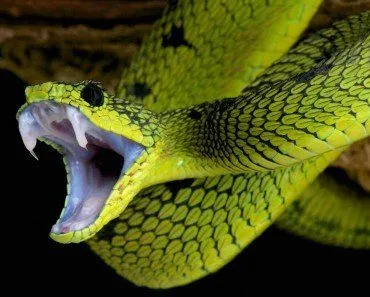
Milk snakes are non-venomous New World snakes in the kingsnake genus Lampropeltis, best known for their bold red, black and white/yellow banding, a pattern that mimics the venomous coral snake. They pose no danger to humans, eat mostly small mammals and reptiles, and are popular pet snakes because they’re docile and easy to keep. The “milk snake” complex was historically a single species, L. triangulum, but a 2014 phylogenetic revision split it into seven distinct species.
Milk snakes are striking, banded snakes often mistaken for the venomous coral snake. They are completely non-venomous, harmless to humans, and, because of those gorgeous colors and a generally docile temperament, wildly popular as pet snakes.
Milk snakes belong to the kingsnake genus Lampropeltis (Greek for “shiny shield”, an apt name for these glossy-scaled snakes). Until recently, all milk snakes were lumped under a single species, Lampropeltis triangulum, with two dozen subspecies. A 2014 phylogenetic revision (Ruane et al., Systematic Biology) split the complex into seven separate species, which is why field guides differ on whether something like the Honduran milk snake is a subspecies or a full species.
With that in mind, let’s begin with its appearance and how easily it is confused with venomous snakes.
Milk Snake Facts
Across the 24 historical subspecies (now reorganized into several species), milk snake appearance and coloration vary tremendously, but they all share one trait: bold bands running the length of the body. The bands are typically red, black, and white or yellow, with each band edged in black. The arrangement looks random but is actually doing a specific job: Batesian mimicry of the venomous coral snake (the rhyme “red touches black, friend of Jack; red touches yellow, kills a fellow” is a rough mnemonic for telling them apart in the U.S., though it doesn’t hold up outside North America).
Milk snakes are primarily carnivorous and take a wide variety of prey. Their most common food source is mice, rats, voles and other rodents found in agricultural areas. They are also ophiophagous (snake-eating): preying on other snakes, including venomous species like small rattlesnakes and even coral snakes, is a normal part of the diet for the genus Lampropeltis, not just a fallback when other food is scarce. Milk snakes are partially resistant to pit-viper venom, which helps.
Behavior And Diet Of Milk Snakes
Milk snakes are primarily nocturnal and mostly active at dusk and during the night. The only time they venture out during the day is when it’s either wet or cold. When the temperature rises, they tend to hide or seclude themselves under logs, rocks or burrows. In the winter, milk snakes go into a state of brumation in communal dens. Communal dens are usually rock crevices in which several snakes huddle together to share body heat and more effectively regulate their body temperature. Brumation is similar to hibernation, but as ectotherms, brumating snakes track ambient temperature rather than actively suppressing metabolism, and they periodically rouse on warm days to drink water.
Beyond rodents, milk snakes also take lizards (especially skinks, which dominate the diet of juveniles), other snakes, snake eggs and bird eggs, a diet that shifts more strongly toward mammals as the snake matures.
Why Are They Called Milk Snakes?
It is a fair question, because these snakes have nothing to do with dairy. The name comes from a piece of early American farm folklore. Settlers in the northeastern United States and Canada kept finding these boldly banded snakes coiled up inside their barns, sharing the space with the dairy cows, and folklore leapt to a tidy but wrong conclusion: the snakes must be creeping in at night to suckle milk straight from the cows’ udders.

It is a memorable tale, and completely false. A snake simply cannot drink milk this way. It has no lips to form a seal, its needle-fine teeth would send any cow bolting long before a drop was drawn, and reptiles cannot even digest the lactose in milk, so a dairy raid would do the snake no good at all. As the University of Kentucky’s snake identification guide dryly notes, snakes cannot digest lactose, “and we doubt cows would tolerate being milked by a snake.”
So why were milk snakes really lurking in the barn? Food. Barns are dark, sheltered and full of stored grain, which makes them magnets for mice, rats and voles, exactly the small mammals a milk snake hunts. The snakes were quietly doing farmers a favor by keeping the rodents down, not stealing anyone’s breakfast.
Do Milk Snakes Have Teeth?
Yes, though not the kind that should worry you. Milk snakes are non-venomous, so they have no hollow fangs and no venom glands. What they do have is rows of small, backward-curving teeth. These are not built for chewing or for delivering a wound; they work like tiny hooks that grip a struggling mouse or lizard and stop it wriggling free while the snake gets to work.

And the work is constriction, not biting. A milk snake kills the way its kingsnake relatives do, by throwing a couple of coils around its prey and tightening them each time the animal breathes out, until the prey can no longer draw breath. The teeth simply hold the meal in place, the coils do the killing, and the food is then swallowed whole and head-first.
Because no venom is involved, a defensive bite from a milk snake is essentially harmless to a person. A cornered milk snake would far rather flee, but if it is grabbed it may vibrate its tail, give off a foul-smelling musk, and strike. Even then the tiny teeth rarely do more than leave a light scratch, and most milk snakes are reluctant to bite people at all.
Are Milk Snakes Pets?
When it comes to pets most wouldn’t consider snakes to be the ideal pets to keep in their house. But there are a select number of people who do keep snakes as pets. Most beginner hobbyists prefer non-venomous snakes when they’re starting out, to build confidence handling them, and milk snakes top many lists. The appeal is a mix of their gorgeous colouration and the fact that they’re completely non-venomous and slow to bite.
The two of the most preferred types are the Honduran milk snake and the Eastern milk snake.
Honduran Milk Snake
The Honduran milk snake is native to Honduras, Nicaragua, and northeastern Costa Rica, taking its name from the country where it is most commonly encountered. It inhabits low to medium elevations of sub-tropical rainforest and grassland, usually among the leaf litter on the forest floor.
Being so close to the equator, the climate in their habitat sustains less seasonal variation. These snakes are found from sea level up to roughly 1,500 m (about 5,000 ft) in higher mountainous terrain. They are the most bred kind of milk snake in captivity and are to a certain extent on the easier side of handling.
Eastern Milk Snake
The Eastern milk snake is considered as a pretty snake, of the many subspecies of milk snake, the eastern is a bit tougher to handle for beginners than its counterpart. It has a reputation, perhaps deserved, of being a bit difficult to acclimate. The olive red, bright red, or maroon blotches are edged narrowly in black and contrast nicely with the grey ground colour.
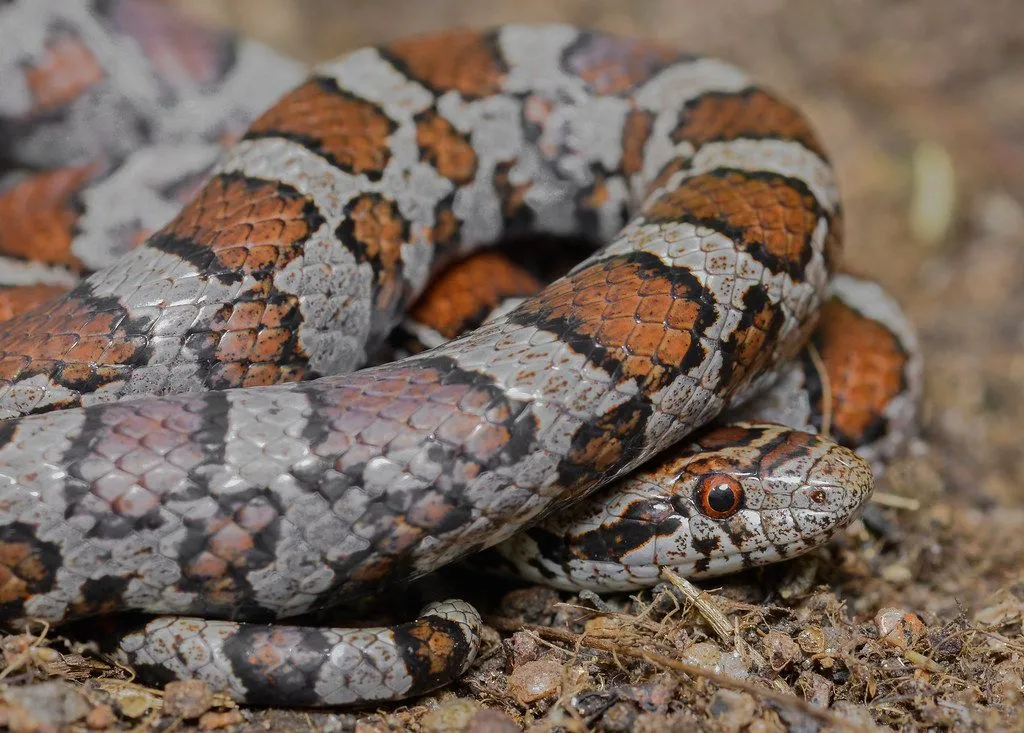
If frightened the milk snake will flatten its head a bit and strike repeatedly. Most adults reach about 60–90 cm (24–36 inches), with large individuals exceeding 130 cm (52 inches). Despite that length, these are slender colubrids: adults usually weigh under 150 g (about 5 oz), not the pound-plus often quoted in pet-care posts. In terms of geographic range, it is found from southeastern Maine and southern Quebec west to southern Minnesota, and south through the Appalachians into Tennessee, northern Georgia and northern Alabama. Unlike the Honduran Milksnake, the Eastern Milksnake has a generalist habitat, this milk snake is found in woodlands, meadows, pastures, at the edges of water courses, amidst talus, under artificial cover, and in many other habitats.
What Do Pet Milk Snakes Eat?
In the wild a milk snake works through whatever small prey it can overpower, but a pet milk snake has a much simpler menu: rodents, and little else. Keepers feed appropriately sized mice, moving up to rats only for the larger subspecies. The usual advice is to offer frozen rodents that have been fully thawed and warmed rather than live ones, because a live mouse can bite back and injure a snake that is not in the mood to strike.
Prey is matched to the size of the snake rather than to a fixed menu. Hatchlings start on “pinkies” (newborn, hairless mice), then graduate to part-furred “fuzzies” and “hoppers” as they grow, and finally to adult mice. A handy rule of thumb is that a meal should be about as wide as the thickest part of the snake’s body, leaving only a modest bulge once it is swallowed.
Growing snakes eat more often than adults. A rough schedule is a meal every other day for tiny hatchlings, about twice a week for juveniles, and once a week for a full-grown adult. As with the wild diet everything is swallowed whole, so an appropriately sized rodent is far safer and easier to manage than one that is too large.
Are Milk Snakes Venomous Or Poisonous?
This is easily the most common worry a milk snake provokes, and the answer is reassuring: a milk snake is neither venomous nor poisonous. The two words are not interchangeable, even though they get swapped all the time. A venomous animal makes its own toxins and injects them, through fangs or a sting, when it bites or strikes. A poisonous animal is one that harms you if you eat it or, in some cases, merely touch it. A milk snake does neither. It has no venom glands and no hollow fangs (only the small gripping teeth described above), and there is nothing toxic about its skin or flesh. You could handle one bare-handed all afternoon and the worst you might come away with is a startled scratch.

So why does it look so alarming? Because looking dangerous is the entire strategy. A milk snake’s bold red, black and yellow bands are a textbook case of Batesian mimicry, in which a harmless species evolves to resemble a genuinely dangerous one, here the venomous coral snake (some populations echo the blotched pattern of a copperhead instead). A predator that has learned to leave brightly ringed snakes alone gives the milk snake a wide berth too, no venom required. The snag is that the bluff also works on people, and a startled human who mistakes a milk snake for a coral snake may kill it for no reason. A widely repeated rhyme about whether the red bands touch the black or the yellow ones offers a rough guide in the United States, but it is unreliable elsewhere, so the safest habit is simply to leave any wild snake alone.
Are milk snakes aggressive? Not really. A milk snake would far rather slip away than pick a fight, and its defenses are almost pure theatre. Cornered, it may pull into an S-shaped coil, buzz its tail against dry leaves to imitate a rattlesnake, and strike repeatedly. Even a genuine bite from those tiny teeth seldom breaks the skin. In short, a milk snake puts a great deal of effort into pretending to be dangerous precisely because it is not.
Where Do Milk Snakes Live?
Milk snakes are one of the great success stories of the snake world, and part of that success is sheer geographic reach. Taken as a group, they claim one of the widest ranges of any snake in the Americas. They turn up from southeastern Canada (Ontario, southern Quebec and southeastern Maine), down through the eastern and central United States, and into northern Mexico. Under the older, broader definition of the species they were traced much further still, all the way through Central America and into the northern edge of South America. They are just as relaxed about altitude, living from sea level up to around 2,600 m (roughly 8,500 ft) in mountainous country.

That huge spread comes with an unusually varied taste in habitat. Milk snakes do well along forest edges and in open woodland, but they are equally at home in prairies and grasslands, on rocky hillsides, beside streams and marshes, in tropical hardwood forest, and right up to the margins of farms and towns. What ties these places together is not the scenery but the essentials: somewhere dark to shelter by day, and a dependable supply of rodents, lizards and other small prey to hunt after dark.
The price of covering so much ground is a tangled family tree. For a long time biologists bundled all of these snakes into a single species, Lampropeltis triangulum, with as many as 24 subspecies. A 2014 genetic study by Ruane and colleagues reshuffled that arrangement, promoting several of the old subspecies to full species in their own right and leaving the name L. triangulum for the milk snakes of eastern and central North America shown on the map above. So depending on where a biologist draws the lines, the “milk snake” in question might be one wide-ranging species or a whole cluster of close relatives, which is a large part of why the group’s range looks so vast.
Reproduction And Life Span Of Milk Snakes
Milk snakes usually mate between March and May, depending on the subspecies of the milk snake. The mating usually begins when they come out of their brumation period, but they may occasionally mate in their winter dens. The mating process usually starts with the females first exiting the den and leaving a trail of pheromones once they begin to ovulate. The males pick up on the trail and follow it. Milk snakes usually copulate for hours, which is done to prevent rival males from trying to inseminate the ovulating females.
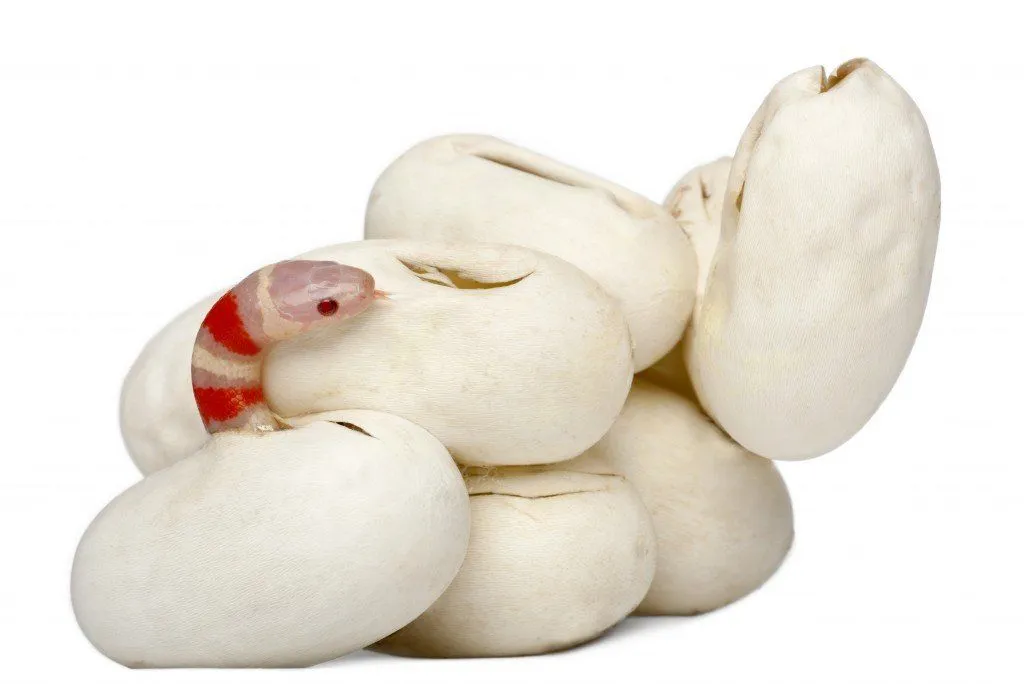
Milk snakes are oviparous, which means females lay eggs rather than giving live birth. Females usually lay clutches of 2 to 17 eggs (averaging around 10) in early summer, in places like rotting logs, beneath rocks, or buried in soil. The eggs then incubate for roughly 28 to 60 days in the warm, humid microclimate of the nest site before hatching. The hatchlings emerge at about 15–20 cm (6–7 inches) long, with very bright colouration that dulls as they mature. The young ones usually prefer to feast on invertebrates before moving on to birds and mammals. They mature at around 3 to 4 years of age and have been recorded (in captivity) to have a life span of 22 years.
In conclusion, let’s end with a rhyme that helps to differentiate the coral snake from the milk snake; it goes something like this… “If red meets yellow, he’s a deadly fellow, but if red meets black, he’s a friend of Jack!”
References (click to expand)
- Snakes of South Carolina and Georgia - SREL herpetology.
- Scarlet kingsnake - BioKIDS.
- Eastern Milk Snake | Mountain Lake Biological Station, U.Va..
- Eastern Milksnake (Lampropeltis triangulum) - University of Kentucky.
- On Myths and Milksnakes - The Orianne Society.
- Milk Snake Care Sheet - PetMD.
- Lampropeltis triangulum - Animal Diversity Web, University of Michigan.
- Lampropeltis triangulum - The Reptile Database.
- Eastern Milksnake - Virginia Herpetological Society.